
The 11 best AI email support agents in 2026
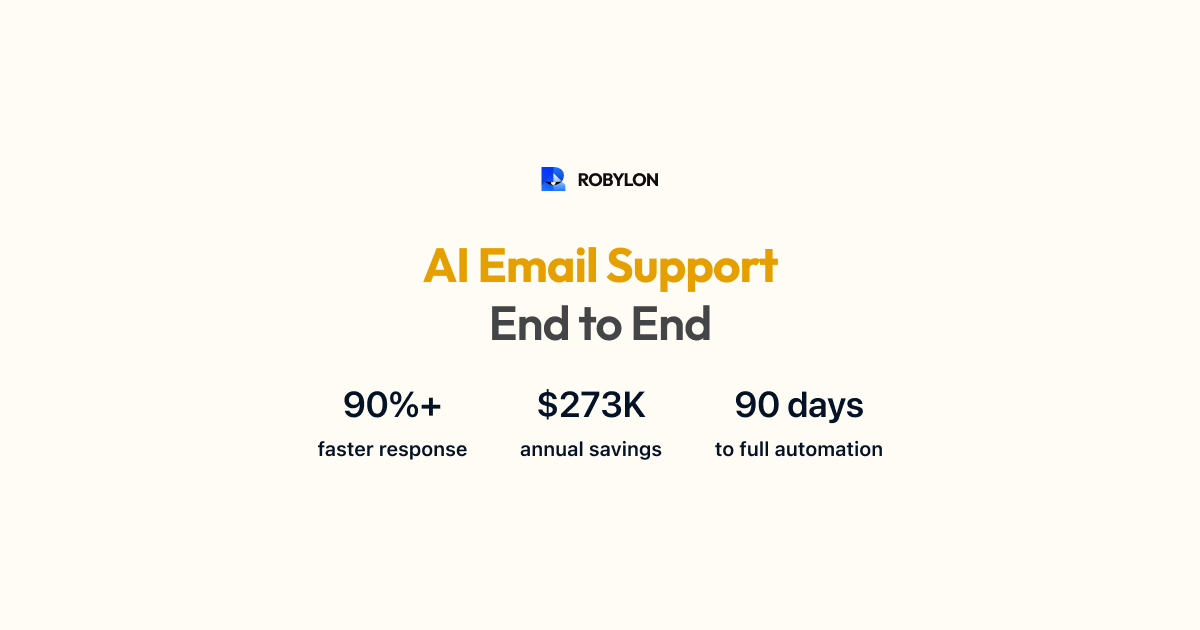
Eleven AI agents that answer and resolve customer support email, grouped into four kinds and compared on actions, channels, where each runs and how each bills, with prices checked in October 2026.
Chief Executive Officer, Robylon
Dinesh Goel is the co-founder and CEO of Robylon. He leads the company's work on AI agents that resolve customer support and sales conversations end to end across chat, voice, WhatsApp, and email. He works directly with enterprise CX teams on rolling out automation that takes real actions rather than just deflecting, and writes about resolution quality, AI reliability, and the economics of modern support.
Eleven AI agents that answer and resolve customer support email, grouped into four kinds and compared on actions, channels, where each runs and how each bills, with prices checked in October 2026.
Nine alternatives to Decagon, compared on what each AI agent can do, which channels it covers, where it runs and how you buy it, with prices checked in October 2026.
From 1 October 2026, Meta charges per delivered message for WhatsApp service replies and for utility templates sent inside the 24-hour window, at each market's utility rate, after 1,000 free service messages per number each month. This guide covers the rates by market, the payment method deadline, what a support team will actually pay and how to keep the bill down.
Angry customers calm down when they are heard, owned and given a dated next step. This guide covers the human de-escalation method, how it changes by channel, how AI spots frustration, and the moments AI must hand the conversation to a person.
Omnichannel customer service is not about how many channels you offer. It is about whether a customer can switch channels without starting over. This guide covers what it takes to run, which channels matter, how to measure it and where it goes wrong.
A tribunal rejected the argument that a chatbot is a separate legal entity, and the reasoning has held ever since. This is a practical read on where liability sits for AI customer service in 2026, what the EU and US rules changed this year, and the controls that make up a defensible record.
Most human-in-the-loop programmes in customer service are approval queues where reviewers approve almost everything. This is a practical argument for designing oversight around risk-weighted sampling and real reviewer authority, plus the metrics that show whether it is working.
Procurement questionnaires have started asking about ISO 42001, and the instinct is to forward it to whoever owns SOC 2. That is mostly wrong. Here is what the standard certifies, which controls land inside a support inbox, and what a vendor certificate does and does not cover.
Article 50 makes you disclose that an AI is answering. It does not tell you how to word it. Here are 15 disclosure lines that work in a support inbox, the phrasings that reliably backfire, and how to test the change without guessing.
Article 50 of the EU AI Act became enforceable on 2 August 2026 and covers every customer-facing AI agent, not just high-risk ones. Here's what disclosure actually requires in a support inbox, who carries the duty, and where the rules are still genuinely unclear.
The support contact form has survived two decades without changing shape, and it is about to stop making sense. An argument for agent-first entry points: what replaces the form, what breaks when it goes, and the five things worth doing in the next year.
AI agents now outnumber humans reading documentation. They are hitting support surfaces built for people, badly. This is an argument for publishing a proper agent-facing support interface, a four-level ladder for doing it, and an honest account of why you might not want to.
When a customer's AI assistant decomposes one question into ten precise queries, your resolution rate looks great and your cost per customer triples. Here's how to design fair-use limits, backpressure that works without an HTTP status code, and pricing terms that don't punish you for it.
More support email is being read by AI agents before a human sees it. The habits that make a reply feel warm are often the habits that make it unparseable. Here's how to write for both readers without running two templates.
A growing share of inbound support email is drafted by the customer's own AI assistant, not the customer. This essay covers how to spot machine-written tickets, which metrics stop working, and what support leaders should change before the volume gets serious.
A growing share of your support replies are parsed by software before a human sees them. This guide covers what a machine reader actually extracts, why the usual tone advice breaks down, and how to write one email that works for both audiences.
Vendors imply instant results. Skeptics assume a year of tuning. Neither matches what we see. Across 42 email deployments and 3.8 million customer emails, the median AI email agent starts at 31% on day one and crosses 70% autonomous resolution around week nine. This is the curve, the four phases behind it, and the four things that reliably move it.
Most support teams cannot say why their AI agent escalated a thread, because the escalation carries no reason at all. This article publishes an eight-family reason-code taxonomy built from 2.1 million escalated emails, with volume shares, handling costs, and how the mix shifts as a deployment matures.
Most cost claims about AI email support compare a before number to an after number and skip everything in between. This piece models the full 24-month curve: where costs rise first, when the crossover happens, and why the cost of the tickets your agent cannot handle keeps climbing.
Count the same quarter two ways and you get 79% or 65%. This report opens Robylon's email deployment data on resolution, reopens and escalations, then sets it against the published 2026 research on adoption, pricing, compliance and security.
Most support teams guess their intent mix and guess wrong. We classified 10.2 million inbound support emails into 13 top-level intents and measured volume, autonomous resolution, and human handling time for each. The ranking by volume and the ranking by cost are almost opposites.
WhatsApp's per-message pricing, BSP markup, and 18% GST make the real cost of the Business API in India hard to predict. This breakdown walks through every layer with a worked example so you can estimate your actual monthly bill.
The free WhatsApp Business App and the WhatsApp Business API solve different problems. This guide breaks down what each one does, where the app hits its ceiling, and how to tell which one your team actually needs.
Cart recovery works best when it behaves like support, not like a billboard. This guide breaks down how an AI agent recovers abandoned carts on WhatsApp by answering the actual objection and taking the checkout action, plus the compliance guardrails and metrics that matter.
WhatsApp is the best channel most brands have for reaching customers and the worst one they have for tracking work. This guide covers what a chat-born ticket needs to carry, how the 24-hour reply window breaks normal SLA design, and where ticketing everything makes support slower instead of faster.
WhatsApp conversations never really close, customers set the pace, and Meta's billing rules change what a fast reply is worth. This guide covers the speed, outcome, quality and cost metrics that hold up on WhatsApp, plus the definitions that quietly inflate them.
Zendesk's AI pricing looks simple on the pricing page and lands very differently on the invoice. Here's the full three-layer cost stack, the January 2026 auto-billing change, and how to model your real number.
Zendesk AI and Robylon both resolve support tickets without a human, but they price and count that work very differently. Here is a straight comparison of cost, resolution quality, integrations, and time to deploy, including where Zendesk is the better call.
"Resolution rate" is the number every WhatsApp AI vendor quotes and almost nobody defines the same way. This guide breaks down what a good benchmark actually looks like, how to measure it without fooling yourself, and the four traps that make a bad number look great.
Most support teams drown in the same handful of questions on repeat. This is a step-by-step playbook for using a WhatsApp AI agent to deflect and resolve that volume before it ever reaches a human, and how to measure whether it's working.
You can run customer support entirely on WhatsApp without a traditional helpdesk. This guide walks through the pieces you actually need, the order to set them up, and the honest point where a bare-bones setup starts to cost you more than it saves.
True 24/7 support on WhatsApp is not just an always-on chatbot. Meta's 24-hour service window, template rules, and escalation policy all shape what always available can mean. This is a practical guide to building round-the-clock WhatsApp support with AI agents that resolve, not just reply.
Automating WhatsApp support is less about buying a bot and more about deciding what to hand off, how to escalate, and what to measure. This playbook walks through the whole sequence, from first automated reply to the resolution rate that actually matters.
WhatsApp has quietly become the channel customers actually want for support. This guide covers why that happened, how the Business API and its pricing work in 2026, where AI agents fit, and how to stand up a WhatsApp support operation that customers trust.
A WhatsApp chatbot follows a decision tree. An AI agent reasons and acts. This explainer breaks down the real difference across understanding, action, context, and cost, with concrete examples, so you can tell which one a vendor is actually selling you.
A WhatsApp AI agent reasons across a conversation and acts on your systems instead of following a decision tree. This guide explains the difference from a chatbot, what agents can actually resolve on WhatsApp, and how the channel's 24-hour rules shape what good automation looks like.
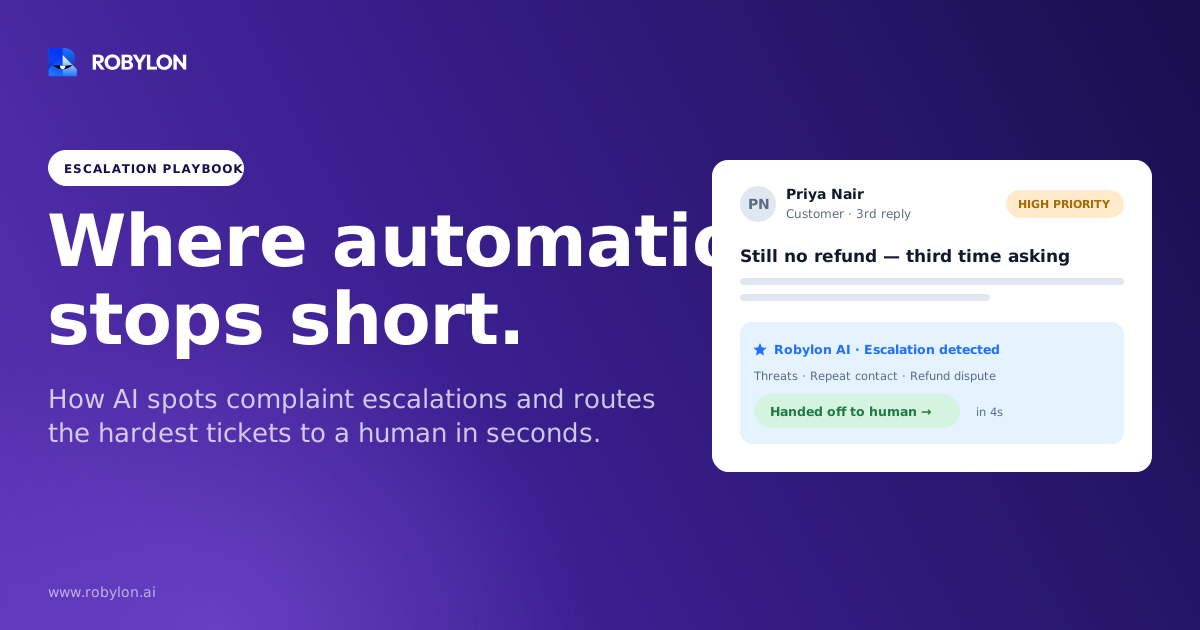
Complaint escalation emails are the highest-stakes tickets in any inbox. This guide covers how AI detects them, what triggers a handoff, and where automation must stop short.
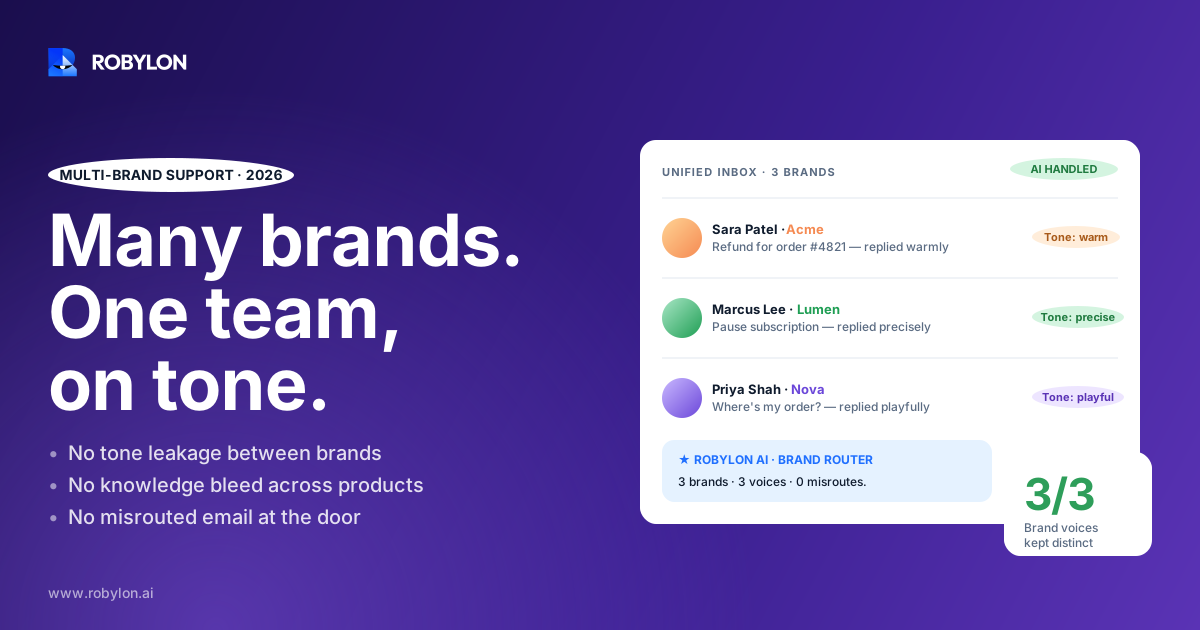
Multi-brand support teams fight tone leakage, knowledge bleed, and misrouted email every day. This guide breaks down how AI email agents keep each brand distinct while one team runs all of them, and where you still need a human.
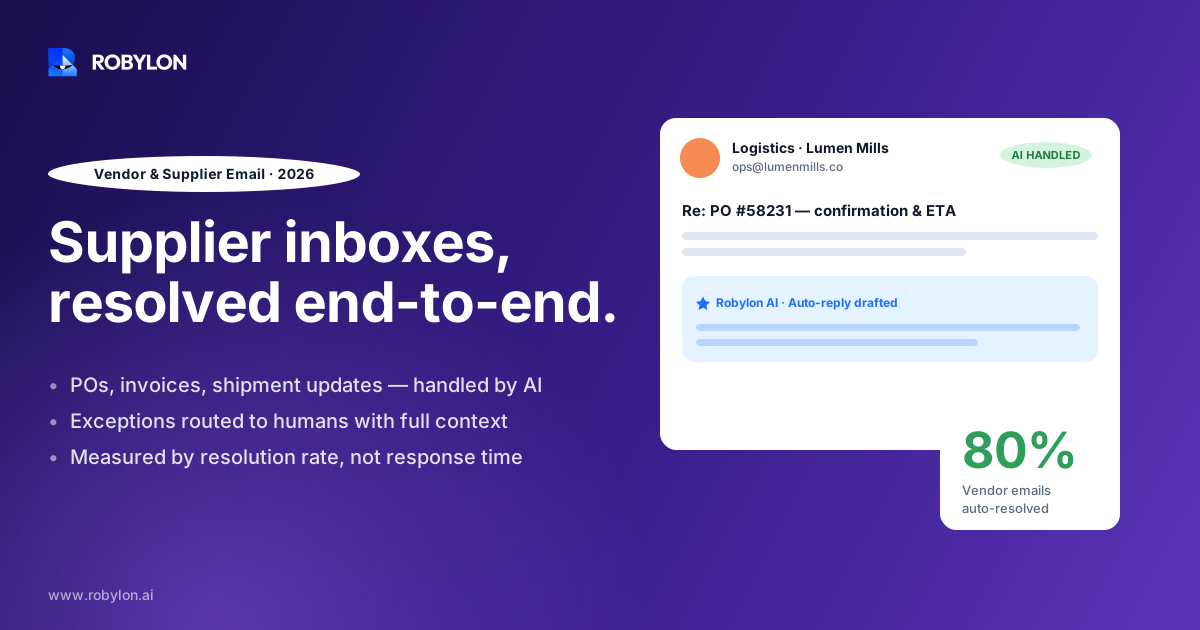
Vendor and supplier inboxes are full of repetitive, structured email that AI can resolve end to end. This guide covers what to automate, where to keep humans in the loop, and how to measure it.
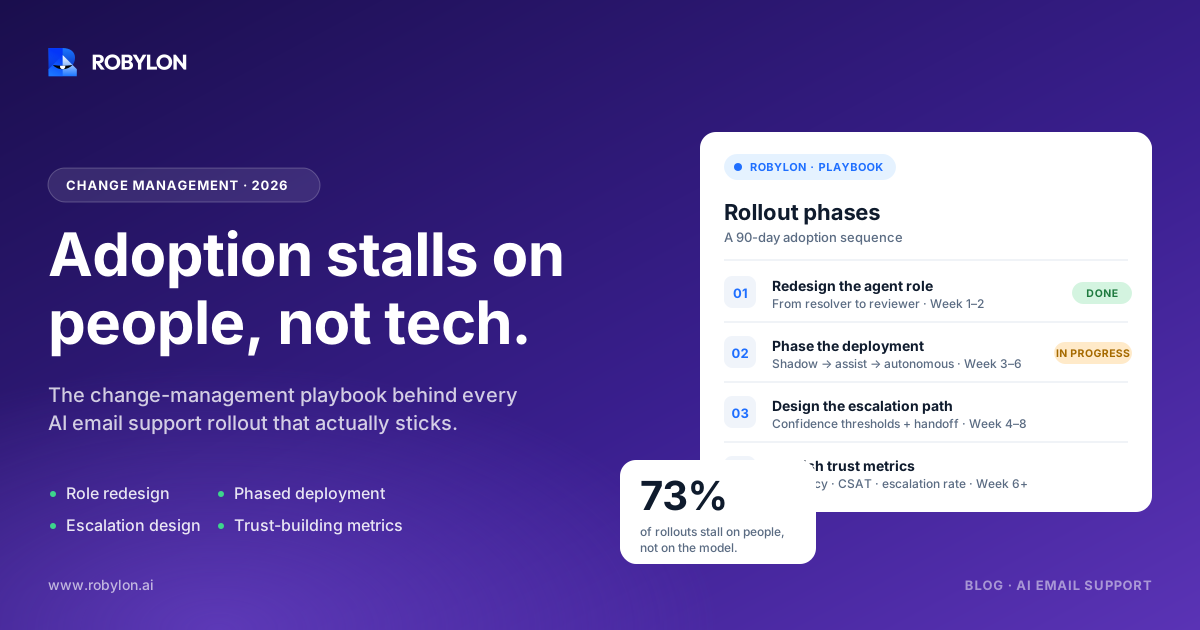
Most AI email support rollouts stall on people, not technology. This guide covers the change management work that actually decides adoption: role redesign, phased deployment, escalation design, and the metrics that build trust.
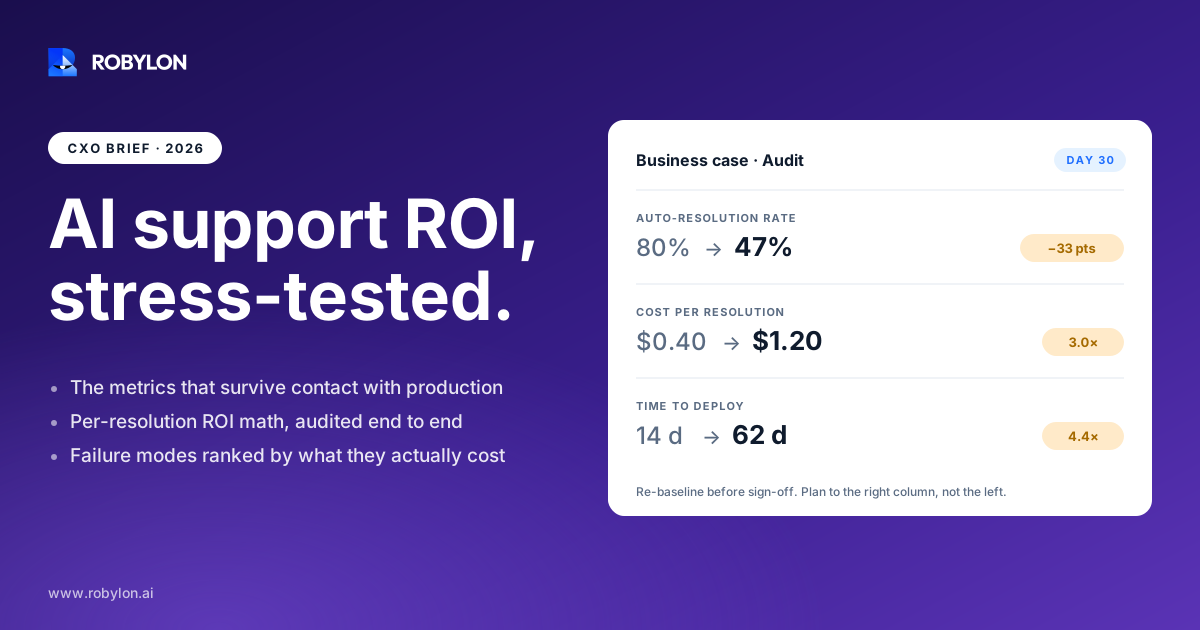
Most AI support business cases don't survive contact with reality. This guide gives CXOs the metrics, the ROI math, and the failure modes to plan around before signing off on an email automation rollout.
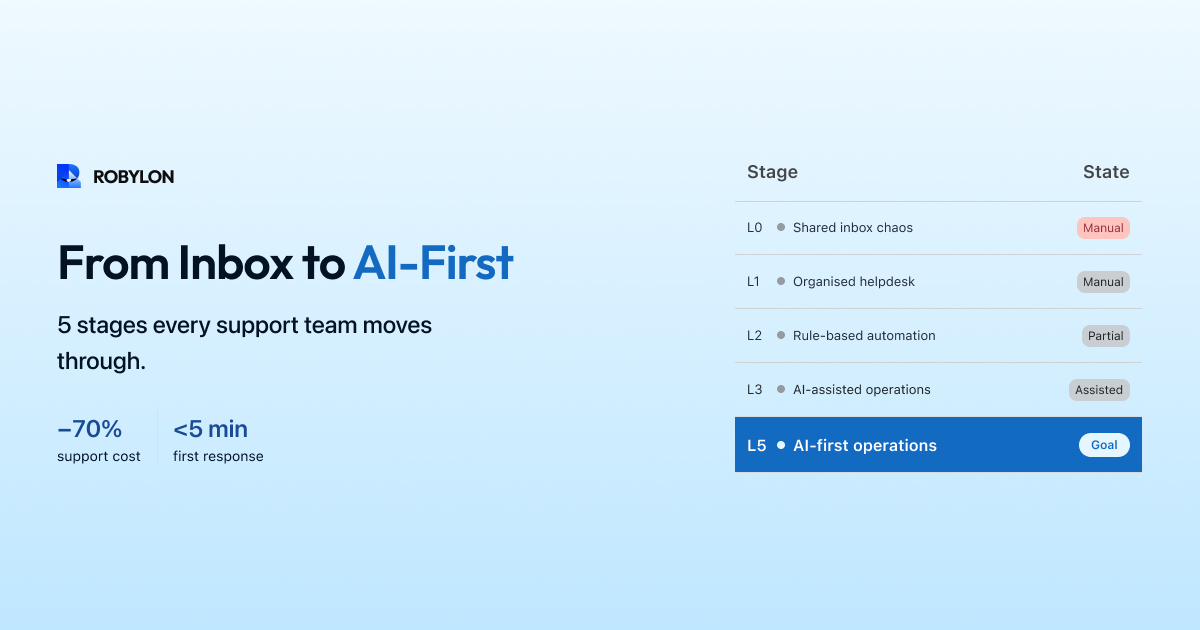
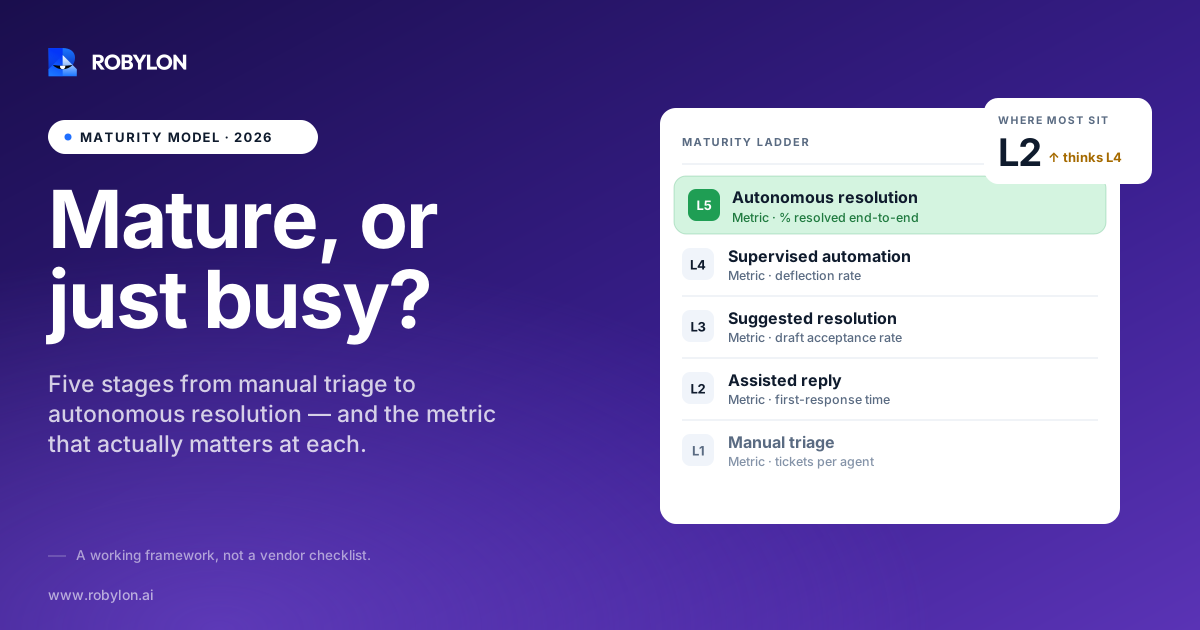
Most email support teams can't tell whether their AI is mature or just busy. This maturity model maps five stages, from manual triage to autonomous resolution, with the metric that actually matters at each one.
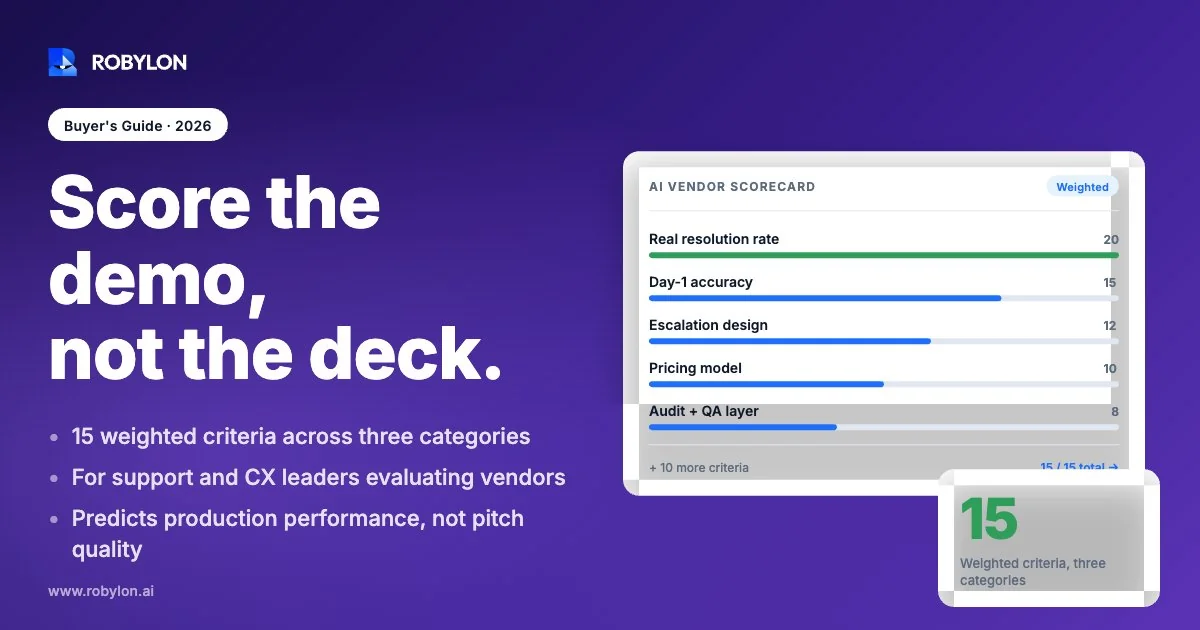
Most AI email support demos look identical. This 15-point scorecard gives support and CX leaders a weighted rubric to score vendors on what actually predicts production performance, from real resolution rate to pricing model to escalation design.
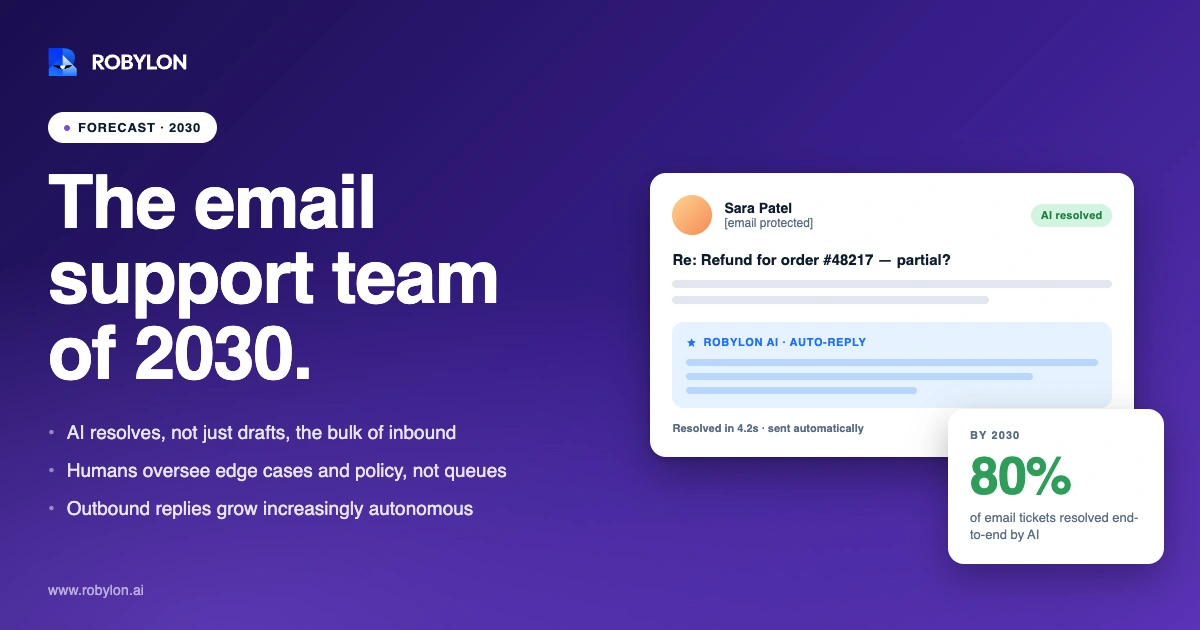
Email support is moving from reply-drafting to autonomous resolution, and the next three years will reshape who answers, who oversees, and who even sends the email. Here is a grounded forecast of where support teams land by 2030, and how to prepare without betting on hype.
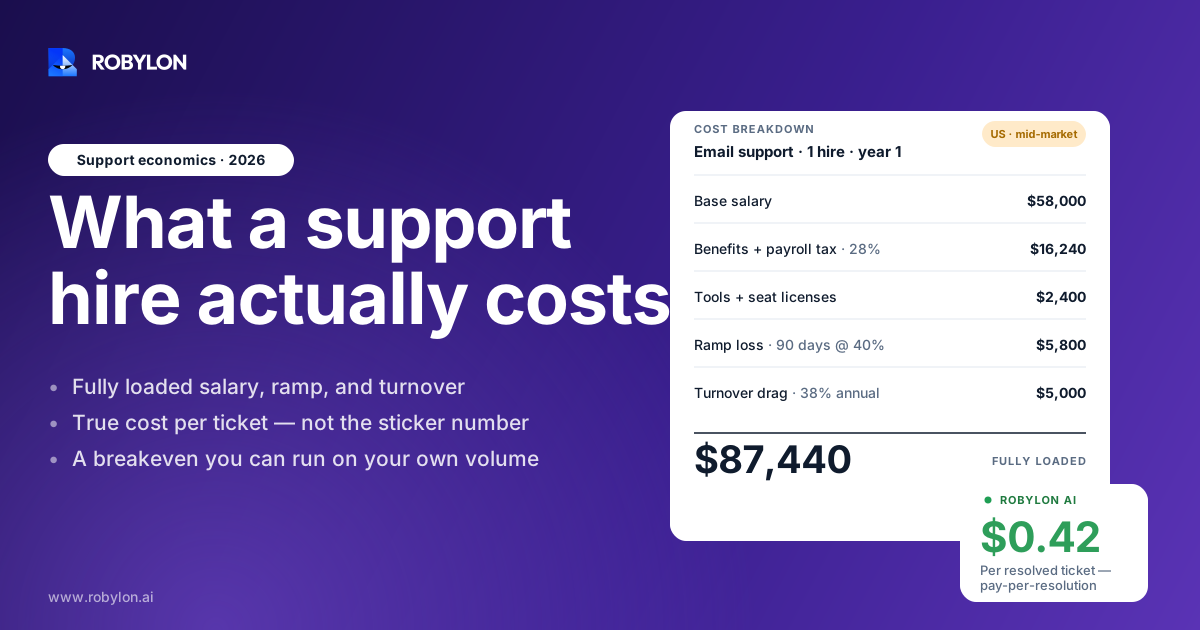
A practical breakdown of what a human email support hire actually costs in 2026 versus AI automation. Includes fully loaded salary math, cost per ticket, turnover drag, and a breakeven framework you can run on your own volume.
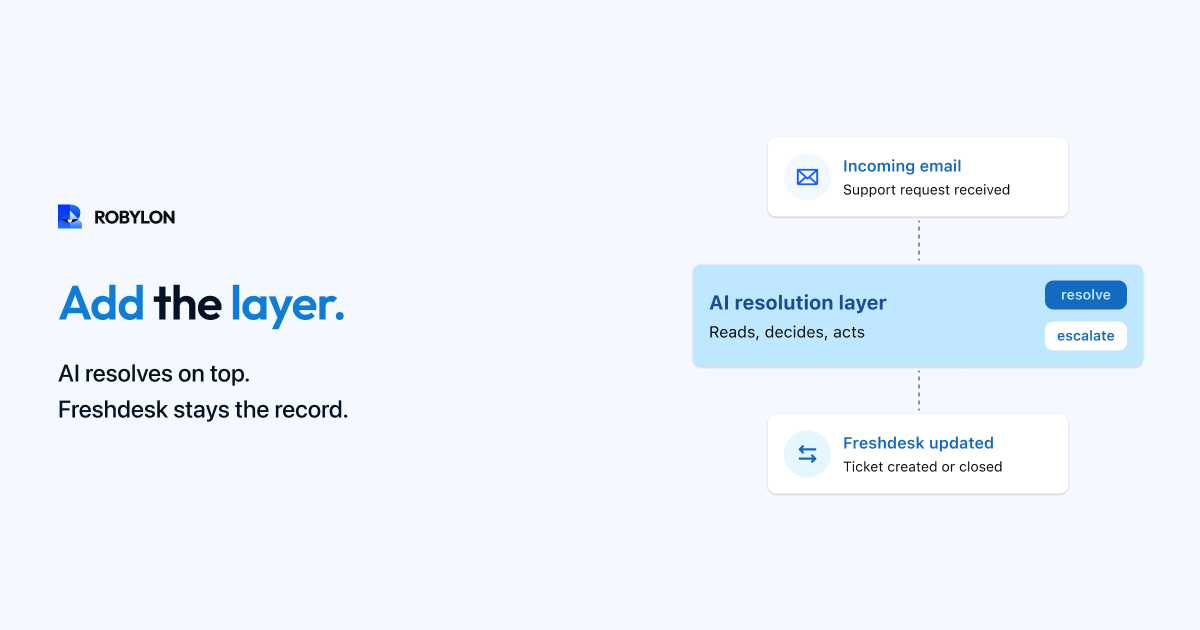
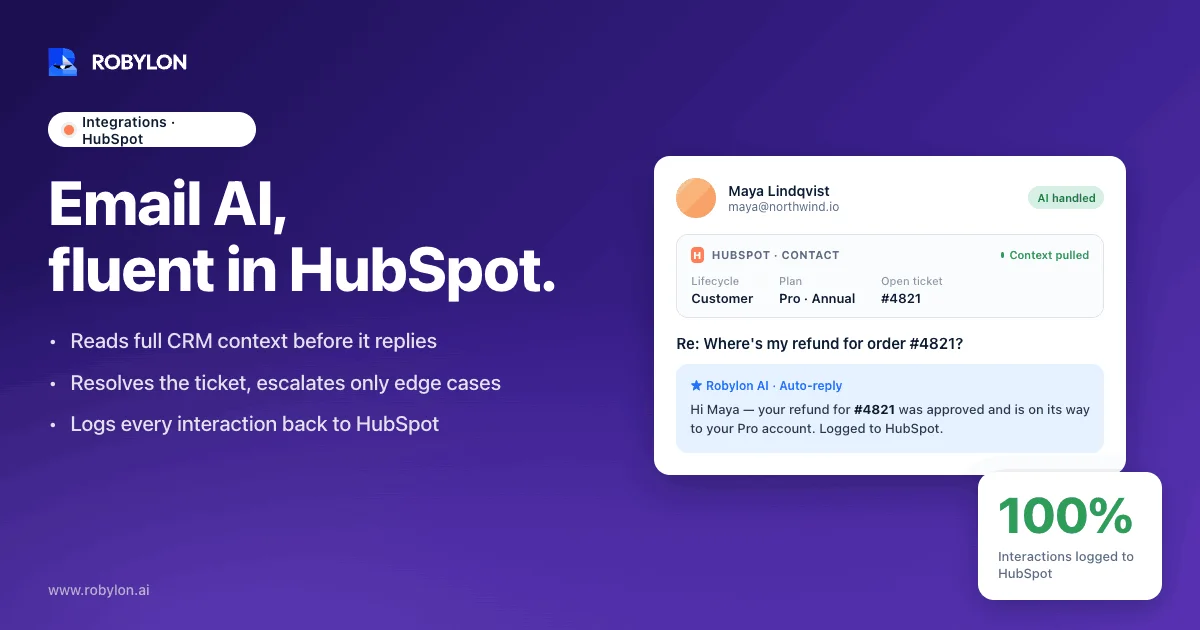
Most teams bolt AI onto the inbox, not onto HubSpot. This guide shows how to connect an AI email agent to HubSpot CRM so it reads customer context before replying, resolves tickets, and logs every interaction back, keeping HubSpot as the system of record.
Deploying an AI customer service agent on Shopify doesn't take a quarter. This is a day-by-day plan for going live in a week: prerequisites, connecting Shopify and your inbox, the queries to automate first, the guardrails that keep you safe, and a phased go-live.
Shopify Inbox handles storefront chat well and costs nothing, but every conversation still needs a human and email is only an offline fallback. This guide breaks down where Inbox stops scaling and what a dedicated AI customer service platform does instead.
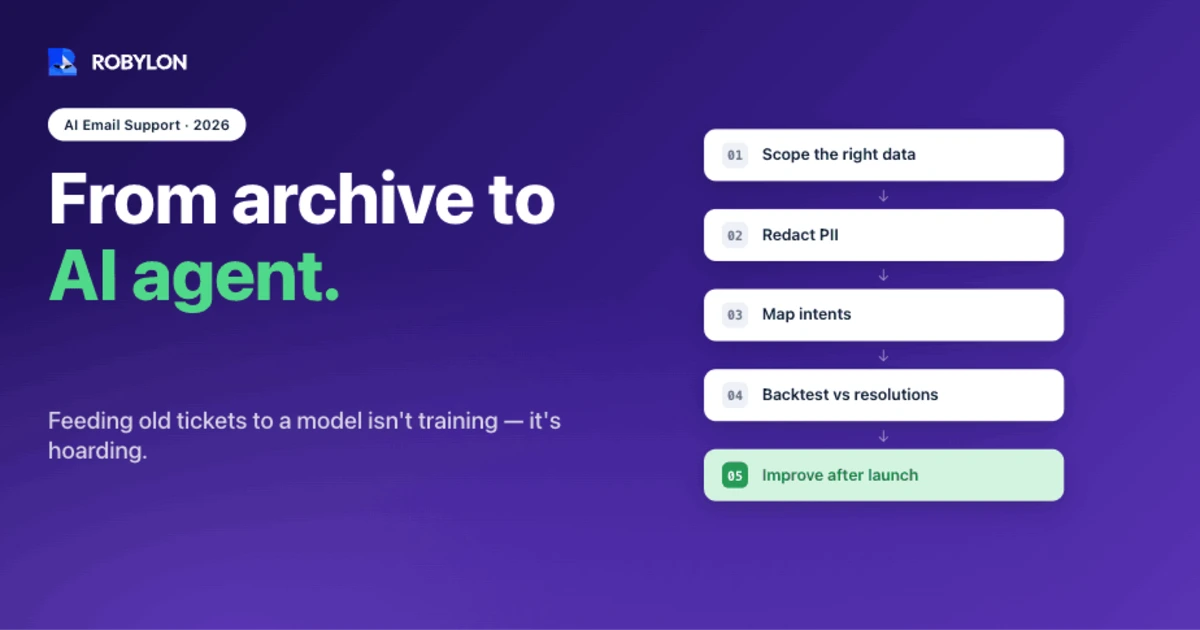
Feeding old tickets to a model isn't training, it's hoarding. This is the practitioner's process for turning historical ticket data into an AI email agent that resolves real cases: scoping the right data, redacting PII, mapping intents, backtesting against past resolutions, and getting better after launch.
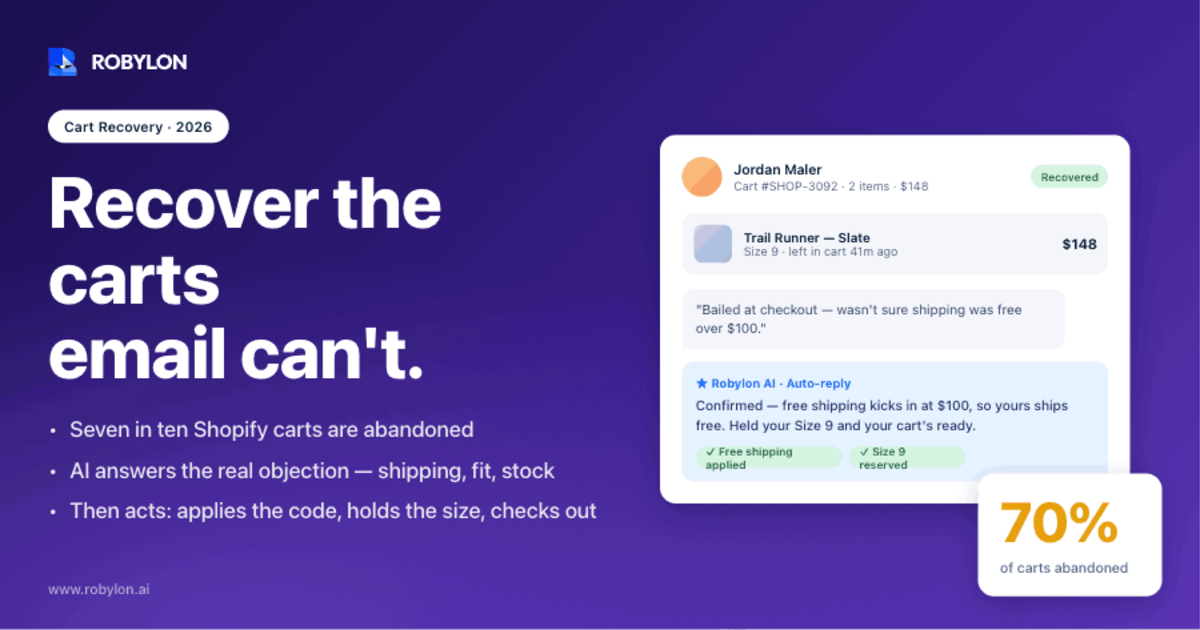
Seven in ten Shopify carts get abandoned, and a static reminder email wins back only a sliver of them. This guide breaks down why carts die, where the email-only playbook falls short, and how AI agents recover more revenue by answering the real objection and taking action on the store's behalf.
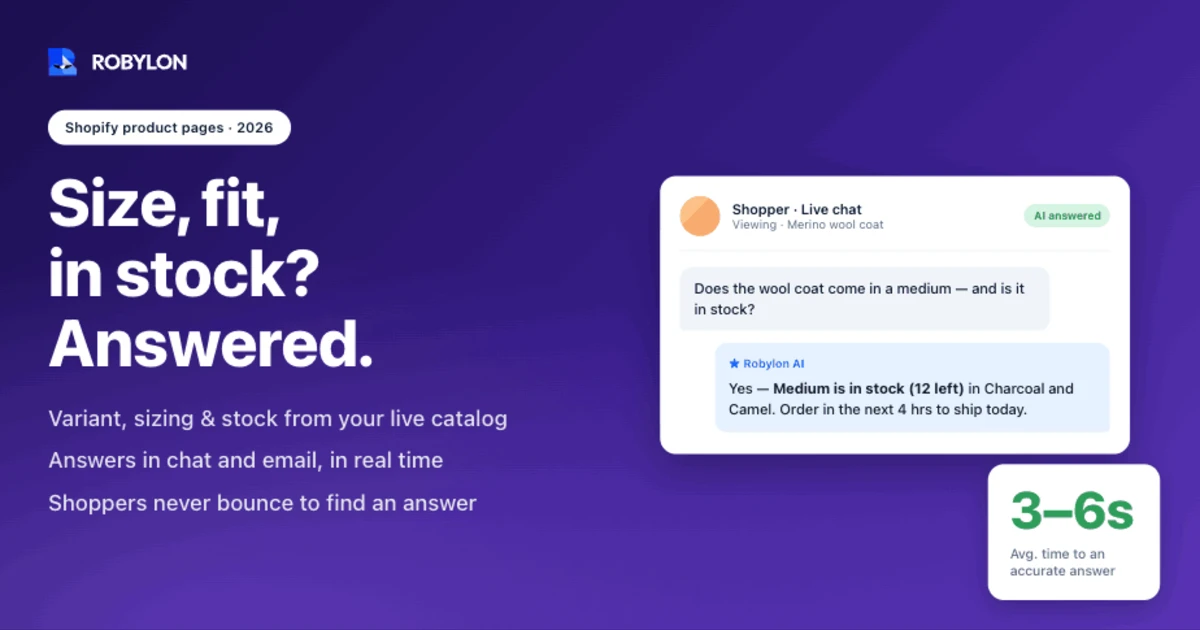
The variant, sizing, and stock questions shoppers ask on Shopify product pages decide whether a sale closes. Here is how to automate accurate answers in real time, across chat and email.
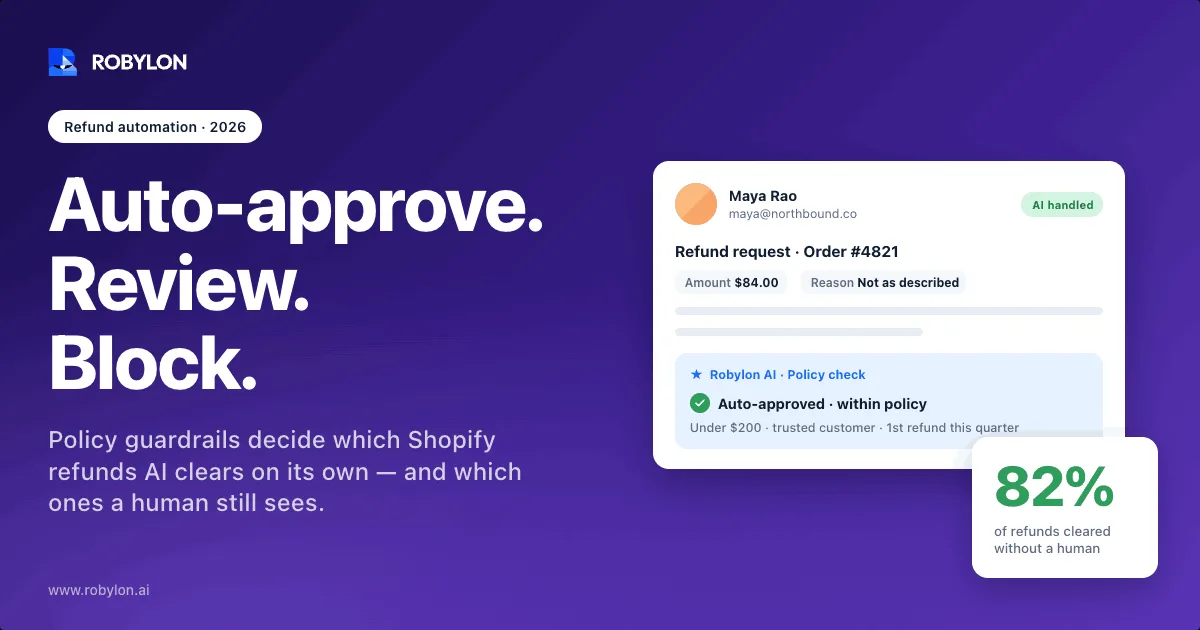
Refunds are the second most common Shopify support ticket and one of the riskiest to automate. This guide covers how to set up AI refund automation with policy guardrails that decide when to auto-approve, when to review, and when to block.
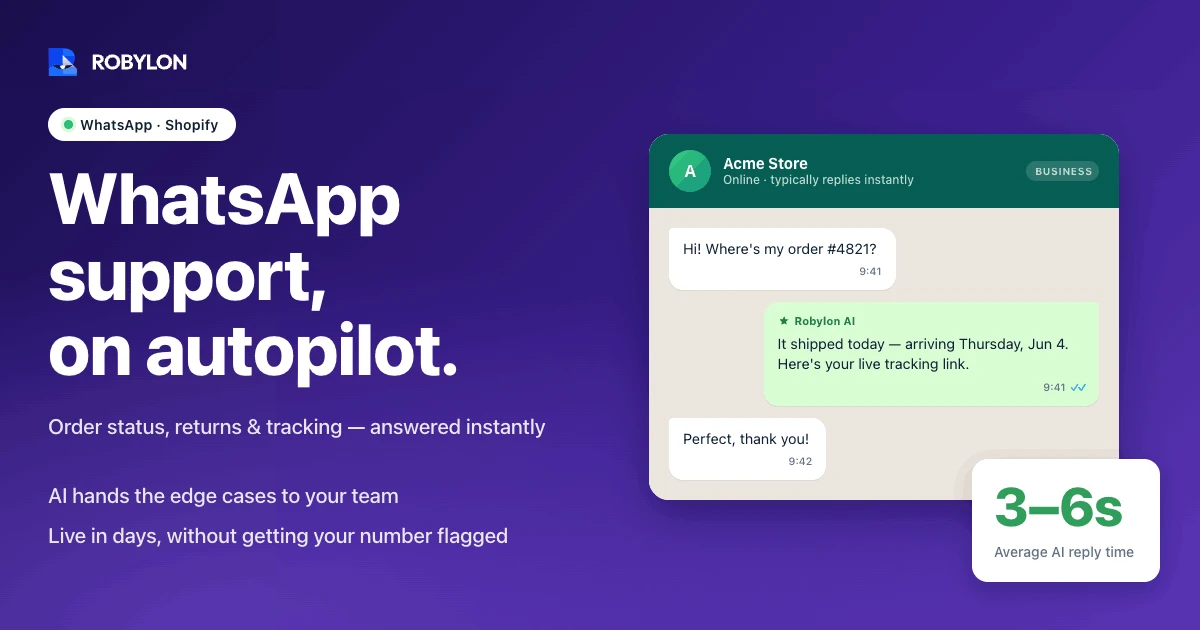
WhatsApp is now the channel where Shopify shoppers expect a reply within minutes. This guide covers what you can automate, how the Business Platform pricing actually works, where AI should hand off to a human, and how to set it up without getting your number flagged.
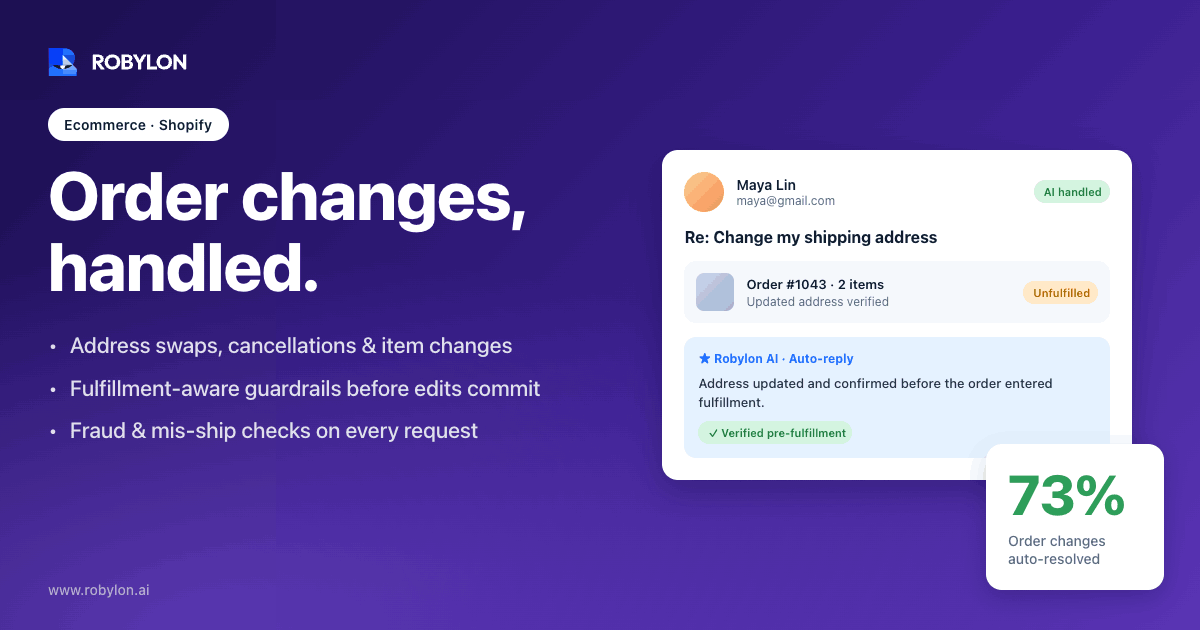
Order change requests are one of the highest-volume, most time-sensitive ticket types in ecommerce. This guide breaks down how AI agents handle address changes, cancellations, and item swaps on Shopify, with fulfillment-aware guardrails that protect against fraud and mis-shipments.
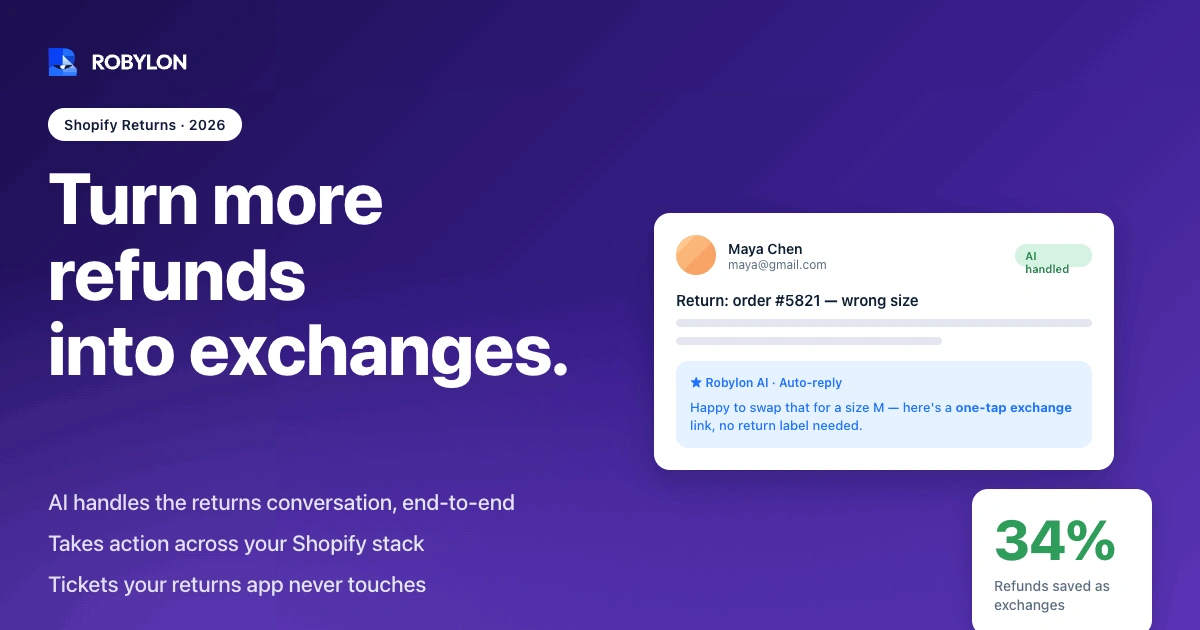
Returns generate a flood of support tickets that your returns app never touches. This guide shows how AI returns automation handles the conversation layer for Shopify stores, takes action across your stack, and turns more refunds into exchanges.
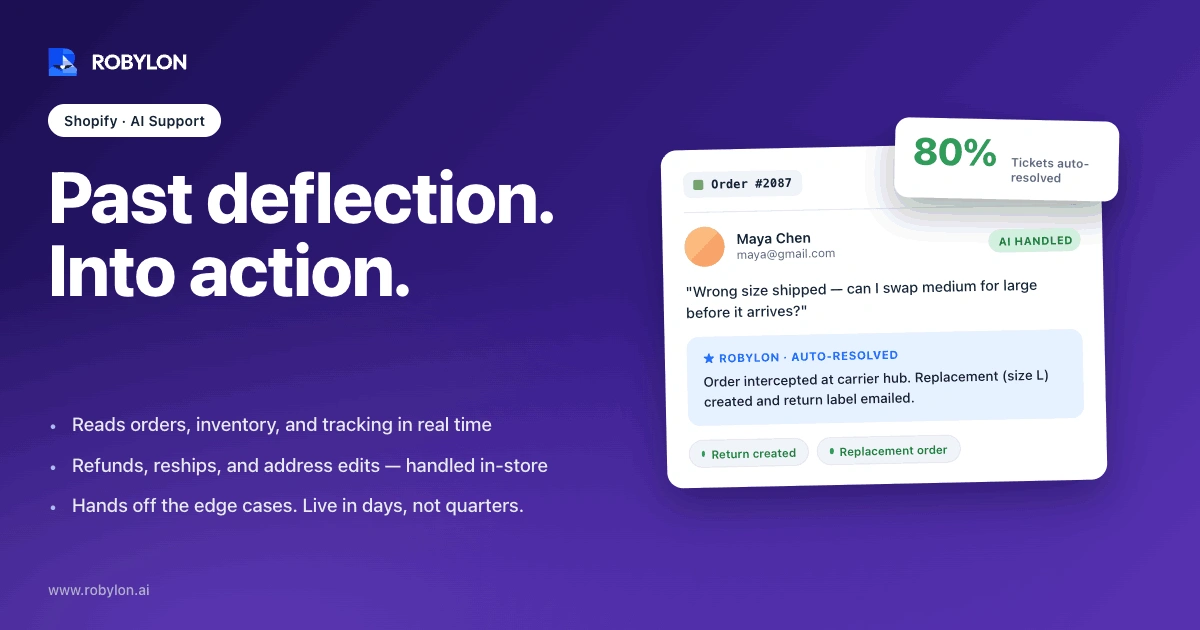
AI customer service for Shopify has moved past deflection bots to agents that read order data and take action. This guide covers the ticket mix that automates, what an agent does inside your store, where it should hand off to a human, and how to roll it out in days.
A practical comparison of Re:amaze AI and Robylon for Shopify support teams. We look at how each handles order emails, what its AI actually does, what it costs as you scale, and which one fits which kind of store.
A practical, side-by-side comparison of Siena AI and Robylon for Shopify support teams. We look at pricing models, helpdesk fit, channel coverage, action depth, deployment time, and the buyer profile each tool actually serves.
A side-by-side comparison of Yuma AI and Robylon for Shopify support teams. We dig into per-resolution vs credits-based pricing, helpdesk fit, action depth, the voice and WhatsApp gap, and which buyer profile each tool actually serves.
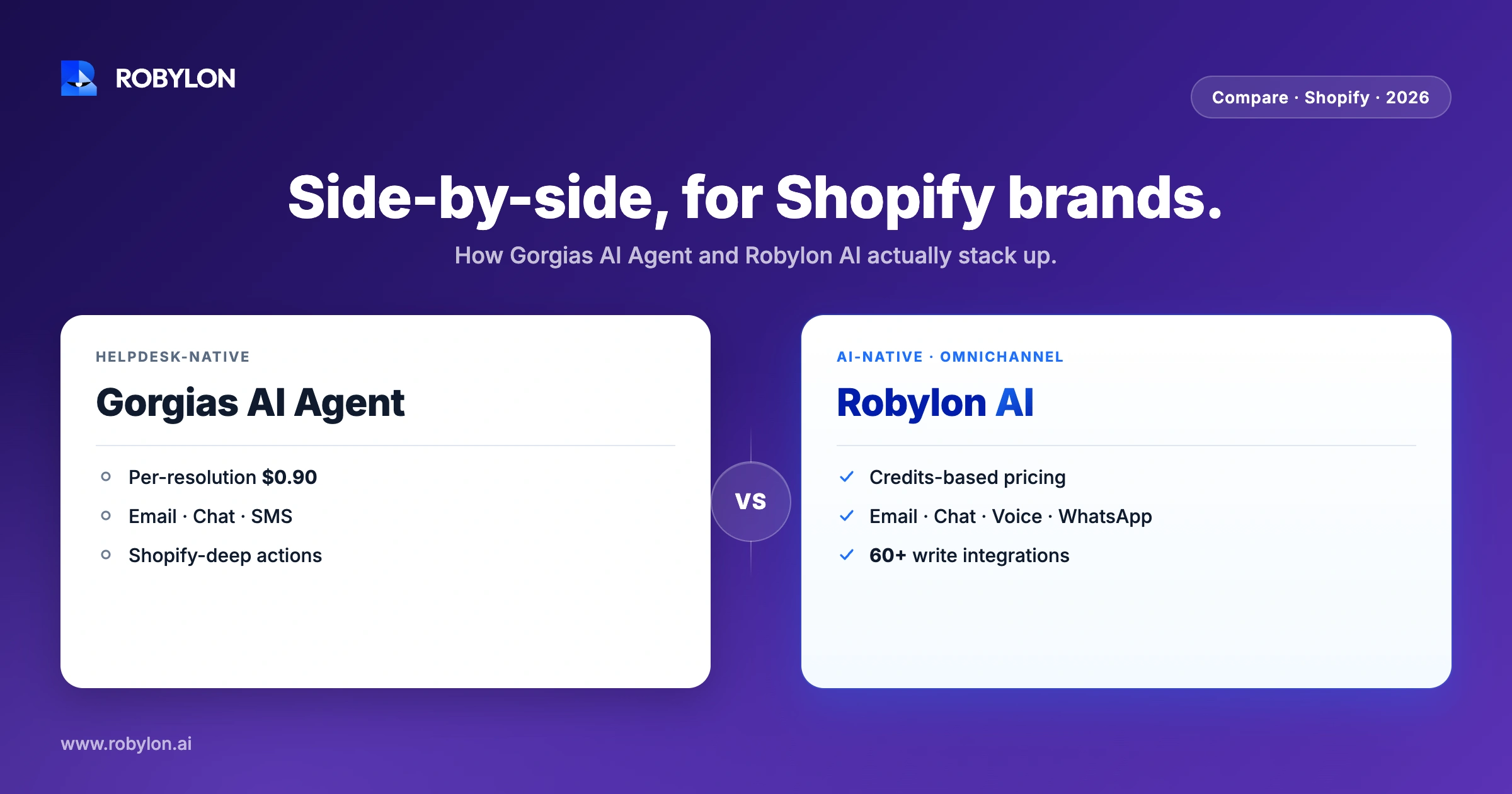
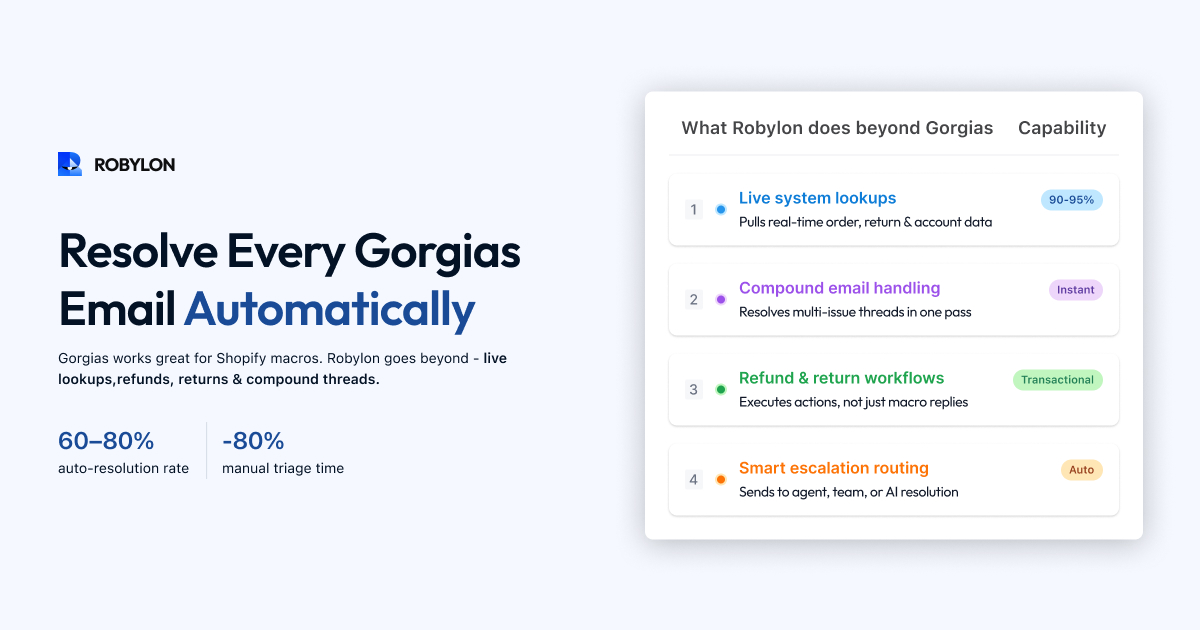
An honest side-by-side of Gorgias AI Agent and Robylon AI for Shopify brands. Pricing math at 5,000 tickets/month, resolution rates, channel coverage, integration depth, and three buyer profiles with a named pick for each.
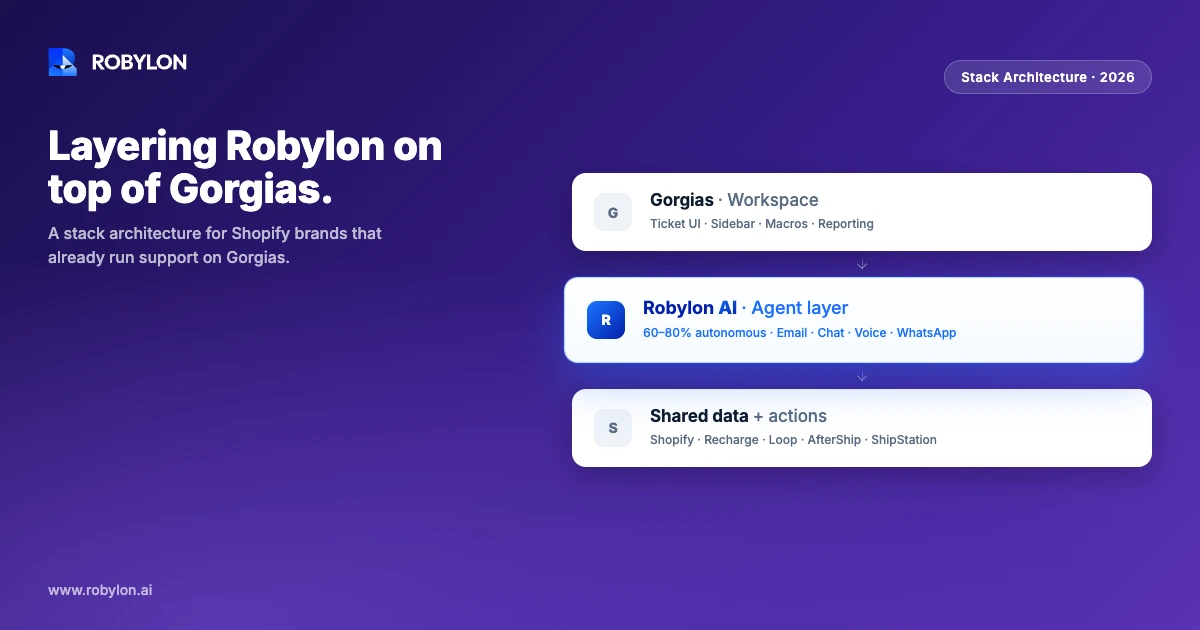
A practical architecture guide for Shopify brands running Gorgias who want better AI economics without a helpdesk migration. The shape of the layered stack, what changes, what doesn't, and when this setup wins over picking one vendor.
Internal helpdesks get a fraction of the investment external support gets, and the volume keeps climbing. Most internal email tickets follow a small number of patterns that AI can resolve end-to-end. Here is the playbook for IT, HR, and facilities, including where automation must stop.
Returns are the email category that turns busy weeks into 2,400-message inboxes. Most return emails are not really questions, they are status checks and process steps that AI can execute end-to-end. Here is how to design that automation, and where to keep humans in the loop.
B2B email support is structurally different from B2C: longer threads, named contacts, contract terms that vary by account, and stakes that compound. Generic AI agents trained on B2C tickets fail predictably here. This is what changes when AI is built for B2B from the ground up.
Billing emails are the second-largest category of support volume after WISMO. Most of them follow predictable patterns that AI can resolve end-to-end, if it has write access to your billing stack. Here is how to design that automation without losing customer trust.
Procurement-grade comparison of the 10 AI email support tools enterprise teams shortlist — autonomous resolution rates, published pricing, deployment timelines, security posture, TCO math, and a decision framework matched to your buyer profile.
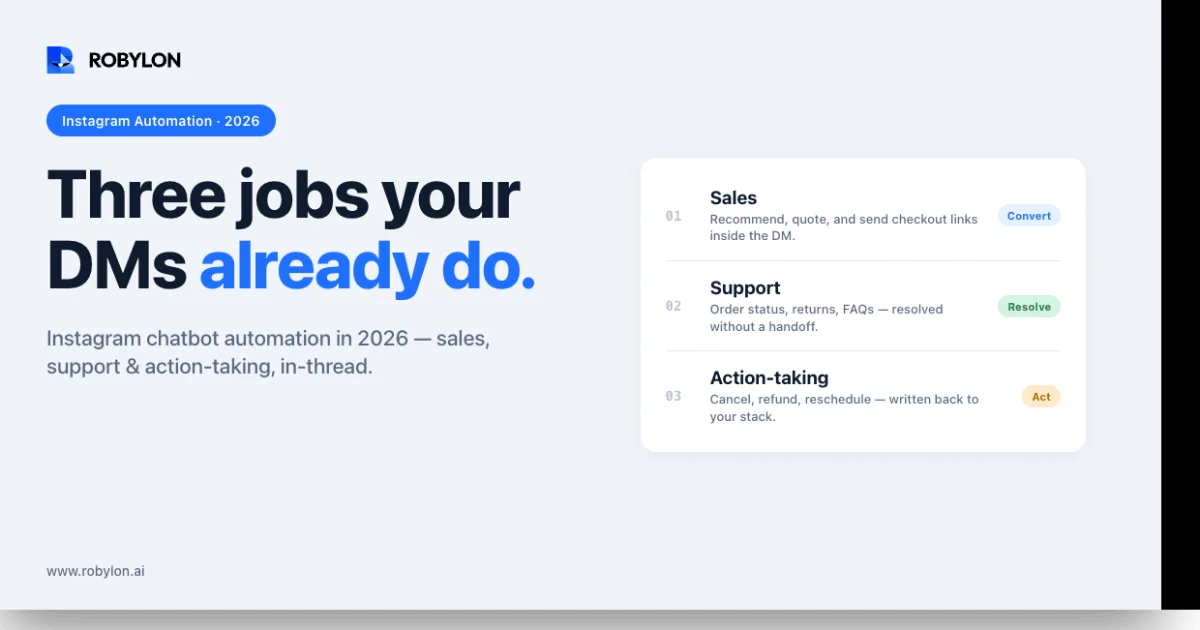
Instagram DMs are now a real revenue and support channel for D2C brands — but most chatbot tools only handle marketing flows, not actual order resolution. This guide covers what production-grade Instagram automation looks like in 2026, including the Instagram Messaging API mechanics most posts skip, when ManyChat is the right tool versus an omnichannel platform, and the specific architecture that resolves customer queries instead of just responding to them.
Compliance requirements for AI email support, organised by industry rather than by framework — with side-by-side controls, the actual questions auditors ask vendors, and deployment patterns from real engagements.
A practical guide to building AI email support audit trails — what events to log, retention requirements, SIEM integration, and how to satisfy auditors in regulated industries.
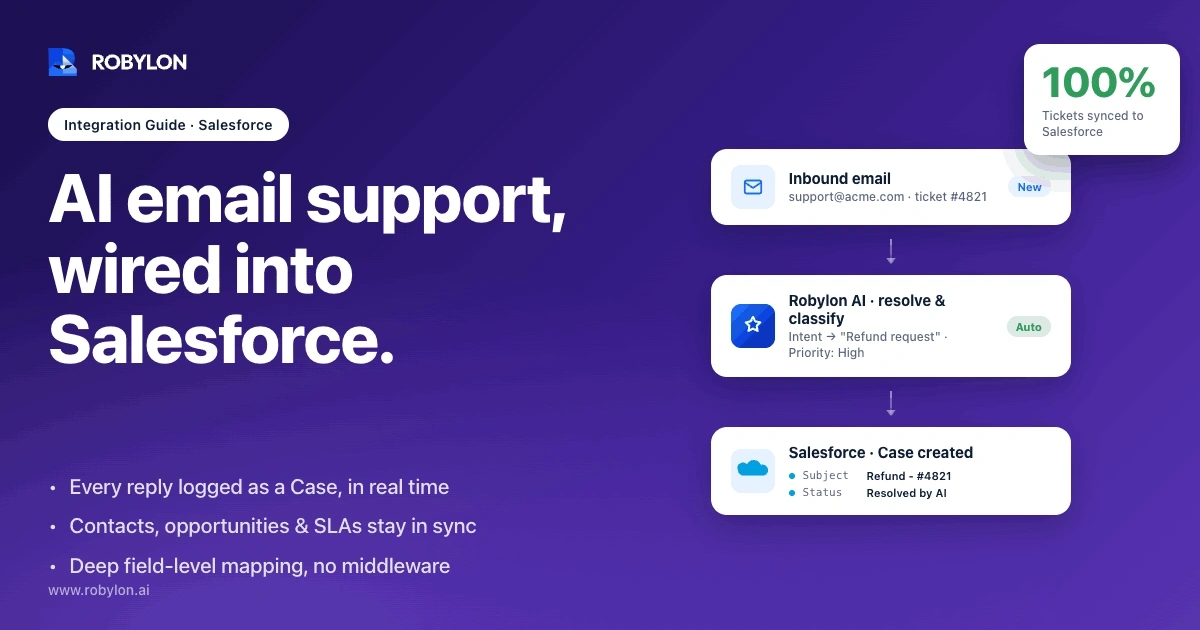
A deep integration guide for connecting AI email support to Salesforce CRM. Covers authentication, case management, custom objects, Service Cloud workflows, and common pitfalls.
A comprehensive security checklist for enterprise procurement teams evaluating AI email support vendors — certifications, encryption, AI-specific risks, and what to demand in contracts.
How to build customer trust in AI-handled email support. Covers disclosure language, escalation patterns, confidence framing, error recovery, and the metrics that matter.
A practical guide to data residency for AI email support — the multi-hop problem, regulatory drivers, sub-processor complications, and what true regional isolation looks like.
Everything EU support teams need to know about deploying AI email support under GDPR — lawful basis, data residency, DPAs, sub-processor management, and DSAR handling.
Multi-agent AI workflows are how modern email support handles complex multi-intent tickets. Covers specialisation, orchestration patterns, handoff design, and when single-agent systems fall short.
Hallucinations are the #1 fear of AI email support. This guide covers proven techniques to prevent them: RAG grounding, confidence scoring, output validation, and escalation patterns.
A buyer's guide to evaluating SOC 2 compliance specifically for AI email support tools — Type I vs Type II, what to look for in the report, and AI-specific gaps to ask about.
Comparing Ada AI and Robylon AI on email ticket resolution rates, autonomy depth, integrations, and total cost of ownership for support teams.
AI email support vendors price the same product five different ways, and the model you pick shapes your bill more than the sticker rate. This guide breaks down per-seat, per-conversation, per-resolution, usage-based, and hybrid pricing with worked cost math at three volume tiers.
A practical comparison of HubSpot Service Hub and Robylon AI for email automation, focusing on resolution rates, pricing, and ease of use for growing teams.
A detailed head-to-head comparison of Intercom Fin and Robylon AI on email ticket resolution, autonomy, pricing, and integrations.
Comparing Kustomer and Robylon AI for email-first support operations, covering customer timelines, AI resolution rates, pricing, and best-fit use cases.
An in-depth comparison of Salesforce Agentforce and Robylon AI for email support automation, covering autonomy, integration, pricing, and deployment.
Comparing Tidio's chat-first AI (Lyro) against Robylon AI's email-first approach for customer email support.
Zoho Desk's Zia is a capable agent-assist AI, but it lives inside the Zoho ecosystem and rarely closes tickets on its own. This compares Zia and Robylon on autonomous resolution, action-taking, knowledge access, and pricing.
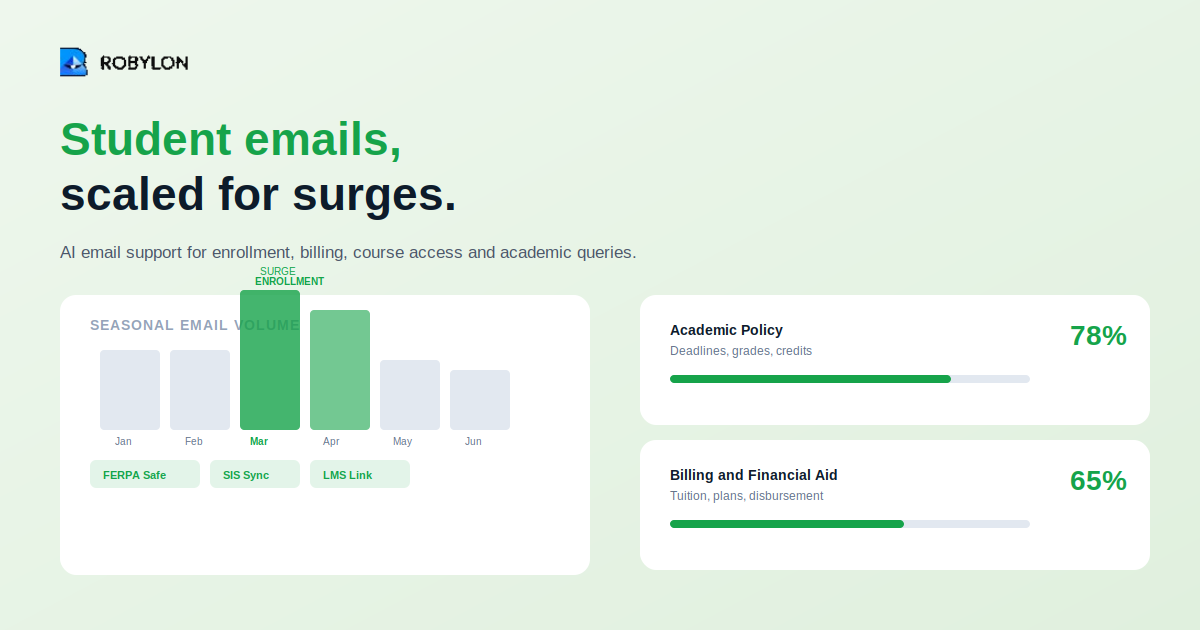
Education support teams face massive seasonal spikes — enrollment periods, exam seasons, and billing cycles. AI email support handles these surges while maintaining the personal touch students expect.
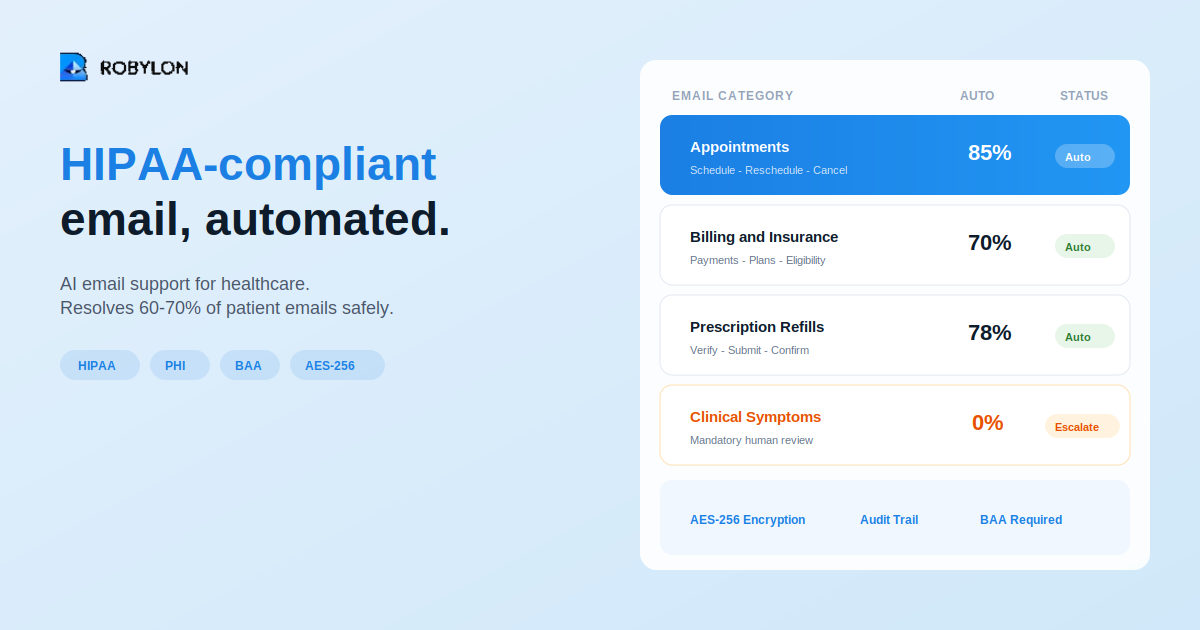
Healthcare support teams handle thousands of patient emails daily — appointment requests, billing questions, insurance inquiries, and prescription refills. AI can automate 60–70% of these while maintaining strict HIPAA compliance.
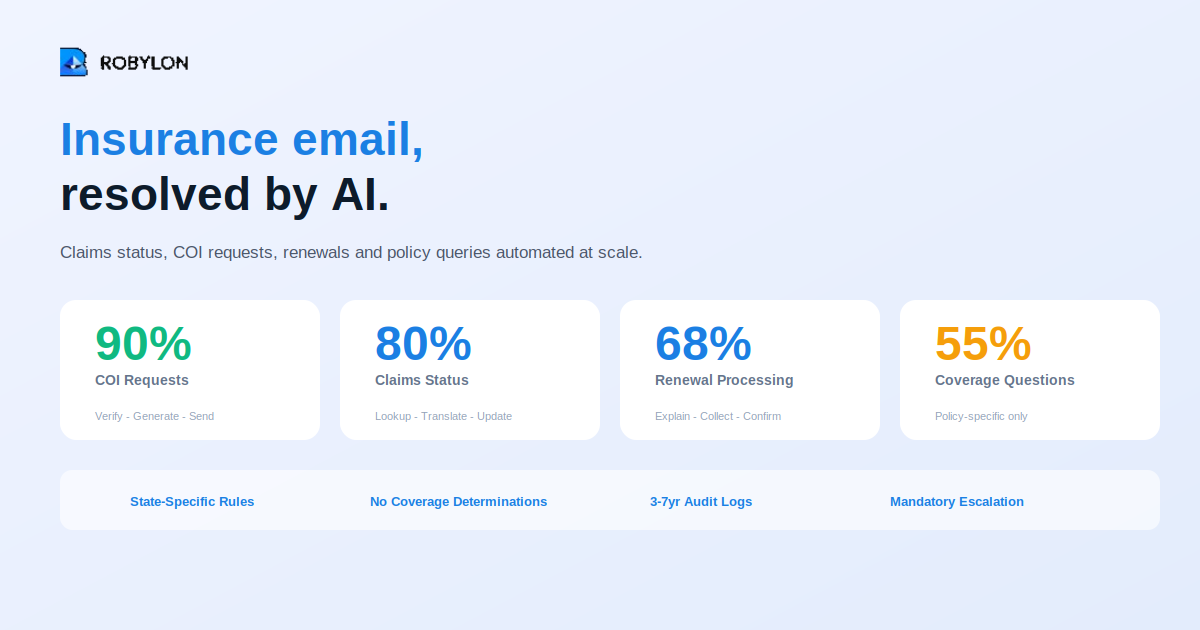
Insurance email is 80% repetitive: claims status checks, renewal reminders, policy questions, and certificate requests. AI resolves these automatically while routing complex claims to adjusters.
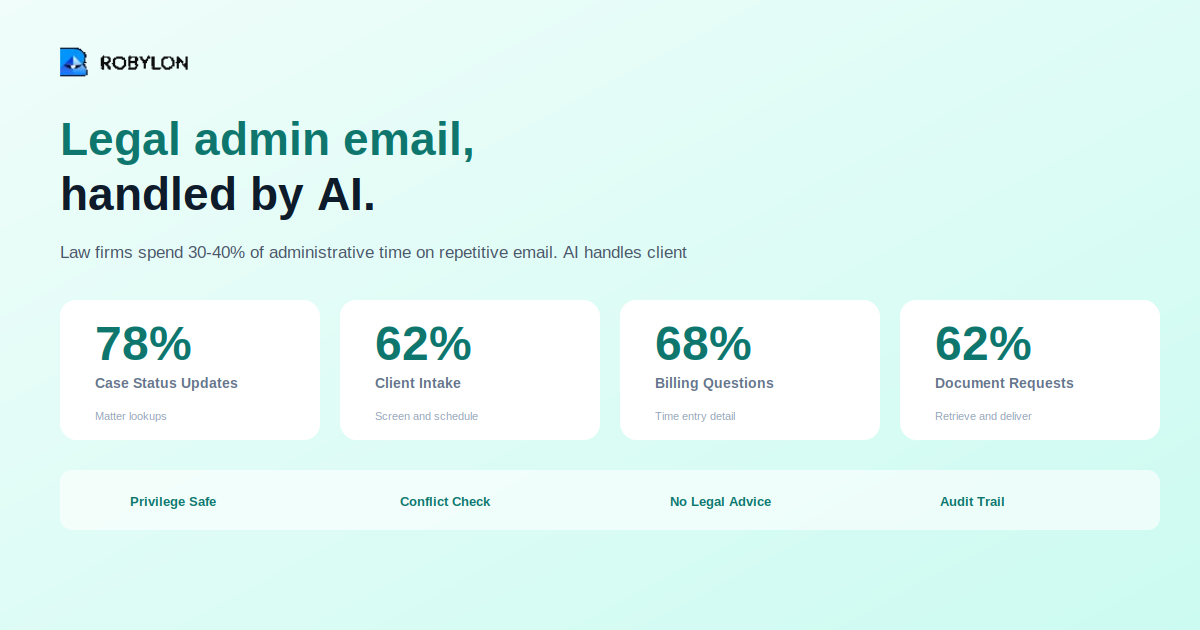
Law firms spend 30-40% of administrative time on repetitive email. AI handles client intake, case status updates, and billing questions — freeing attorneys for billable work.
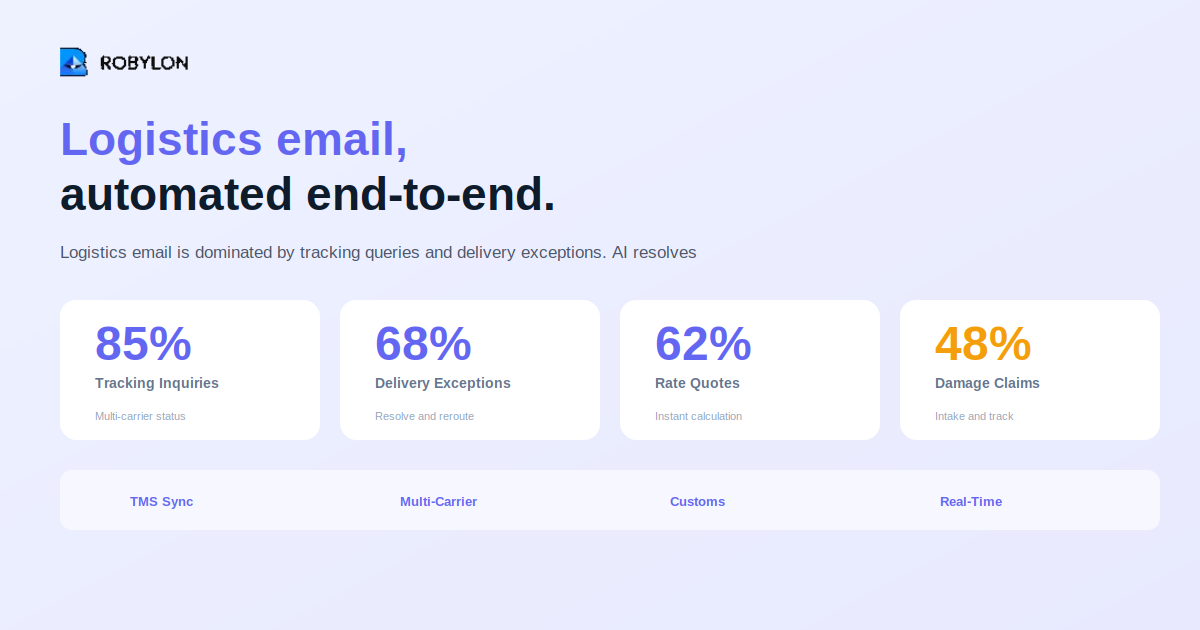
Logistics email is dominated by tracking queries and delivery exceptions. AI resolves 70-80% of these instantly by connecting to TMS and carrier APIs in real time.
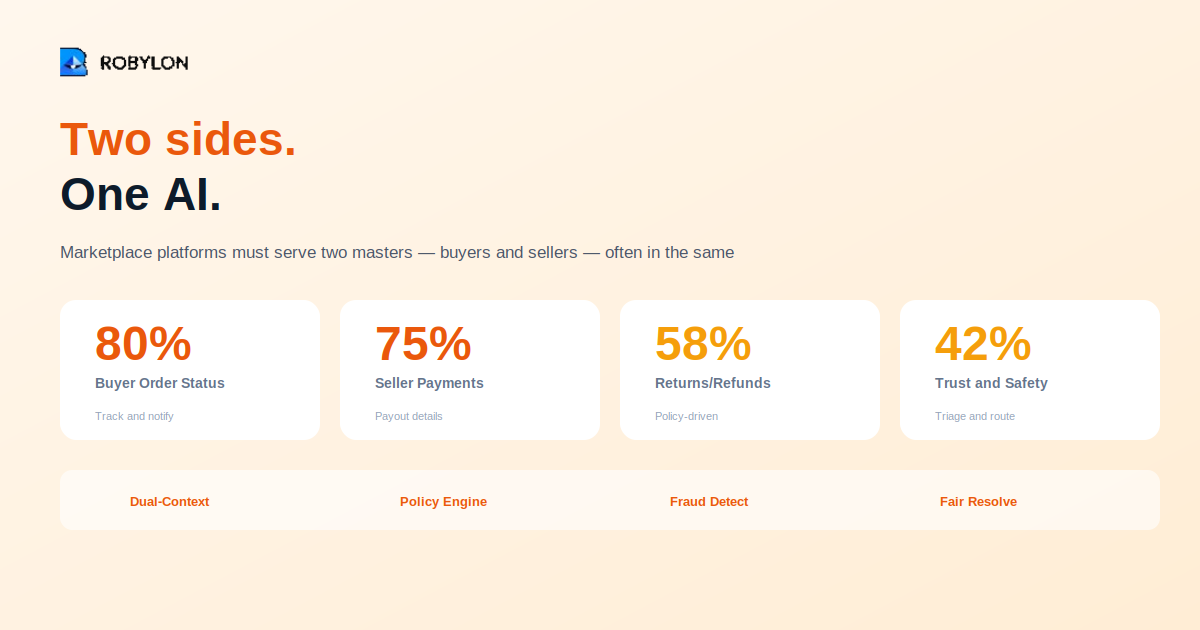
Marketplace platforms must serve buyers and sellers — often in the same dispute. AI triages both sides, applies policies consistently, and resolves 55-65% of cases automatically.
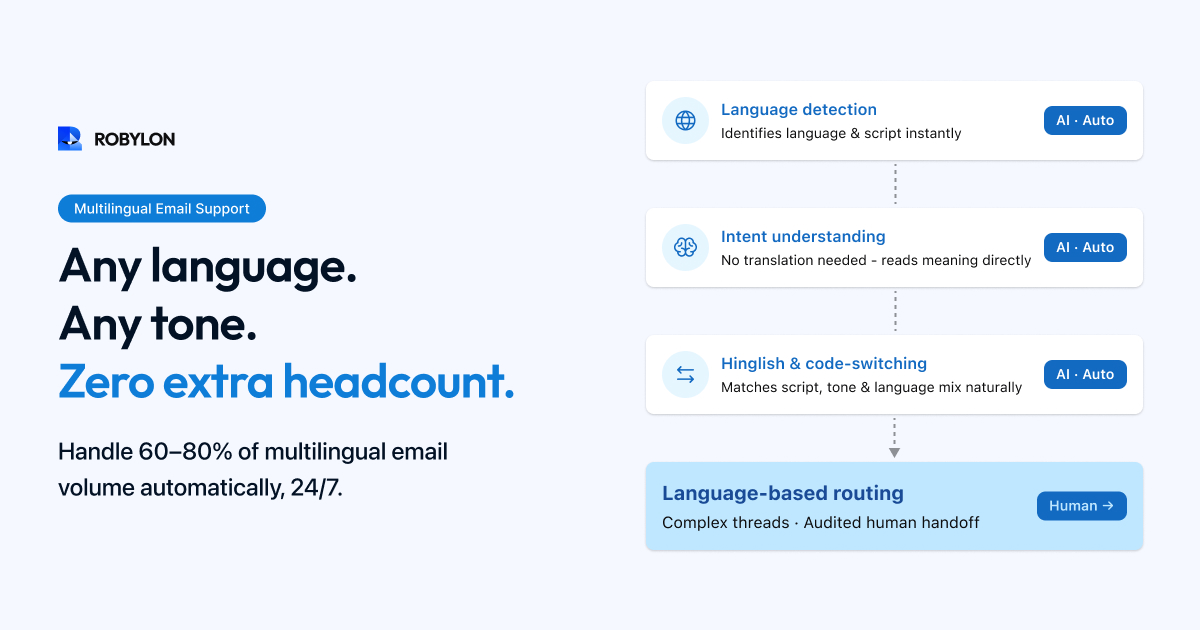
Your customers email in Hindi, Spanish, Arabic, and Hinglish — and they expect a response in their language. This guide shows how AI auto-detects language, retrieves knowledge base content, responds natively, and handles the code-switching that breaks basic translation tools
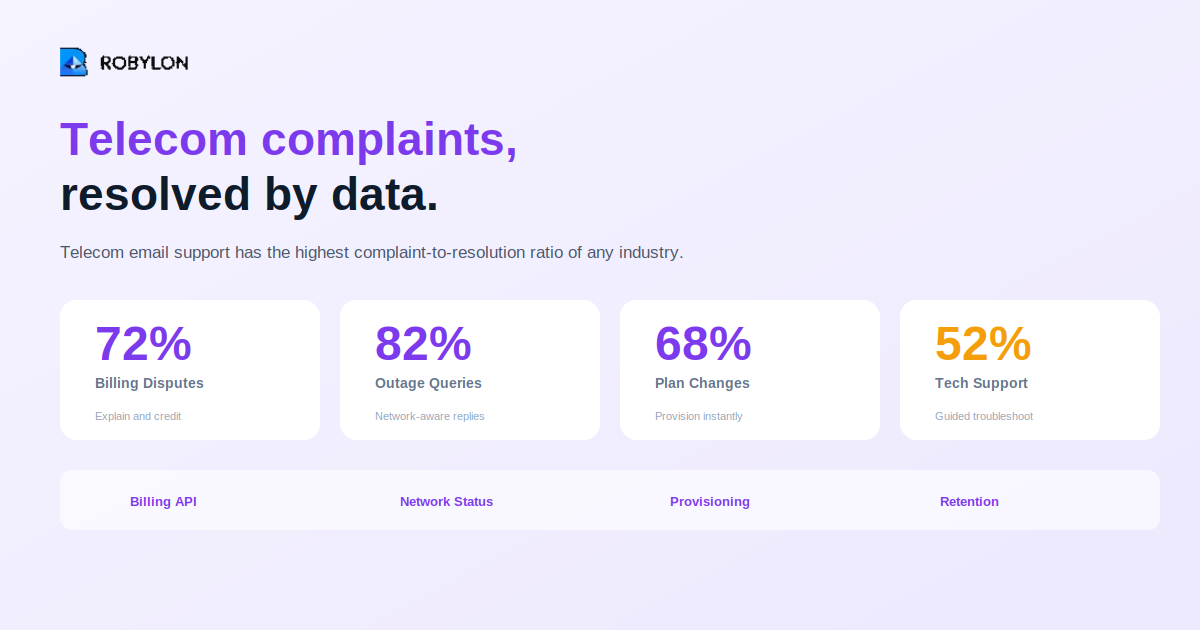
Telecom email support has the highest complaint-to-resolution ratio of any industry. AI handles billing questions, outage notifications, and plan changes — reducing resolution from days to hours.
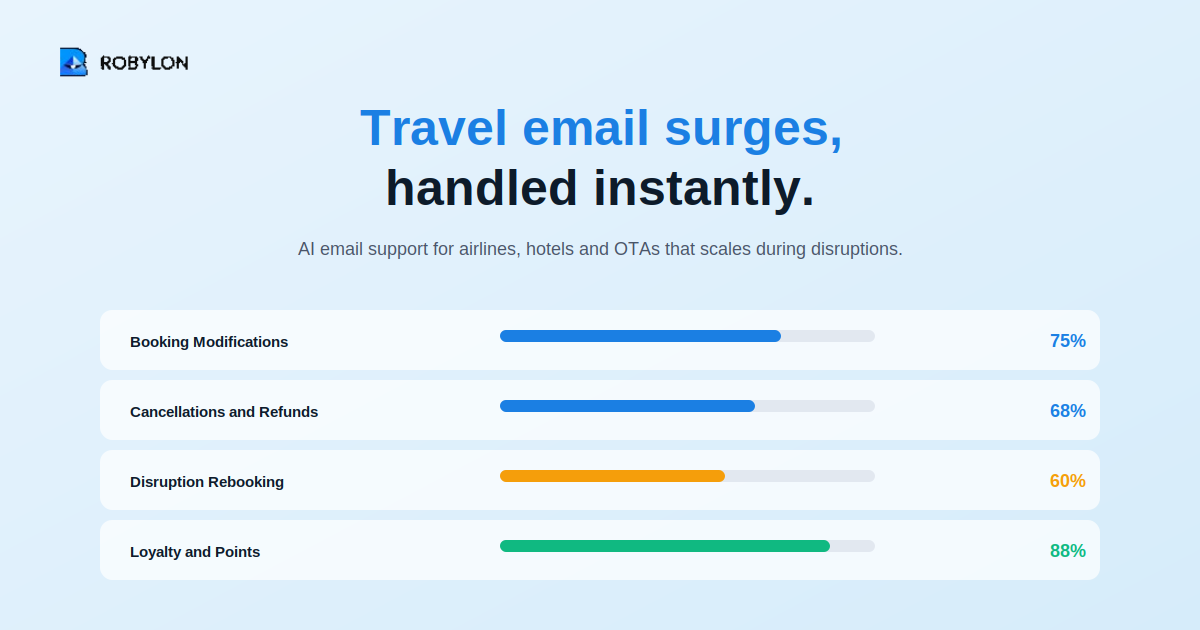
Travel companies face extreme email spikes during disruptions — storms, cancellations, overbookings. AI email support handles these surges without adding temporary staff, resolving 60–75% of routine travel queries automatically.
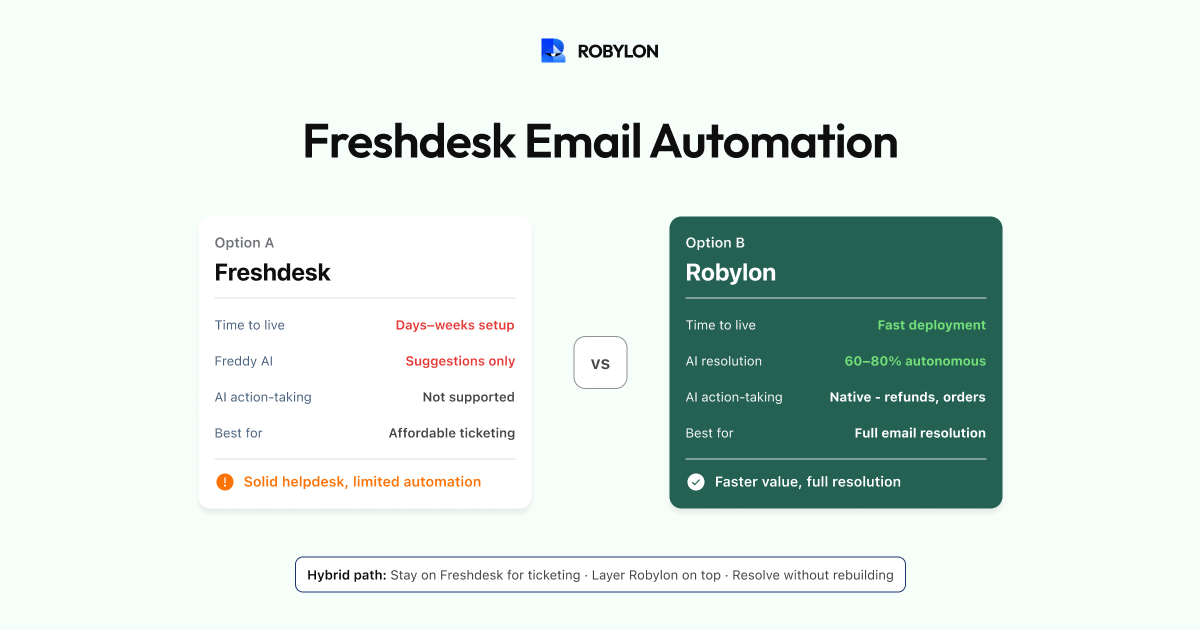
Freshdesk is one of the most popular helpdesks for email support. This review covers how well Freddy AI automates email tickets, where it stops and what it costs, and links to the full comparison of Freshdesk alternatives.
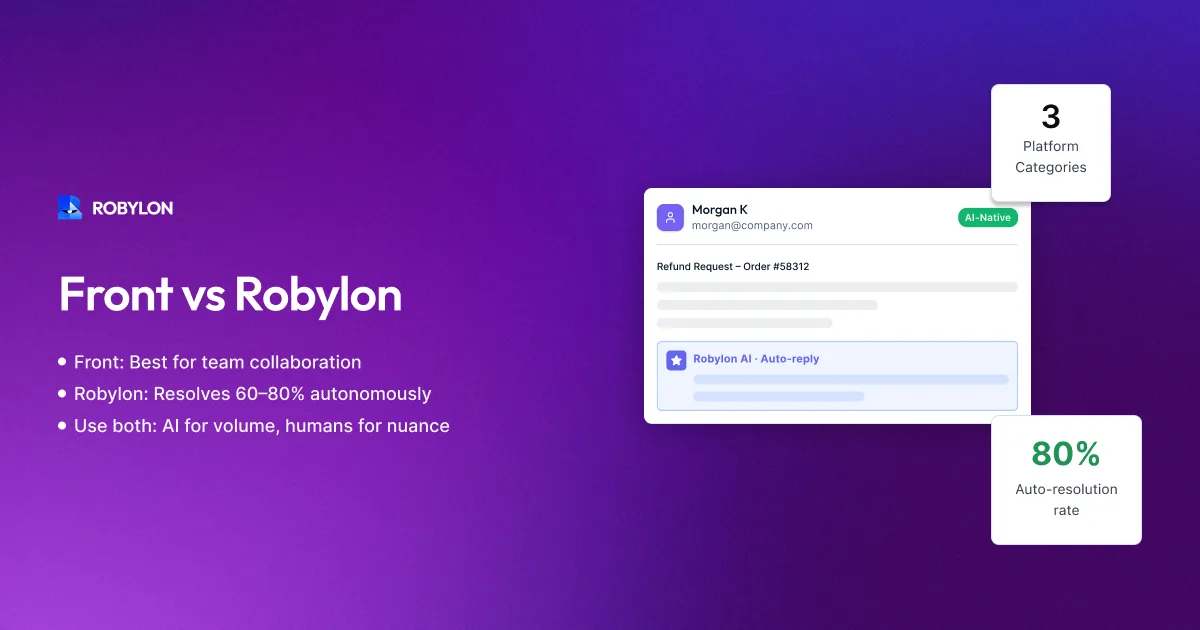
Front is great for teams that collaborate on email. Robylon is great for teams that want AI to resolve email. This comparison helps you decide which problem to solve first — and why many teams end up using both.
Gorgias is the go-to helpdesk for Shopify merchants. This review covers how well it automates email, where it stops and what it costs at volume, and links to the full comparison of Gorgias alternatives.
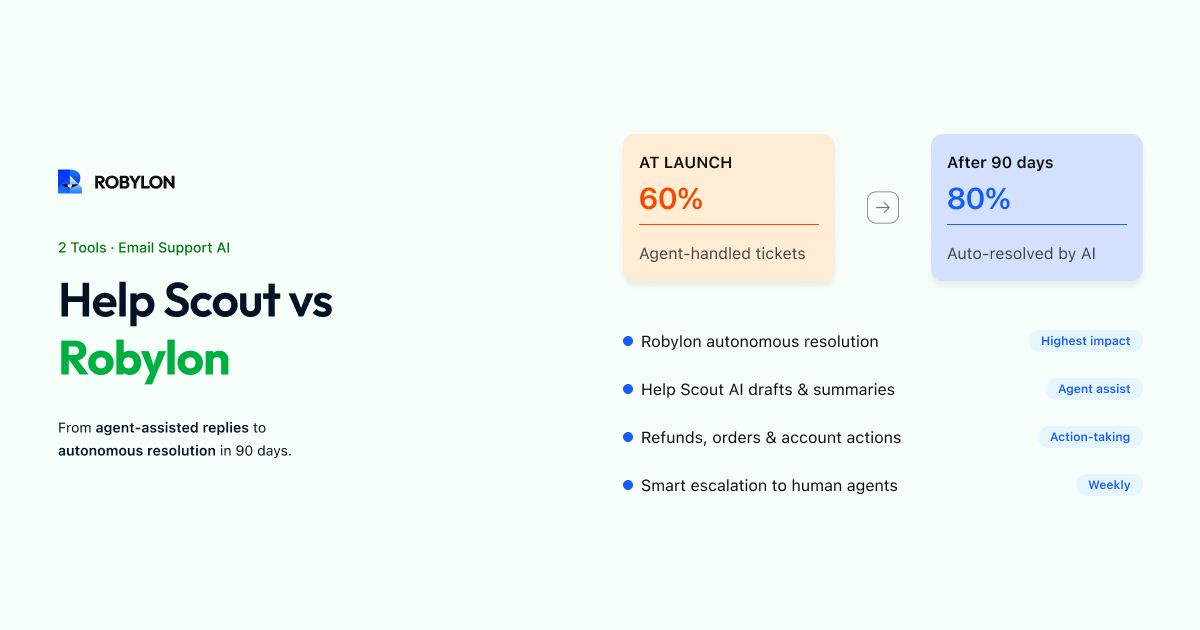
Help Scout's clean shared inbox is perfect for teams that want simplicity. Robylon's AI engine is built for teams that want automation. This head-to-head comparison covers AI depth, email handling, pricing, and the hybrid approach that gets you the best of both.
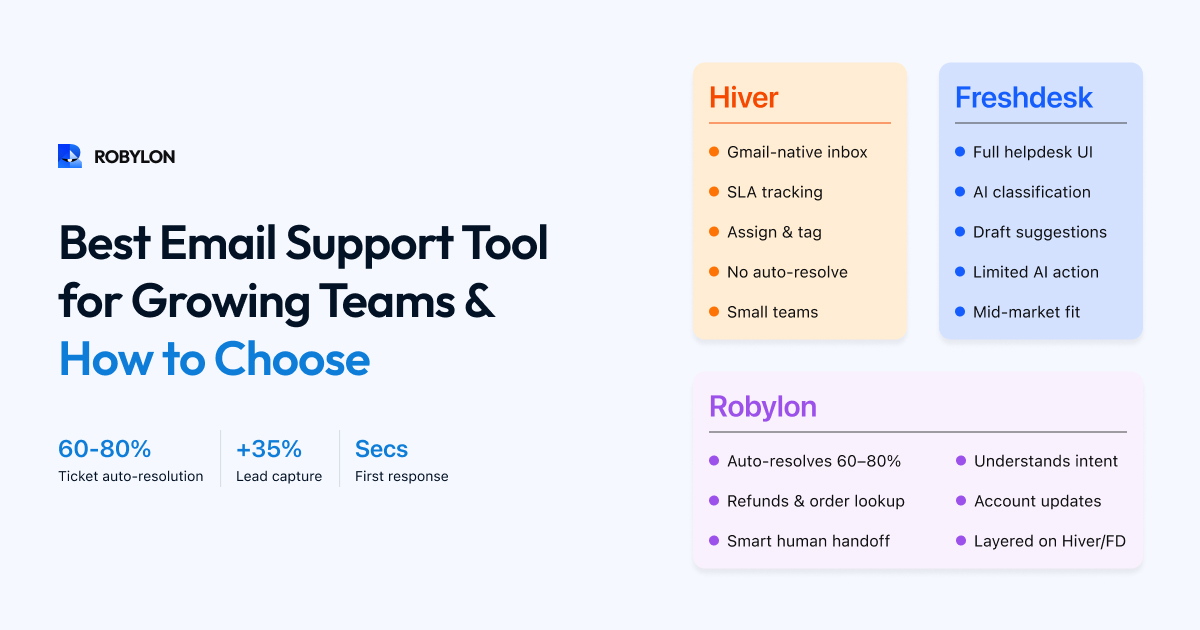
Hiver keeps you in Gmail. Freshdesk gives you a proper helpdesk. Robylon gives you AI that resolves emails. This three-way comparison helps growing teams decide which approach fits their current stage and future growth.
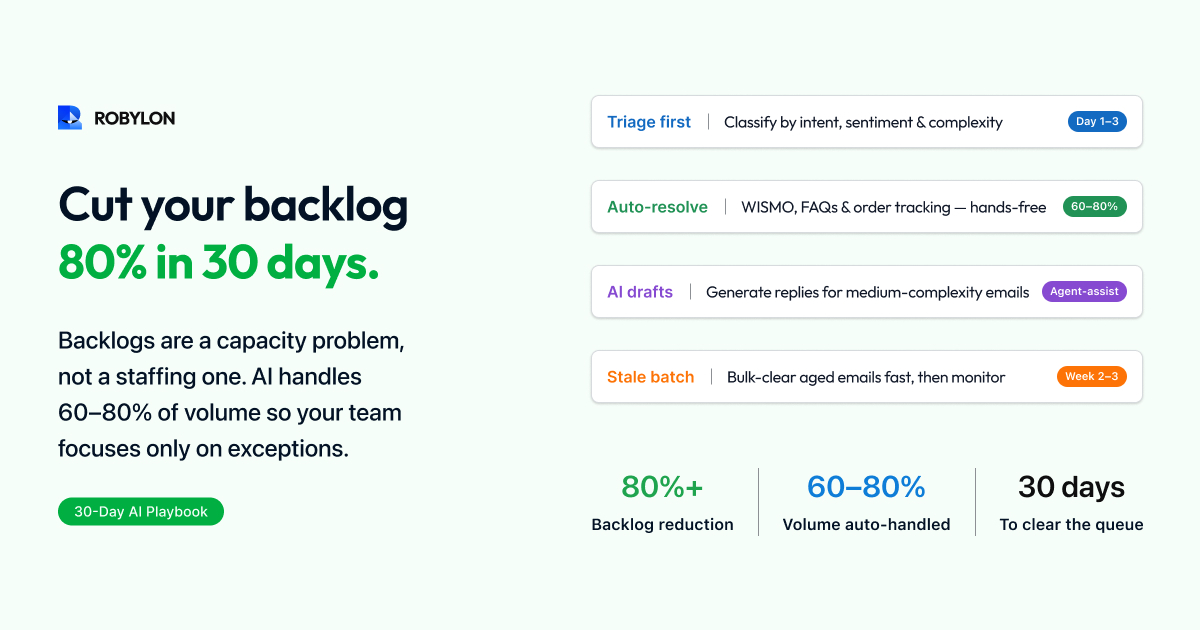
If you are searching for this article, you have an email backlog problem right now. This is the tactical guide — no theory, no fluff. Five phases to go from a growing backlog to an 80% reduction within 30 days using AI automation, with specific actions, timelines, and benchmarks for each phase.
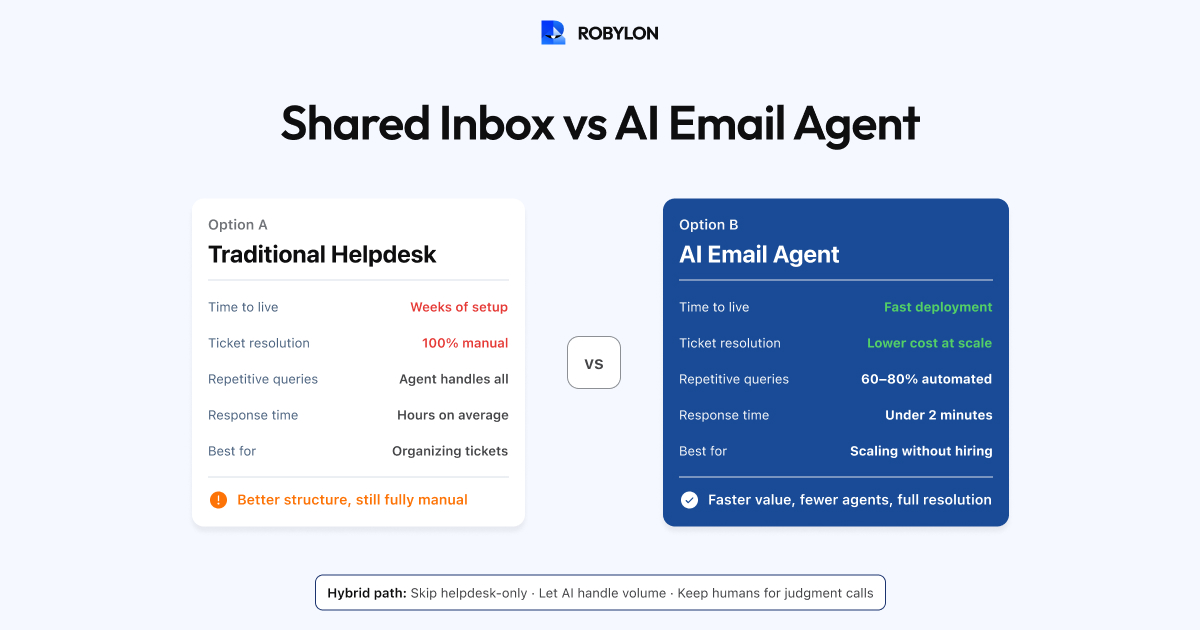
Every support team starts with a shared inbox. Most outgrow it within months. This guide identifies the 7 tipping points that signal it's time to upgrade — and makes the case that in 2026, the right upgrade skips the traditional helpdesk and goes straight to AI email resolution.
Zendesk is the biggest helpdesk in the world, but how well does it automate email? This review covers what Zendesk's email AI handles, where it stops and what it costs, and links to the full comparison of Zendesk alternatives.
Most chatbots can answer questions. Few can actually do things. This guide explains how action-taking AI agents work — executing workflows like refund processing, order modifications, and account updates within conversations — and why the shift from answering to acting is what separates 30% automation from 80%.
D2C brands live and die by customer experience. This guide shows how AI chatbots automate both sides of the D2C journey — converting browsers into buyers with pre-purchase assistance, then retaining them with seamless post-purchase support across chat, email, WhatsApp, and Instagram.
AI chatbots can capture and qualify leads 24/7 — but only if designed correctly. This playbook walks you through building lead gen chatbot flows, integrating with your CRM, scoring leads with AI, and measuring pipeline contribution.
AI chatbot pricing is confusing by design — per-agent fees, AI add-ons, per-resolution charges, and hidden usage limits make real costs hard to compare. This guide demystifies every pricing model and shows what you should actually pay based on your team size and ticket volume.
The first 30 days determine whether a SaaS customer stays or churns. AI chatbots accelerate onboarding by answering setup questions instantly, guiding users through integrations, and proactively nudging stalled accounts — all without consuming CSM time.
Many business owners wonder if they can just use ChatGPT for customer support instead of deploying a purpose-built AI chatbot. This guide explains the fundamental differences — in data access, accuracy, integration, and business value — so you can make the right choice.
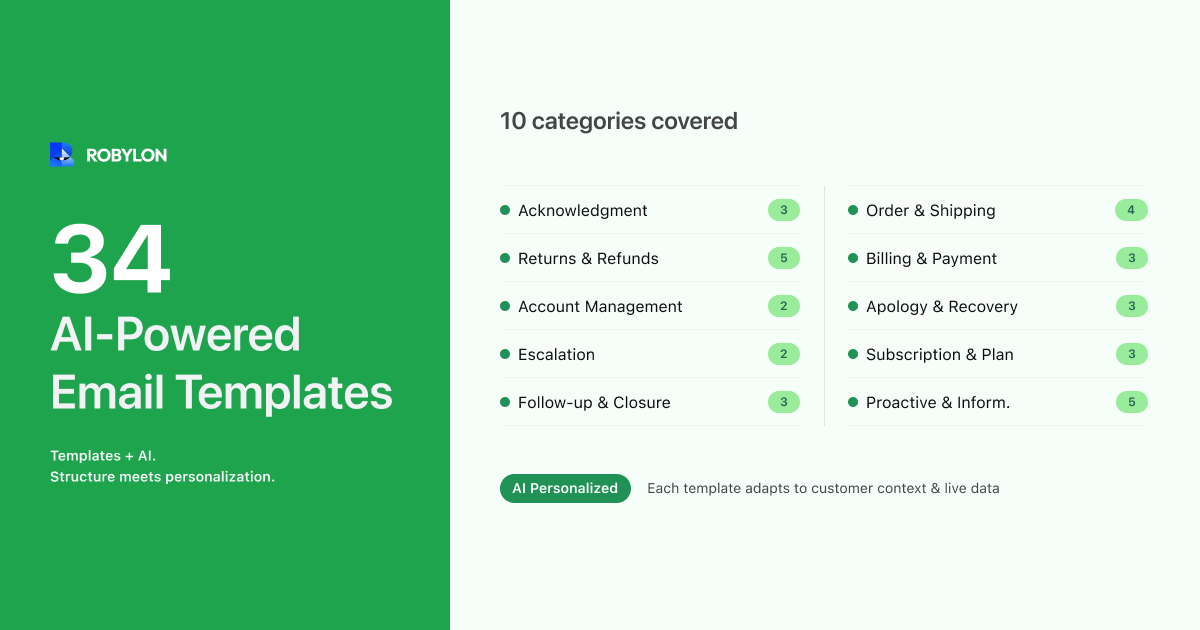
Stop writing the same email replies from scratch every day. These 34 AI-enhanced templates cover every common support scenario - from acknowledgments to apologies to refund confirmations - with guidance on when to let AI draft instead.
Building a case for AI in customer service? This collection of 50+ statistics covers everything from adoption trends and automation rates to cost savings, customer satisfaction impact, and channel-specific benchmarks — sourced from industry research and real-world deployments.
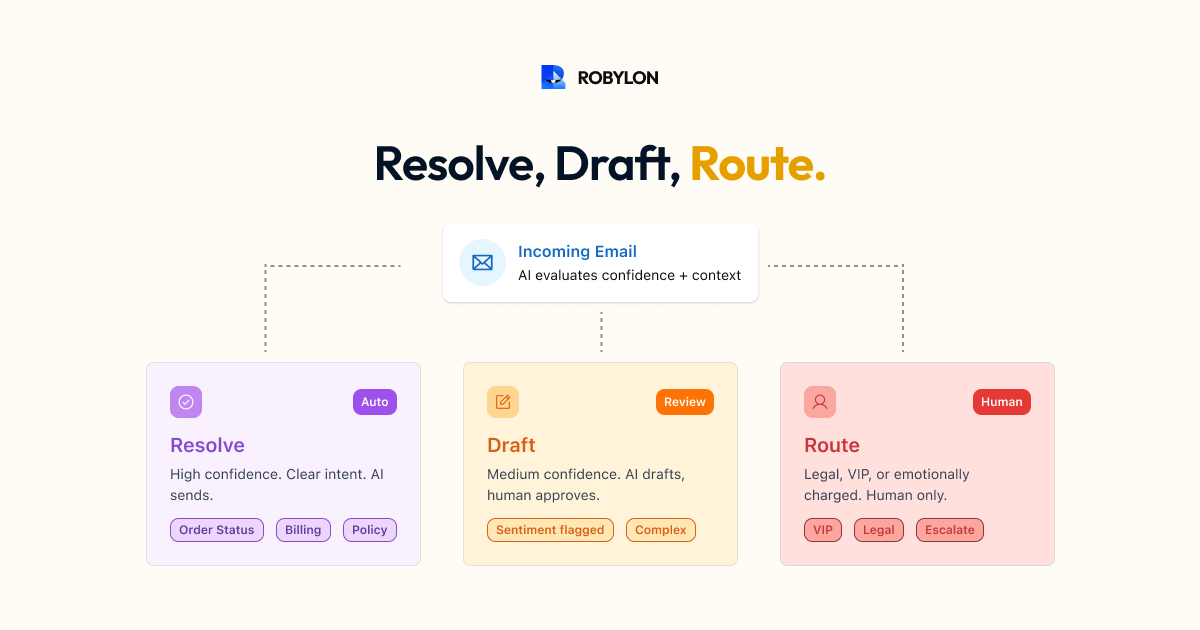
Knowing when NOT to auto-resolve is just as important as knowing when to. This guide provides a complete escalation framework for AI email support — confidence gates, sentiment triggers, topic-based rules, and the context handoff that makes escalation seamless.
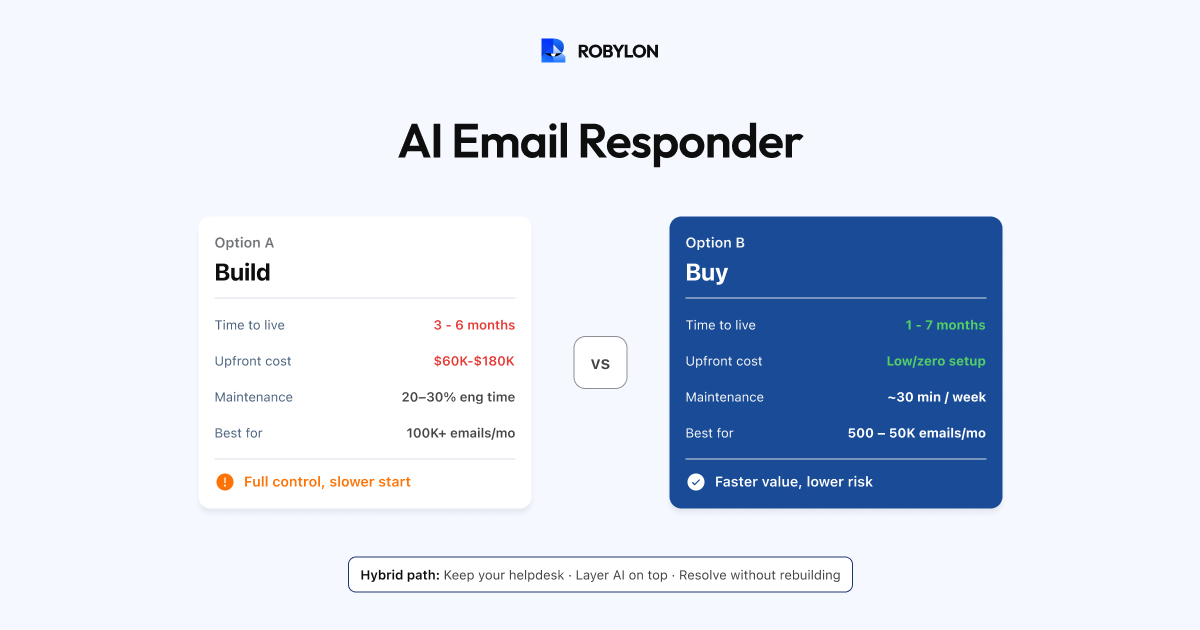
Your team wants AI to handle email support - but should you build a custom solution with LLM APIs or buy a purpose-built platform? This guide compares both approaches honestly across cost, speed, capabilities, and maintenance.
The biggest objection to AI email support is "What if it sends wrong answers?" This guide shows how to systematically achieve 95%+ accuracy through knowledge base optimization, confidence threshold calibration, multi-issue parsing tuning, and continuous feedback loops — with specific benchmarks for each stage of maturity.
Email is still the largest customer support channel, and AI can now resolve 60–80% of email tickets without human involvement. This complete guide covers everything from how AI email support works to measuring ROI after deployment.
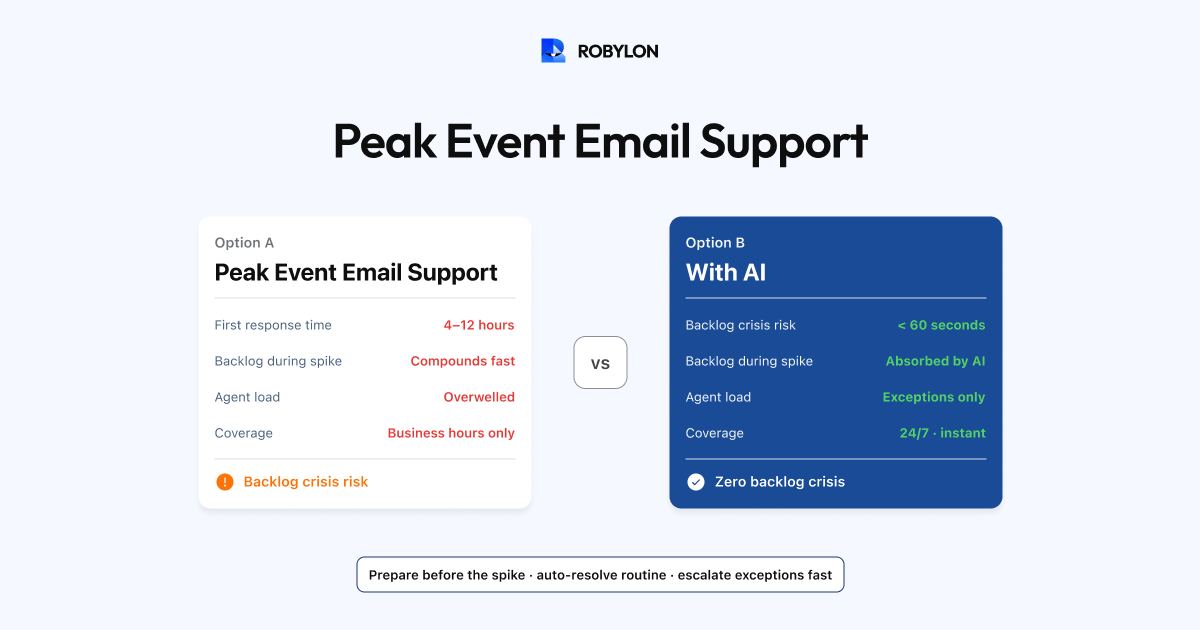
Volume spikes are predictable but devastating to unprepared support teams. Black Friday, product launches, service outages, and viral marketing moments can drive 5–10x normal email volume overnight. This guide covers how to prepare AI email support for surges — pre-loading knowledge, adjusting thresholds, and deploying event-specific automation.
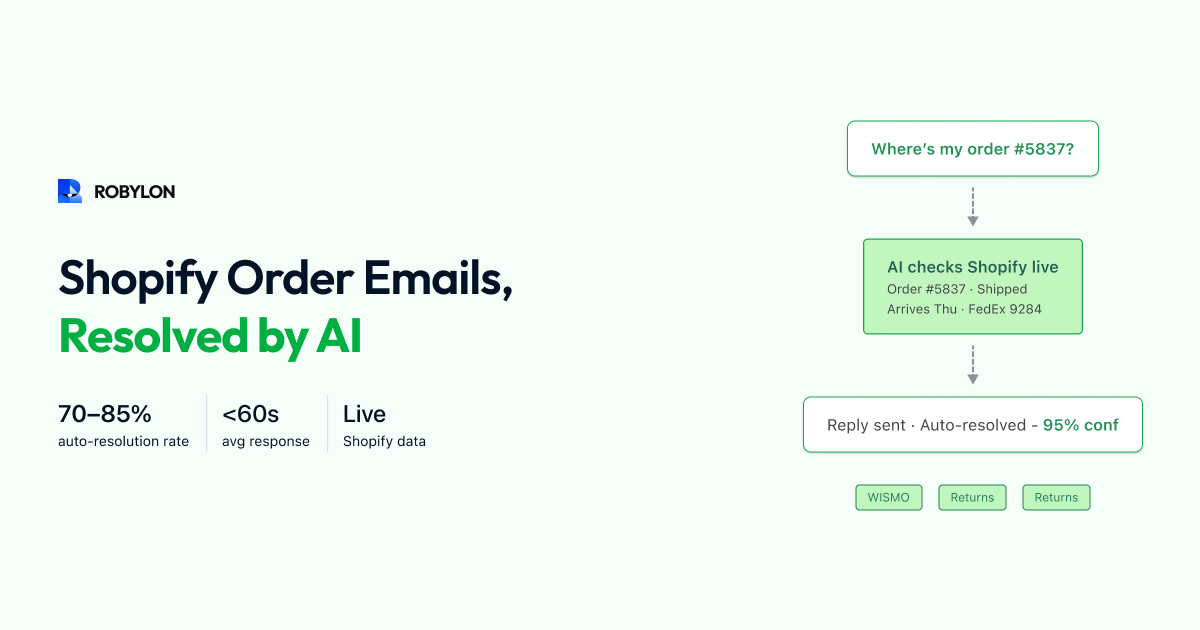
Shopify merchants receive hundreds of order-related emails daily — where is my order, I want to return this, my refund hasn't arrived. This guide shows how AI connected to Shopify's API resolves these emails end-to-end, from detecting the intent to processing the action in Shopify and confirming to the customer.
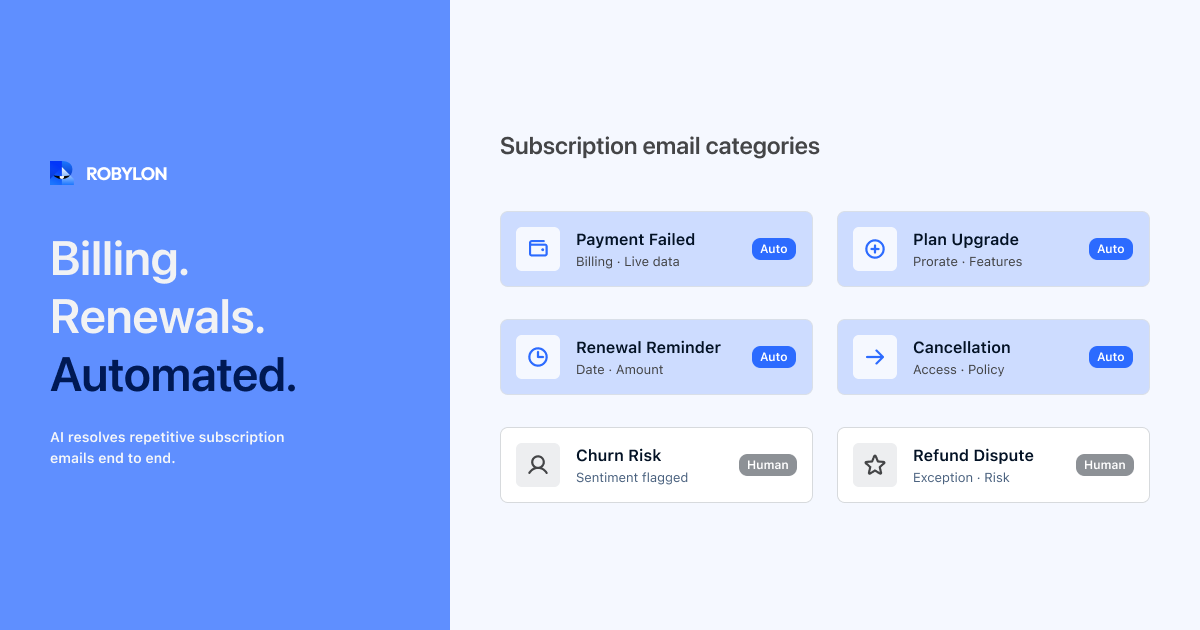
Subscription businesses face unique email patterns: cancellation requests, billing disputes, proration questions, and failed payment recovery. This guide shows how AI resolves 65–80% of these emails while routing churn-risk signals to retention specialists.
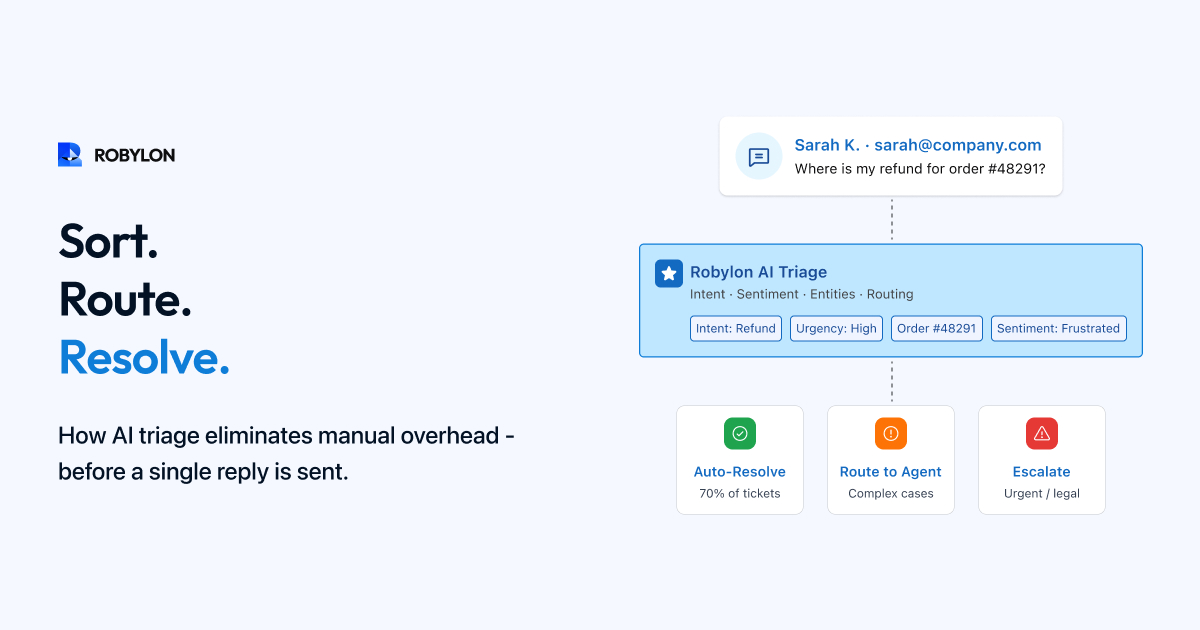
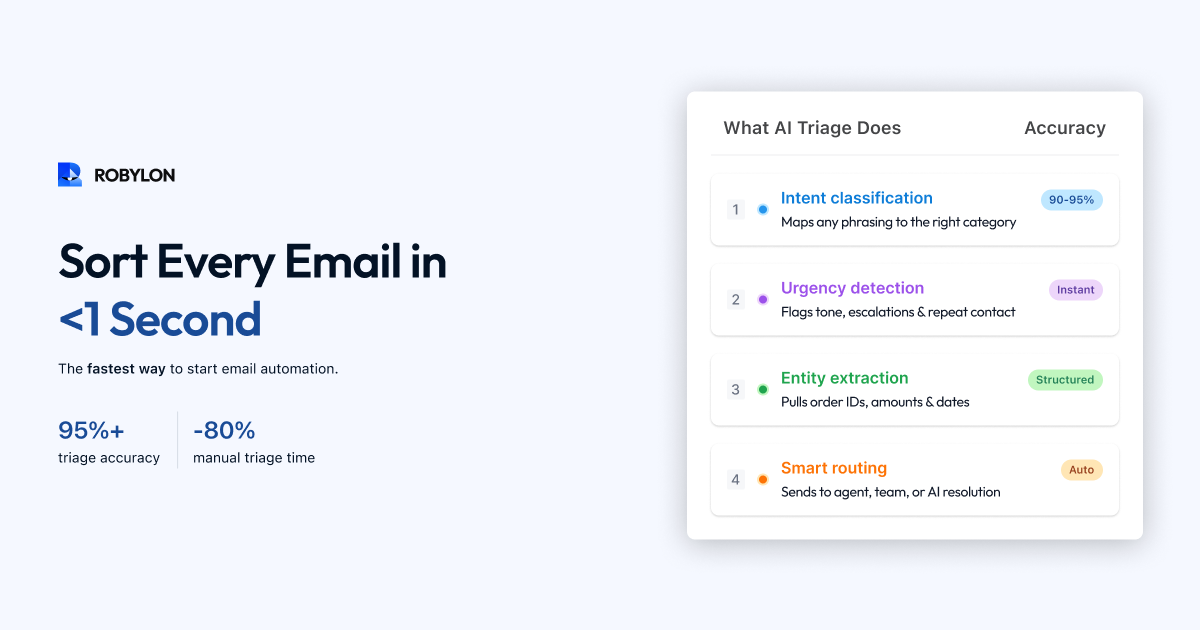
Manual email triage wastes 15–30 minutes per agent per day on sorting, tagging, and routing. AI does it in milliseconds - with higher accuracy. This guide covers how AI email triage works, how to set it up, and what it unlocks.
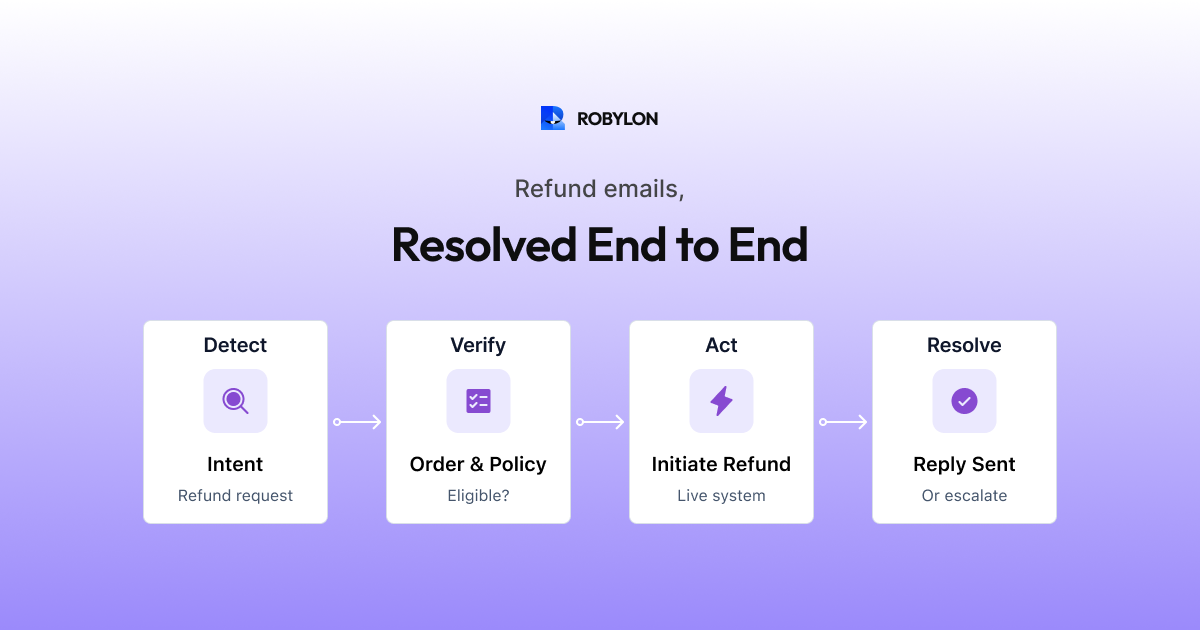
Refund emails are the #2 email category after WISMO. This article walks through exactly how AI reads a refund request, checks eligibility, queries your payment system, and resolves the issue — including 8 edge cases that trip up basic automation.
Live chat is the highest-rated support channel — but staffing it 24/7 is expensive. AI-powered live chat resolves routine queries instantly, assists agents on complex ones, and routes conversations intelligently. This guide covers the full AI + live chat stack.
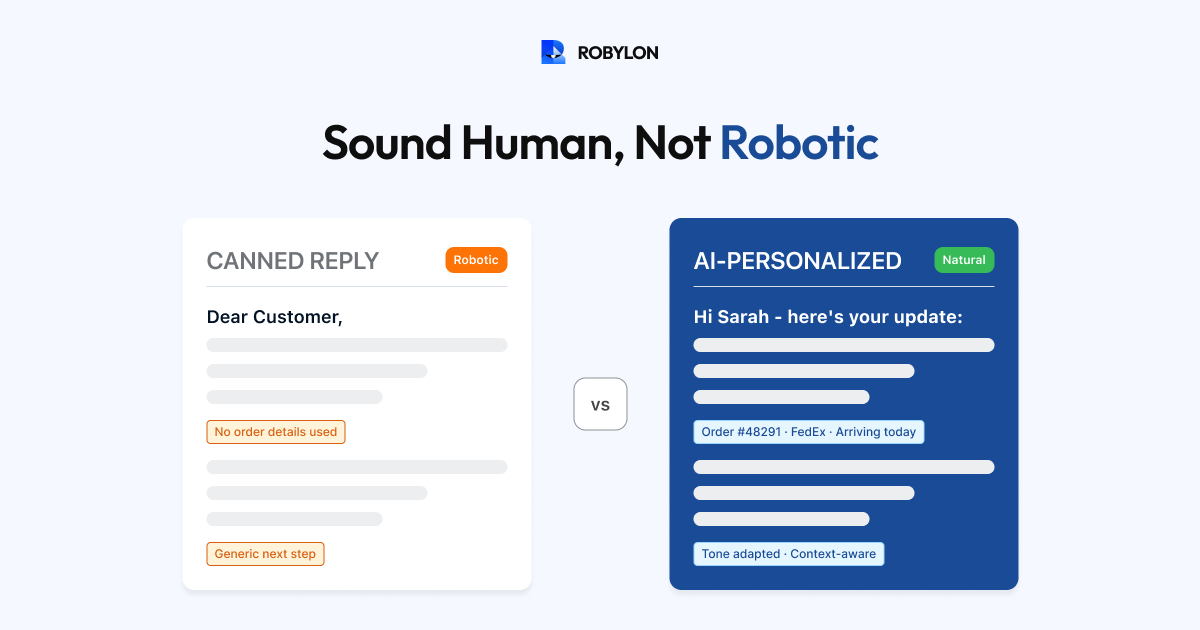
The #1 objection to AI email support is "it'll sound robotic." This guide covers 8 practical techniques — from brand voice configuration to dynamic personalization to sentiment-adaptive tone — that make AI-generated emails indistinguishable from human-written ones.
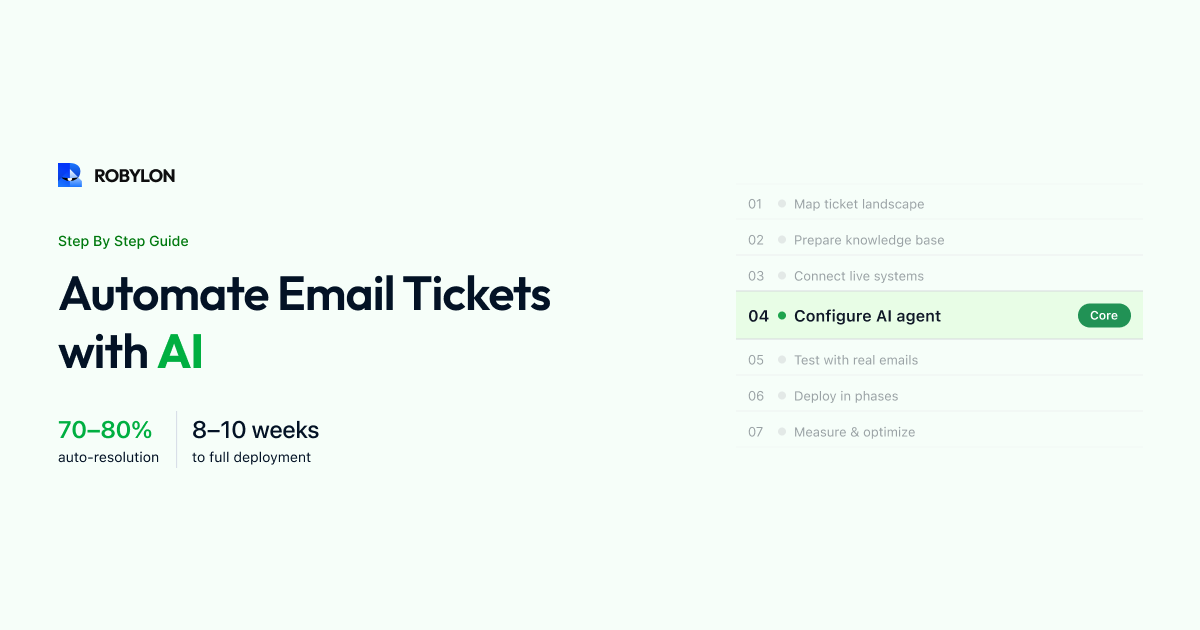
Stop manually replying to the same email tickets over and over. This step-by-step guide shows you how to set up AI that reads, understands, and resolves email tickets automatically - with a practical implementation checklist.
B2B buying cycles are longer, deal sizes are larger, and stakeholders are more demanding. This guide shows how AI chatbots accelerate both sides of the B2B funnel — qualifying leads faster and automating post-sale support for complex products.
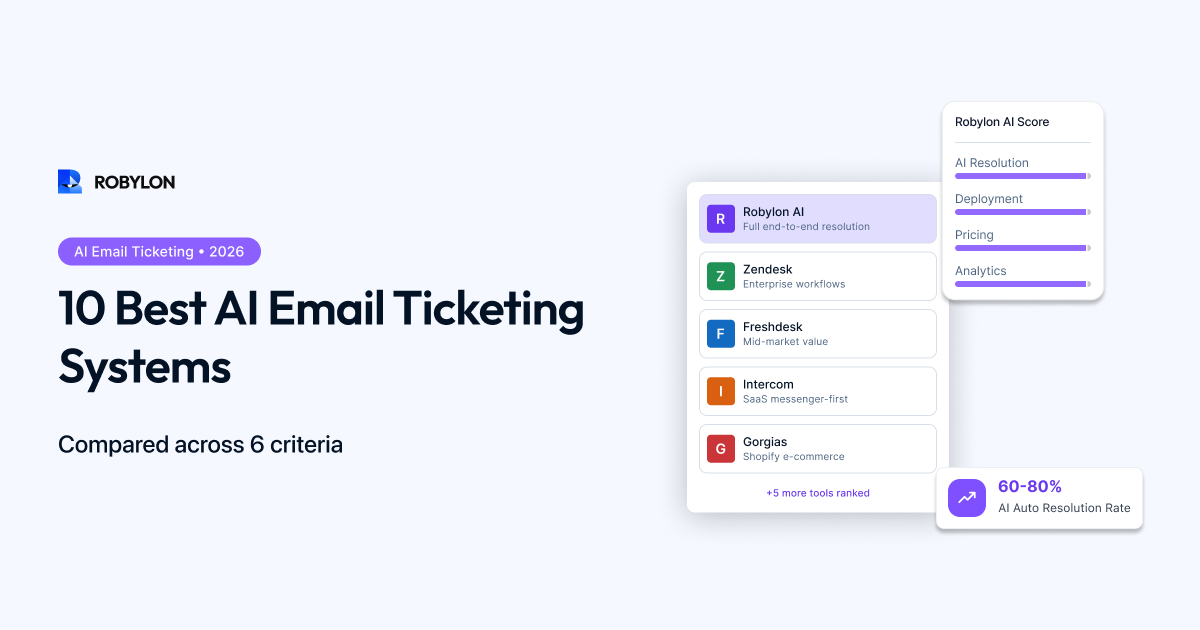
Not all email ticketing systems handle AI equally. This comparison reviews the 10 best platforms for AI-powered email support — from auto-triage to full resolution - with honest assessments of pricing, strengths, and limitations.
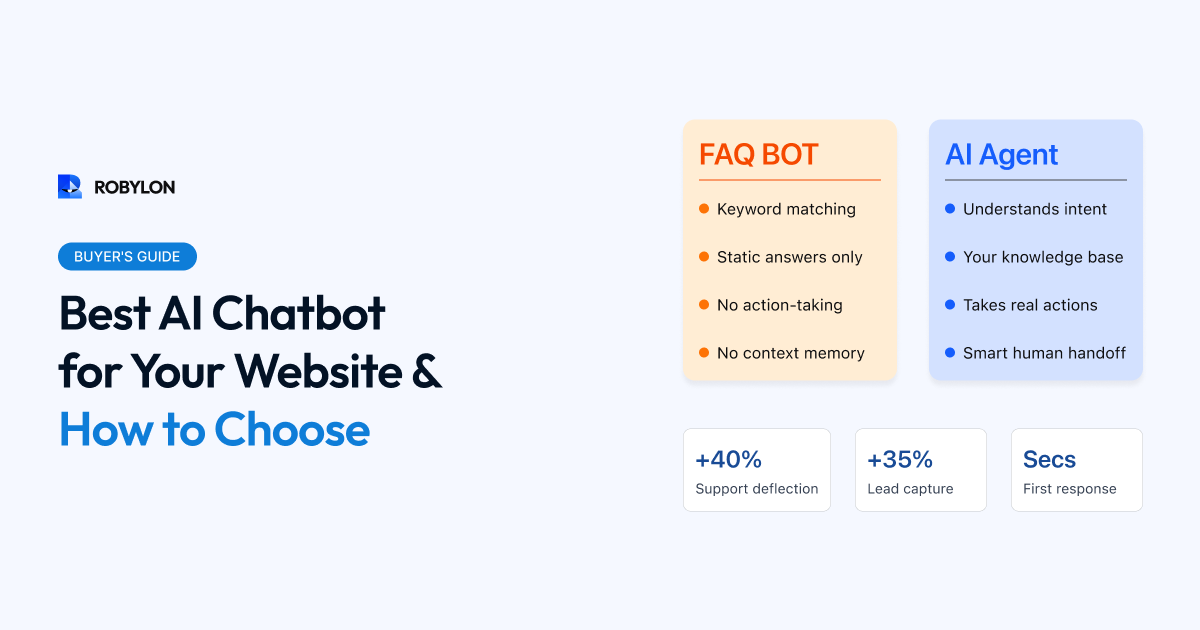
Not all website chatbots are equal. This guide breaks down the 10 features that matter, compares the top platforms, and gives you a decision framework to pick the right AI chatbot for your site.
Black Friday and Cyber Monday can 5–10x your ticket volume overnight. Your AI chatbot needs to be ready. This guide covers the complete preparation playbook — from capacity planning and KB updates to promotional flows and post-sale support scaling.
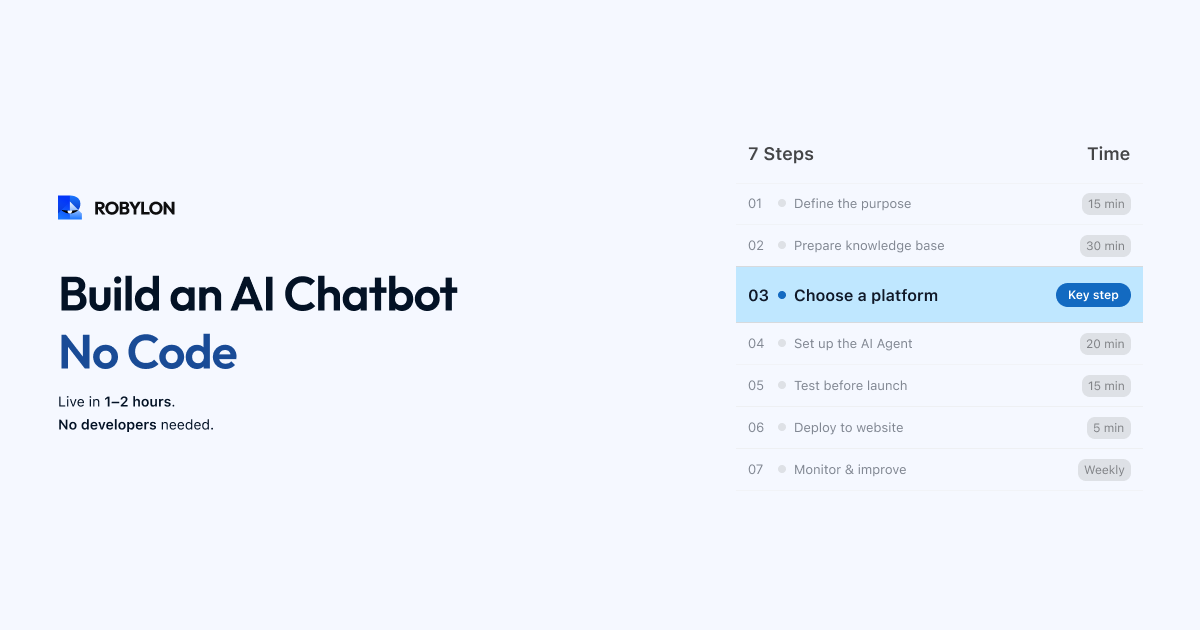
You do not need a developer to build an AI chatbot in 2026. This step-by-step tutorial walks you through planning, training, testing, and deploying a no-code AI chatbot that resolves real customer queries.
RAG (Retrieval-Augmented Generation) is the architecture behind every accurate AI chatbot in 2026. This guide walks through the full pipeline — document processing, embedding, retrieval, generation, and evaluation — with practical advice for building production-ready RAG systems.
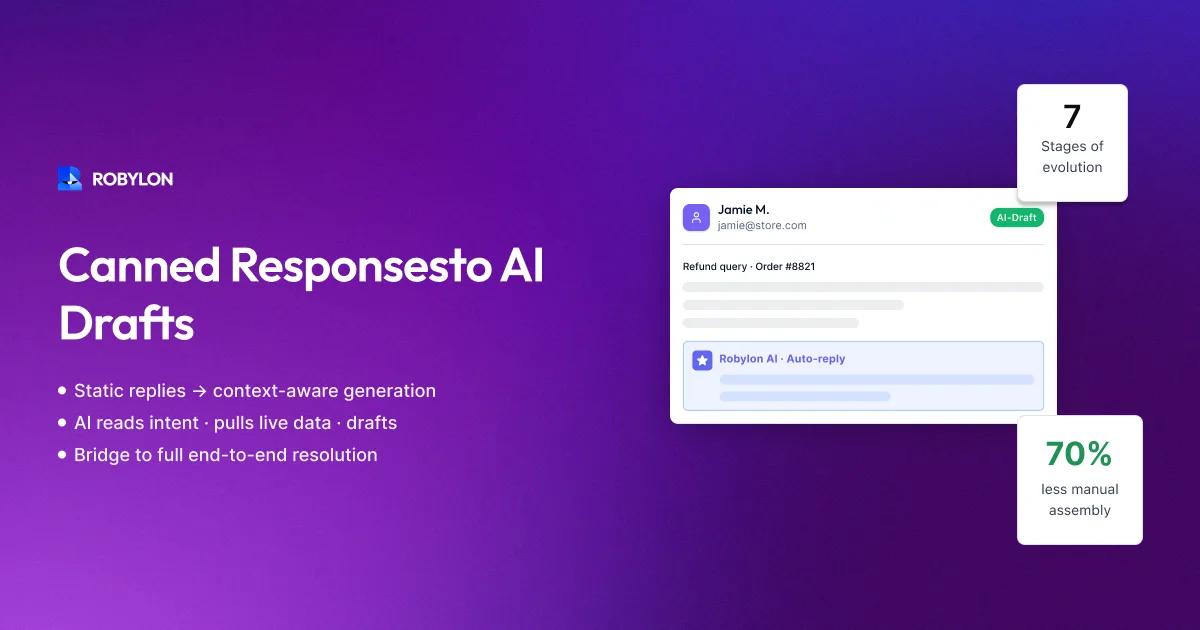
Email support technology has evolved through six distinct stages over two decades — shared inbox, helpdesk with canned responses, rule-based macros, AI triage, AI drafts, and full AI resolution. This narrative traces the evolution, explains why most teams are stuck at stage 3 or 4, and shows what stages 5 and 6 look like in practice.
Deploying a chatbot is the easy part. Knowing whether it is working — and making it better — requires the right analytics. This guide covers the 12 metrics every chatbot team should track, how to build dashboards that surface real insights, and the optimization loop that compounds performance gains.
Small businesses need chatbots that are affordable, easy to set up, and effective without a dedicated IT team. This guide compares the best free and paid chatbot platforms for small teams, with honest assessments of where each one shines and where it falls short.
Chatbots are not just for support — they are conversion machines. This guide covers how marketing teams use AI chatbots to convert website visitors, capture leads, deliver lead magnets, run promotional campaigns, and nurture prospects across chat, WhatsApp, and Instagram.
ChatGPT can help your customer service team — but not in the way most people think. This guide separates the high-value use cases (agent assistance, content creation, training) from the risky ones (direct customer-facing deployment) and shows how to use it effectively.
Freshdesk is the most popular helpdesk for mid-market teams. This guide shows how to layer Robylon AI on top of your existing Freshdesk setup — adding autonomous email resolution while keeping your agents, automations, and reporting exactly where they are.
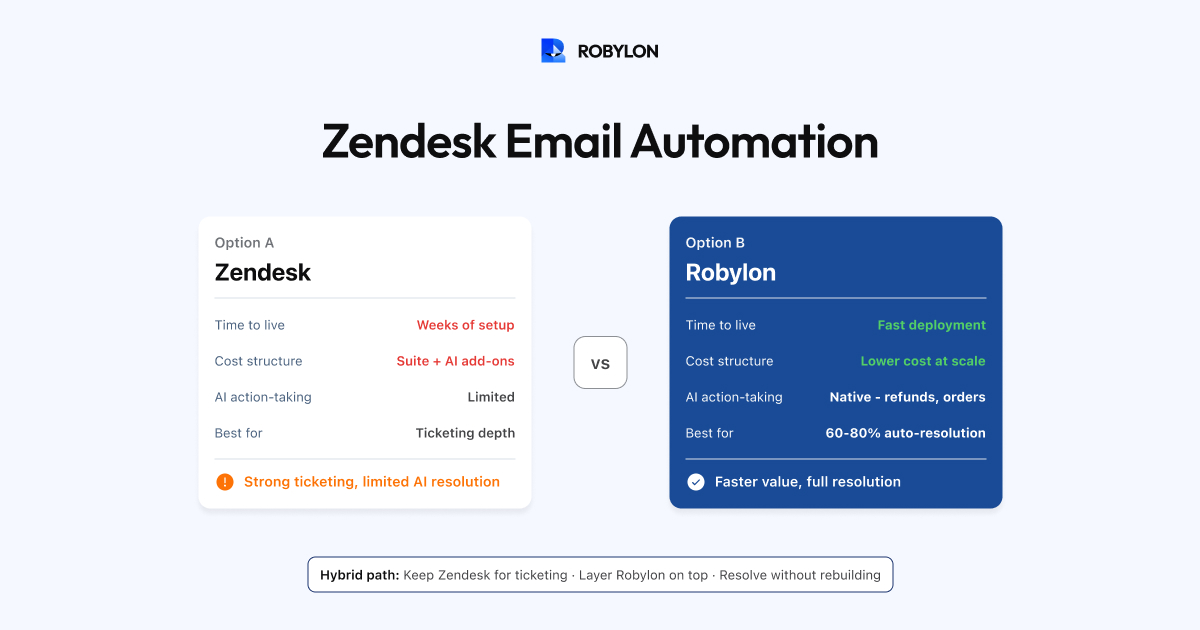
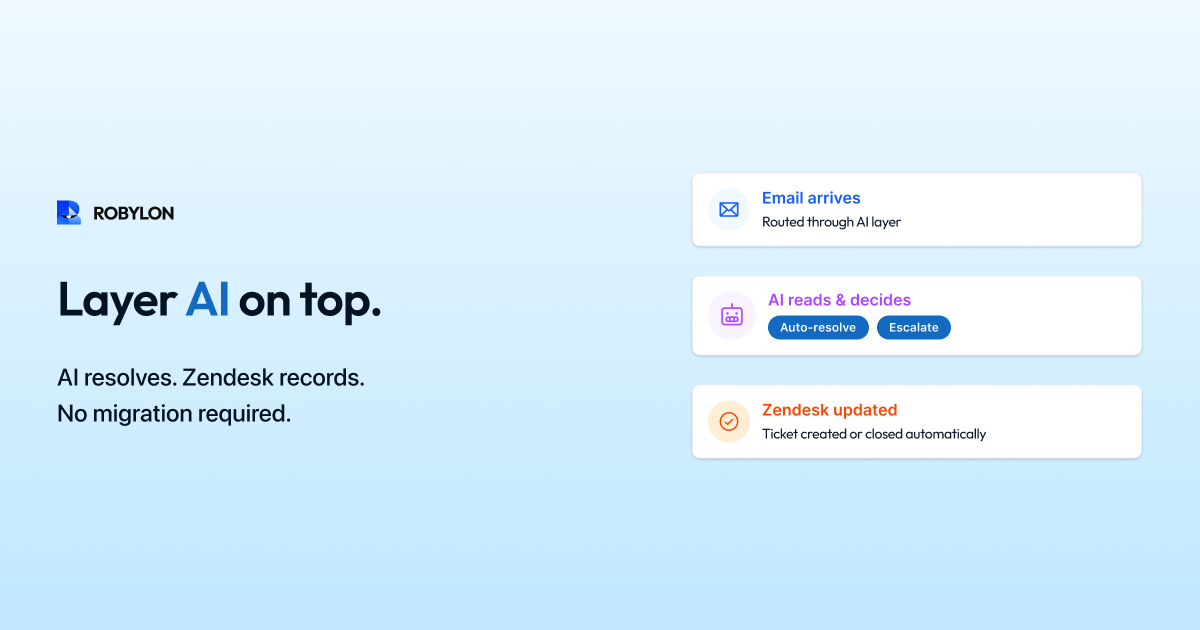
You do not have to leave Zendesk to get AI email resolution. This integration guide shows how Robylon AI layers on top of your existing Zendesk setup — processing incoming emails, resolving 60–80% automatically, and syncing everything back to Zendesk for agent workflows and reporting.
Conversational AI is transforming e-commerce from browse-and-click to ask-and-buy. This guide covers 10 high-impact use cases across the shopping journey, showing how AI conversations drive revenue, reduce costs, and improve customer lifetime value with measurable ROI.
Most support leaders know their total support budget but not their cost per email ticket. This data-rich guide provides fully loaded cost benchmarks by industry, breaks down every cost component, and shows exactly how AI reduces cost per ticket from $5–$20 to $2–$6 — with the math to prove it.
69% of customers prefer self-service — but only 30% succeed. The gap is not customer willingness; it is portal quality. This guide covers how to build an AI-powered self-service portal that resolves issues, not just deflects them — combining smart knowledge bases, AI search, and transactional self-service.
Customer service automation has moved far beyond canned responses and basic chatbots. This guide covers the full automation stack — AI chatbots, email AI, voice agents, self-service portals, and workflow automation — with a practical framework for deploying each layer.
The metrics that defined great customer service in 2020 are incomplete in 2026. AI automation, omnichannel support, and proactive service have introduced new KPIs while reshaping old ones. This guide covers the 15 metrics every support leader should track today.
Seeing is believing. This guide showcases 15 real-world customer support chatbot use cases across industries — showing exactly how the chatbot handles each scenario, what data it needs, and what results to expect. Use these examples to design your own chatbot workflows.
Digital customer service is not just "support on digital channels." It is a strategic framework that combines AI automation, self-service, omnichannel orchestration, and proactive engagement to deliver faster, cheaper, and better customer experiences. This guide covers the complete strategy.
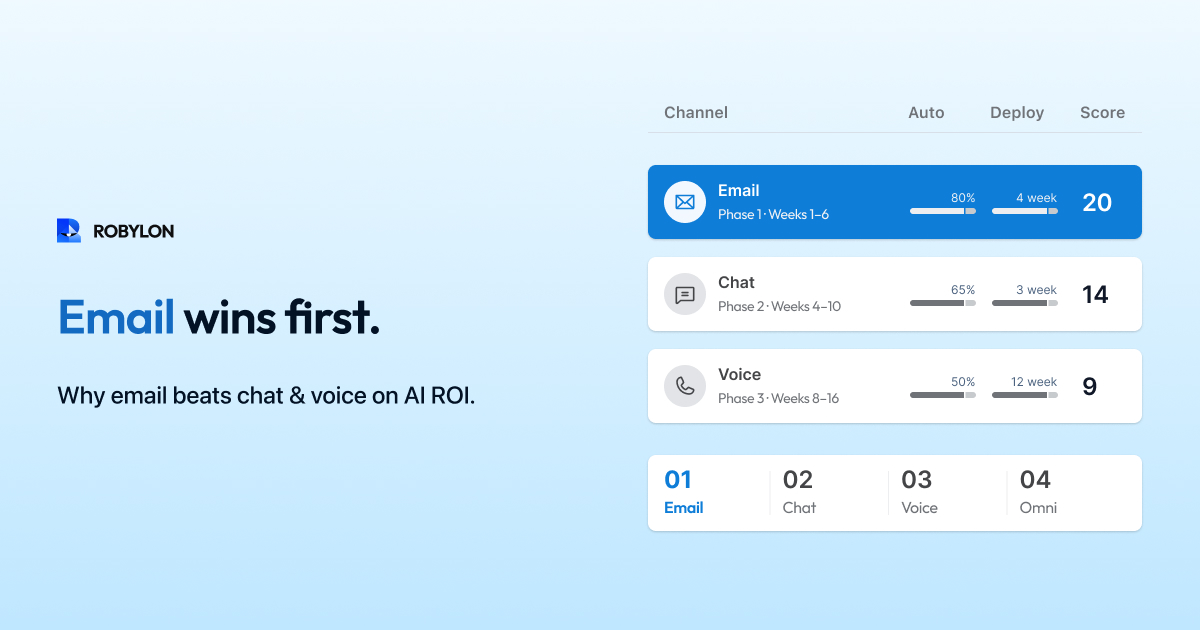
The conventional wisdom is to start AI automation with chat. The data says otherwise. Email has no real-time pressure, higher volume, greater customer tolerance for AI, richer context per message, and better economics. This article makes the contrarian, data-backed case for automating email first — and why Robylon AI is built on this principle.
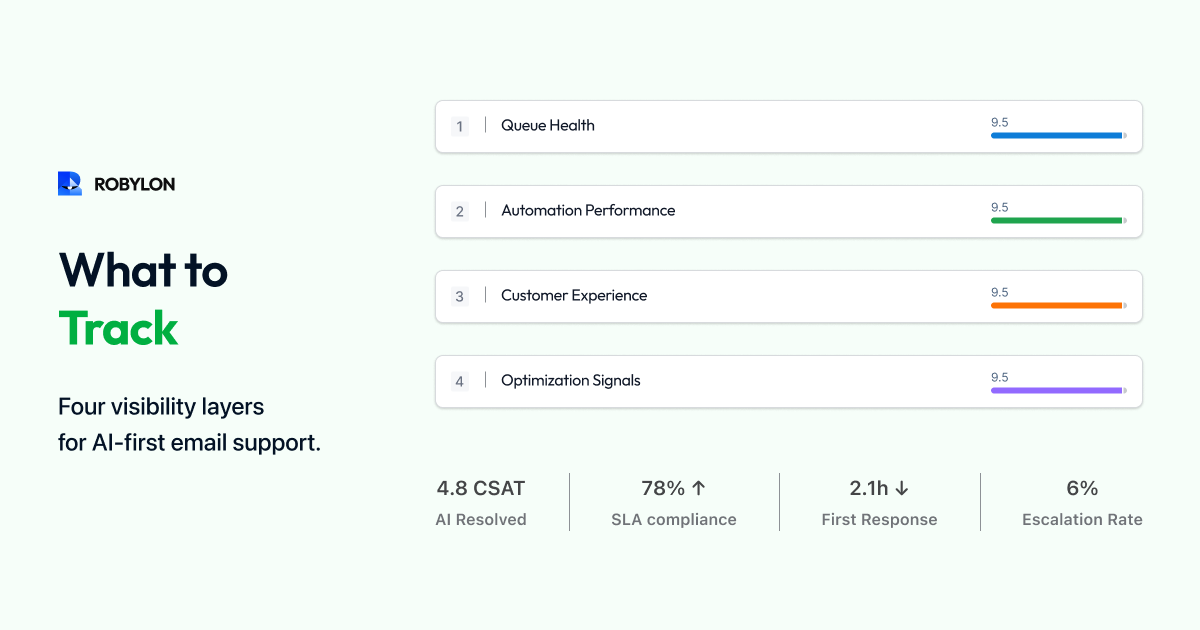
Most email support dashboards show basic metrics (volume, FRT, CSAT) that describe what happened but do not tell you what to do about it. This guide shows you how to build a modern email analytics dashboard with AI-powered metrics that drive weekly optimization decisions.
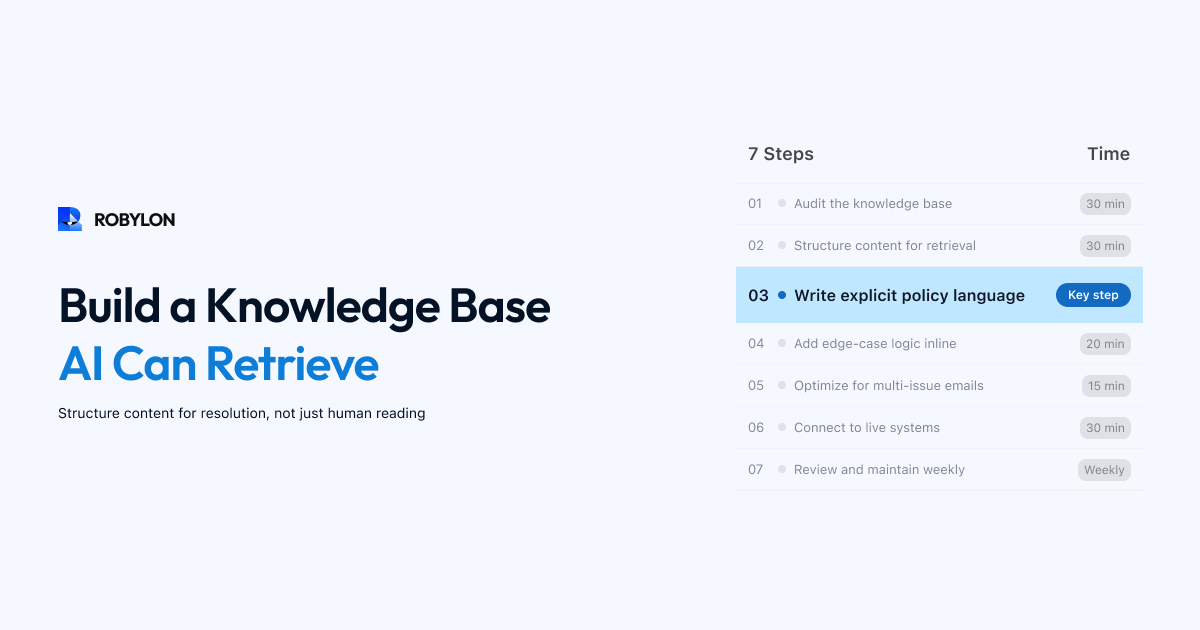
The #1 determinant of AI email accuracy is not the model — it is the knowledge base. This guide shows how to structure articles for optimal AI retrieval, write conditional policies the AI can interpret correctly, organize content for multi-issue emails, and maintain the KB for continuous improvement.
Most teams track generic customer service metrics and apply them to email. That is a mistake. Email has its own dynamics — different expectations, different volumes, different cost structures. This guide defines the 8 metrics every email support leader should track in 2026, provides industry benchmarks, and shows how AI changes the targets for each one.
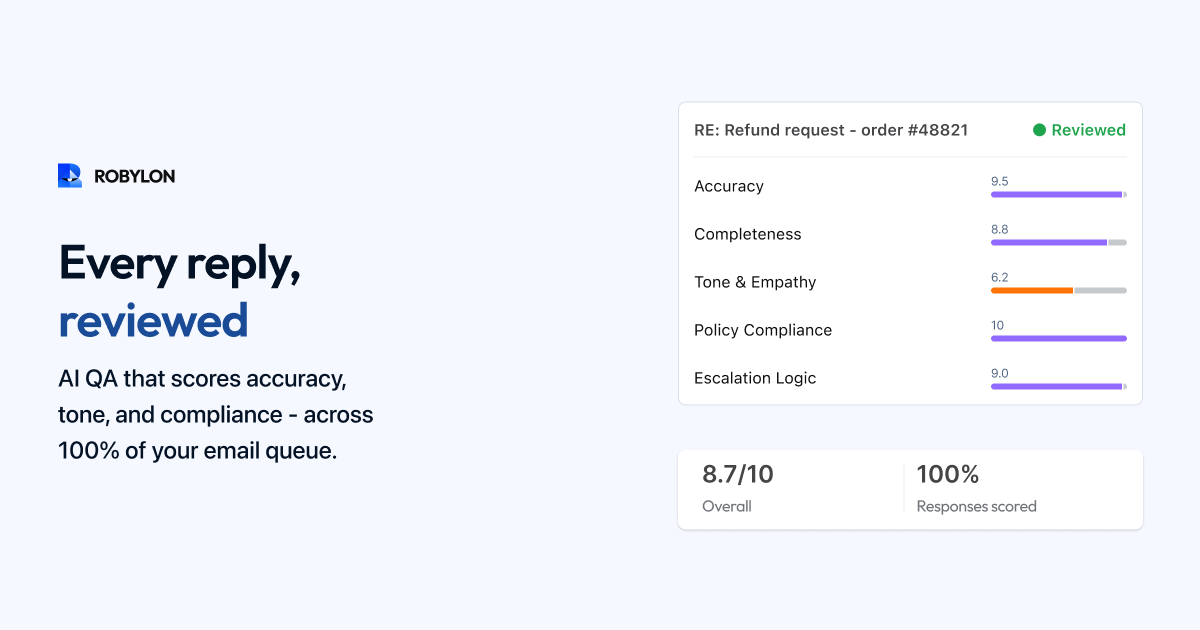
Traditional email QA is manual, sampling-based, and lagging — reviewing 5–10% of responses days after they were sent. AI-powered QA scores every single email response in real-time across accuracy, tone, compliance, and completeness, catching issues before they reach customers and providing continuous coaching data for agents.
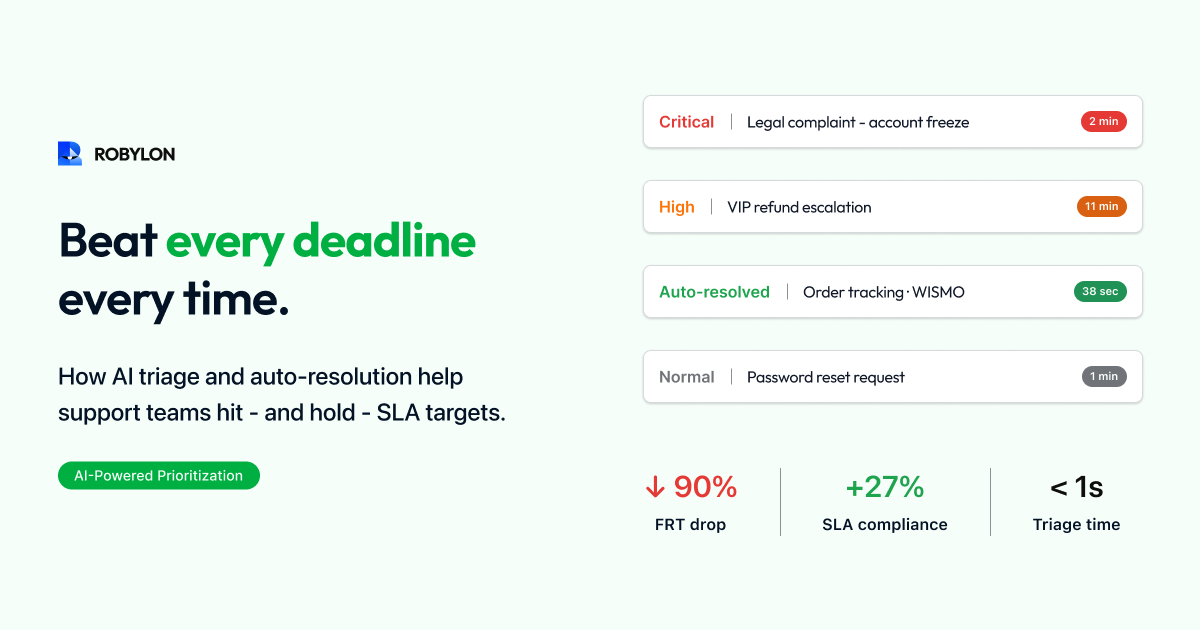
SLA breaches are the most visible failure in email support — and the hardest to fix with humans alone. This guide covers how to set realistic email SLAs, the specific ways AI helps you meet them, and how to move from "managing SLAs" to "guaranteeing SLAs" with intelligent automation.
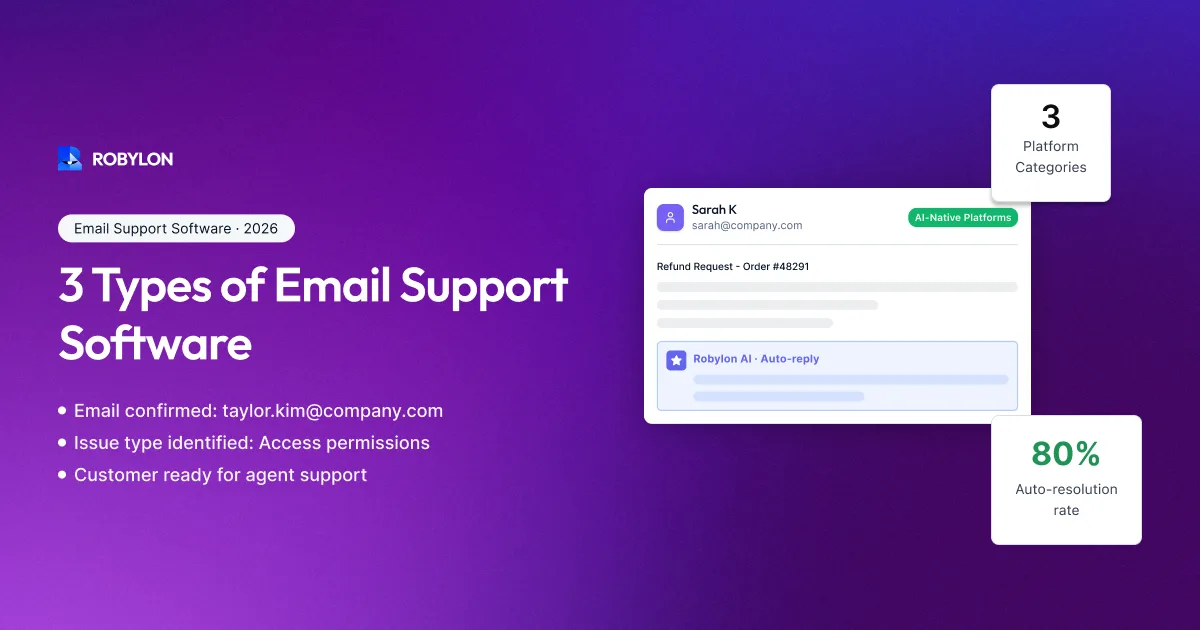
The email support software market has split into three categories: legacy helpdesks adding AI, AI-native platforms, and AI layers that sit on top of your existing tools. This guide explains the differences and helps you pick the right approach.
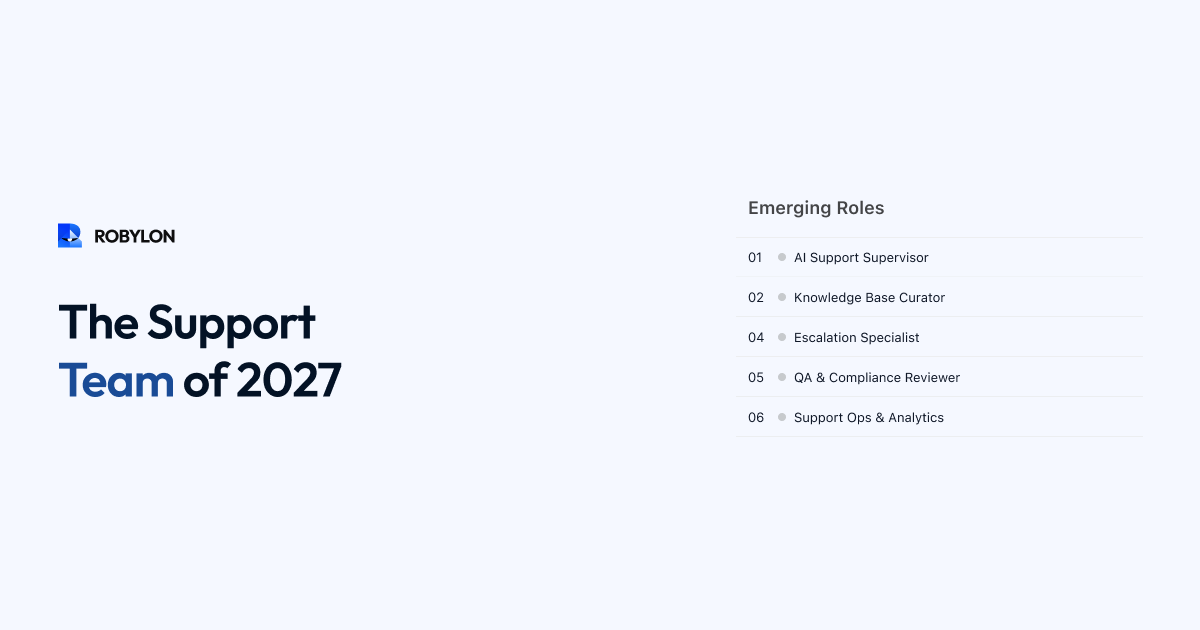
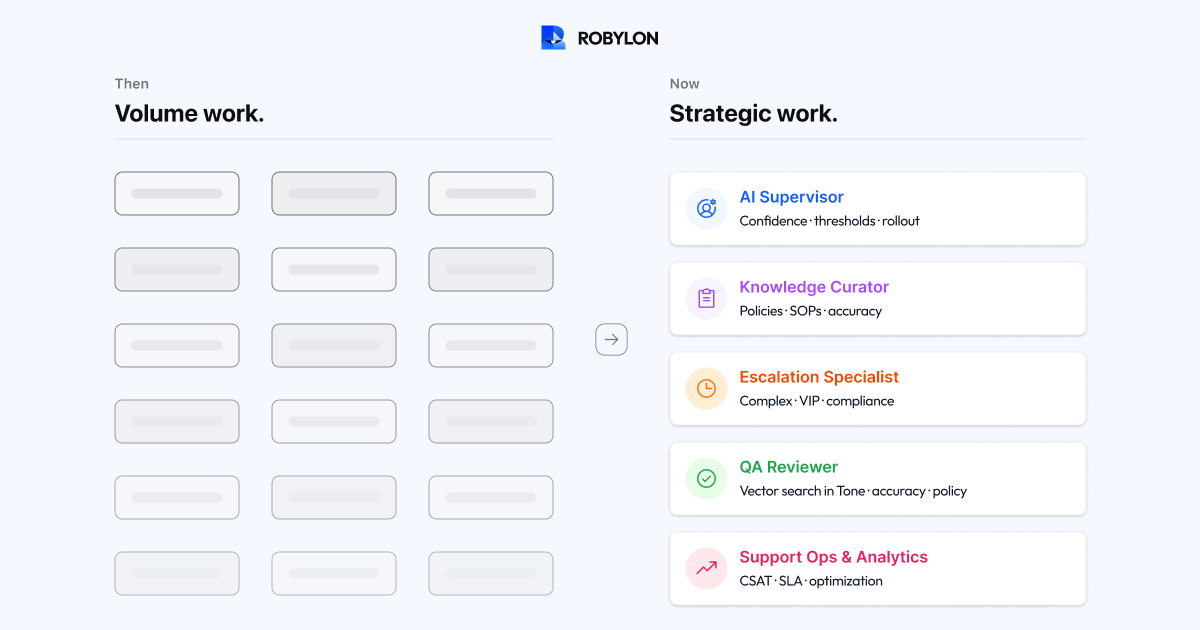
As AI takes over repetitive email resolution, the support team does not disappear — it evolves. This forward-looking piece maps the emerging roles (AI Supervisor, KB Curator, Escalation Specialist), the skills that become essential, and the team structure that maximizes the human-AI combination.
A customer replies 5 times to the same email thread, each time adding new information or asking new questions. How does the AI keep track? This deep dive covers email threading, context maintenance, state tracking across long conversations, and the technical challenges that make email context harder than chat context.
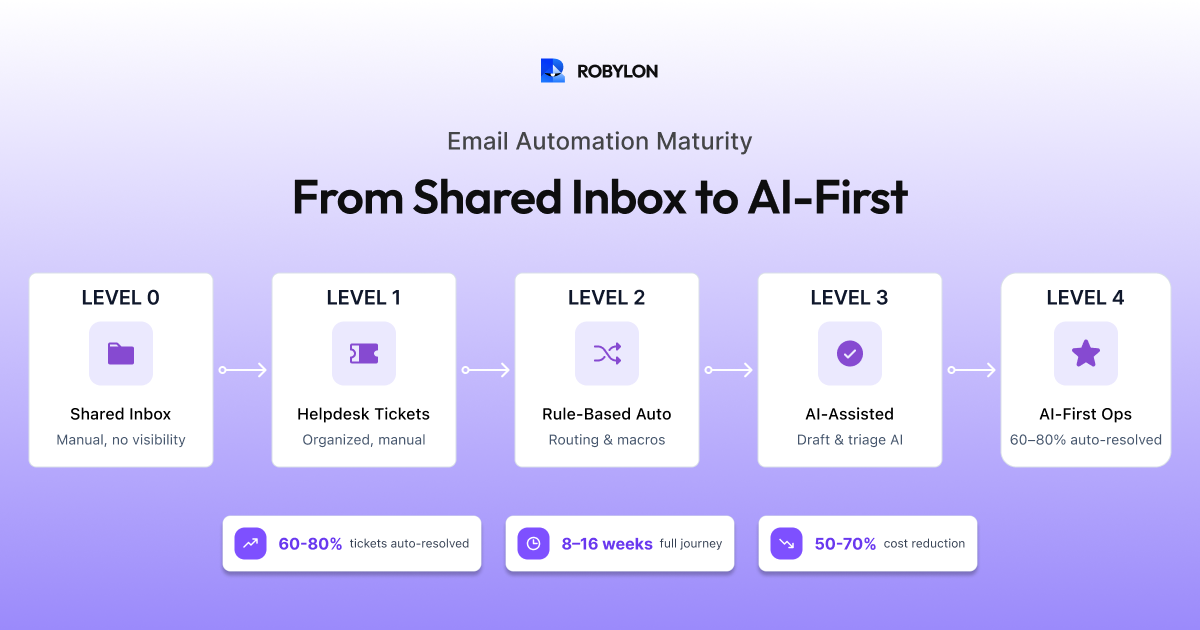
Most teams automate email in fragments - a rule here, a macro there. This guide presents the complete maturity framework from Level 0 (shared inbox chaos) to Level 4 (AI-first operations), with a practical migration plan for each stage.
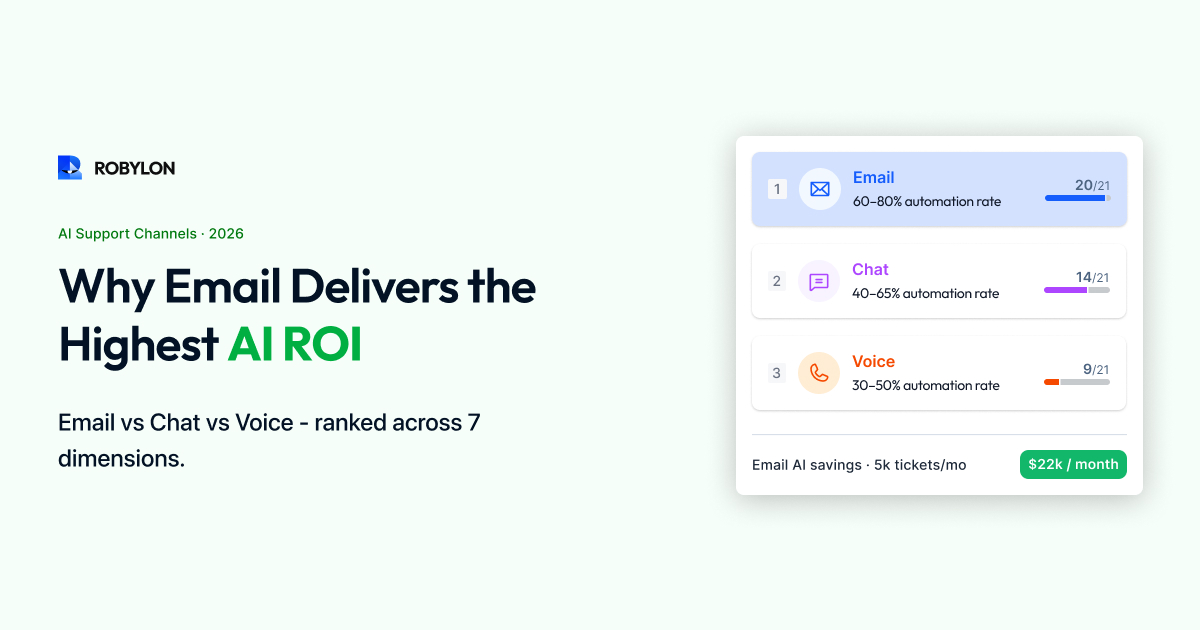
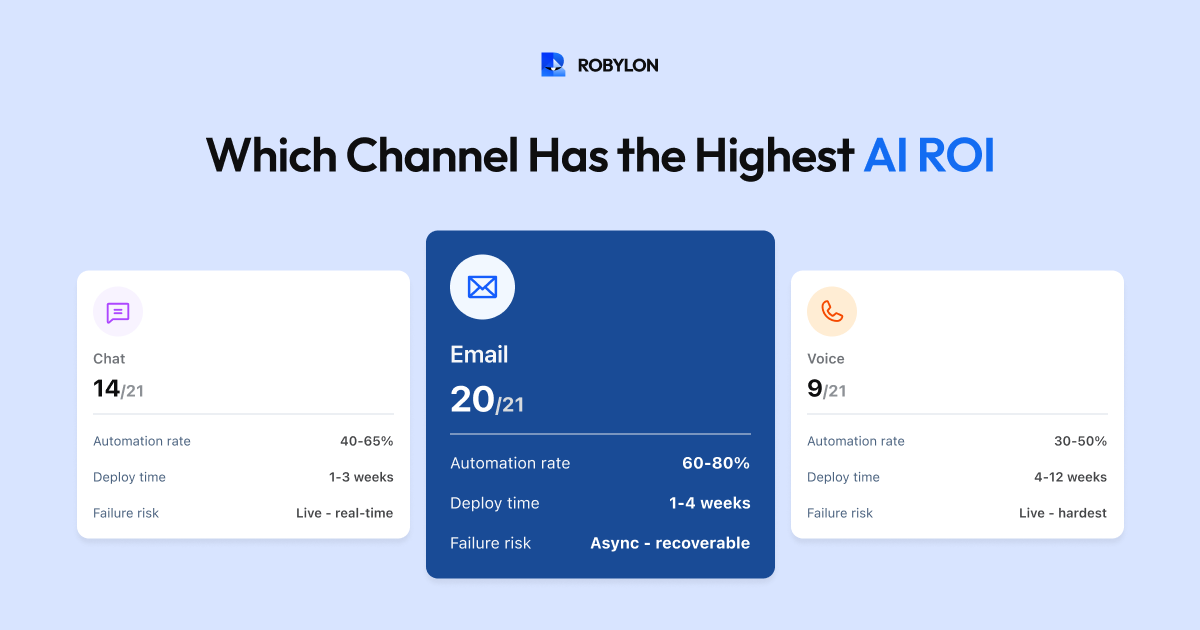
Every support leader wants to deploy AI but has to choose where to start. This analysis compares email, chat, and voice across 7 dimensions - cost, automation rate, speed to deploy, risk, volume, customer tolerance, and learning potential - to show why email delivers the highest ROI fastest.
Enterprise AI chatbot deployments face requirements that SMB tools cannot meet — SOC 2 compliance, data residency, SSO integration, role-based access, and SLA guarantees. This guide covers the security, compliance, and deployment considerations every enterprise buyer should evaluate.
Facebook Messenger has 1 billion+ monthly users and remains a key customer communication channel. This guide covers how to set up a Messenger chatbot for lead capture, support automation, and e-commerce — with platform comparisons and step-by-step setup instructions.
Most FAQ chatbots frustrate more than they help. This guide shows you how to build one that actually resolves questions — covering content structure, AI setup, fallback handling, multi-language support, and the optimization loop that keeps accuracy climbing.
Nine alternatives to Freshdesk and Freddy AI, compared on seat price, channels, what the AI agent does and how it bills, with prices checked in October 2026.
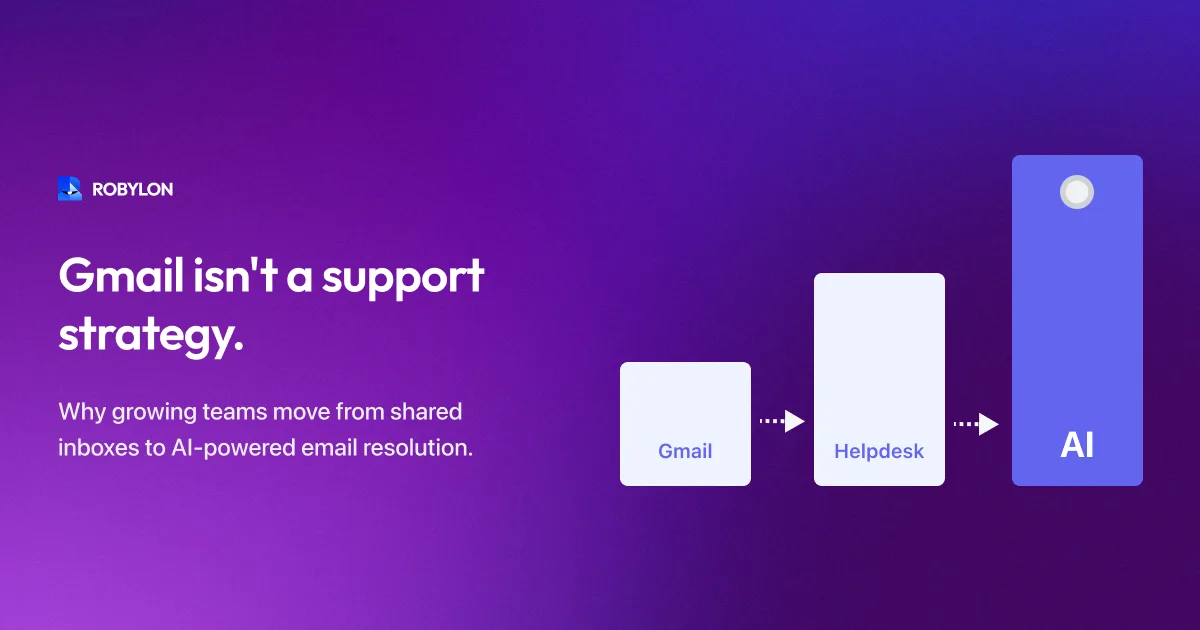
Thousands of support teams run customer service through a shared Gmail inbox. It works — until it doesn't. This guide covers the exact limitations that break Gmail-based ticketing, the tools teams typically move to, and why in 2026 the smartest upgrade path skips the traditional helpdesk and goes straight to an AI email agent.
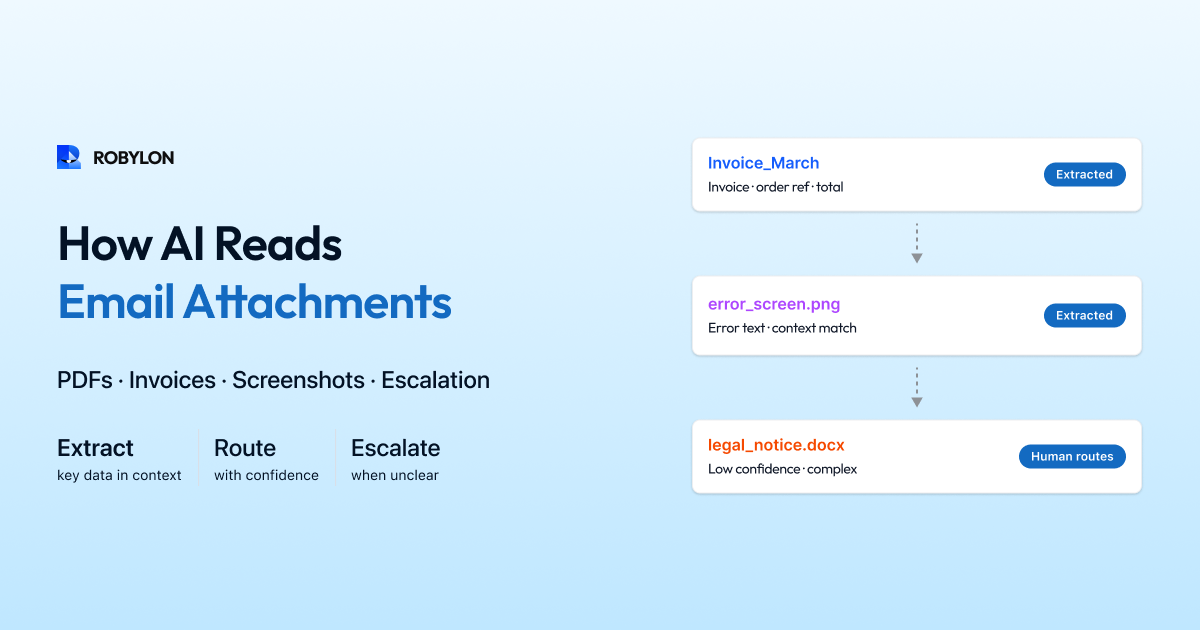
Customers don't just write support emails — they attach evidence. Screenshots of error messages, PDFs of invoices, photos of damaged products. This deep dive covers how AI processes email attachments, extracts actionable information, and uses it to resolve tickets — a capability most AI platforms lack entirely.
Nine alternatives to Help Scout, compared on seat price, the AI agent each includes, channels and billing, with the options for keeping Help Scout and adding an AI agent.
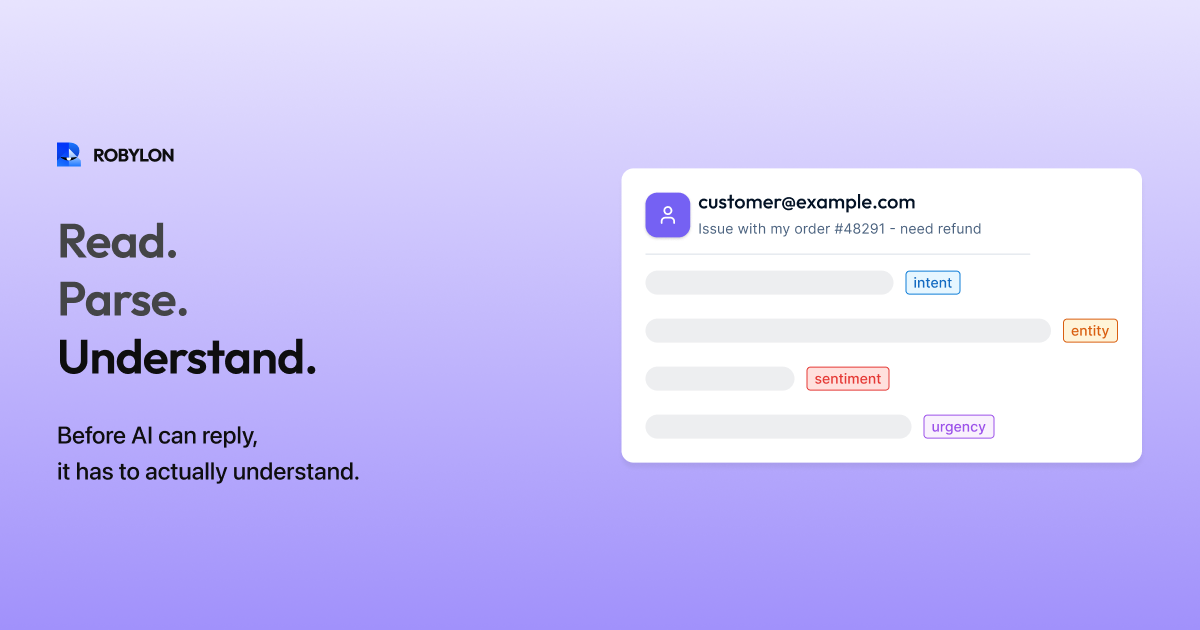
AI email support is not magic — it is a series of well-defined NLP steps that turn unstructured customer emails into structured, actionable data. This educational guide explains each step of the pipeline, from raw email parsing through intent detection, entity extraction, sentiment analysis, and response generation.
Eight alternatives to HubSpot's chatflows and its Customer Agent for teams that keep HubSpot as their CRM, compared on what each AI can do, channels, how each connects to HubSpot and how each one bills, with prices checked in October 2026.
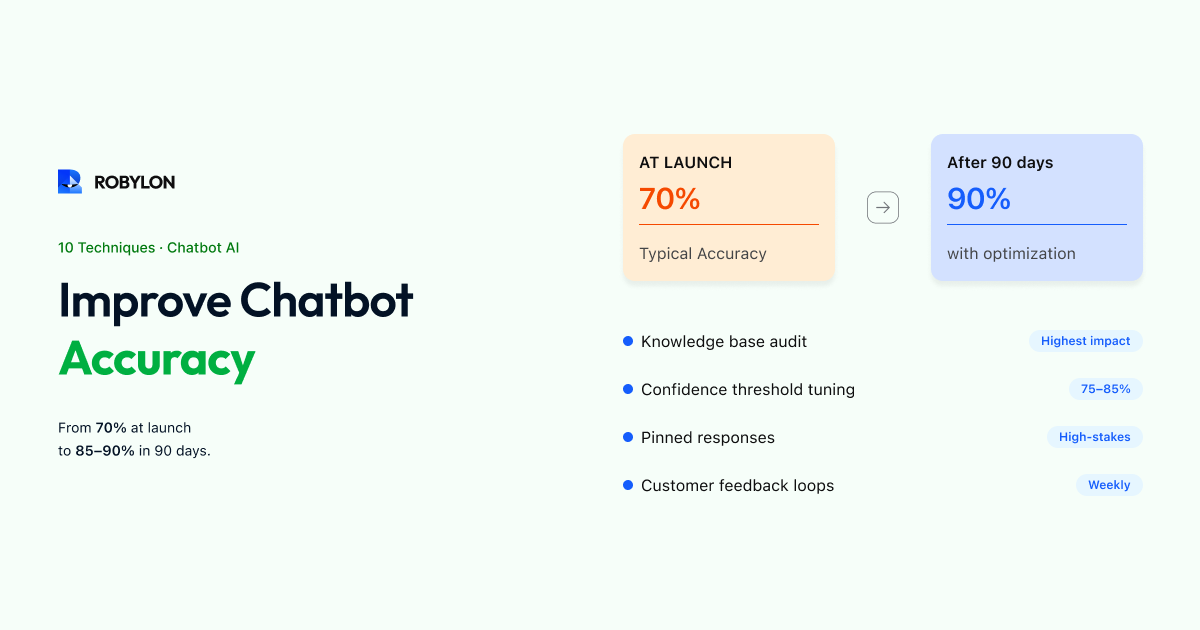
An inaccurate chatbot is worse than no chatbot at all. This guide covers 10 actionable techniques to improve your AI chatbot's accuracy — with practical examples you can implement this week.
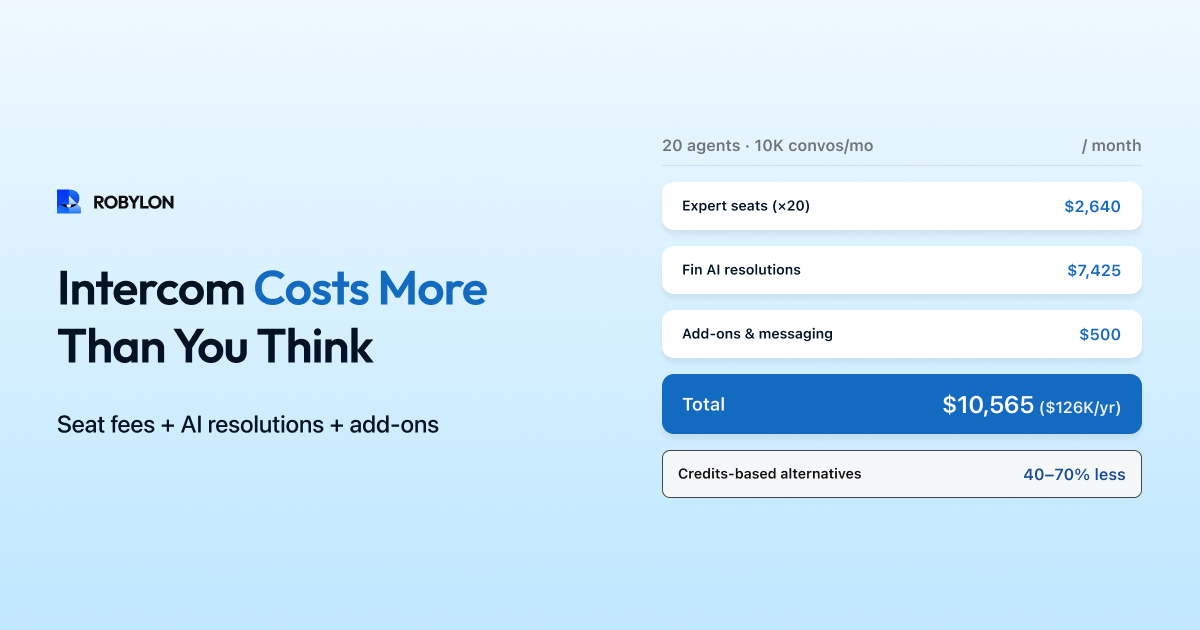
Intercom's pricing looks simple on the surface but gets complex fast. This guide breaks down every plan, the real cost of Fin AI per resolution, and where the bill surprises you — plus alternatives that cost 40–70% less.
Enterprise support teams often start with an Outlook shared mailbox because IT already manages Microsoft 365. It works at low volume — then breaks in predictable, painful ways. This guide covers the 9 specific failures, compares the upgrade options, and shows why AI-powered email support is the right next step in 2026.
When an AI chatbot invents a refund policy that does not exist or gives a customer the wrong order status, trust evaporates. This guide covers 10 proven techniques to prevent hallucinations in customer support AI — so your bot stays accurate, grounded, and trustworthy.
Reactive support waits for customers to complain. Proactive support uses AI to predict problems, notify customers before they escalate, and prevent tickets from being created. This guide covers the strategies, data signals, and tools that make proactive service possible.
Should you use RAG or fine-tune an LLM for your customer support chatbot? This guide provides a practical decision framework — covering how each approach works, where each excels, and why most support teams should start with RAG and add fine-tuning only when specific needs demand it.
Support costs scale linearly with volume — unless you deploy AI. This guide provides a data-backed framework for reducing support costs by 50%: identifying your cost drivers, calculating AI ROI, deploying automation in phases, and measuring savings without sacrificing customer satisfaction.
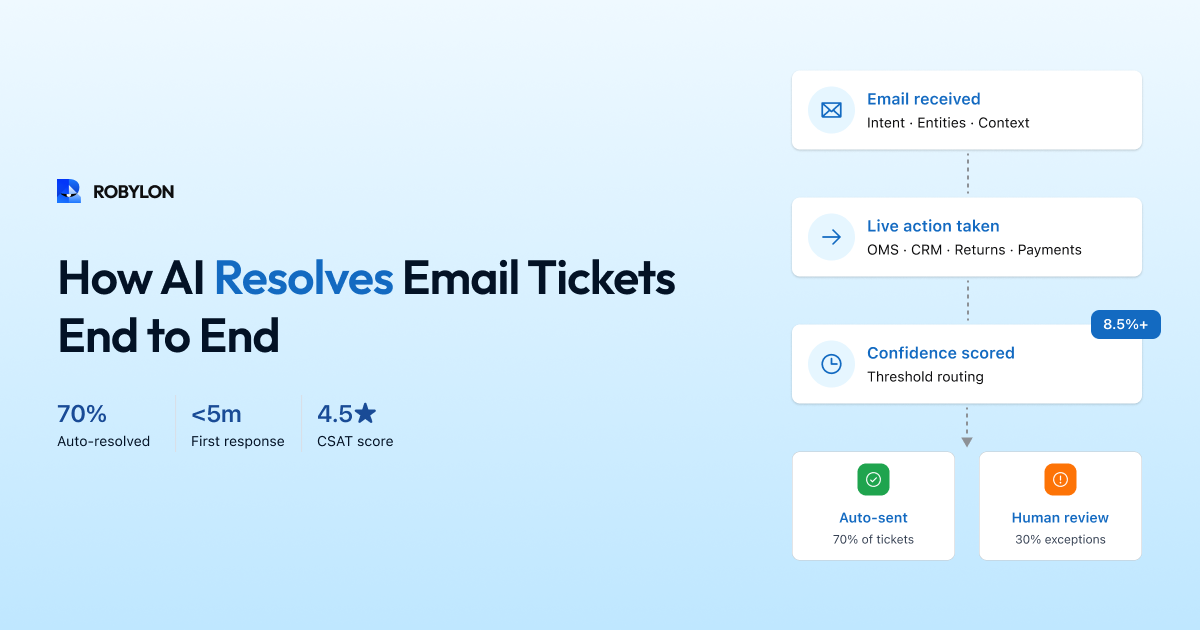
Most AI email tools stop at drafting responses. Robylon goes further - it reads, understands, takes action, and resolves email tickets end-to-end. This article shows exactly how it works, step by step, with real examples.
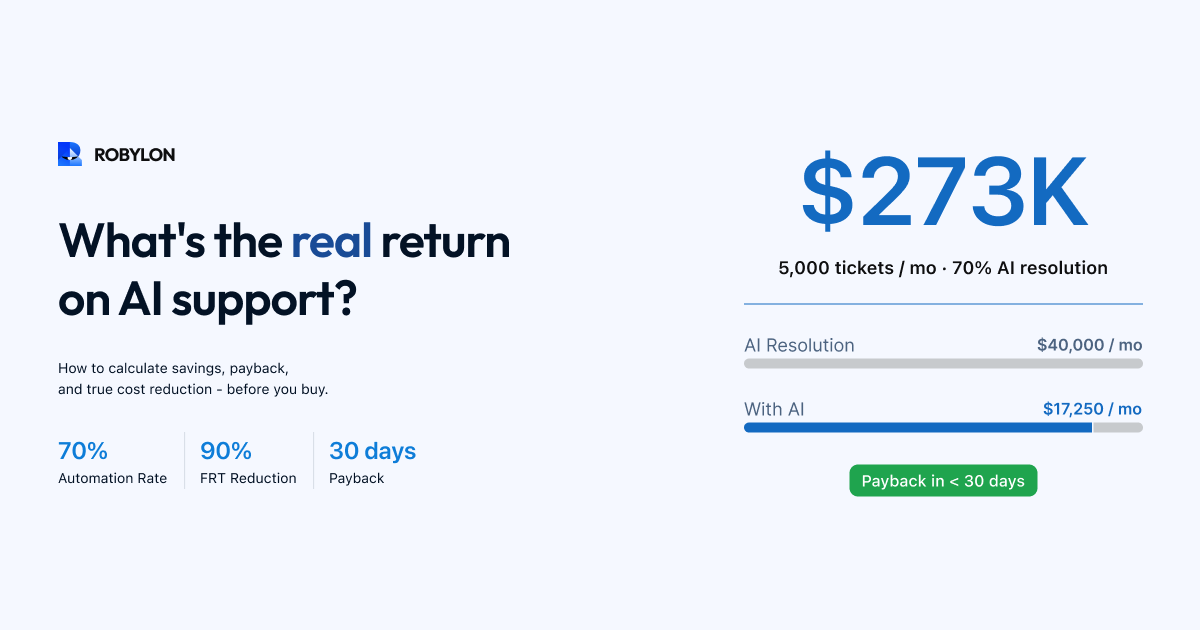
The CFO does not care about auto-resolution rates or NLP accuracy — they care about cost savings, break-even timelines, and whether the investment produces a return. This guide provides the exact math to calculate AI email support ROI, with real numbers across e-commerce, SaaS, and fintech use cases.
Salesforce's native AI (Einstein Bots, Agentforce) offers chatbot capabilities within the ecosystem, but limitations in autonomous resolution and cost push many teams to explore alternatives. This guide covers all your options for adding AI to Salesforce.
Auto-responding to support emails with AI is powerful — but getting it wrong erodes customer trust faster than getting it right builds it. This practical guide covers when to auto-respond immediately versus acknowledge and queue, confidence threshold calibration, tone engineering, and handling opt-out requests.
Shopify stores lose revenue to slow support and abandoned carts every day. This guide shows you how to deploy an AI chatbot that handles WISMO, returns, product discovery, and checkout nudges - with step-by-step Shopify installation.
Eight alternatives to Tidio and its Lyro AI agent, compared on what each AI can do, which channels it covers, free plans and how each one bills, with prices checked in October 2026.
Conversational AI powers the chatbots, voice agents, and virtual assistants that handle billions of customer interactions every day. This comprehensive guide explains how it works, what distinguishes it from basic chatbots, where it delivers the most value, and how to evaluate platforms for your business.
WhatsApp has 2 billion+ users and the highest open rates of any messaging channel. This complete guide covers how to build, deploy, and scale an AI-powered WhatsApp chatbot for customer support, sales, and engagement.
WordPress powers 40%+ of all websites — and most of them have no intelligent chat support. This guide compares the best AI chatbot options for WordPress sites, from native plugins to platform-based solutions, with setup instructions and honest feature assessments.
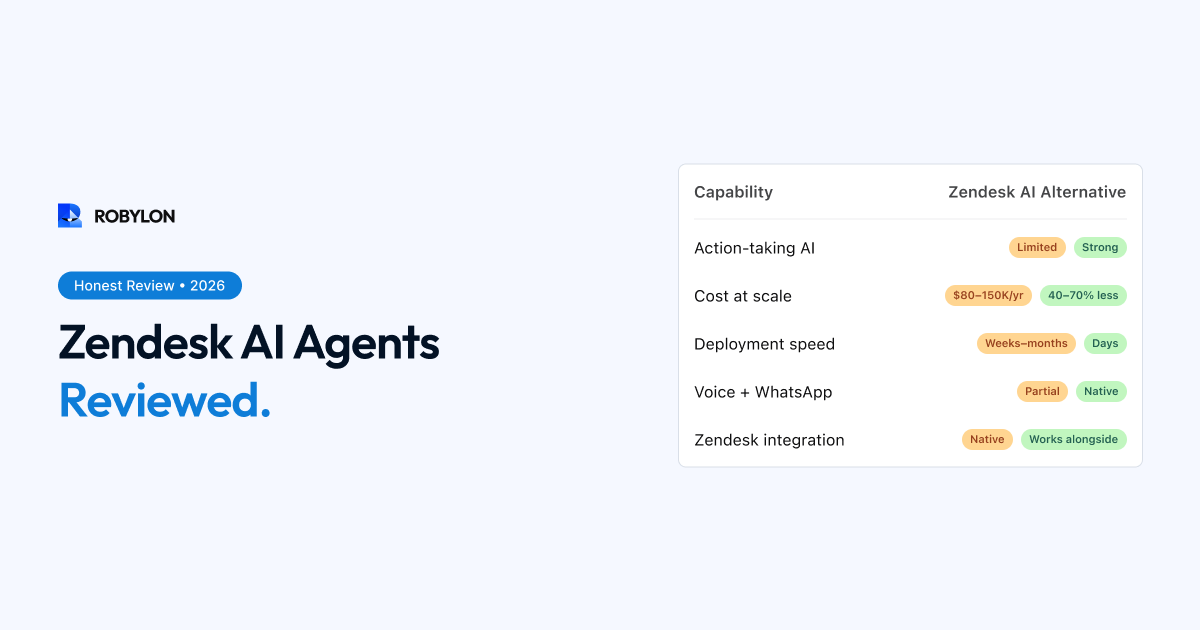
Zendesk AI Agents promise automated resolutions inside your existing Zendesk setup. This review covers what they actually deliver — the strengths, the limitations, the real cost — and compares them to purpose-built AI alternatives.
Already on Zendesk but want AI chatbot capabilities? This guide covers three paths: Zendesk's native AI agents, marketplace chatbot apps, and the overlay approach with platforms like Robylon. We compare setup complexity, automation depth, and cost for each.
Zendesk pricing is complex and gets expensive fast. This guide breaks down every plan, add-on, and hidden cost so you can calculate your real total — and shows where AI-native alternatives deliver better unit economics.
Discover the best AI customer service chatbots for 2025. Compare top platforms like Robylon, Zendesk, Intercom, and more to automate support, cut costs, and deliver 24/7 customer experiences.
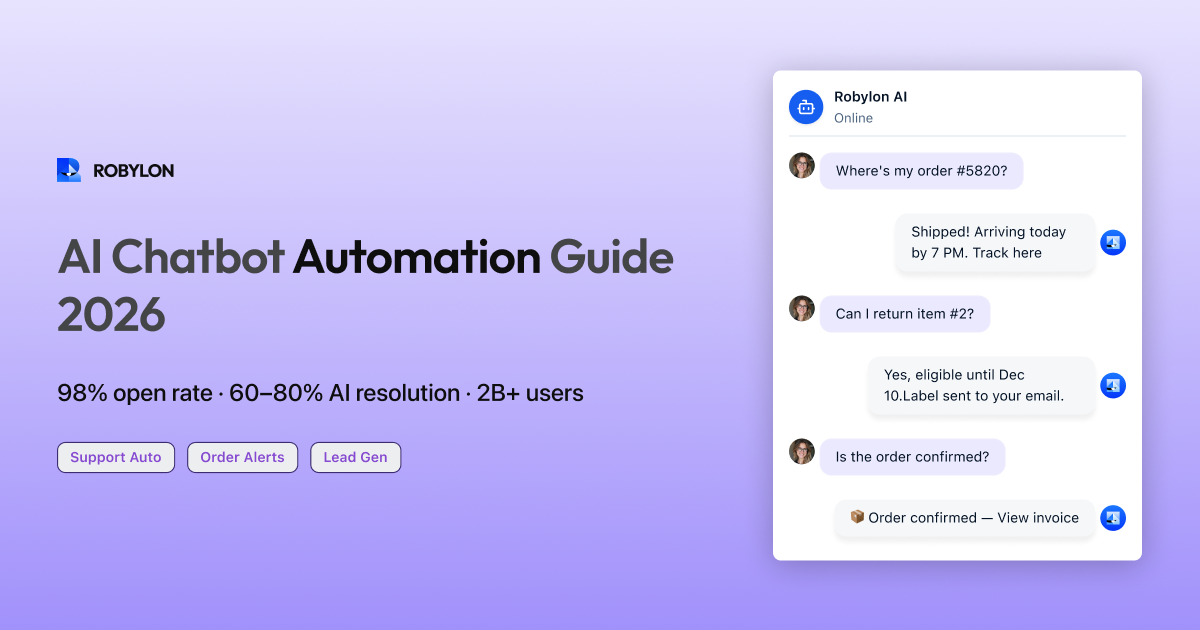
See the top AI chatbot use cases and examples in 2026, support, sales, marketing, IT, and more, with real examples, ROI metrics, and tips to deploy fast.
Discover why traditional businesses must adopt AI in 2026. Learn about proven AI use cases, measurable ROI, and strategies for modernisation and automation.
Robylon automates Tier 1 customer support tickets by accurately detecting intent, resolving common issues using live data and workflows, escalating low-confidence cases to humans, and operating directly inside existing helpdesk tools with full auditability and brand control.
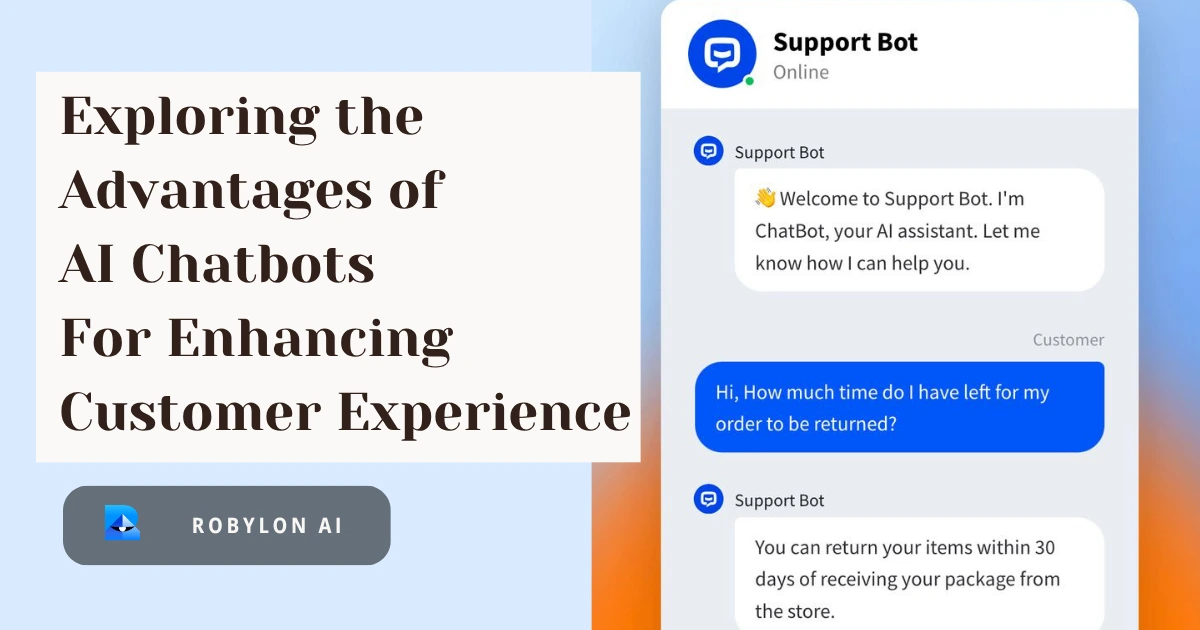
Explore how AI chatbots enhance customer experience with 24/7 support, automation, and personalization. Learn key benefits and real-world use cases in 2026.
Seven alternatives to Chatbase for teams that need more from an AI agent trained on their own content: actions in other systems, a human inbox, more channels or more predictable billing, with prices checked in October 2026.
Understand the real difference between AI agents and chatbots including how they work, when to use them, and why AI agents deliver smarter, scalable automation.
Learn how AI escalation works; sentiment triggers, intent scoring, fallback rules and how Robylon’s agentic AI hands off with full context across chat, email, and voice to boost CSAT and FCR.
AI chatbots automate support, boost CX, and handle complex tasks using NLP, ML, and generative AI reshaping how businesses engage and scale.
Discover the best AI voice agents for customer support in 2026. Compare Robylon - built specifically for support - with top platforms like Lindy, Retell AI, Synthflow, Cognigy, Ask JADA, and Aircall.
Ten alternatives to LiveChat, now sold as Text, compared on what each AI agent can do, which channels it covers, free plans and how each one bills, with prices checked in October 2026.
Learn what good customer service is, its qualities, skills, examples, and KPIs, plus steps to deliver it consistently and boost retention.
Nine alternatives to Yellow.ai, compared on what each AI agent can do, which channels and languages it covers, where it runs and how you buy it, with prices checked in October 2026.
Top 11 customer service trends for 2026: from AI copilots to autonomous agents, voice AI, omnichannel, GenAI, and human+AI partnerships.
2026 chatbot idea bank: 15+ AI chatbot plays for sales, support, HR, and ecommerce, WhatsApp automation, voice/multimodal bots, KPIs, and AI tactics to drive ROI.
A practical comparison of AI platforms that can fully resolve customer support tickets end to end. Covers real automation, system access, confidence controls, escalation, and when humans still matter.
From lightweight tools for startups to advanced systems with AI and automation, explore the top free and freemium help desk software of 2026.
See 2026’s biggest chatbot shifts: human-like voice, agentic automation, multimodal UX, first-party data personalisation, practical tips and KPIs included.
Explore the 6 best AI chatbots for banks and financial services in 2026. Compare compliance controls, fraud safeguards, step-up authentication, audit logging, and high-volume automation performance.
Compare the best AI chatbots for health and fitness brands, including Robylon, Pylon, Forethought, Kaily, and Keepme. Explore automation rates, guardrails, compliance (HIPAA, SOC 2), omnichannel support, and real performance metrics to choose the right platform for safe, high-conversion member support.
Compare 2026’s best AI sales agents: Robylon, Regie.ai, Artisan, Microsoft Sales Copilot, and HubSpot to automate outreach, qualify leads, and grow pipeline.
Nine alternatives to Botpress, from visual builders and developer frameworks to enterprise platforms and finished AI support products, compared on what each AI can do, channels, human handover and how each bills, with prices checked in October 2026.
Eight alternatives to Drift, which Salesloft is sunsetting, split by the two jobs Drift did: turning website visitors into pipeline and answering customers on the website. Status, prices and ratings checked in October 2026.
Explore what makes AI chatbots sound human from NLP and LLMs to tone design and empathy. Learn how businesses build realistic, natural language chatbot experiences.
Eight alternatives to the Intercom helpdesk, compared on seat price, channels, the AI agent each includes and where it runs, with prices checked in October 2026.
Choosing between rule-based chatbots and AI chatbots? Get the definition, main limitation, pros/cons, and when a hybrid chatbot wins with a use-case guide.
See the top 10 AI customer service tools of 2026. Compare features, pricing, and use cases to cut resolution time, deflect tickets, and deliver 24/7 support.
Discover how AI is revolutionizing call centers with intelligent automation, voice bots, and real-time customer support.
Choosing the best AI chatbot 2026? We compare LLM integrations, safety/policy controls, pricing, and UX so you can pick the most intelligent chatbot for support, research, or automation.
The 11 best SaaS support tools for 2026, ranked with real pricing and an honest take on which charging model (per-agent, per-resolution, or credits) actually fits your team.
Compare the 7 best multilingual AI voice agents in 2026. See features, language coverage, latency, and pricing to pick the right voice AI for your global support and sales.
Find out how top AI agents of 2026 are revolutionizing customer service and streamlining operations for greater efficiency.
50+ live customer service chat script examples & free templates to improve support in 2026. Use ready-to-go scripts for greetings, refunds, upselling & more.
Explore top Voice AI Agents of 2026, featuring tools for voice-based automation, multilingual support, and CRM-integrated customer experiences, reducing cost and boosting FCR.
Discover xAI’s Grok AI - Elon Musk’s ChatGPT alternative with real-time data, bold personality, and powerful reasoning. Learn how to use it now.
AI QA software that scores 100% of support conversations for quality, compliance, and sentiment across chat, voice, and email.
Compare Robylon, Intercom, Zendesk, Freshdesk, and Tawk.to to find the best AI customer support chatbot for startups, with details on accuracy, automation, and pricing.
Robylon is the AI chatbot for banks and financial services with SOC 2, ISO 27001 and GDPR compliance, encrypted deployment, voice and chat automation, real-time intent detection, multi-channel orchestration, step-up authentication, WORM audit logs, and up to 95% resolution accuracy.
Discover the best AI customer service chatbots for 2026. Compare top platforms like Robylon, Zendesk, Intercom, and more to automate support, cut costs, and deliver 24/7 customer experiences.
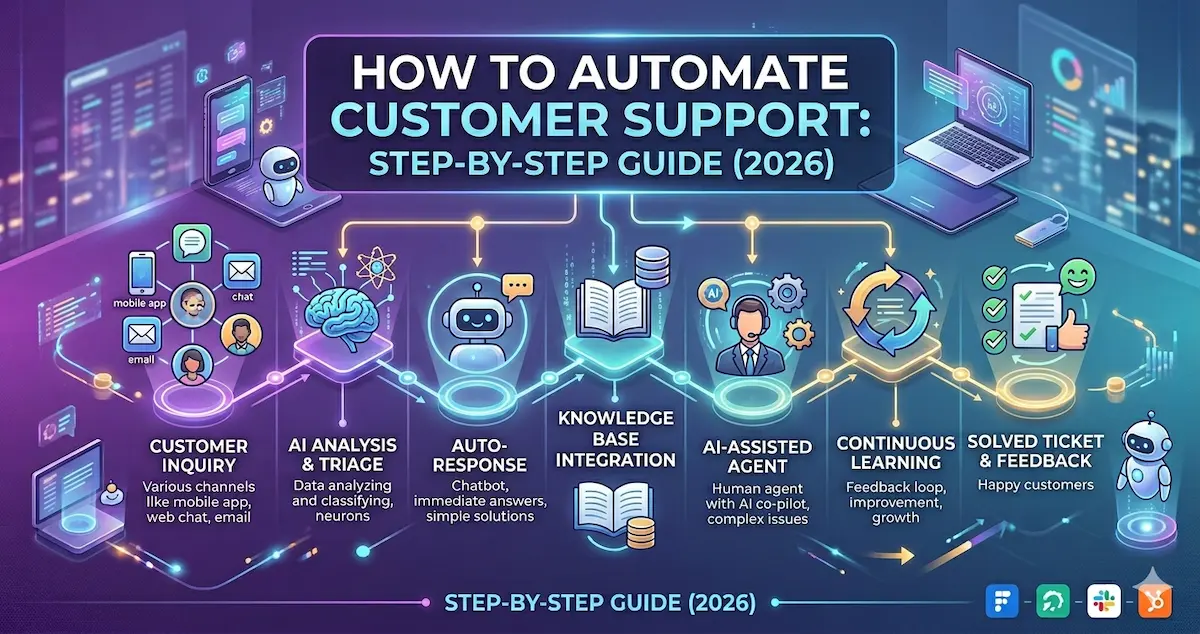
Automate 80% of repetitive support queries across chat, email, voice, and WhatsApp without sacrificing CSAT. This step-by-step guide covers ticket auditing, knowledge base setup, AI platform selection, phased deployment, and ongoing optimization.
Automate customer support ticket replies with AI that understands intent, follows workflows, integrates with your helpdesk, and escalates to humans when needed.
Analyze every support ticket for sentiment, agent handling quality, and AI performance. 100% coverage, weekly insights, and unified QA dashboards.
Discover the best AI voice agents for customer support in 2025. Compare Robylon - built specifically for support - with top platforms like Lindy, Retell AI, Synthflow, Cognigy, Ask JADA, and Aircall.
Meet Robylon's AI Agent: Your all-in-one solution for AI texting, voice, chat & omnichannel reach, fast deployment, deep integrations.
A practical guide to AI in CX: chatbots, voice bots, personalisation, analytics, and agent assist; with examples, KPIs, and a rollout plan for ROI.
Boost customer satisfaction with fast replies, clear updates, AI assist, and self-service. Learn CSAT/NPS/CES, FCR playbooks, VoC loops, and recovery steps.
Explore why an AI customer service chatbot boosts FCR, enables multilingual support, and powers self-service with RAG/KB. Complete guide.
Measure success with AI voice agents: explore 12 key metrics (intent accuracy, containment rate, FCR & more) to improve customer service outcomes in 2026
Discover 2026 ecommerce customer service playbook. Learn how AI agents, live chat, returns automation, and omnichannel boost retention, sales, reviews in D2C.
Eight alternatives to LimeChat for D2C brands, compared on WhatsApp marketing, what each AI agent can do in Shopify, which channels it covers and how it bills, with prices checked in October 2026.
Robylon’s 31 G2 Winter 2026 badges, led by #1 APAC Multilingual Support, show how its AI CX platform powers automation, conversational support and self-service.
This article reviews the top 10 AI chatbots for customer support in 2025, including Zendesk, Freshworks, Intercom, Drift, and more. It highlights their strengths, limitations, and best-fit use cases. The clear winner is Robylon AI, which delivers autonomous agents with 97% accuracy, 85–95% query automation, and 30% cost savings: making it the best overall choice for enterprises seeking scalable, reliable, and cost-efficient customer support.
Explore the 10 best AI chatbots for E-Commerce in 2025. Compare platforms like Robylon, Tidio, Intercom, Gorgias, and Ada to see how chatbots improve customer support, reduce costs, and boost sales.
Handle ecommerce tracking, delivery updates, and returns automatically with Robylon’s AI chatbots. Cut wait times and costs while giving customers instant answers.
Robylon’s AI voice agents modernize outdated IVR systems with intelligent, human-like conversations: automating routing, personalization, and call resolution while integrating with your existing telephony stack.