
ROI of AI Email Support: How to Calculate and What to Expect
The CFO does not care about auto-resolution rates or NLP accuracy — they care about cost savings, break-even timelines, and whether the investment produces a return. This guide provides the exact math to calculate AI email support ROI, with real numbers across e-commerce, SaaS, and fintech use cases.
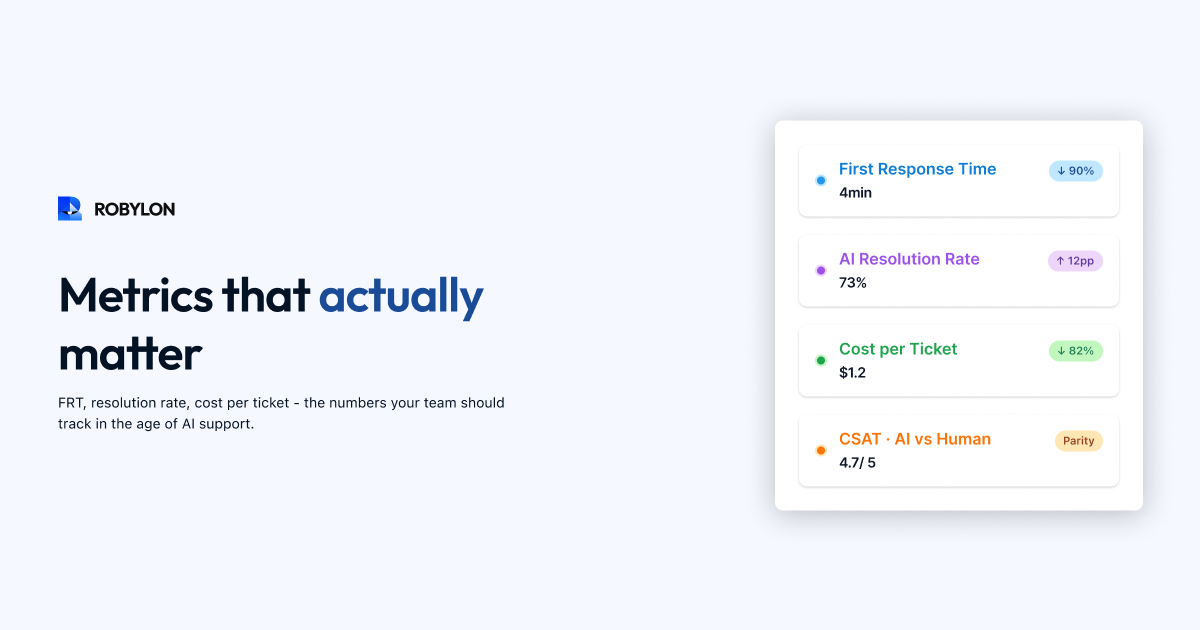
Support leaders know AI email automation works. The challenge is proving it — in the language of finance, with numbers a CFO will accept. “It resolves 70% of email tickets” is compelling for a VP of Support; the CFO wants to know what that means in dollars, when the investment pays for itself, and what the three-year total cost of ownership looks like compared to the alternative.
This guide gives you the math. We break down the cost of human-handled email, the cost of AI-resolved email, the break-even calculation, and the total ROI model — with real numbers you can adapt to your own volume, headcount, and vendor pricing.
Step 1: Calculate Your Current Cost Per Email Ticket
Before calculating AI ROI, you need to know what email support costs today. Most teams underestimate this because they only count agent salaries — ignoring overhead, tooling, management, and quality assurance.
The Fully Loaded Agent Cost
Start with annual agent salary. In the US, a support agent earns $35,000–$55,000 per year. In India, $4,000–$10,000. Add 25–35% for benefits, taxes, and overhead (office space, equipment, training). This gives you the fully loaded annual cost per agent.
Example for a US-based team: $45,000 salary + 30% overhead = $58,500 per agent per year, or roughly $4,875 per month.
Agent Capacity
A full-time email support agent handles 40–60 emails per day (depending on complexity), which translates to 850–1,250 emails per month. Using the midpoint (1,050 emails per month), the cost per human-handled email is $4,875 ÷ 1,050 = $4.64 per email at the lower end. For higher-salary regions, complex tickets, or lower productivity, the number ranges from $5 to $15 per email.
Add Tooling and Management Costs
Helpdesk software: $15–$150 per agent per month (Freshdesk to Zendesk Suite Pro). QA tools: $10–$30 per agent per month. Team lead and management overhead: typically 1 manager per 8–12 agents, adding 8–12% to the per-ticket cost. Training costs: $500–$2,000 per new agent, amortized across their tenure.
When you add everything up, the true cost per human-handled email ticket typically falls in the $6–$12 range for US-based teams and $2–$5 for India-based teams.
Step 2: Calculate the Cost Per AI-Resolved Email
AI email resolution costs depend on the pricing model of your chosen platform.
Per-Resolution Pricing (Zendesk, Intercom)
You pay $0.99–$2.00 every time the AI resolves a ticket. At 3,500 AI resolutions per month (70% of 5,000 emails), the cost is $3,465–$7,000 per month, or $0.99–$2.00 per resolved email. Simple math, but the cost scales linearly with automation improvement — the better your AI gets, the more you pay.
Credits-Based Pricing (Robylon AI)
You purchase a bundle of credits that cover AI processing. The cost per resolved email is typically $0.50–$1.50, depending on the plan and volume tier. At 3,500 AI resolutions per month, the cost ranges from $1,750–$5,250 per month. Crucially, the per-unit cost decreases as volume increases — the opposite of per-resolution pricing.
Per-Seat + AI Add-On Pricing (Zendesk, Freshdesk)
You pay per agent seat ($55–$150/month) plus an AI add-on fee ($50/agent/month for Zendesk Advanced AI). The AI cost is fixed regardless of resolution volume, which makes unit economics better at high volume but worse at low volume. However, these platforms typically achieve lower auto-resolution rates (35–55% vs 60–80%), so the blended cost per ticket is higher.
Step 3: Build the ROI Model
Let us work through a concrete example. We will use a mid-size e-commerce company as the baseline.
Baseline: Current State (No AI)
Monthly email volume: 5,000 tickets. Support agents: 5 (handling 1,000 emails each). Fully loaded agent cost: $4,500 per month each (US-based). Helpdesk cost: $79 per agent per month (Freshdesk Pro). Total monthly cost: $22,500 (agents) + $395 (helpdesk) = $22,895. Cost per email ticket: $22,895 ÷ 5,000 = $4.58.
With AI: Conservative Scenario (60% Auto-Resolution)
AI-resolved: 3,000 emails per month (60%). Human-handled: 2,000 emails per month (40%). Agents needed: 2 (handling 1,000 each). AI platform cost: $2,000 per month (credits-based). Total monthly cost: $9,000 (agents) + $158 (helpdesk for 2 agents) + $2,000 (AI) = $11,158. Cost per email ticket: $11,158 ÷ 5,000 = $2.23. Monthly savings: $22,895 – $11,158 = $11,737. Annual savings: $140,844.
With AI: Optimized Scenario (75% Auto-Resolution)
AI-resolved: 3,750 emails per month (75%). Human-handled: 1,250 emails per month (25%). Agents needed: 1.5 (round to 2 for coverage). AI platform cost: $2,500 per month (higher tier for better performance). Total monthly cost: $9,000 (agents) + $158 (helpdesk) + $2,500 (AI) = $11,658. Cost per email ticket: $11,658 ÷ 5,000 = $2.33. Monthly savings: $22,895 – $11,658 = $11,237. Annual savings: $134,844.
Note that the optimized scenario saves slightly less in this example because the AI platform cost increases while agent count remains the same (you cannot hire half an agent). The real gain in the optimized scenario is capacity — the same team can handle growth to 7,000–8,000 emails per month without adding headcount.
Step 4: Calculate the Break-Even Timeline
Break-even is the point at which cumulative savings exceed cumulative costs (AI platform fees + implementation costs). For most deployments, implementation costs are minimal — $0–$5,000 for a platform like Robylon (which includes onboarding), versus $10,000–$50,000 for an enterprise helpdesk migration.
Break-Even Math
Implementation cost: $2,000 (one-time onboarding). Monthly AI platform cost: $2,000. Monthly savings once live: $11,737. Weeks 1–3: shadow mode (no savings, platform cost accrued). Week 4 onward: savings begin at 40% auto-resolution and ramp to 60% by week 6.
Typical break-even: 25–35 days after going live with auto-resolution. By end of month 2, cumulative savings exceed all costs incurred (implementation + 2 months of platform fees). By end of year 1, ROI is 500–700% — every dollar spent on AI returns $5–$7 in savings.
Step 5: Account for Hidden Savings
The cost-per-ticket math captures direct savings. But AI email automation produces several indirect savings that are real but harder to quantify:
Avoided Hiring
If email volume is growing 20% per year, a team of 5 agents handling 5,000 emails per month will need 6 agents next year and 7 the year after. AI at 70% auto-resolution means you need 2 agents this year and still 2 agents next year — even as volume grows to 7,200. The avoided cost of 4–5 agents over 3 years is $648,000–$810,000 (at $4,500/month fully loaded).
Reduced Training Costs
Every new agent requires 2–4 weeks of training ($2,000–$8,000 in lost productivity and training time). When you hire 3 agents per year (to replace turnover and support growth), that is $6,000–$24,000 annually. With AI reducing headcount needs, training costs scale proportionally down.
Improved Customer Retention
Faster response times (minutes vs hours) and higher first-contact resolution (80–90% vs 55–65%) directly impact customer retention. A 5% improvement in retention for an e-commerce company with $10M annual revenue translates to $500,000 in preserved revenue — far exceeding the cost of any AI platform.
24/7 Coverage Without Night Shifts
If you currently have no overnight coverage, emails received between 10 PM and 8 AM wait until morning — creating a daily backlog. Hiring a night shift agent costs $4,500–$6,000 per month. AI provides 24/7 coverage at no additional cost beyond the base platform fee, resolving overnight emails in real-time.
ROI by Industry: What to Expect
E-Commerce
Email mix: 40% WISMO, 25% returns/refunds, 15% product questions, 20% other. Typical BRR: 70–80% (high repetition, clear intents). Cost per ticket reduction: $6–$10 → $2–$3 blended. Year 1 ROI: 400–700% at 5,000+ monthly emails.
SaaS
Email mix: 30% billing, 25% feature/how-to, 20% bugs/technical, 25% other. Typical BRR: 55–70% (billing and how-to automated; bugs often escalated). Cost per ticket reduction: $8–$15 → $4–$7 blended. Year 1 ROI: 250–500% at 3,000+ monthly emails.
Fintech
Email mix: 35% transaction queries, 20% KYC/compliance, 20% account management, 25% other. Typical BRR: 50–65% (compliance-heavy queries require human review). Cost per ticket reduction: $10–$20 → $5–$9 blended. Year 1 ROI: 200–400% at 3,000+ monthly emails.
How to Present This to Your CFO
CFOs care about four things: the size of the investment, the timeline to payback, the ongoing savings, and the risk. Structure your business case as follows:
Investment: $2,000–$5,000 implementation + $2,000–$3,000/month platform fee.
Payback: 25–35 days from go-live. Cumulative positive ROI by end of month 2.
Annual savings: $100,000–$200,000 in direct agent cost reduction (at 5,000 monthly emails, US-based team). Additional $50,000–$100,000 in avoided hiring as volume grows.
Risk mitigation: Shadow mode testing before any customer-facing deployment. Gradual rollout by email category. Fallback to human agents for any AI failures. Monthly contract terms — no multi-year lock-in.
The most persuasive element is the avoided-hiring story. CFOs understand that support costs scale linearly with volume — every 1,000 additional monthly emails requires another agent. AI breaks this linearity. Show the 3-year headcount projection with and without AI, and the cumulative cost difference makes the decision obvious.
Bottom Line
AI email support is not a speculative investment. The math is straightforward: human-handled email tickets cost $5–$15 each, AI-resolved tickets cost $0.50–$2.00 each, and well-configured platforms resolve 60–80% of email volume automatically. The break-even happens within a month, year 1 ROI ranges from 200–700% depending on industry, and the savings compound as volume grows because AI scales without proportional cost increase.
The question is no longer “Does AI email support have ROI?” — the answer is unambiguously yes. The question is how quickly you want to capture it.
See the ROI for your email volume. Robylon AI resolves 60–80% of email tickets at $0.50–$1.50 each — versus $5–$15 for human-handled emails. Most teams break even within 30 days. Start free at robylon.ai
Frequently asked questions
What is the break-even timeline for AI email support?
Most teams break even within 25–35 days of going live with AI auto-resolution. The math: implementation cost ($0–$5,000 one-time) plus monthly platform fee ($2,000–$3,000) versus monthly savings from reduced agent costs ($8,000–$15,000 at 5,000 monthly emails). Shadow mode (weeks 1–3) accrues platform costs without savings. Week 4 onward, savings accumulate rapidly. By end of month 2, cumulative savings exceed all costs. By end of year 1, ROI is typically 200–700% depending on volume and industry.
How much does a human-handled email ticket actually cost?
The fully loaded cost per human-handled email is $5–$15 for US-based teams and $2–$5 for India-based teams. This includes: agent salary ($35K–$55K/year in the US), benefits and overhead (+25–35%), helpdesk software ($15–$150/agent/month), QA tools ($10–$30/agent), management overhead (1 manager per 8–12 agents), and training costs ($500–$2,000 per new hire). Most teams underestimate by only counting salary — the fully loaded number is typically 40–60% higher than base salary divided by tickets.
How do I present the AI email support business case to my CFO?
Structure it around four points CFOs care about: 1) Investment size: $2,000–$5,000 implementation + $2,000–$3,000/month platform fee. 2) Payback timeline: 25–35 days from go-live. 3) Annual savings: $100K–$200K in direct agent cost reduction (at 5,000 monthly emails, US-based). 4) Risk mitigation: shadow mode testing, gradual rollout, agent fallback, monthly contracts. The strongest argument is the avoided-hiring projection — show the 3-year headcount trajectory with and without AI, demonstrating that AI breaks the linear relationship between email volume growth and staffing costs.
What ROI can I expect from AI email support in e-commerce vs SaaS?
E-commerce sees the highest ROI: 400–700% in year 1 at 5,000+ monthly emails. High repetition (40% WISMO, 25% returns), clear intents, and strong integrations (Shopify, OMS) drive 70–80% auto-resolution. Cost per ticket drops from $6–$10 to $2–$3 blended. SaaS achieves 250–500% ROI at 3,000+ emails. Billing and how-to queries automate well (55–70% BRR), but bug reports and technical issues often require human judgment. Cost per ticket: $8–$15 to $4–$7. Fintech: 200–400% ROI, 50–65% BRR, with compliance requirements keeping more tickets in the human queue.
What are the hidden savings of AI email support beyond direct cost reduction?
Four categories of hidden savings: 1) Avoided hiring: If volume grows 20%/year, AI prevents 4–5 new hires over 3 years, saving $648K–$810K. 2) Reduced training: Fewer agents = fewer $2K–$8K training investments per new hire. 3) Customer retention: Faster response times (minutes vs hours) and higher first-contact resolution (80–90% vs 55–65%) improve retention — a 5% retention improvement on $10M revenue preserves $500K/year. 4) 24/7 coverage: AI resolves overnight and weekend emails at no additional cost, eliminating the need for a night shift agent ($4,500–$6,000/month).