
The Email Support Team of 2027: How AI Reshapes Roles and Skills
As AI takes over repetitive email resolution, the support team does not disappear — it evolves. This forward-looking piece maps the emerging roles (AI Supervisor, KB Curator, Escalation Specialist), the skills that become essential, and the team structure that maximizes the human-AI combination.
The typical email support team in 2024 looked like this: 10–20 agents handling 5,000–10,000 emails per month, 2 team leads managing shifts and escalations, 1 QA specialist sampling 5–10% of responses, and 1 manager reporting metrics and managing headcount. Everyone’s primary job was reading and responding to email. Eighty percent of the team’s time was spent on repetitive queries — WISMO, returns, policy questions — that followed predictable patterns.
By 2027, AI handles 60–80% of that repetitive volume. The 10–20 agent team becomes 4–6 people — but those people are not doing the same job. They are doing better, more interesting, more impactful work. The team is smaller but more skilled, more strategic, and more valuable to the organization.
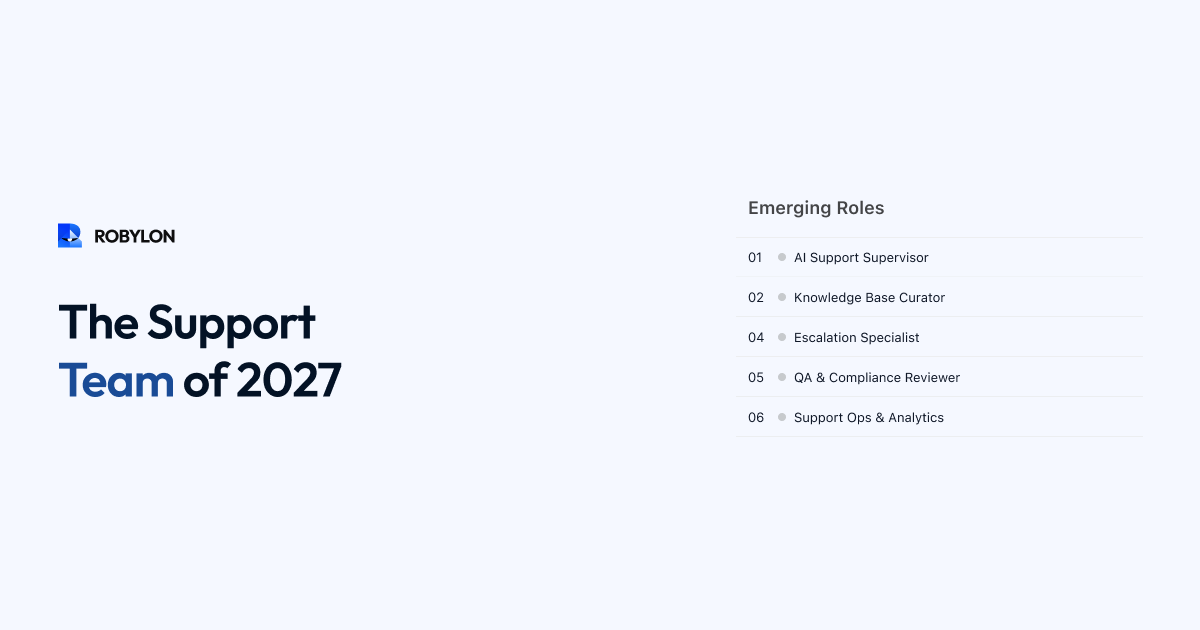
The Emerging Roles
AI Operations Manager (Formerly: Support Team Lead)
The team lead’s job was scheduling shifts, handling escalations, and monitoring queue depth. The new role manages the AI system: monitoring auto-resolution rates by category, tuning confidence thresholds, reviewing weekly accuracy data, and deciding which new email categories to automate next. The skill shift is from people management to system optimization — understanding how AI models work, reading performance dashboards, and making data-driven decisions about when to adjust thresholds or add integrations.
This is not an engineering role. It is an operations role that requires curiosity about how the AI works, comfort with data and metrics, and the judgment to balance automation speed against quality. The best candidates are current team leads who are already analytically minded.
Knowledge Base Curator (Formerly: Senior Agent)
The AI’s accuracy is directly determined by knowledge base quality. The KB Curator’s full-time job is ensuring the knowledge base is complete, accurate, up-to-date, and structured for optimal AI retrieval. This means rewriting articles in clear, conditional language (not marketing copy), updating content within hours of policy changes, creating new articles for recurring knowledge gaps surfaced by the AI, and organizing content so the AI retrieves the right information for each email type.
This role did not exist in the pre-AI team because the knowledge base was a secondary resource — agents memorized answers and the KB was a reference. When AI is the primary resolver, the KB becomes the single most important asset in the support operation, and maintaining it requires dedicated, skilled attention.
Escalation Specialist (Formerly: Agent)
When AI resolves 70% of email volume, the remaining 30% is not a random sample of emails — it is the hardest 30%. Complex multi-system issues, emotionally charged complaints, unique situations with no precedent, regulatory-sensitive queries. These emails require deep product knowledge, strong empathy, creative problem-solving, and the authority to make judgment calls.
The Escalation Specialist is a senior role — not an entry-level ticket responder. They handle 15–25 emails per day (compared to 50–70 for the old agent role) because each email requires deeper investigation, more nuanced communication, and often cross-functional coordination. The quality of their work directly shapes customer perception because they handle the interactions that matter most.
AI QA Analyst (Formerly: QA Specialist)
The old QA specialist sampled 5–10% of responses and scored them manually. The AI QA Analyst reviews AI-generated quality scores across 100% of responses, identifies patterns in accuracy failures, calibrates the scoring rubric, investigates edge cases where the AI and human quality assessments diverge, and maintains compliance monitoring rules. They spend less time reading individual emails and more time analyzing quality trends, updating scoring criteria, and feeding improvements back into the system.
Customer Experience Analyst (New Role)
With AI handling volume and the AI QA Analyst monitoring quality, there is room for a role that did not exist before: someone who analyzes the customer experience across the AI-human journey. What happens when a customer is resolved by AI and then emails again? Is the AI creating follow-up conversations through incomplete resolutions? Are there customer segments that prefer human interaction and should be routed accordingly? Which AI-resolved emails get the highest CSAT and what makes them different from low-CSAT resolutions?
This role turns support data into product and business insights — identifying why customers email in the first place and feeding that back to product, marketing, and operations to reduce email volume at the source.
The Skills Shift
Skills That Become Less Important
Speed typing and email throughput. Memorizing policies and product details. Following scripts and templates. Managing high-volume queues. These skills defined the traditional email agent role and will be largely automated.
Skills That Become Essential
Data literacy: reading dashboards, interpreting accuracy metrics, understanding confidence scores. Content writing: creating clear, structured knowledge base articles that AI can retrieve effectively. Critical thinking: handling edge cases where standard processes do not apply. Emotional intelligence: managing the hardest, most sensitive customer interactions that AI escalates. System thinking: understanding how changes to the knowledge base, confidence thresholds, and integrations affect the entire email operation.
The Team Structure
A team that handled 8,000 emails per month with 15 people in 2024 handles the same volume with 5–6 people in 2027: 1 AI Operations Manager (owns the system, reports to Head of Support), 1 Knowledge Base Curator (full-time content optimization), 2–3 Escalation Specialists (handle the complex 20–30%), 1 AI QA Analyst (quality monitoring and compliance). Optional: 1 Customer Experience Analyst (insights and optimization).
Total headcount reduced by 60–70%. But the team is more senior, more skilled, more strategically valuable, and handling more interesting work. Average compensation per team member increases even as total team cost decreases. The team transitions from a cost center that scales linearly with volume to a strategic function that scales with intelligence.
The Transition Path
Phase 1: Augmentation (Months 1–3)
AI handles auto-resolution for simple categories. Agents still handle the majority of emails but with AI copilot assistance (suggested drafts, customer context). No headcount changes. Agents begin learning to work alongside AI — reviewing drafts, providing feedback, and understanding confidence scores.
Phase 2: Specialization (Months 4–6)
Auto-resolution expands to 50–60% of volume. Agents begin specializing: some focus on complex escalations, one takes ownership of the knowledge base, the team lead starts managing the AI system alongside the human team. Natural attrition (agents leaving for other roles) is not backfilled — the remaining team absorbs the workload because AI has reduced it.
Phase 3: Transformation (Months 7–12)
Auto-resolution reaches 65–80%. The new roles are formalized: AI Operations Manager, KB Curator, Escalation Specialists, AI QA Analyst. The team is smaller, more senior, and each person has a distinct role with clear ownership. Training programs shift from “how to respond to emails” to “how to optimize the AI system, write effective KB content, and handle complex escalations.”
What Happens to the Agents?
This is the question every support leader wrestles with. The honest answer: some agents transition into the new roles (escalation specialist, KB curator) based on their skills and interests. Some move into other customer-facing roles — customer success, onboarding, sales support — where their product knowledge and empathy are valuable. Some move to other companies that are earlier in their AI adoption journey. And yes, some roles are eliminated through natural attrition.
The ethical approach: start the transition early, be transparent about the timeline, invest in upskilling (data literacy, content writing, AI tools), and create internal mobility paths. The companies that handle this well end up with a smaller, more engaged, more skilled team. The companies that handle it poorly — sudden layoffs after AI deployment — create fear that undermines AI adoption across the organization.
Bottom Line
AI does not eliminate the email support team — it transforms it from a large group of generalists processing repetitive volume into a small team of specialists managing an intelligent system. The work is more interesting, the skills are more valuable, and the impact per person is dramatically higher. The transition requires intentional planning, transparent communication, and investment in upskilling — but the destination is a team that is better for the company, better for customers, and better for the people on it.
Transform your email team, not just your email. Robylon AI handles the repetitive 60–80% so your team can focus on the work that matters — complex escalations, knowledge curation, and customer experience strategy. Start free at robylon.ai
Frequently asked questions
What new roles emerge on an AI-powered email support team?
Five emerging roles: 1) AI Operations Manager (monitors BRR, tunes thresholds, manages automation expansion). 2) Knowledge Base Curator (full-time KB optimization — the most impactful role for AI accuracy). 3) Escalation Specialist (handles the complex 20–30% requiring deep expertise and empathy). 4) AI QA Analyst (monitors quality scores across 100% of responses, maintains compliance rules). 5) Customer Experience Analyst (analyzes the AI-human journey, feeds insights to product and operations). Total team: 5–6 people handling the same volume that required 15–20.
How does AI change the skills needed for email support?
Less important: Speed typing, policy memorization, template management, high-volume queue processing. More important: Data literacy (reading dashboards, interpreting accuracy metrics), content writing (creating AI-optimized KB articles), critical thinking (handling edge cases where standard processes fail), emotional intelligence (managing the most sensitive escalations), and system thinking (understanding how KB changes, threshold adjustments, and integrations affect the whole operation).
Will AI replace email support agents?
AI transforms the team rather than eliminating it. A team of 15 handling 8,000 emails/month becomes 5–6 people handling the same volume — but in different, more skilled roles. Some agents become escalation specialists, some become KB curators, some move to customer success or sales roles. Natural attrition is not backfilled as AI absorbs the volume. The ethical approach: start early, be transparent, invest in upskilling, and create internal mobility paths. The result is a smaller, more senior, more engaged team doing more interesting work.
What does the transition from traditional to AI-powered email team look like?
Three phases: Phase 1 (months 1–3): AI augments — agents use AI copilot, no headcount changes, team learns to work alongside AI. Phase 2 (months 4–6): AI handles 50–60%, agents specialize — some focus on escalations, one owns KB. Natural attrition is not backfilled. Phase 3 (months 7–12): AI handles 65–80%, new roles formalized — AI Operations Manager, KB Curator, Escalation Specialists, AI QA Analyst. Team is smaller, more senior, with distinct ownership per role.
How does the support team transition affect compensation?
Average compensation per team member increases even as total team cost decreases. The new roles (AI Operations Manager, Escalation Specialist, KB Curator) require more skill and carry higher salaries than entry-level ticket responders. Example: 15 agents at $40K average = $600K annual team cost. Post-AI: 5–6 specialists at $55K average = $275K–$330K. Total cost drops 45–55%, but individual compensation rises 35–40%. The team transitions from a cost center to a strategic function.