Layering Robylon on Top of Gorgias: Stack Architecture for Shopify Brands
A practical architecture guide for Shopify brands running Gorgias who want better AI economics without a helpdesk migration. The shape of the layered stack, what changes, what doesn't, and when this setup wins over picking one vendor.
A Shopify subscription brand runs Gorgias as their helpdesk. They like the workspace, the customer sidebar is wired to Shopify and Recharge the way they want it, and 18 support agents have built muscle memory around the macros. They’re paying $7,200 a month for Gorgias AI Agent against 8,000 tickets at 60% autonomous resolution, and the CFO has started asking what happens when volume hits 15,000.
The vendor pitch from most AI agent companies in this situation is: switch helpdesks. Migrate off Gorgias, retrain the team, rebuild the integrations, and on the other side you get a different AI agent. For most brands deep in Gorgias, that math doesn’t work. The migration cost is bigger than the AI savings.
There’s a third option that doesn’t get talked about enough. Keep Gorgias. Layer Robylon on top.
It’s an architecture question, not a vendor question
The choice most Shopify brands think they’re making is “which AI agent vendor.” The actual choice is “which architecture.” Once you reframe it, the answer shifts for a lot of brands.
In a single-vendor architecture, your helpdesk and your AI agent are the same product. Gorgias plus Gorgias AI Agent is the most common version of this in Shopify. The upside is integration cleanliness — one workspace, one bill, one support contract. The downside is the pricing model couples your helpdesk seats to your AI resolution count, so AI-resolved tickets get billed both ways.
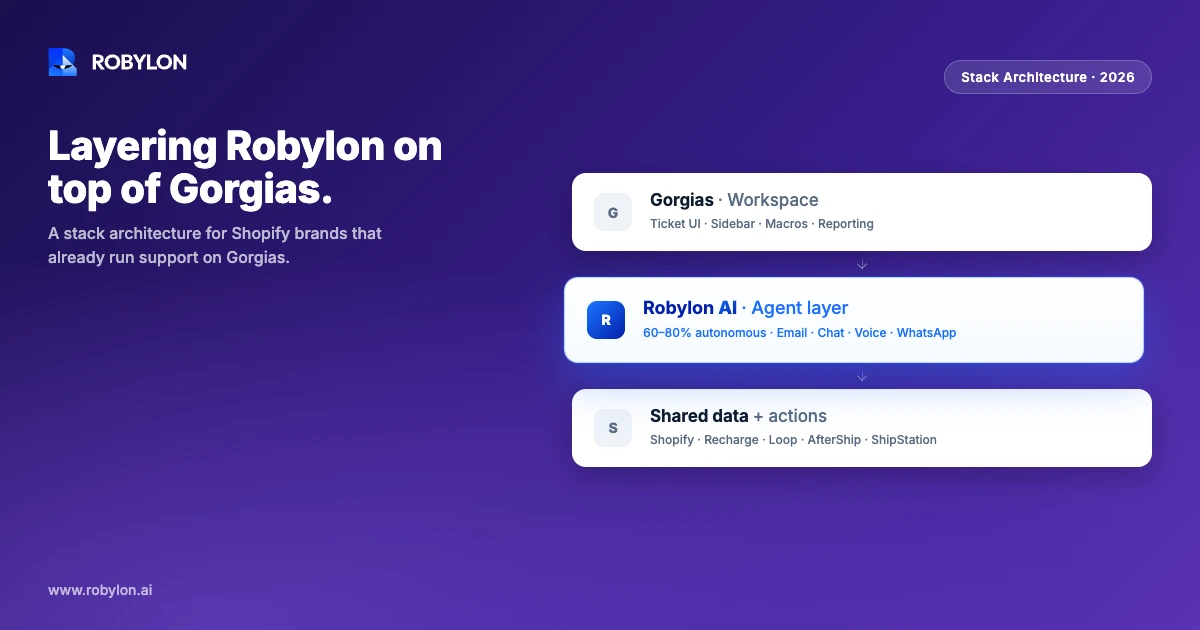
In a layered architecture, your helpdesk and your AI agent are different products that share data. Gorgias remains the workspace; Robylon reads from the same ticket queue and acts as the AI layer. The upside is independent economics on each layer and channel breadth Gorgias doesn’t cover natively. The downside is you manage two vendors instead of one.
For brands under 2,000 tickets/month, the single-vendor architecture usually wins on simplicity. Past 5,000 tickets/month, especially with voice, WhatsApp, or non-Shopify integrations in scope, the layered architecture starts to make sense. We covered the head-to-head economics in our side-by-side comparison, and the wider vendor landscape in our roundup of Gorgias alternatives. This article is the architecture follow-up for brands who’ve decided not to pick.
The stack: workspace layer plus AI agent layer
Here’s what the layered stack actually looks like in practice.
The Gorgias layer (workspace)
Gorgias holds the workspace: ticket UI, agent assignment rules, macros for human-handled tickets, conversation history, the customer profile sidebar with live Shopify and Recharge data, reporting on team performance, SLA tracking. This is what your support agents see when they log in. Nothing here changes when Robylon comes in.
The Robylon layer (AI agent)
Robylon holds the AI agent: a model trained against your historical tickets during onboarding, an action engine plugged into 60+ write-access integrations, escalation logic with tone-shift detection, and channel handlers covering email, chat, voice, and WhatsApp at parity. The AI doesn’t try to be a workspace; it tries to close tickets without one.
The shared layer (data and actions)
Both layers read from the same underlying systems: Shopify customer and order data, Recharge subscription state, Loop returns flows, AfterShip shipment tracking, ShipStation labels, Klaviyo lists, and whatever else is connected to your stack. Gorgias pulls this into the sidebar for human agents. Robylon pulls it into the AI’s context and writes back when an action needs to fire.
How the integration actually works
The Gorgias-Robylon integration runs over the Gorgias API. There’s no agent extension to install, no Chrome plugin, no workspace swap. Robylon authenticates against the Gorgias API and subscribes to ticket events.
When a new ticket lands in Gorgias, Robylon ingests it within seconds. The AI evaluates whether the ticket falls inside the autonomous resolution band based on intent classification, customer history, and the actions required to resolve it. If it’s in band, Robylon drafts the response, executes any required actions through the connected integrations (refund through Shopify, pause through Recharge, redirect through AfterShip, whatever the resolution needs), and posts the response back into the Gorgias thread. The ticket closes in Gorgias. Reporting still rolls up under Gorgias.
If the ticket falls out of band — a refund above the auto-approval threshold, a tone shift suggesting real frustration, a customer asking for a manager — Robylon doesn’t reply. It tags the ticket in Gorgias for human handling and surfaces a recommended response plus the customer context inline. The human agent picks it up in the workspace they’re trained on.
From an agent’s perspective, Gorgias looks the same. The difference is that 60–80% of the tickets that used to land in the queue are already closed by the time anyone checks in.
What you keep when you layer
The layered stack is designed so nothing your team relies on changes:
- The workspace: Gorgias’s ticket UI, queue views, agent assignment, macros, and reporting all stay. No retraining.
- The Shopify sidebar: Customer profile, order history, subscription state — all visible to agents in the Gorgias sidebar the way they are today.
- Existing helpdesk integrations: Anything you’ve wired into Gorgias (Shopify, Recharge, Klaviyo) keeps working for the human-handled tickets.
- Reporting and SLAs: Team performance, response time, CSAT — Gorgias’s reporting still reflects what your humans handle.
For ops teams that have spent six to twelve months tuning Gorgias to their workflow, this matters more than the AI economics. The institutional knowledge stays in the workspace where it was built.
What you gain when you layer
The gains show up on the AI agent layer specifically:
- Credits-based pricing on autonomous resolution: The AI portion of your spend moves off per-resolution fees and onto a credit pack sized to volume. At 8,000 tickets/month and 60% autonomy, the AI line item materially shrinks.
- Voice and WhatsApp at parity: The same agent reasoning and action surface that handles email and chat also handles voice calls and WhatsApp threads — channels Gorgias AI Agent doesn’t natively cover.
- Broader action surface: Robylon’s 60+ integrations extend the AI’s reach into Loop, AfterShip, ShipStation, Klaviyo, and the long tail of post-purchase Shopify apps the helpdesk-native AI can’t easily reach.
- Validated resolution rate: Robylon validates 60–80% autonomous resolution against your actual historical tickets during onboarding, so the number you sign for is anchored to your real ticket mix, not a marketing average.
The gains compound. A subscription brand at 8,000 tickets/month that adds voice support without adding headcount, picks up WhatsApp because their LATAM volume justifies it, and moves the autonomous resolution spend off per-ticket fees is running a meaningfully different economic model than they were before.
What you don’t gain (the honest part)
The layered stack isn’t free, and pretending it is would be the wrong way to pitch it.
You still pay Gorgias for seats. The AI handles the autonomous tickets, but the human queue still exists, and Gorgias still bills per-seat for the agents working it. The savings come from the AI fees, not from the helpdesk subscription. If your goal is “spend less on Gorgias,” layering doesn’t get you there directly.
The Gorgias workspace UX is unchanged. If you wanted a different customer profile sidebar or different macro syntax, this stack doesn’t solve that. The workspace is still Gorgias’s workspace.
Vendor count goes from one to two. That means two contracts, two support paths when something breaks, two SLAs to track. For some ops teams that’s a real overhead; for others it’s a non-issue. Either way, name it honestly during evaluation.
And if Gorgias has an outage, your human queue is down. Robylon can keep resolving tickets in the channels it controls, but anything that needs human handling sits until Gorgias recovers. That’s the symmetric cost of relying on the workspace layer being available.
When the layered stack makes sense
Three brand profiles where this architecture is the right call.
Subscription or returns-heavy brands past 5,000 tickets/month
Credits-based pricing flattens better than per-resolution as volume rises, and the action surface covers Recharge, Loop, AfterShip, and ShipStation natively. If a meaningful share of your tickets are Shopify order emails about subscription pauses, return label requests, or shipment redirects, the broader integration surface wins on resolution rate, not just on price.
Brands with material voice or WhatsApp volume
If your customers call — high-AOV apparel, wellness, jewelry, anything where a $400 order drives a phone conversation — voice automation matters, and Gorgias AI Agent doesn’t cover it. Same for WhatsApp if you sell into India, LATAM, or parts of Europe. Layering gets you those channels without replacing the workspace.
Teams deeply trained on Gorgias they don’t want to disrupt
If you have 15 or 20 agents who know the Gorgias workspace cold, the migration cost of moving them isn’t just the integration work. It’s the productivity hit during the changeover. Layering preserves the team’s training and only changes the layer they don’t directly touch.
When to consolidate instead
Two cases where the layered stack is the wrong answer.
Under 2,000 tickets/month, all-in on Gorgias. The per-resolution math hasn’t started to hurt yet. Layering adds vendor complexity for marginal savings. Stick with Gorgias plus Gorgias AI Agent until the volume crosses the threshold where the economics flip.
Already migrating off Gorgias for non-AI reasons. If you’re moving the helpdesk anyway — for ticket volume Gorgias can’t handle, for compliance reasons, for a multi-brand setup Gorgias doesn’t support cleanly — then don’t layer. Pick a new helpdesk, pick the AI agent, build the new stack from clean ground. Robylon runs equally well on Zendesk, Freshdesk, Intercom, or standalone.
What the deployment actually looks like
Layering Robylon on top of Gorgias takes 3–7 days end to end. The shape:
- Days 1–2: API connection to Gorgias, historical ticket export (typically the last 90 days), ingestion into the Robylon training pipeline. No production changes yet.
- Days 2–3: Validation pass. Robylon scores autonomous resolution rate against the historical tickets and surfaces the in-band and out-of-band breakdown. This is the number you sign for.
- Days 3–5: Integration setup. The action surface (Shopify, Recharge, Loop, AfterShip, plus whatever else is in scope) gets connected. Escalation rules, tone-shift thresholds, and refund auto-approval limits are configured.
- Days 5–6: Shadow mode. Robylon processes live tickets but doesn’t post responses — the AI’s draft and the action plan are visible to the team for review. This is the calibration window.
- Day 7: Go live on a defined ticket scope. Usually starts with two or three ticket types (WISMO, refund requests, subscription pauses) and expands from there over the next two to three weeks.
Gorgias never goes offline during any of this. The team’s workspace doesn’t change. The first thing they notice is that the queue is shorter on Monday morning.
Ready to layer AI on top of the helpdesk you already run? Robylon AI resolves 60–80% of tickets autonomously across email, chat, voice, and WhatsApp, with action chains across Gorgias, Shopify, Recharge, Loop, AfterShip, and 60+ other integrations. Start free at robylon.ai
Frequently asked questions
Do I need to migrate off Gorgias to use Robylon?
No. Robylon is helpdesk-agnostic and runs on top of Gorgias, Zendesk, Freshdesk, Intercom, Front, or standalone. The layered stack architecture keeps Gorgias as your workspace and adds Robylon as the AI agent layer that reads the same ticket queue, executes actions through 60+ integrations, and escalates back to your Gorgias-trained agents for tickets out of band. No migration, no retraining.
What happens to Gorgias AI Agent if I add Robylon on top?
Most brands turn Gorgias AI Agent off when Robylon goes live, because running two AI agents against the same ticket queue creates conflicts on which one responds first. The simpler model is Gorgias as the workspace, Robylon as the AI. You keep the Gorgias helpdesk subscription for human agents and replace the AI Agent line item with Robylon's credits-based pricing. A few brands run both during a transition window for comparison; long-term, one or the other handles the autonomous resolution.
How does Robylon hand tickets back to Gorgias agents?
When a ticket falls out of the autonomous resolution band — a tone-shift signal, a refund above threshold, an explicit ask for a human — Robylon doesn't post a response. It tags the ticket in Gorgias for human handling and surfaces a recommended response and the customer context inline for the agent. The handoff is native to Gorgias's ticket workflow, so the agent picks it up in the queue view they already use. Nothing about the human side of the workflow changes.
Does layering both vendors double my spend?
No. The Gorgias helpdesk subscription stays roughly the same because you still need seats for the human agents. What changes is the AI line item: Gorgias AI Agent's per-resolution fees go away, replaced by Robylon's credits-based pricing. For most brands past 5,000 tickets/month, the net spend goes down because credits-based pricing flattens at higher autonomy and volume in a way per-resolution fees don't.
How long does the Gorgias-Robylon integration take to set up?
End to end, 3–7 days from contract to live. Days 1–2 cover the API connection and historical ticket ingestion. Days 2–3 are the validation pass against your real ticket history. Days 3–5 handle integration setup for Shopify, Recharge, Loop, AfterShip, and others. Days 5–6 run shadow mode for calibration. Day 7 is a scoped go-live, typically on two to three ticket types, expanding from there. Gorgias doesn't go offline at any point.
Related reading
- Comparisons
6 AI Platforms That Fully Automate Support Tickets in 2026 (90%+ Resolution)
A practical comparison of AI platforms that can fully resolve customer support tickets end to end. Covers real automation, system access, confidence controls, escalation, and when humans still matter.
- Comparisons
9 best Ada alternatives for AI customer support in 2026
Nine alternatives to Ada, compared on what each AI agent can do, which channels it connects natively, where it runs and how you buy it, with prices checked in October 2026.
- Comparisons
AI Chatbot Pricing Guide 2026: What Should You Pay?
AI chatbot pricing is confusing by design — per-agent fees, AI add-ons, per-resolution charges, and hidden usage limits make real costs hard to compare. This guide demystifies every pricing model and shows what you should actually pay based on your team size and ticket volume.