
AI Email Support for Logistics & Shipping: Tracking, Claims & Delivery Issues
Logistics email is dominated by tracking queries and delivery exceptions. AI resolves 70-80% of these instantly by connecting to TMS and carrier APIs in real time.
The Logistics Email Challenge
Logistics companies operate in a world of constant exceptions. Delayed shipments, customs holds, damaged goods, address corrections, and proof-of-delivery requests generate enormous email volumes. For 3PL providers, the challenge multiplies because they manage communications for dozens of shipper clients simultaneously.
Tracking and status inquiries represent 35-40% of all inbound email. Delivery exceptions account for 20-25%. Damage and loss claims make up 10-15%. Rate quotes and booking requests represent 10-15%. Customs and documentation questions add another 10%.
Why Logistics Email AI Differs from E-Commerce
B2B logistics email is fundamentally different from e-commerce WISMO. Shipments involve multiple carriers, modes (air, ocean, ground, rail), and handoff points. A single shipment might generate tracking events from five different systems. Additionally, logistics operates on tight SLA windows where a delayed response about a customs hold can mean demurrage charges of hundreds of dollars per day.
High-Automation Email Categories
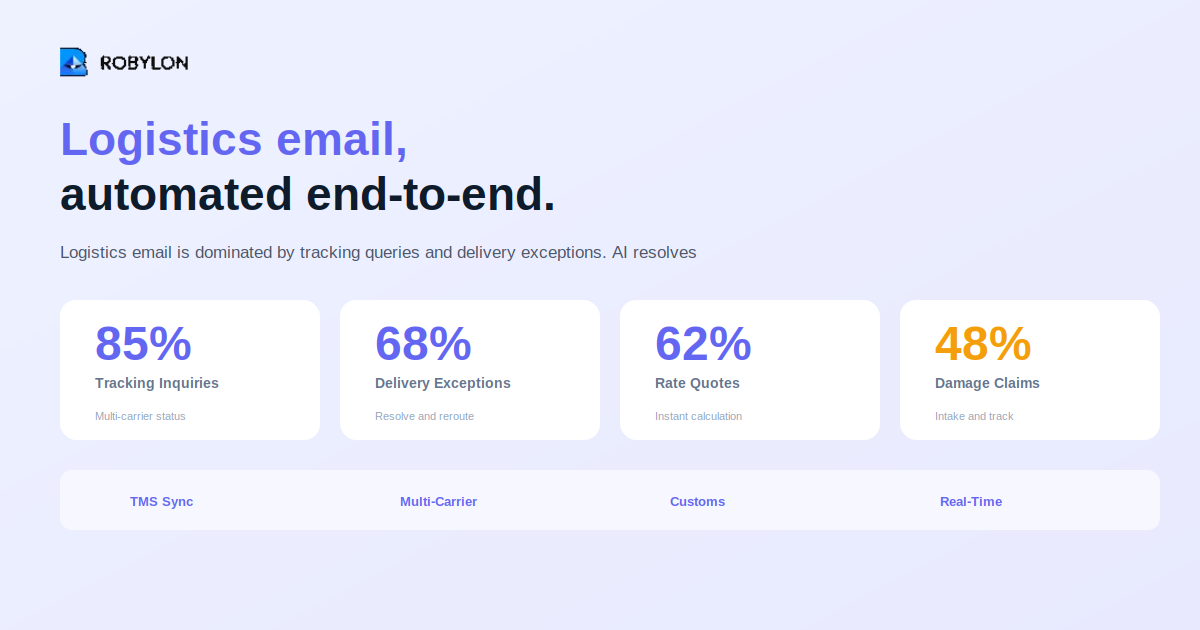
Tracking and Status Inquiries (80-90% automation)
The AI identifies the shipment by tracking number, BOL, PO number, or container number, queries the TMS or carrier API, translates carrier status codes into clear language, provides estimated delivery dates, and flags active exceptions. The key differentiator is multi-carrier consolidation across multiple carriers and modes for a single shipment.
Delivery Exception Handling (60-75% automation)
The AI automatically identifies exception types, pulls specific details from the carrier, provides resolution options, and initiates rescheduling or address correction through carrier APIs.
Rate Quotes and Booking (55-70% automation)
Standard rate quote requests follow predictable patterns. The AI calculates quotes from rate tables, presents multiple carrier options with transit times, and converts accepted quotes into bookings. Complex quotes involving hazmat or oversized freight need human review.
Damage and Loss Claims (40-55% automation)
The AI manages claim intake by collecting required information, creating the claim in the management system, setting processing timeline expectations, and providing status updates on existing claims.
Integration Architecture
Logistics AI email requires TMS for shipment data, carrier APIs for real-time multi-carrier tracking, WMS for inventory and fulfillment status, customs brokerage systems for international documentation, and claims management platforms.
Bottom Line
Logistics email is high-volume, time-sensitive, and data-rich — ideal for AI automation. The key is multi-carrier integration that provides consolidated visibility regardless of which carriers are involved.
Automate logistics email at scale. Robylon AI connects to your TMS and carrier APIs to resolve tracking queries, handle exceptions, and process claims. Start free at robylon.ai
Frequently asked questions
What percentage of logistics emails can AI resolve?
AI resolves tracking inquiries at 80-90%, delivery exceptions at 60-75%, rate quotes at 55-70%, and damage claims intake at 40-55%. Multi-carrier integration is essential for consolidated tracking visibility.
How does AI handle multi-carrier tracking?
The AI aggregates tracking data across multiple carriers and modes (air, ocean, ground, rail) by connecting to carrier APIs and the TMS simultaneously, providing consolidated status regardless of which carriers are involved.
What integrations does logistics AI email need?
Essential integrations include TMS for shipment data, carrier APIs for real-time tracking, WMS for fulfillment status, customs brokerage systems for international documentation, and claims management platforms.
Can AI handle customs and documentation queries?
AI handles common customs queries by checking documentation status, identifying missing documents, and providing clearance timelines. Speed matters — delayed responses can accrue demurrage charges of hundreds of dollars per day.
What is the ROI of AI email for logistics?
Key metrics include tracking resolution dropping from 2-4 hours to under 2 minutes, exception resolution rate, demurrage cost avoidance, and operations team hours recaptured.