
Building an Email Support Knowledge Base Optimized for AI Resolution
The #1 determinant of AI email accuracy is not the model — it is the knowledge base. This guide shows how to structure articles for optimal AI retrieval, write conditional policies the AI can interpret correctly, organize content for multi-issue emails, and maintain the KB for continuous improvement.
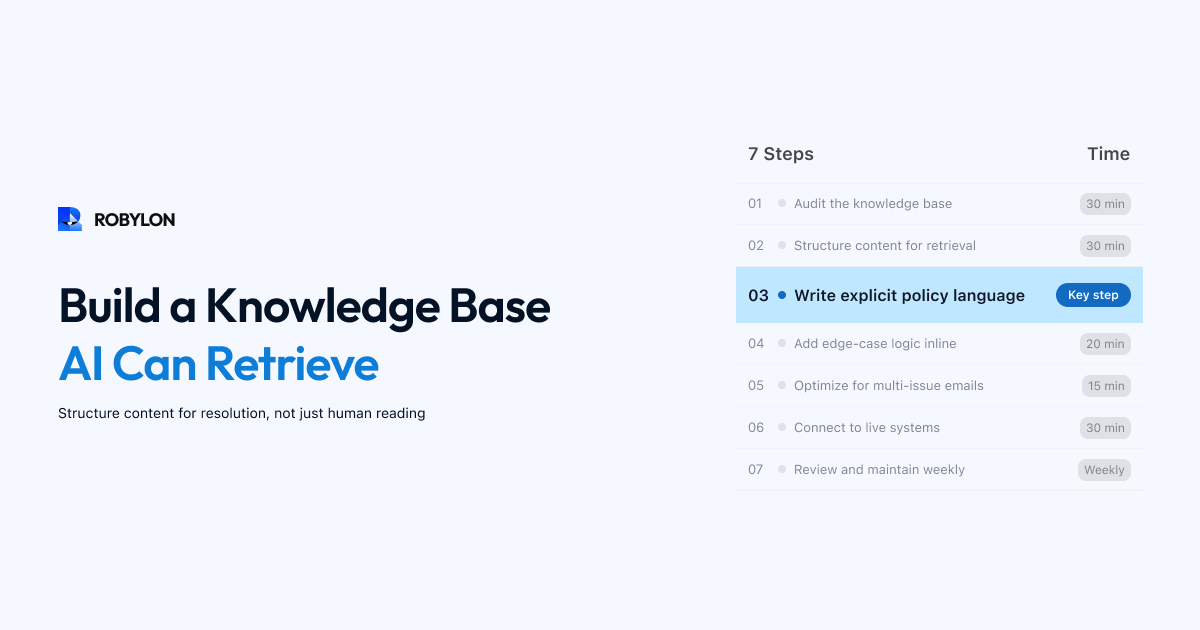
Key takeaways
- The single biggest determinant of AI email accuracy is the knowledge base, not the model.
- Human-readable and AI-retrievable are different goals. One topic per article and a question-answer structure beat long comprehensive guides.
- Write conditional policies as explicit rules. If the AI has to infer an exception, it will eventually infer the wrong one.
- State boundaries explicitly - what the policy does not cover is as important to retrieval as what it does.
- Document escalation triggers in the KB itself, so the decision to hand off is grounded in the same source as the answer.
The single most important factor in AI email accuracy is not the LLM, not the prompt engineering, and not the confidence threshold — it is the knowledge base. When the AI retrieves accurate, clear, complete content, it generates accurate, clear, complete responses. When the knowledge base is outdated, ambiguous, or incomplete, the AI produces wrong answers with high confidence — the worst possible outcome.
Most knowledge bases were written for humans: help center articles designed for customers to read, internal wikis designed for agents to reference. These are useful but suboptimal for AI retrieval. An AI-optimized knowledge base is structured differently — with clear conditional logic, focused topics, explicit boundaries, and machine-readable formatting that maximizes retrieval accuracy.
The Fundamental Difference: Human-Readable vs AI-Retrievable
A human-readable KB article might say: “Returns are generally accepted within 30 days. Sale items may have different return windows. Please check the product page for specific details.” A human agent reads this, understands the nuance (“generally” means exceptions exist, “may have” means they need to check), and uses judgment to handle each case.
An AI reads this literally and faces ambiguity: what does “generally” mean? Which sale items? What are the “specific details”? The AI either guesses (risking inaccuracy) or flags low confidence (routing to humans unnecessarily).
An AI-optimized version: “Return window: 30 days from delivery date for full-price items. Return window: 14 days from delivery date for items purchased during a sale event (any item with a sale tag at time of purchase). Exception: Final sale items (marked ‘Final Sale’ on the product page) are not eligible for return. Exception: Electronics have a 7-day return window regardless of sale status.”
The second version removes ambiguity, lists every condition explicitly, and handles exceptions as discrete rules. The AI retrieves exactly the right return window for any given situation without guessing.
KB Architecture for AI Email Resolution
One Topic Per Article
Human KB articles often combine related topics: “Shipping, Returns, and Refunds” in one article. For AI retrieval, this is problematic — when a customer asks about refunds, the AI retrieves the entire article (including shipping content that dilutes the response) and must extract the relevant section. This increases processing time and reduces accuracy.
Split into focused articles: “Return Policy,” “Refund Processing Timeline,” “Shipping Methods and Timeframes,” “Exchange Process.” Each article addresses one topic completely. When the AI detects a refund inquiry, it retrieves the refund article — nothing more, nothing less.
Question-Answer Format
Structure articles as explicit question-answer pairs rather than narrative prose. Instead of a 500-word article about your return process, write a series of Q&A pairs: “How long do I have to return an item?” → 30 days for full-price, 14 days for sale items. “How do I start a return?” → Email support with order number, or visit the returns page. “When will I receive my refund?” → 3–5 business days after we receive the item.
This format maps directly to how customers phrase their emails — making retrieval more accurate because the knowledge base content structurally matches the customer’s question format.
Conditional Logic as Explicit Rules
Support policies are full of conditions: different rules for different products, customer tiers, order values, and time periods. Write every condition explicitly as an if-then rule that the AI can evaluate mechanically.
Instead of: “Refund timelines vary depending on the payment method.” Write: “Credit card refunds: 3–5 business days. Debit card refunds: 5–10 business days. PayPal refunds: 1–3 business days. Store credit: immediate. Bank transfer refunds: 7–14 business days.”
The AI can now match the customer’s payment method (extracted from the email or looked up in the payment system) to the correct timeline and include it in the response.
Explicit Boundaries
Tell the AI what it should NOT do as clearly as what it should do. “The AI should never promise a specific refund date — only provide the standard processing timeline.” “The AI should not offer discounts or credits unless the customer has experienced a verified service failure.” “The AI should not share internal pricing, cost structures, or margin information under any circumstances.”
These negative constraints are as important as positive instructions. Without them, a well-intentioned AI might promise a refund “by Friday” (exposing you to a commitment you cannot keep) or offer a 10% discount to appease a frustrated customer (creating unauthorized discounts at scale).
Writing KB Content for Email-Specific AI
Account for Email Length
Email queries are longer and more detailed than chat messages. A customer email might be 150 words with embedded context, multiple questions, and personal details. Your KB content should be comprehensive enough to address the full depth of email queries — not the brief, surface-level answers sufficient for chat.
Include Entity Mapping
Document how customers refer to things in their emails versus how they appear in your systems. Customers say “blue hoodie” — your system calls it “Premium Cotton Hoodie - Navy (SKU: PCH-NAV-L).” Customers say “the card ending in 4521” — your system stores the full card fingerprint. Create a mapping document that helps the AI translate between customer language and system identifiers.
Document Escalation Triggers
Clearly define when the AI should NOT attempt resolution and should route to a human: legal threats, regulatory complaints, media mentions, requests for executive contact, safety issues, and any topic where an incorrect AI response could cause significant harm. Make these triggers explicit in the KB so the AI treats them as hard rules, not suggestions.
Maintaining the KB for Continuous Improvement
The Weekly KB Review (30 Minutes)
Every week, review two reports from your AI platform: the knowledge gap report (topics where the AI could not find relevant content) and the accuracy error report (responses where the AI retrieved content but the response was still incorrect). The knowledge gap report tells you what to add. The accuracy error report tells you what to fix.
Close the top 3–5 gaps and fix the top 3–5 errors each week. This 30-minute investment typically improves auto-resolution rate by 2–5 percentage points per week for the first 2–3 months.
Policy Change Protocol
When a policy changes (new return window, updated pricing, new product launch), the KB must be updated before the change takes effect — not after. If you announce a new 14-day return policy on Monday but do not update the KB until Wednesday, the AI will incorrectly tell customers they have 30 days for two days. Build a checklist: every policy change triggers a KB update as a prerequisite for the change going live.
Seasonal Content
Some KB content is time-limited: holiday shipping deadlines, seasonal promotions, temporary policies (extended return windows during holidays). Tag this content with effective dates and expiration dates. Set calendar reminders to add seasonal content 2 weeks before the event and remove it after. Stale seasonal content (last year’s holiday shipping deadlines) is worse than no content — it produces confidently wrong answers.
Measuring KB Quality
Track three KB-specific metrics: retrieval accuracy (when the AI retrieves a KB article, is it the correct article for the question? Target: 95%+), content sufficiency (when the correct article is retrieved, does it contain enough information to resolve the query? Target: 90%+), and content freshness (what percentage of articles have been reviewed or updated in the last 30 days? Target: 80%+).
These three metrics together predict AI accuracy. If retrieval accuracy is high but content sufficiency is low, you have the right articles but they are not detailed enough. If both are high but accuracy is still low, the issue is in the AI’s response generation, not the KB. This diagnostic capability lets you invest optimization effort where it will have the most impact.
Bottom Line
Your knowledge base is the foundation of AI email accuracy — and most knowledge bases were not designed for AI. Converting a human-readable KB into an AI-retrievable one requires focused topics, explicit conditional logic, question-answer formatting, clear boundaries, and consistent maintenance. The effort is modest (30 minutes per week of ongoing optimization) and the impact is dramatic (the difference between 65% and 85% auto-resolution is almost entirely knowledge base quality).
Build the KB that powers 80% auto-resolution. Robylon AI surfaces knowledge gaps automatically, shows you exactly what content to add, and improves accuracy as your KB grows. Start free at robylon.ai
Frequently asked questions
Why is the knowledge base the #1 factor in AI email accuracy?
The AI generates responses grounded in KB content via RAG (Retrieval-Augmented Generation). When the KB has accurate, clear, complete content, the AI produces accurate responses. When the KB is outdated, ambiguous, or incomplete, the AI produces wrong answers with high confidence — the worst outcome. The difference between 65% and 85% auto-resolution is almost entirely knowledge base quality, not model capability. Improving the KB is the highest-ROI activity for any AI email deployment.
How should I structure KB articles for AI retrieval?
Three principles: 1) One topic per article — split "Shipping, Returns, and Refunds" into three separate articles so the AI retrieves exactly what it needs. 2) Question-answer format — structure content as explicit Q&A pairs that map to how customers phrase emails. 3) Conditional logic as explicit rules — write every condition as an if-then statement. Instead of "refund timelines vary by payment method," write: "Credit card: 3–5 business days. PayPal: 1–3 days. Bank transfer: 7–14 days." Remove all ambiguity.
How often should I update my email support knowledge base?
Weekly (30 minutes): Close the top 3–5 knowledge gaps (topics the AI could not resolve due to missing content) and fix the top 3–5 accuracy errors from QA data. This 30-minute investment typically improves auto-resolution by 2–5 percentage points per week for the first 2–3 months. Immediately: Update before any policy change goes live (new return window, updated pricing, new product launch). Seasonally: Add event-specific content 2 weeks before holidays, sales, and launches. Remove after the event.
What is the difference between a human-readable and AI-optimized KB?
Human-readable: "Returns are generally accepted within 30 days. Sale items may have different windows." A human understands the nuance. AI-optimized: "Return window: 30 days for full-price items. 14 days for sale items. Final sale items: not eligible. Electronics: 7 days regardless of sale status." The AI-optimized version removes ambiguity, lists every condition explicitly, and handles exceptions as discrete rules. The AI retrieves the exact applicable rule without guessing.
What three metrics measure knowledge base quality?
1) Retrieval accuracy — when the AI retrieves a KB article, is it the correct one? Target: 95%+. (If low, article titles and structure need improvement.) 2) Content sufficiency — when the correct article is retrieved, does it contain enough information? Target: 90%+. (If low, articles need more detail and conditional logic.) 3) Content freshness — what percentage of articles have been reviewed/updated in the last 30 days? Target: 80%+. (If low, stale content is producing outdated answers.) These three together predict overall AI accuracy.