
AI Email Support for Education & EdTech: Enrollment, Billing & Student Queries
Education support teams face massive seasonal spikes — enrollment periods, exam seasons, and billing cycles. AI email support handles these surges while maintaining the personal touch students expect.
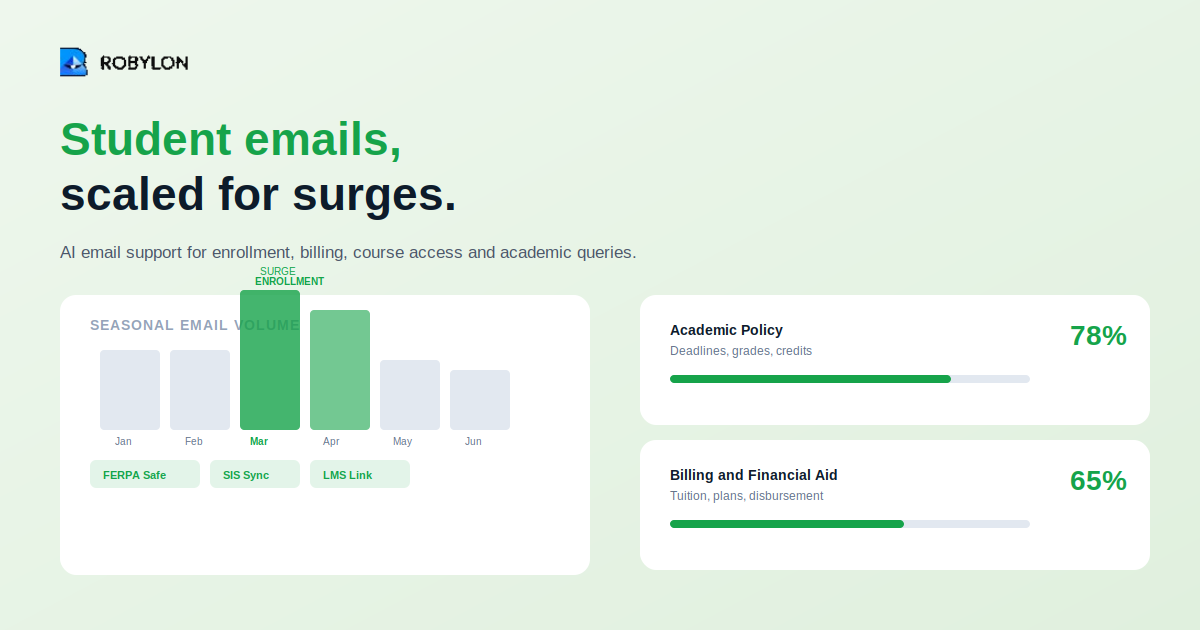
The Education Email Pattern
Educational institutions and EdTech companies share a common support challenge: extreme seasonality. Enrollment periods, exam seasons, financial aid deadlines, and semester starts create email surges that overwhelm support teams, followed by quieter periods.
Enrollment and admissions questions surge 60–90 days before term starts (20–25% of volume). Billing, financial aid, and payment inquiries peak around tuition due dates (25–30%). Course access and technical issues spike during the first two weeks of each term (15–20%). Academic policy questions maintain a steady 10–15%. General inquiries make up the remaining 10–15%.
Why Education Email Support Is Unique
FERPA Compliance
In the United States, FERPA restricts how student educational records can be shared. An AI email system must verify that the person emailing is the student themselves (or has legal authority) before sharing grades, enrollment status, financial information, or disciplinary records. Parent inquiries about adult students (18+) cannot receive record information without a signed FERPA release on file.
Multiple Stakeholder Groups
Education support handles emails from students, parents, prospective applicants, faculty, alumni, and employers. Each group needs different information and has different access rights. The AI must classify the sender type and adjust responses accordingly.
High Emotional Stakes
Education represents a life-defining investment. Emails about financial aid shortfalls, academic probation, or enrollment complications carry real emotional weight. AI responses must be empathetic and solution-oriented.
High-Automation Categories
Enrollment and Admissions (55–70% automation)
Pre-enrollment inquiries about programs, requirements, deadlines, and application processes draw from public information. Application status updates are similarly automatable — the AI checks the admissions system and provides current status with next steps.
Billing and Financial Aid (60–75% automation)
The AI can pull account balances, explain tuition breakdowns, process payment plan enrollments, provide financial aid package details (to verified students), explain scholarship disbursement timelines, and generate receipts. Complex appeals require human counselors.
Course Access and Technical Support (65–80% automation)
Password resets, course enrollment sync issues between SIS and LMS, content loading issues, and assignment submission problems all have standard resolution paths the AI can follow.
Academic Policy Questions (70–85% automation)
The AI combines published policy information with the student’s specific situation — pulling enrollment status, credit count, and academic record to give personalized guidance on deadlines, withdrawal procedures, and graduation requirements.
Integration Requirements
Essential systems include Student Information System (SIS) for enrollment and academic records, Learning Management System (LMS) for course access troubleshooting, financial systems for tuition and financial aid, admissions CRM for application tracking, and identity verification for FERPA compliance.
Seasonal Deployment Strategy
Start with general inquiries during a quiet period. Add enrollment automation before the next surge. Deploy billing automation before tuition due dates. Layer in technical support before term start. This validates each category before peak volume.
Measuring Success
Track seasonal peak handling capacity, student satisfaction scores by channel, enrollment conversion impact from faster response times, FERPA compliance through regular audits, and reduced temporary staffing costs during surges.
Bottom Line
Education email support is defined by seasonal extremes and stakeholder diversity. AI scales instantly during enrollment surges while correctly differentiating responses for students, parents, and faculty. FERPA compliance requires identity verification before sharing records. Start with highest-volume, lowest-risk categories and expand as confidence builds.
Handle enrollment surges without seasonal hiring. Robylon AI integrates with your SIS and LMS to resolve student emails automatically — from application status to course access issues. Start free at robylon.ai
Frequently asked questions
How does AI email support handle FERPA compliance?
The AI verifies the requester's identity and access rights before sharing any educational records. For adult students (18+), parents need a signed FERPA release on file. Without verified authorization, the AI provides only general policy information.
Which student emails can AI resolve automatically?
AI resolves academic policy questions at 70–85%, course access issues at 65–80%, billing and financial aid at 60–75%, and enrollment questions at 55–70%. Financial aid appeals and academic probation situations require human counselors.
How does AI handle seasonal email surges in education?
AI scales instantly during enrollment periods, exam seasons, and billing cycles without seasonal hiring. Deploy in phases aligned to the academic calendar: policy questions first, then enrollment, billing, and technical support before each surge.
What integrations does education AI email need?
Essential integrations include SIS for enrollment and academic records, LMS for course access troubleshooting, financial systems for tuition and financial aid, admissions CRM for application tracking, and identity verification for FERPA compliance.
Does AI email help with student enrollment conversion?
Yes — faster response to prospective student inquiries directly improves enrollment yield. AI responds in minutes rather than hours, providing program details, requirements, and financial aid information while interest is highest.