
AI Returns and Exchanges Automation for Shopify Stores
Returns generate a flood of support tickets that your returns app never touches. This guide shows how AI returns automation handles the conversation layer for Shopify stores, takes action across your stack, and turns more refunds into exchanges.
Key takeaways
- Your returns app handles the return. It does not handle the conversation about the return, which is where the tickets actually come from.
- Returns automation works by taking action across the stack - checking eligibility, issuing labels, confirming refund timing - rather than explaining the policy.
- The commercial upside is converting refunds into exchanges, which a well-timed alternative suggestion does and a policy page does not.
- Some returns should escalate even when the agent could technically resolve them. High-value orders and repeat returners are judgement calls.
- Peak season is the real test: returns spike when your team has least capacity to absorb them.
It’s the Monday after a big sale weekend, and the support inbox already has 200-plus messages before the team logs in. Almost none of them are new problems. They’re the same four questions: where is my refund, can I swap this for a larger size, how do I send it back, and did you get my return yet?
Every one of those takes a human two to five minutes. Look up the order. Check the return status. Read the policy. Copy a tracking number. Reply. Multiply that by a few hundred and you’ve lost a full week of your team’s time to questions a machine could answer in seconds.
This is the part of returns that nobody budgets for. You can have the best returns portal money can buy and still drown in returns-related tickets. Here’s why that happens, and what an AI agent that actually takes action does about it.
Why returns quietly became your biggest support cost
Returns stopped being a rounding error a while ago. The National Retail Federation pegged the 2024 average ecommerce return rate at 16.9%, and 2025 estimates put the online figure closer to one in five orders. For apparel, it routinely runs 20 to 40%. Roughly $850 billion in merchandise came back across US retail in 2025.
The headline rate isn’t even the expensive part. Processing a single return costs somewhere between $10 and $65 once you add return shipping, inspection, restocking, and the markdown on whatever can’t go back to full price. For a store doing $500K a year at a 20% return rate, that’s $100K of merchandise in motion and a five-figure processing bill on top.
Then there’s the support tax. Returns-related inquiries make up 30 to 50% of all support tickets for a typical ecommerce brand. That share spikes hard during the holidays, when return volume can jump four to ten times its baseline and retailers expect roughly 17% of holiday sales to come back.
A lot of this traces back to bracketing, where shoppers order three sizes intending to keep one. Half of Gen Z does it with clothing and shoes. The order looks great on the revenue dashboard in November and turns into three support conversations and two return labels in January.
The gap your returns app doesn’t close
If you run a Shopify store, you probably already use a returns platform. Loop, AfterShip Returns, ReturnGO, Return Prime, Redo. They’re good at what they do: a branded self-service portal, policy rules, exchange-first flows, carrier labels, and restocking back into Shopify inventory. ReturnGO and Loop in particular push customers toward exchanges instead of cash refunds, which protects revenue.
But notice what all of that is. It’s the transaction. The RMA, the label, the refund mechanics. None of it answers the customer who didn’t read the portal, or read it and got confused, or wants something the portal won’t let them do.
So the emails keep coming. The industry even has a name for the new wave: WISMR, “where is my refund,” the sequel to the classic WISMO “where is my order.” Customers ask it for the same reason they asked about delivery. They can’t see progress, and the average refund still takes around nine days to land once you count transit and warehouse processing. A portal doesn’t stop a worried customer from emailing. It just gives them a link they ignore on the way to your inbox.
This is the honest gap. Your returns app runs the workflow. Your support team runs the conversation. And the conversation is where the hours and the frustration pile up.
What returns automation AI actually does
“Returns automation” gets used for two different things, and it’s worth keeping them straight. The returns platform automates the logistics. An AI support agent automates the conversation and the actions inside it. The second one is what this article is about, and it’s the layer most Shopify stores haven’t automated yet.
An AI agent built for support reads the customer’s actual message, in their actual words, and resolves it the way a trained rep would. A typical returns and exchanges workload looks like this:
- Starting a return or exchange: the customer says “this jacket is too small,” and the agent confirms eligibility against your policy, then kicks off the return or size swap without a human touching it.
- Refund and return status: “where’s my refund” gets answered with the real state of that specific return, pulled live, not a canned “please allow 7 to 10 days.”
- Policy questions: what’s the window, is this item final sale, do I pay return shipping. Answered consistently, every time, in line with the policy you actually wrote.
- Exchange logistics: generating or resending a return label, confirming the replacement is in stock, and telling the customer when it ships.
- “Did you get it back?”: checking received status and reassuring the customer their package landed, which heads off the angry follow-up three days later.
The difference that matters is action. A chatbot that can only answer questions just sends the customer back to the portal. An agent with write access can do the thing. That’s the line between deflection and resolution, and it’s the whole game for ecommerce support automation.
Taking action, not just answering
Real resolution depends on what the agent can reach. To close a return ticket end to end, it has to read the order in Shopify, check the return record in your returns app, look at the payment in Stripe or Shopify Payments, and sometimes issue store credit or a discount code. An agent that can only read is a glorified FAQ.
This is where write-access integrations change the math. When the agent can create the return, push the label, update the order note, and trigger the refund inside your existing tools, the customer gets a finished answer in one message instead of a four-email relay. We’ve seen this is the single biggest factor in whether a returns ticket actually closes on the first touch or bounces to a human.
It also keeps your systems honest. Because the agent works through your returns app and Shopify rather than around them, the return record, the inventory count, and the refund all stay in sync. No shadow process, no reconciliation headache later.
Turning more refunds into exchanges
Here’s the part finance teams care about. A refund is lost revenue. An exchange or store credit keeps the money in the store. Returns platforms already know this, which is why exchange-first flows and bonus store credit exist. The problem is that incentives sitting in a portal only work if the customer opens the portal.
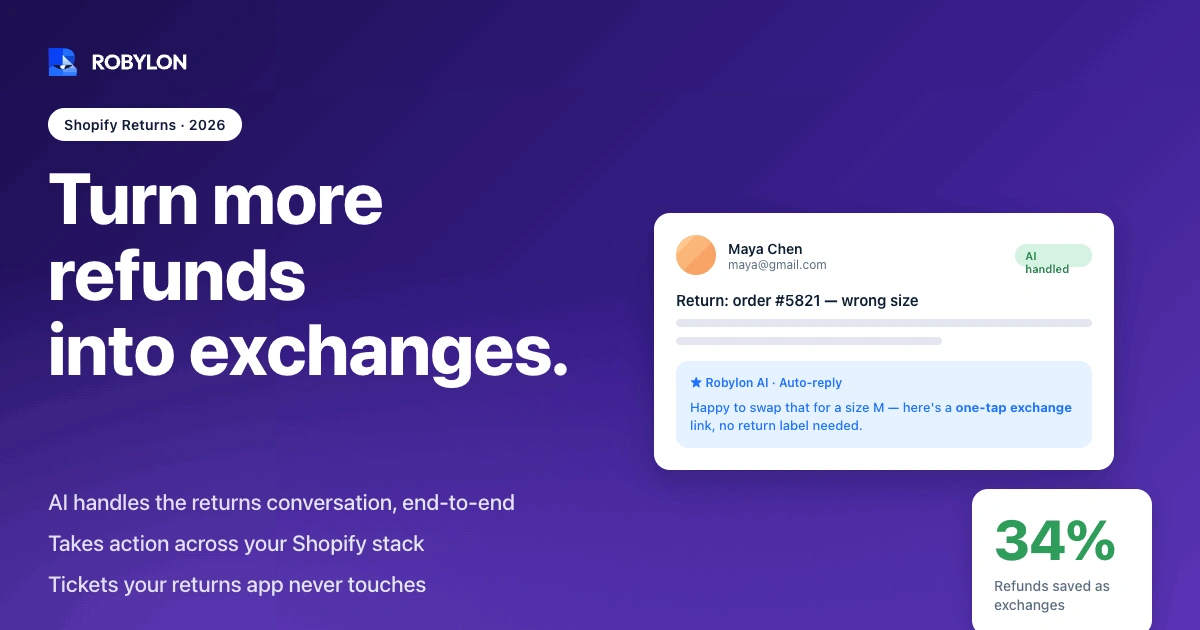
An AI agent moves the nudge into the conversation, where the customer already is. When someone emails to return a pair of boots, the agent can offer the same boots in a different size first, surface store credit with a small bonus, or suggest a similar in-stock item before defaulting to cash back. It’s not pushy. It’s the same offer your returns app would make, delivered at the moment the customer is actually paying attention.
Done well, this is one of the few support investments that shows up as retained revenue rather than just cost savings. The math on a 40-store apparel brand is hard to argue with once anyone bothers to run it: shifting even a fifth of refunds to exchanges meaningfully changes the quarter.
Where AI should escalate, even when it could technically resolve
Now the honest part, because a returns AI that automates everything is a returns AI you’ll regret. Some return conversations should never close without a human, even when the agent has enough access to do it.
Return fraud is the obvious one. It costs US retailers north of $100 billion a year, and roughly 9% of returns involve some form of abuse. Wardrobing, empty-box claims, false “never arrived” reports, and a newer trick where shoppers upload AI-generated photos of fake damage. About 85% of retailers now use machine learning to spot suspicious return patterns, but only 45% think those tools are fully effective. That gap is the point. An AI agent can flag a serial returner or an odd pattern and pause the refund. It should not be the thing that accuses a customer of fraud or makes the final call on a disputed claim.
A few other cases belong with a person:
- High-value or edge-case exceptions: a $900 order, a clear policy exception, or a goodwill decision that affects margin. Let the agent gather the facts and hand a clean summary to a human.
- Damaged or wrong-item disputes: when the customer and the photos disagree, judgment matters more than speed.
- An angry or escalating customer: tone-shift detection should route a frustrated shopper to a person before the conversation curdles, not after.
- Anything outside the written policy: if the answer requires a new decision rather than applying an existing rule, that’s a human’s call.
The right design isn’t “automate returns.” It’s automate the 60 to 80% that are routine and predictable, and route the rest to people with the full context already attached. That’s the difference between a returns AI that builds trust and one that quietly torches it.
Surviving the peak-season spike
The case for this gets sharpest in January. A two-person support team that handles 60 tickets a day comfortably is buried under 400 the week after Christmas, and most of them are returns. The usual fix is temp staff or a third-party queue, both of which are expensive and slow to spin up.
An AI agent doesn’t care that it’s January. It handles the 4-to-10x spike at the same speed it handles a quiet Tuesday, across whatever channels your customers actually use. Most returns questions land in order-status and refund emails, but they also show up in chat, WhatsApp, and on the phone. Coverage across all of them, in 40-plus languages, is what keeps response times flat while volume triples.
How Robylon fits a Shopify returns stack
Robylon is the support layer that sits on top of your returns setup, not a replacement for it. You keep Loop, AfterShip, or ReturnGO for the RMA and the labels. Robylon handles the conversations those returns generate and takes action across your tools to close them.
In practice that means 60 to 80% of customer emails and messages resolved autonomously, validated against your historical tickets during onboarding so you know the number before you commit. The agent connects through 60-plus write-access integrations, including Shopify, your returns app, and your payment system, so it creates returns, checks status, generates labels, and issues store credit rather than just pointing at a portal. It also handles refund request emails the way a senior rep would, with the actual order data in hand.
Three more things matter for a store doing real volume. Pricing is credits-based, so you pay per resolution instead of per agent, which means peak-season spikes don’t blow up your bill. Deployment runs three to seven days, not the multi-week implementation some enterprise returns tools require. And every workflow is human-in-the-loop, with escalation and tone-shift detection built in, so the judgment calls above always reach a person. If most of your returns traffic is email, the email support automation piece is usually where stores start.
The pitch isn’t replacing your support team. It’s giving them back the week they currently spend copying tracking numbers, so they can handle the conversations that actually need a human.
Ready to stop losing a week of support time to “where’s my refund” emails? Robylon AI resolves 60 to 80% of customer emails and messages autonomously, with AI agents that take action across Shopify, Loop, AfterShip, and 60-plus other integrations. Start free at robylon.ai
Frequently asked questions
Does AI returns automation replace my Shopify returns app?
No. Your returns app like Loop, AfterShip, or ReturnGO still runs the RMA workflow, generates labels, and restocks inventory. An AI support agent sits on top of that stack and handles the conversations returns create, the “where's my refund” and “can I exchange this” messages a portal never resolves. The two work together: the agent reads and updates the returns app through an integration, so records and inventory stay in sync.
How much support volume do returns actually generate?
Returns-related inquiries make up roughly 30 to 50% of all support tickets for a typical ecommerce brand, and that share climbs during peak season when return volume can spike four to ten times its baseline. Even stores with a polished self-service portal still field these messages, because worried customers email rather than check a tracking link. Automating that conversation layer is usually the fastest way to cut a support backlog.
Can AI handle exchanges, not just refunds?
Yes, and exchanges are where it protects revenue. An AI agent can confirm the replacement size or color is in stock, start the exchange, generate the return label, and offer store credit with a bonus before defaulting to a cash refund. Because the nudge happens inside the conversation rather than in a portal the customer might skip, more returns convert into retained revenue instead of lost sales.
What about return fraud and policy abuse?
An AI agent can flag suspicious patterns, like a serial returner or a refund that doesn't match the order history, and pause the refund for human review. What it should not do is make the final fraud call or accuse a customer, since wardrobing and disputed-damage claims need human judgment. Return fraud costs US retailers over $100 billion a year, so the right setup combines AI pattern-flagging with a person on the genuinely risky cases.
How long does it take to deploy on a Shopify store?
Robylon typically deploys in three to seven days, not the multi-week implementation some enterprise returns tools require. Setup involves connecting your Shopify store, returns app, and payment system, then validating the agent against your historical tickets so you see the expected resolution rate before going live. Pricing is credits-based and charged per resolution, so seasonal spikes don't trigger per-agent fees.
Related reading
- Customer Support
11 SaaS Help Desk Tools Ranked for 2026 (3 Are Completely Free)
The 11 best SaaS support tools for 2026, ranked with real pricing and an honest take on which charging model (per-agent, per-resolution, or credits) actually fits your team.
- Customer Support
11 Customer Service Trends in 2026 Every Support Leader Must Know
Top 11 customer service trends for 2026: from AI copilots to autonomous agents, voice AI, omnichannel, GenAI, and human+AI partnerships.
- Customer Support
9 Free Help Desk Tools in 2026 That Don't Feel Free (Full Breakdown)
From lightweight tools for startups to advanced systems with AI and automation, explore the top free and freemium help desk software of 2026.