Gorgias AI Agent vs Robylon AI: Side-by-Side for Shopify Brands
An honest side-by-side of Gorgias AI Agent and Robylon AI for Shopify brands. Pricing math at 5,000 tickets/month, resolution rates, channel coverage, integration depth, and three buyer profiles with a named pick for each.
Key takeaways
- The comparison runs at a realistic volume rather than a favourable one: a Shopify brand at 5,000 tickets a month and 60% AI resolution.
- The autonomous resolution gap between the two is smaller than either vendor's marketing suggests. Pricing model and channel coverage separate them more than resolution rate does.
- Voice is the clearest difference. If phones carry meaningful volume for you, the comparison stops being close.
- Three buyer profiles get a named pick, including one where Gorgias is the right answer - under 3,000 tickets a month and already deep in Shopify-native workflows.
It’s Wednesday afternoon and a Shopify Plus support lead has two browser tabs open. One has Gorgias AI Agent’s per-resolution pricing calculator. The other has a Robylon AI demo recording from last week.
The brand does 5,000 tickets a month, the CFO wants the AI vendor decision closed by Friday, and the two products keep looking different on every dimension that matters — but not in ways that map cleanly to a yes/no.
This article is the side-by-side that lead is looking for. It compares Gorgias AI Agent and Robylon AI across the dimensions Shopify brands actually weigh in vendor evaluations: pricing model, autonomous resolution rate, action depth, channel coverage, and time to deploy. Both are legitimate products. The honest answer to “which should I pick” depends on three or four things about your business, not on which vendor markets harder.
What each product actually is
Gorgias AI Agent is the autonomous resolution layer inside the Gorgias helpdesk. If you’re a Shopify or Shopify Plus brand on Gorgias, the AI Agent sits in the same workspace your team already uses, reads Shopify customer and order data from the native sidebar, and resolves tickets end-to-end without human handoff for the ticket types you enable it on. It’s built for ecommerce, and especially for Shopify.
Robylon AI is an AI-native agent that layers on top of any helpdesk — Gorgias, Zendesk, Freshdesk, Intercom — or runs standalone. It’s omnichannel by design (email-first AI, chat, voice, WhatsApp at parity) with 60+ write-access integrations covering Shopify, Recharge, Loop, AfterShip, ShipStation, and most of the post-purchase Shopify app stack. Deployment runs 3–7 days and pricing is credits-based, not per resolution.
One is a deeply native add-on inside a specific helpdesk. The other is a portable AI layer that runs across whatever stack you already have.
Pricing models compared, with real math
This is where the two products diverge sharpest, and where most Shopify CFOs end up making the call. The pricing models aren’t just different in number — they’re different in shape.
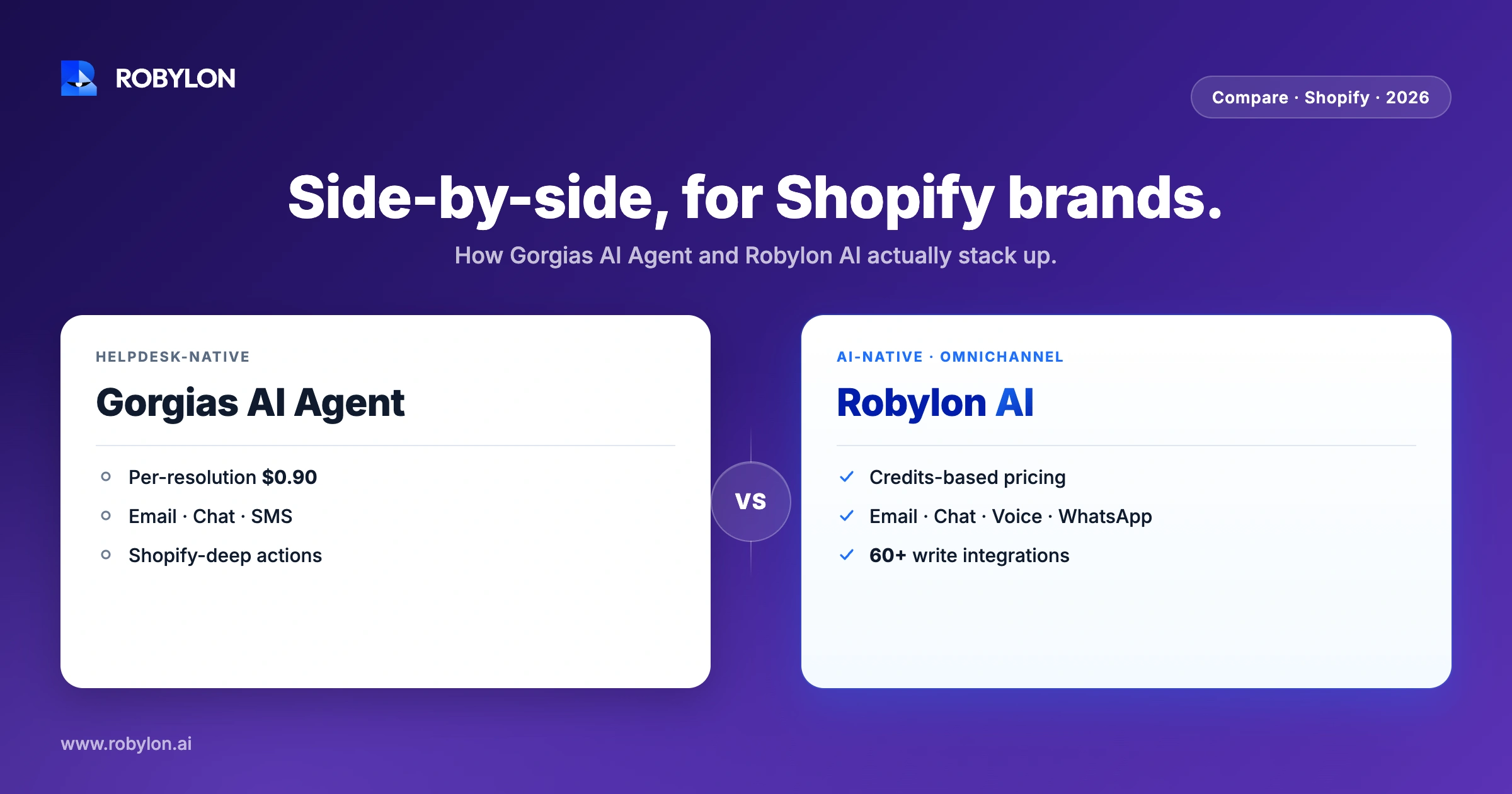
Gorgias AI Agent costs $0.90 per resolution on an annual contract, $1.00 on monthly. Critically, AI-resolved tickets also count against your Gorgias helpdesk plan’s ticket allotment. So a ticket the AI handles autonomously costs you both the per-resolution fee and a unit from your plan ceiling. Past the ceiling, you pay $0.36–$0.40 in overage per ticket.
Robylon’s pricing is credits-based. You buy a credit pack sized to your ticket volume and AI usage burns credits. No separate helpdesk seat fees. No per-resolution surcharge. No double-billing against a plan ceiling.
Here’s the math at a representative volume. Take a Shopify brand running 5,000 tickets per month at 60% AI resolution:
- Gorgias: Advanced plan (~$900/month, covers roughly 5,000 tickets) plus 3,000 AI resolutions × $0.90 = $2,700/month in AI fees. Total comes in around $3,600/month, plus overage if a campaign spikes volume past the plan ceiling.
- Robylon: Credits-based, billed for AI usage rather than per resolution, with no helpdesk seat layer underneath. A comparable tier lands materially lower at this volume. The exact quote depends on the credit pack you size to.
That’s the honest answer. We’re not going to fabricate a Robylon line item, but the structural difference is real: a brand growing from 5,000 to 15,000 tickets a month roughly triples its Gorgias AI bill in lockstep with volume, while Robylon’s credit-based curve flattens as utilization rises.
If you’re sub-2,000 tickets a month and already on Gorgias, the per-resolution model is fine. Past 5,000 tickets, the math starts to hurt.
Autonomous resolution rate: the gap is smaller than marketing suggests
Both products claim high autonomy. The honest reading is that they’re closer than the headline numbers suggest, and the difference depends heavily on ticket mix and setup quality rather than the underlying model.
Third-party reporting from MyAskAI puts Gorgias AI Agent in the 26–56% range on autonomous resolution across observed deployments. That’s a wide band, and the wide band is the point: the rate depends on how many of your tickets are “where is my order” versus “I need to swap sizes on a subscription that ships in three days.” The first category is highly automatable. The second needs deeper action chains.
Robylon validates a 60–80% autonomous resolution rate against each customer’s historical tickets during onboarding, before the contract is signed. The validation runs on real tickets, not a hypothetical corpus, which means the number you sign for is the number that holds up in practice.
The gap between 56% and 60% isn’t a chasm. What changes the chasm is two things: how broad your action surface needs to be (returns that touch Loop, subscription changes that touch Recharge, shipment redirects that touch AfterShip and ShipStation), and how willing the vendor is to commit to a number against your real ticket history. Pick the vendor that will validate against your tickets, not the one with the better marketing slide.
Action depth: where each one wins by category
Resolution rate is the headline. Action depth is the substance. An AI that “resolves” 70% of tickets by sending a templated email is worth less than one that resolves 50% by actually doing the work — refunding the order, swapping the SKU, pausing the subscription, updating the shipping address.
Gorgias AI Agent has the deepest Shopify-native action stack on the market right now. Because it shares a data model with the Gorgias helpdesk sidebar, it can read live Shopify customer and order data, trigger refunds, edit orders, cancel and re-create orders, and act on Shopify customer fields without an integration handoff. For brands whose universe is mostly Shopify-native actions, this is genuinely hard to beat.
Robylon’s action footprint is broader rather than deeper-into-Shopify. The 60+ write-access integrations mean the AI can pause Recharge subscriptions, process Loop returns, redirect AfterShip parcels, update ShipStation labels, and act inside whichever helpdesk you’ve kept around (Gorgias, Zendesk, Freshdesk, Intercom, Front). Shopify itself is supported with refunds, order edits, and customer data, but it’s one integration in a wider write surface.
The honest split:
- Pure Shopify action depth: Gorgias wins. The native sidebar UX and the shared data model make Shopify-only flows cleaner.
- Breadth across the post-purchase Shopify app stack: Robylon wins. Recharge, Loop, AfterShip, ShipStation, Klaviyo, plus the long tail.
- Multi-helpdesk environments: Robylon wins, because Gorgias AI Agent is Gorgias-only.
If 80% of your action chains end inside Shopify, Gorgias’s depth is the right tradeoff. If 30%+ of your chains touch a third-party app — and for most subscription, returns-heavy, or 3PL-shipped brands they do — Robylon’s breadth wins.
Channels: voice is the clearest delta
Gorgias AI Agent supports email, chat, and SMS. Voice is not a documented channel; WhatsApp parity is unclear. The product is built around the channels Gorgias the helpdesk supports natively.
Robylon supports email, chat, voice, and WhatsApp at parity. The AI doesn’t get smarter on email and dumber on voice — the same agent reasoning, integrations, and escalation logic apply across all four channels.
This matters less if you’re a chat-and-email-only brand. It matters a lot if you sell anything that drives phone calls: high-AOV apparel, subscription wellness, jewelry, anything where customers want to talk to a person about a $400 order. Voice automation is hard, and most AI vendors don’t have a credible voice stack. Shopify chatbot automation alone won’t cover the brands whose customers still call.
WhatsApp is the other under-discussed channel. For brands with material customer bases in India, LATAM, or parts of Europe, WhatsApp can be a primary support surface, and having it at parity with email is rare in the AI agent category.
Setup, deployment, and team fit
This is the dimension where Gorgias has a real, underrated advantage, and where the answer flips depending on where you start.
If you’re already on Gorgias as your helpdesk, turning on Gorgias AI Agent is the shortest path to live AI you’ll find. The integration is native, the data model is shared, the team is already trained on the workspace. Enable, tune the response policies, and watch the resolution rate climb over a few weeks of feedback.
If you’re on Zendesk, Freshdesk, Intercom, or running multiple helpdesks across regions, “go to Gorgias” is a much bigger project than the AI Agent decision suggests. You’re not evaluating an AI add-on; you’re evaluating a helpdesk migration.
Robylon’s 3–7 day deployment is the honest other path. The AI runs on top of your existing helpdesk, ingests historical tickets to validate the resolution rate, plugs into the 60+ integrations in scope, and goes live without a workspace switch. The team keeps using the helpdesk they’re trained on. The AI handles the front line.
The team-fit answer is symmetric. Already deep in Gorgias? Gorgias AI Agent is the path of least resistance. Already on something else, or running multi-helpdesk? Robylon is the path that doesn’t require a re-platform.
Which one should you pick?
Three buyer profiles, three honest picks.
You’re a Shopify Plus brand all-in on Gorgias, doing under 3,000 tickets/month
Pick Gorgias AI Agent. The native sidebar, the shared Shopify data model, and the team’s familiarity with the workspace are real advantages at this volume. The per-resolution math hasn’t started to hurt yet. There’s no integration migration to justify. Turn it on, tune the policies, ship.
You’re scaling past 5,000 tickets/month, or your support surface is multi-channel
Pick Robylon. The credits-based pricing scales better, voice and WhatsApp give you the channels Gorgias AI Agent doesn’t cover, and the 60+ integrations handle the long tail of post-purchase apps. If you’re touching Recharge, Loop, AfterShip, or running phones for any volume, the channel and integration breadth wins. See the wider field in our Gorgias alternatives comparison if you want to triangulate against a third option.
You’re on Zendesk or Freshdesk and not migrating
Pick Robylon. Gorgias AI Agent isn’t available without the Gorgias helpdesk, and a helpdesk migration is a much larger project than an AI rollout. Robylon layers on the helpdesk you already run.
The one frame to push back on: the idea that this is a winner-takes-all choice. It isn’t. Both products are legitimate. The question is which one fits the shape of your ecommerce operation today and where you expect to be in 18 months. For brands deep in Shopify-native workflows under modest volume, Gorgias’s depth is the right tradeoff. For multi-channel, multi-integration, or multi-helpdesk brands, Robylon’s breadth and pricing model are the right tradeoff. If you’re running Shopify order email automation as your primary use case, validate both vendors against your real historical tickets before signing.
Ready to size the right AI agent for your Shopify stack? Robylon AI resolves 60–80% of customer conversations autonomously across email, chat, voice, and WhatsApp, with action chains across Shopify, Recharge, Loop, AfterShip, and 60+ other integrations. Start free at robylon.ai
Frequently asked questions
What's the cost difference at 5,000 tickets/month?
For a Shopify brand at 5,000 tickets per month with 60% AI resolution, Gorgias AI Agent on the Advanced plan runs roughly $3,600/month — $900 helpdesk plus $2,700 in per-resolution AI fees at $0.90 per resolution. Robylon's credits-based pricing lands materially lower at this volume, with a quote that depends on the credit pack you size to. The structural difference is that Robylon's per-ticket cost flattens as volume rises, while Gorgias's scales linearly with resolution count.
Does Gorgias AI Agent handle voice or WhatsApp?
Gorgias AI Agent supports email, chat, and SMS as documented channels. Voice automation isn't part of the product, and WhatsApp parity with the other channels is unclear from public documentation. Robylon supports email, chat, voice, and WhatsApp at parity, with the same agent reasoning, integrations, and escalation logic across all four. If your brand drives meaningful phone or WhatsApp volume, that's the clearest functional gap between the two products today.
Can I run Robylon on top of Gorgias, or do I have to pick one?
You can run Robylon on top of Gorgias as the helpdesk. Robylon is helpdesk-agnostic and integrates with Gorgias, Zendesk, Freshdesk, Intercom, and Front as the workspace layer. Brands that want Gorgias's helpdesk UX but Robylon's pricing model, channel breadth, or integration depth can run that combination. You don't have to migrate off Gorgias to use Robylon; you do have to migrate to Gorgias to use Gorgias AI Agent.
Which has the higher autonomous resolution rate in practice?
Third-party reporting puts Gorgias AI Agent at 26–56% across observed deployments. Robylon validates 60–80% against each customer's historical tickets during onboarding. The honest read is that the underlying gap is narrower than the headline numbers suggest, and depends heavily on ticket mix and setup quality. The more important question is which vendor will commit to a validated number against your real tickets before you sign.
How long does each take to deploy from contract to production?
Gorgias AI Agent's enable-and-tune cycle is short if you're already on Gorgias: a few days to enable, then a few weeks of policy tuning before the resolution rate stabilizes. If you're not on Gorgias, add a helpdesk migration timeline on top. Robylon's 3–7 day deployment includes ingesting historical tickets, validating the resolution rate, configuring integrations, and going live on your existing helpdesk. No workspace switch required.
Related reading
- Comparisons
6 AI Platforms That Fully Automate Support Tickets in 2026 (90%+ Resolution)
A practical comparison of AI platforms that can fully resolve customer support tickets end to end. Covers real automation, system access, confidence controls, escalation, and when humans still matter.
- Comparisons
9 best Ada alternatives for AI customer support in 2026
Nine alternatives to Ada, compared on what each AI agent can do, which channels it connects natively, where it runs and how you buy it, with prices checked in October 2026.
- Comparisons
AI Chatbot Pricing Guide 2026: What Should You Pay?
AI chatbot pricing is confusing by design — per-agent fees, AI add-ons, per-resolution charges, and hidden usage limits make real costs hard to compare. This guide demystifies every pricing model and shows what you should actually pay based on your team size and ticket volume.