AI customer service agents for Shopify: the complete 2026 guide
AI customer service for Shopify has moved past deflection bots to agents that read order data and take action. This guide covers the ticket mix that automates, what an agent does inside your store, where it should hand off to a human, and how to roll it out in days.
Key takeaways
- Shopify support has moved past deflection bots to agents that read live order data and act on it.
- The ticket mix is what makes this viable: returns and exchanges alone are 10-20% of volume and fully resolvable once the agent can check eligibility against the order date.
- Order edits, address changes and subscription updates are all write operations. An agent that cannot write can only ever half-resolve them.
- Shopify margins are thin, so the economics matter more than the automation rate. The article works through both.
By 9 a.m. on a Monday, a mid-sized Shopify brand has 60 new messages waiting. Roughly half of them are some version of the same sentence: “where is my order?” Another handful want to start a return, swap a size, or change the shipping address on something that hasn’t left the warehouse yet.
None of those need a human. All of them used to get one. That gap, between what genuinely requires judgment and what just requires a lookup and an action, is the entire reason AI customer service for Shopify exists in 2026.
This guide is for store owners and CX leads who want to understand what these agents actually do, where they break, and how to put one in front of customers without torching the trust you spent years building.
What “AI customer service for Shopify” actually means now
For years, “AI on Shopify” meant a chat bubble that matched keywords to a buried FAQ article and called it resolved. Customers hated it, and rightly so. Pointing someone at a help-center link when they asked a direct question isn’t support. It’s a wall with a search box.
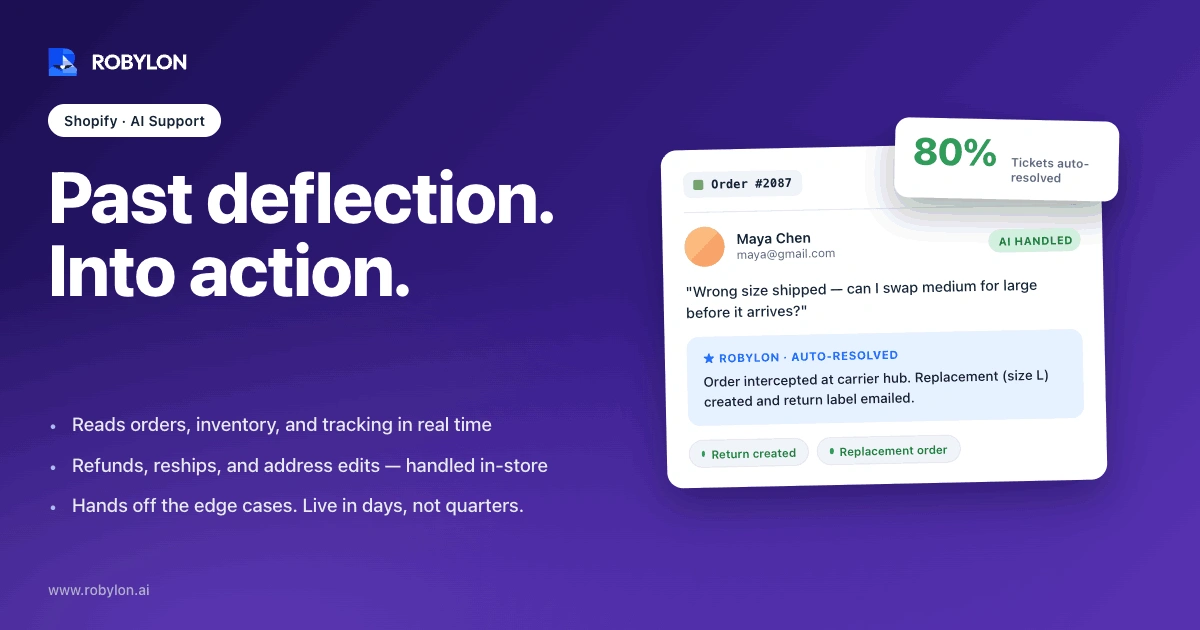
The 2026 version is different in one specific way: the agent takes action. It pulls the live order from your store, reads the carrier status, processes the refund through Shopify, edits the order, or pauses the subscription. It doesn’t just talk about the resolution.
It does the thing.
One distinction trips people up, so it’s worth clearing early. Shopify’s own Sidekick is an AI assistant, but it lives in your admin and works for you, the merchant. It analyzes sales, drafts product copy, builds Flow automations, and edits themes. It does not sit in your storefront fielding “where’s my refund” from shoppers. Customer-facing AI customer service is a separate layer that connects to the same Shopify data Sidekick uses, then points it outward at the people buying from you.
The Shopify ticket mix is why this works at all
Ecommerce support has an unusually predictable shape, and that shape is what makes automation viable. Across most Shopify brands, the queue breaks down something like this:
- WISMO (“where is my order”): usually 30–60% of all volume. The single highest-volume category, and one of the lowest-complexity to answer once the agent can read live carrier data.
- Returns and exchanges: another 10–20%. Fully resolvable when the agent knows your return policy and can check eligibility against the order date.
- Subscription and billing questions: pause, skip, swap a flavor, update a card, ask why a charge happened. Common for any brand with a recurring product.
- Product and pre-purchase questions: sizing, ingredients, compatibility, “will this ship before Friday.”
- Order edits: wrong address, wrong variant, “can I add one more before it ships.”
One vendor put it bluntly: about 80% of tickets are the same five questions. That’s not a knock on your customers. It’s the nature of selling physical products to a lot of people. And it’s exactly the kind of repetitive, structured work an AI agent handles better than a tired human on their fortieth identical reply of the morning.
Compare that to, say, enterprise B2B support, where every ticket is a bespoke configuration problem. Shopify support is the opposite. It’s high-volume and pattern-heavy, which is the shape automation handles best. That’s also why AI customer support for ecommerce brands tends to hit higher resolution rates than support in messier verticals.
What an agent actually does inside your store
The difference between a chatbot and an agent comes down to write access. A chatbot reads. An agent reads and then acts on your behalf, the way a trained support rep would if you handed them admin access and a clear policy doc. Here’s what that looks like across the big categories.
Order tracking, answered with live data
When a customer asks where their order is, the agent looks up the order in Shopify, reads the fulfillment and carrier status, and replies with the real tracking state and an honest delivery window. If the package is genuinely stuck, it can say so and offer the next step instead of a canned “please allow 5–7 business days.” Pairing the agent with a branded tracking platform like AfterShip or Wonderment shrinks WISMO volume even before customers ask, and feeds the agent the same carrier data when they do.
Returns, exchanges, and refunds
Returns aren’t one ticket type. They’re a small lifecycle: check eligibility, generate the label, confirm receipt, issue the refund or send the exchange. A capable agent walks the customer through it inside the conversation, checks the order against your return window, and processes the refund through Shopify once conditions are met. Some brands gate the refund on the warehouse scanning the package as received, and the agent waits for that signal before releasing money. That’s the kind of conditional logic that separates real resolution from a glorified FAQ.
Address changes and order edits
“I typed the wrong apartment number” is a tiny request with a tight deadline. If the order hasn’t shipped, the agent can update the address or swap a variant directly. If it already shipped, the agent says so plainly and shifts to the realistic options. Speed matters here more than anywhere: a fix that lands in 20 seconds prevents a misdelivery that would’ve cost you a replacement unit and a frustrated customer.
Subscriptions and account changes
For subscription brands, “pause my next box” and “skip this month” are constant. An agent wired into your subscription app handles those without a human, and can catch the save opportunity too: someone trying to cancel because they have too much product often just wants to push the next ship date, not leave.
All of this depends on how deeply the agent connects to your stack. The order data lives in Shopify, but the returns logic might live in a returns app, the tracking in a post-purchase tool, and the customer history in your helpdesk. The agents worth deploying ship with broad write-access integrations so they can act across all of those systems, not just read from one.
Where the agent should stop and call a human
Here’s the part most vendor pages skip, and it’s the part that actually protects your brand. A good agent knows what it shouldn’t touch.
Some tickets need a person, and trying to automate them is how you end up on a screenshot in someone’s angry post. The agent should escalate, with full context, when it sees:
- Emotional escalation: a customer who’s already upset, using strong language, or on their second or third contact about the same problem. Tone-shift detection should route these to a human fast.
- High-value or fraud-flagged disputes: chargebacks, suspected fraud, large refunds outside policy. These need judgment and often a second set of eyes.
- Damaged or wrong items with evidence: when a customer sends a photo of a broken product, the resolution usually involves a goodwill call the agent shouldn’t make alone.
- Policy exceptions: the return window closed yesterday and the customer has a sympathetic reason. Whether to bend the rule is a brand decision, not an automation one.
The mark of a mature setup isn’t a high automation number alone. It’s a high automation number plus clean handoffs, where the human picking up the ticket gets the full history, the order context, and a suggested resolution instead of a cold “customer needs help.” Honestly, a system that escalates well is worth more than one that brags about resolving 95% and quietly mangles the other 5%.
The economics, because Shopify margins are thin
This is where the case stops being about convenience and starts being about survival. The median DTC brand nets somewhere between 3% and 10% after ad spend, COGS, shipping, returns, and fees. There isn’t much room. A loaded support ticket costs roughly $5 to $15 once you count agent time, tooling, and overhead, and WISMO tickets have a nasty habit of generating repeat contacts when the first answer doesn’t satisfy.
Now do the math on a brand handling a few thousand tickets a month where 80% are repetitive. Automating that volume isn’t a nice-to-have. It’s the difference between hiring your third support rep and not needing to. Gartner projects that by 2029, agentic AI will resolve 80% of common service issues and cut operational support costs by around 30%. DTC brands are already running ahead of that curve, because their ticket mix is the friendliest possible terrain for it.
Pricing model matters here too. Per-seat support tools charge you whether or not the seat is busy. A credits-based AI chat agent ties cost to resolutions, which lines up far better with the spiky, seasonal volume most Shopify brands actually see. You pay for the work done, not for a license sitting idle in February.
How to roll it out on your store
Deploying AI customer service on Shopify is faster than most teams expect, but the sequence matters. Do it in this order and you’ll avoid the fragmented mess that comes from gluing point tools together after the fact.
- Connect your data first. Wire the agent into Shopify, your helpdesk, your returns app, and your tracking tool. The agent is only as good as the data it can read and the actions it can take.
- Validate against your real history. Before it touches a live customer, run the agent against your past tickets to see how it would have answered. This is where you catch policy gaps and bad assumptions cheaply.
- Start with WISMO. It’s the biggest, safest category. Automate it, confirm resolution quality and CSAT, then move on.
- Expand to returns and subscriptions. Once tracking is solid, layer in the action-heavy workflows where the agent is processing refunds and editing orders.
- Set your escalation rules. Define exactly what goes to a human and make sure the handoff carries full context. This is the safety net that lets you automate aggressively.
- Measure against a baseline. Track resolution rate, CSAT, and response time against where you started. Then find the next category to automate.
A well-scoped deployment lands in roughly 3–7 days, not months. The long part isn’t the technology. It’s writing down the policies you’ve been carrying in your head.
How Robylon handles Shopify support
Robylon is an AI agent built to resolve customer conversations end-to-end, not just suggest replies. It connects to Shopify and the rest of your stack, reads order and customer history, and takes action across email, chat, WhatsApp, and voice with email-first specialization. On a typical Shopify ticket mix, it resolves 60–80% of conversations autonomously, validated against your historical tickets during onboarding so the number is real before you go live.
The action layer is the point. With 60+ write-access integrations, the agent processes refunds, edits orders, updates addresses, and manages subscriptions rather than handing every action back to your team. When a ticket needs a person, human-in-the-loop workflows with tone-shift detection escalate it with full context. It works across 40+ languages, which matters once your store ships internationally.
One concrete result: a D2C fashion brand using Robylon resolved 85% of chat queries and 60% of tickets, with average reply times dropping to 3–6 seconds while responses stayed personalized using each customer’s purchase history. For a deeper look at the ecommerce angle, our breakdown of smarter AI support for ecommerce goes further into the workflows.
Ready to take WISMO, returns, and refunds off your team’s plate? Robylon AI resolves 60–80% of customer conversations autonomously, with agents that take action across Shopify, your helpdesk, WhatsApp, and 60+ other integrations. Start free at robylon.ai
Frequently asked questions
Is Shopify Sidekick the same as AI customer service?
No. Sidekick is Shopify's built-in assistant for merchants, living inside your admin to help you analyze data, write content, and build automations. It works for the store owner, not the shopper. AI customer service is a separate, customer-facing layer that connects to your Shopify data and answers and resolves tickets from buyers. The two are complementary: Sidekick helps you run the store, while a support agent handles the people buying from it.
What customer questions can an AI agent resolve on Shopify?
The agent handles the high-volume, repetitive categories that make up most of a store's queue. That means order tracking answered with live carrier data, returns and exchanges processed against your policy, refunds issued through Shopify, address and order edits before shipment, and subscription changes like pausing or skipping. Roughly 80% of a typical Shopify queue is the same handful of questions, which is exactly the work an agent is built to take off your team's plate.
How accurate are AI customer service agents for Shopify?
On an ecommerce ticket mix, well-configured agents resolve a large majority of conversations autonomously, often in the 60–80% range and higher for chat-heavy stores. Accuracy depends on data access and good escalation design. The agents to trust use confidence scoring: when certainty is low, they route to a human with full context instead of guessing. Validating the agent against your historical tickets before launch is the best way to confirm the number is real for your store.
Will an AI agent replace my support team?
The realistic framing is augmentation, not replacement. The agent absorbs the repetitive volume that burns out reps, which lets a smaller team focus on the conversations that need judgment: upset customers, fraud, damaged goods, and policy exceptions. Most brands use the freed capacity to improve quality and avoid hiring ahead of growth, rather than cutting headcount. The goal is scaling support without scaling cost in lockstep.
How long does it take to set up AI customer service on Shopify?
A focused deployment usually takes 3–7 days, not months. Most of that time goes into connecting your data sources and writing down policies, not technical integration. The fastest path is to connect Shopify and your helpdesk, validate the agent against past tickets, launch on order-tracking questions first, then expand into returns and subscriptions once you've confirmed resolution quality and CSAT hold up against your baseline.
Related reading
- Customer Support
11 SaaS Help Desk Tools Ranked for 2026 (3 Are Completely Free)
The 11 best SaaS support tools for 2026, ranked with real pricing and an honest take on which charging model (per-agent, per-resolution, or credits) actually fits your team.
- Customer Support
11 Customer Service Trends in 2026 Every Support Leader Must Know
Top 11 customer service trends for 2026: from AI copilots to autonomous agents, voice AI, omnichannel, GenAI, and human+AI partnerships.
- Customer Support
9 Free Help Desk Tools in 2026 That Don't Feel Free (Full Breakdown)
From lightweight tools for startups to advanced systems with AI and automation, explore the top free and freemium help desk software of 2026.