
AI Email Support for Travel & Hospitality: Bookings, Cancellations & Disruptions
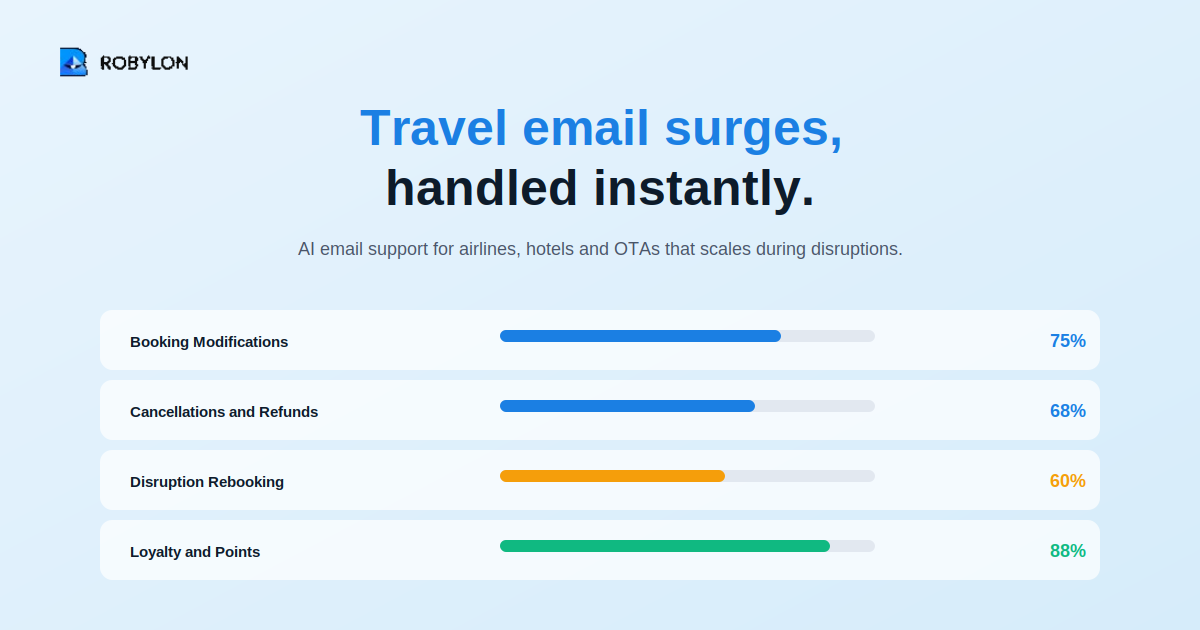
Travel companies face extreme email spikes during disruptions — storms, cancellations, overbookings. AI email support handles these surges without adding temporary staff, resolving 60–75% of routine travel queries automatically.
The Travel Email Landscape
Travel is the most unpredictable industry for customer support. A single weather event can generate ten times your normal email volume overnight. Airlines, hotels, OTAs, and tour operators face a fundamental scaling problem: you cannot hire and train temporary agents fast enough to handle a disruption that starts at 2 AM and peaks by 6 AM.
Travel support email breaks down into predictable categories. Booking modifications (date changes, room upgrades, seat selection) represent 25–30% of volume and are highly automatable. Cancellation and refund requests make up 20–25%. Pre-trip information requests account for 15–20%. Disruption-related emails represent 10–15% normally but can spike to 60%+ during disruptions. Loyalty program queries add another 10–15%.
Why Travel Email AI Is Different
Real-Time Inventory Dependency
When a customer emails asking to change their flight from Tuesday to Wednesday, the AI needs to check live seat availability, calculate fare differences, apply the correct change policy, and confirm the new booking. This requires deep integration with reservation systems (GDS, PMS, or OTA backend).
Multi-Party Coordination
A single travel booking might involve an airline, a hotel, a car rental, and a transfer service. When one component changes, the others may need adjustment. AI email systems must understand itinerary dependencies.
Emotional Intensity During Disruptions
A cancelled flight is not the same as a delayed package. Stranded travelers are stressed, sometimes in unfamiliar countries. AI responses during disruptions need to lead with empathy and provide immediate actionable alternatives.
Automating Booking Modifications
The AI workflow for a date change follows a clear sequence: identify the booking using confirmation number or email, parse the requested change, check the modification policy and applicable fees, check availability in the reservation system, calculate any price difference and present options, then execute the modification and send updated confirmation.
For hotels, this resolves 70–80% of modification requests without human involvement. For airlines, the rate is 60–70% because of fare class complexity.
Handling Cancellations and Refunds
The critical path is determining the applicable cancellation policy, calculating the refund amount (full, partial, or credit), processing the cancellation, initiating the refund, and sending confirmation with timeline details.
Edge cases requiring human review include gray-area cancellations during weather events without formal waivers, group bookings with negotiated terms, and requests citing medical emergencies or bereavement.
Disruption Management: The Acid Test
Proactive Communication
The best travel AI email systems send proactive notifications when disruptions occur — cancellation notices, automatically rebooked alternatives, refund or credit options, hotel and meal voucher information, and compensation claim instructions where applicable (such as EU261 regulations).
Handling the Inbound Surge
AI handles the surge by matching emails to the disruption event and booking, classifying request types, searching available alternatives for rebooking, checking compensation eligibility, and providing voucher information for practical needs.
Loyalty Program Email Automation
Loyalty emails are among the easiest to automate at 80–90% rates. Points balance inquiries need only a database lookup. Tier qualification questions require calculating activities against thresholds. Award redemption involves searching availability. Missing points claims follow verification workflows. Status match requests follow documented policies.
Integration Requirements
Essential integrations include reservation systems or GDS (Amadeus, Sabre, Travelport), Property Management Systems, payment processing for refunds, disruption feeds (FlightAware, OAG), loyalty systems, and CRM for customer history.
Measuring ROI
Track disruption handling capacity, rebooking conversion rate, average resolution time during disruptions (typical reduction from 4–8 hours to under 30 minutes), seasonal cost avoidance, and revenue recovery through modifications.
Bottom Line
Travel email support is defined by volatility. AI email support gives travel companies the ability to scale instantly during crises while maintaining quality and empathy. The key is deep reservation system integration, disruption-aware workflows, and proactive communication.
Handle travel email surges without hiring sprees. Robylon AI integrates with booking systems and scales instantly during disruptions — resolving 60–75% of travel emails automatically. Start free at robylon.ai
Frequently asked questions
How does AI handle email surges during travel disruptions?
AI handles disruption surges by scaling instantly — processing thousands of concurrent emails. It matches emails to disruption events and bookings, classifies requests, searches rebooking alternatives, checks compensation eligibility, and sends proactive outreach to affected travelers.
What percentage of travel emails can AI resolve?
Loyalty queries achieve 80–90% automation, booking modifications reach 60–80%, cancellations hit 65–75%, and pre-trip information resolves at 75–85%. During disruptions, AI handles 50–65% of the inbound surge automatically.
What integrations does travel AI email need?
Travel AI email requires reservation systems or GDS (Amadeus, Sabre, Travelport), Property Management Systems, payment processors for refunds, disruption feeds (FlightAware, OAG), loyalty systems, and CRM for customer history.
Can AI email handle flight rebooking automatically?
Yes, with GDS integration. The AI searches available alternatives, presents options with fare differences, and executes rebookings upon confirmation. Simple same-day rebookings with waiver codes can be fully automated. Complex multi-segment international rebookings typically need human agents.
How do you measure ROI of travel AI email support?
Track disruption handling capacity, rebooking conversion rate, resolution time during disruptions (typical improvement from 4–8 hours to under 30 minutes), seasonal cost avoidance, and revenue recovery from retained bookings.