
Cost Per Email Ticket: Industry Benchmarks and How AI Cuts It by 60%
Most support leaders know their total support budget but not their cost per email ticket. This data-rich guide provides fully loaded cost benchmarks by industry, breaks down every cost component, and shows exactly how AI reduces cost per ticket from $5–$20 to $2–$6 — with the math to prove it.
Every email your support team handles has a cost. Not just the obvious cost — the agent’s time — but the fully loaded cost that includes salary, benefits, overhead, tooling, management, training, and quality assurance. Most support leaders dramatically underestimate this number because they divide agent salaries by ticket count and call it done, ignoring the 40–60% overhead that makes the real number much higher.
Understanding your true cost per email ticket is the foundation for every ROI calculation, hiring decision, and automation business case. This guide provides the benchmarks, the calculation methodology, and the AI impact data you need.
How to Calculate Your True Cost Per Email Ticket
The Full Cost Stack
Start with agent compensation: base salary plus benefits, taxes, and employment overhead (typically 25–35% of base). Add workspace costs: office space, equipment, internet (for remote teams: hardware stipend, software licenses). Add tooling: helpdesk software, QA tools, knowledge base, CRM access — typically $50–$250 per agent per month. Add management overhead: team leads, managers, and directors spend time on scheduling, coaching, escalation handling, and reporting — allocate 10–15% of their fully loaded cost to email operations. Add training: new hire onboarding ($2,000–$8,000 per agent), ongoing training, and the productivity ramp (new agents operate at 50–70% efficiency for their first 4–6 weeks). Add quality assurance: QA staff time, calibration sessions, coaching hours.
Divide this total by the number of email tickets resolved per month. That is your true cost per email ticket.
Industry Benchmarks: Cost Per Email Ticket in 2026
E-Commerce
Agent salary range: $30,000–$45,000 (US), $4,000–$8,000 (India/Philippines). Fully loaded cost per agent per month: $3,250–$5,000 (US), $500–$900 (offshore). Emails per agent per day: 50–70 (high repetition, simpler queries). Cost per email ticket: $6–$10 (US-based), $1.50–$3.00 (offshore). Blended (mixed team): $3–$6 per ticket.
E-commerce has the lowest per-ticket cost because email queries are highly repetitive (WISMO, returns, product questions) and resolution patterns are straightforward. High-volume merchants (10,000+ emails/month) achieve lower per-ticket costs through specialization and economies of scale.
SaaS / Technology
Agent salary range: $40,000–$65,000 (US), $6,000–$12,000 (offshore). Fully loaded cost per agent per month: $4,500–$7,500 (US), $750–$1,400 (offshore). Emails per agent per day: 30–50 (more complex, requires product knowledge). Cost per email ticket: $8–$15 (US-based), $2.50–$5.00 (offshore). Blended: $5–$9 per ticket.
SaaS email support costs more per ticket because queries are more complex (billing edge cases, technical questions, feature requests), agents require deeper product training, and resolution often involves consulting documentation or engineering teams. Average handle time is 40–60% longer than e-commerce.
Fintech / Financial Services
Agent salary range: $45,000–$70,000 (US), $8,000–$15,000 (offshore). Fully loaded cost per agent per month: $5,000–$8,500 (US), $1,000–$1,800 (offshore). Emails per agent per day: 25–40 (compliance requirements, sensitive handling). Cost per email ticket: $12–$20 (US-based), $4–$8 (offshore). Blended: $7–$12 per ticket.
Fintech has the highest per-ticket cost because agents need compliance training, responses require regulatory awareness, some queries need supervisor approval, and audit trail requirements add overhead to every interaction. PII handling protocols also add time to each email.
B2B Enterprise
Agent salary range: $50,000–$75,000 (US). Fully loaded cost per agent per month: $5,500–$9,000. Emails per agent per day: 20–35 (complex, multi-stakeholder). Cost per email ticket: $15–$25 per ticket.
B2B enterprise email support involves multi-threaded issues, multiple stakeholders, custom configurations, and SLA-driven response requirements. Handle times of 20–40 minutes per email are common. The high per-ticket cost makes AI automation particularly attractive — even modest auto-resolution rates produce significant savings.
How AI Reduces Cost Per Email Ticket
The Direct Mechanism
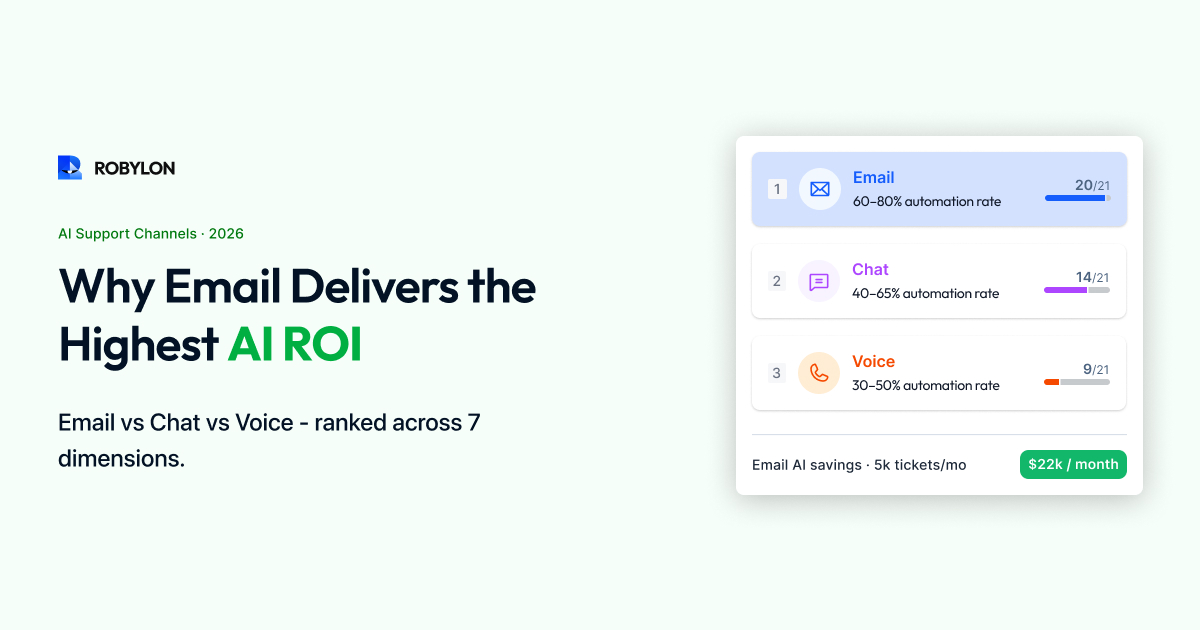
AI-resolved emails cost $0.50–$2.00 each — the cost of the AI platform divided by the number of resolutions. When AI resolves 60–80% of email volume, the blended cost per ticket drops dramatically because you are averaging $0.50–$2.00 (AI) with $6–$20 (human) at a 70/30 ratio.
The math for an e-commerce company at 5,000 emails/month: current state at $7 per ticket = $35,000/month. With AI (70% AI at $1.50, 30% human at $7): (3,500 × $1.50) + (1,500 × $7) = $5,250 + $10,500 = $15,750/month. That is a 55% reduction — from $7.00 to $3.15 per ticket blended.
For SaaS at $10 per ticket and 5,000 emails: current = $50,000/month. With AI (60% AI at $1.50, 40% human at $10): (3,000 × $1.50) + (2,000 × $10) = $4,500 + $20,000 = $24,500/month. A 51% reduction — $10.00 to $4.90 blended.
For fintech at $15 per ticket and 3,000 emails: current = $45,000/month. With AI (50% AI at $2.00, 50% human at $15): (1,500 × $2.00) + (1,500 × $15) = $3,000 + $22,500 = $25,500/month. A 43% reduction — $15.00 to $8.50 blended.
The Indirect Mechanisms
Beyond direct resolution savings, AI reduces cost per ticket through three indirect mechanisms. First, reduced agent handle time: for the emails agents still handle, AI copilot features (auto-suggested drafts, customer context panels, knowledge retrieval) cut handle time by 30–50%, increasing agent throughput from 40–50 emails/day to 55–75. Same agent cost, more tickets resolved. Second, reduced training costs: fewer agents needed means fewer $2,000–$8,000 training investments per year. Third, reduced management overhead: fewer agents requires less management capacity — one team lead can oversee a smaller team, freeing management time.
The Compounding Effect Over Time
Cost per ticket does not stay flat with AI — it decreases over time as the system improves. Month 1 might achieve 55% auto-resolution and a $4.50 blended cost per ticket. By month 6, with knowledge gaps closed, integrations expanded, and confidence thresholds optimized, auto-resolution reaches 75% and blended cost drops to $3.00. By month 12, mature deployments achieve 80%+ and blended costs of $2.00–$2.50.
Meanwhile, email volume is likely growing 10–30% annually. Without AI, this growth requires proportional agent hiring — maintaining cost per ticket while increasing total spend. With AI, volume growth is absorbed by the platform at marginal cost, so both cost per ticket and total spend improve simultaneously.
Bottom Line
Know your true cost per email ticket — it is higher than you think. Use the fully loaded calculation (not just salary ÷ tickets), benchmark against your industry, and then model the AI impact. The numbers are consistent across industries: AI reduces blended cost per email ticket by 40–65%, with the savings compounding as auto-resolution rates improve over time.
Cut your cost per email ticket by 60%. Robylon AI resolves 60–80% of email tickets at $0.50–$1.50 each — versus $5–$20 for human-handled emails. Start free at robylon.ai
Frequently asked questions
What is the average cost per email ticket by industry?
Fully loaded cost per human-handled email (2026 benchmarks): E-commerce: $6–$10 (US), $1.50–$3.00 (offshore). SaaS: $8–$15 (US), $2.50–$5.00 (offshore). Fintech: $12–$20 (US), $4–$8 (offshore). B2B Enterprise: $15–$25 (US). These include agent salary, benefits, overhead, tooling, management, training, and QA. Most teams underestimate by 40–60% because they only count salary divided by tickets.
How does AI reduce cost per email ticket?
AI-resolved emails cost $0.50–$2.00 each versus $5–$20 for human-handled. At 70% AI resolution, blended cost drops 40–65%: an e-commerce company at $7/ticket drops to $3.15 blended, SaaS at $10/ticket drops to $4.90, fintech at $15/ticket drops to $8.50. Indirect savings add more: reduced agent handle time (AI copilot cuts 30–50% on remaining tickets), avoided hiring (AI absorbs volume growth), and reduced training costs (fewer agents to onboard).
How do I calculate cost per email ticket for a blended AI and human team?
Formula: (AI-resolved emails × AI cost per email) + (human-handled emails × human cost per email) ÷ total emails. Example at 5,000 emails/month, 70% AI: (3,500 × $1.50) + (1,500 × $7.00) = $5,250 + $10,500 = $15,750 ÷ 5,000 = $3.15 blended. Include the AI platform cost in the AI per-email calculation: $2,000/month platform ÷ 3,500 resolutions = $0.57 per AI resolution. Add agent fully loaded cost for the human portion.
What is the fully loaded cost calculation for email tickets?
Add all components: agent salary + benefits/overhead (25–35% of salary) + helpdesk software ($15–$150/agent/month) + QA tools ($10–$30/agent) + management overhead (10–15% of manager cost allocated) + training ($500–$2,000 per new hire, amortized). Divide the monthly total by emails resolved per month. Example: $4,875/month fully loaded agent cost ÷ 1,050 emails/month = $4.64/ticket at the low end. Higher-salary regions, complex tickets, or lower productivity push this to $8–$15.
Does cost per email ticket decrease over time with AI?
Yes — cost per ticket compounds downward as the AI improves. Month 1: 55% auto-resolution, $4.50 blended. Month 6: 75% auto-resolution (KB gaps closed, integrations expanded), $3.00 blended. Month 12: 80%+, $2.00–$2.50 blended. Meanwhile, email volume likely grows 10–30% annually — without AI, this growth requires proportional hiring (maintaining cost per ticket but increasing total spend). With AI, growth is absorbed at marginal cost, improving both metrics simultaneously.