
Why Email Should Be Your First AI Automation Channel (Not Chat)
The conventional wisdom is to start AI automation with chat. The data says otherwise. Email has no real-time pressure, higher volume, greater customer tolerance for AI, richer context per message, and better economics. This article makes the contrarian, data-backed case for automating email first — and why Robylon AI is built on this principle.
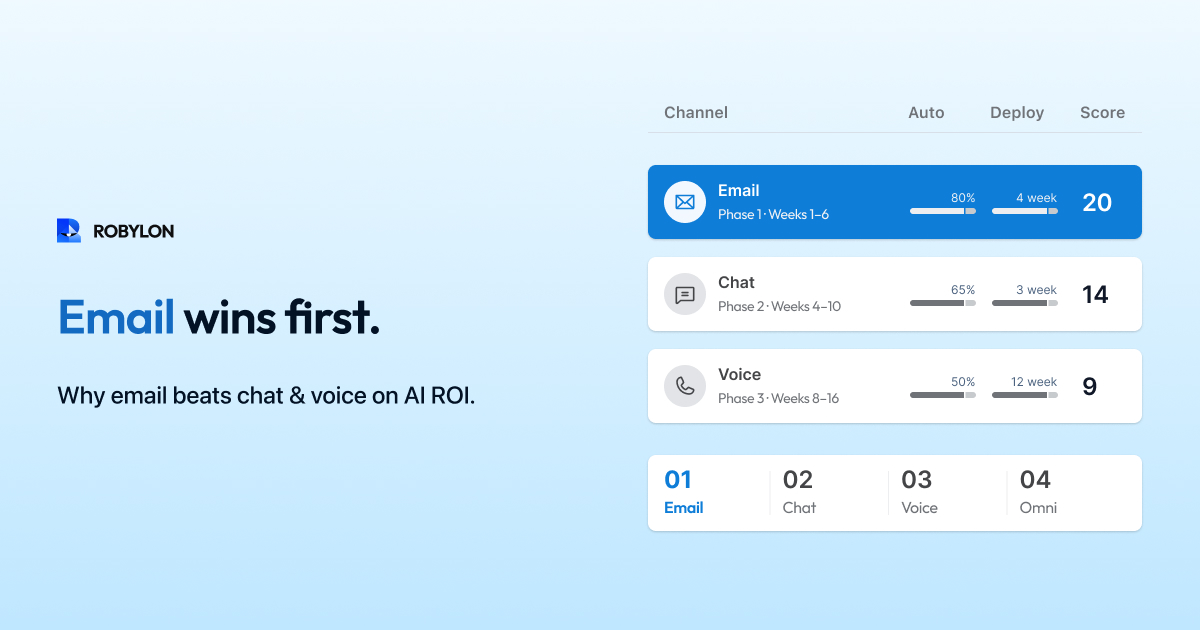
Ask most customer support leaders which channel they would automate first with AI, and the answer is almost always “chat.” It makes intuitive sense — chatbots have been around for years, the technology is visible and familiar, and every SaaS company has a chat widget on their website.
But the intuition is wrong. When you evaluate channels across seven dimensions that determine AI automation success — tolerance for response delay, volume and repetition, context richness, customer expectation, error recovery, data quality for training, and economic impact — email scores higher on every single one. Email is not the second channel to automate. It is the first.
The 7-Dimension AI Automation Scorecard
Dimension 1: Tolerance for Response Delay
Email: High. Chat: Near-zero.
When a customer sends a support email, they expect a response in hours — typically 1–8 hours depending on the industry. This gives the AI time to process carefully: parse a long email, query multiple systems, retrieve knowledge base content, validate the response, and send a well-constructed reply. If the AI takes 30 seconds or 3 minutes, the customer does not notice.
Chat operates in real-time. Customers expect responses in seconds. A 10-second pause feels like an eternity. This real-time pressure forces AI to prioritize speed over accuracy, leading to shorter, less complete responses and higher escalation rates. The AI cannot afford to run a complex multi-step resolution workflow — it needs to respond immediately or the customer gets frustrated.
This single difference — time — is the most important factor in AI automation success. More time means more accurate responses, more complete resolutions, and fewer mistakes.
Dimension 2: Volume and Repetition
Email: Higher volume, more repetitive. Chat: Lower volume, more varied.
Email is the highest-volume support channel for most businesses. E-commerce companies receive 60–70% of their support inquiries via email. SaaS companies receive 40–50%. The majority of these emails fall into predictable categories: order status (30–40%), returns and refunds (15–20%), policy questions (10–15%), billing (10–15%). This high repetition means a well-configured AI can handle a large portion with a relatively small knowledge base.
Chat tends to attract simpler, more impulsive queries — “Is this in stock?” or “What’s the discount code?” — but also more varied, conversational interactions that are harder for AI to handle systematically. Chat volume is typically 30–50% lower than email volume for the same business.
Dimension 3: Context Richness Per Message
Email: Rich. Chat: Sparse.
A customer email typically contains 50–200 words, often including order numbers, account details, screenshots, and a clear description of the issue. This gives the AI abundant signal for intent detection, entity extraction, and personalized resolution.
Chat messages average 8–15 words. The customer types “where’s my order” without an order number, account email, or additional context. The AI must ask follow-up questions — “Can you provide your order number?” — which adds friction and extends the conversation. In email, the customer usually front-loads all the information because they know the response will not be immediate.
Dimension 4: Customer Expectation for AI
Email: High tolerance. Chat: Mixed.
Customers are already accustomed to receiving automated emails — order confirmations, shipping notifications, password resets. An AI-generated support response feels like a natural extension of this. The customer does not know (or particularly care) whether a human or AI wrote the response, as long as it answers their question.
Chat carries stronger expectations for human interaction. Many customers specifically seek out live chat because they want a human conversation. When they encounter a chatbot, frustration is common — “I want to speak to a real person” is among the most frequent chatbot interactions. This expectation gap means chat AI starts at a trust deficit that email AI does not face.
Dimension 5: Error Recovery
Email: Forgiving. Chat: Punishing.
If an AI sends an incorrect email response, the customer replies pointing out the error, and a human agent corrects it. The total impact is a delayed resolution — inconvenient but manageable. The customer’s perception is “they made a mistake and fixed it.”
If a chatbot gives a wrong answer in real-time, the customer sees the error immediately and loses confidence in the AI on the spot. Recovery is difficult because the customer is still in the conversation, already frustrated, and likely demands a human handoff. The real-time nature of chat means errors are visible, immediate, and trust-destroying in a way email errors are not.
Dimension 6: Data Quality for Training
Email: Structured, complete. Chat: Fragmented, incomplete.
Email threads are self-contained: the original question, the response, and any follow-ups are captured in a single thread with clear structure. This makes email an excellent data source for training and improving the AI — every resolved email becomes a labeled example of “this intent → this resolution.”
Chat transcripts are messier: conversations wander, customers disconnect mid-conversation, agents handle multiple chats simultaneously (leading to confused threads), and the sequential nature means important context is spread across dozens of short messages rather than captured in one cohesive email. Training data from chat requires more cleaning and produces noisier signals.
Dimension 7: Economic Impact
Email: Higher savings per automated interaction. Chat: Lower.
A human-handled email costs $5–$15 (7–12 minutes of agent time at fully loaded rates). A human-handled chat costs $3–$8 (4–8 minutes of agent time, often multi-tasked across 2–3 simultaneous chats). An AI-resolved email costs $0.50–$2.00. An AI-resolved chat costs $0.10–$0.50.
The savings per automated interaction are larger for email: $4.50–$13.00 saved per email versus $2.90–$7.50 per chat. At equal volume, automating email produces 40–60% more cost savings than automating chat. And email volume is typically higher, so the absolute savings gap is even wider.
The Scorecard Summary
Across all seven dimensions, email scores 20 out of 21 possible points (3 per dimension). Chat scores 11. This is not a marginal difference — email is nearly twice as favorable for AI automation as chat on every measurable criterion.
The companies that have achieved the highest AI automation rates — 60–80% of support volume resolved without humans — almost all started with email. They built the knowledge base, tuned the confidence thresholds, optimized the integrations, and then expanded the same AI to chat once the email engine was mature. Starting with chat and then trying to adapt to email is harder, because chat AI is designed for speed and simplicity, while email AI is designed for depth and accuracy.
The Email-First Implementation Path
Month 1: Email Automation Foundation
Deploy AI on your email channel. Connect your knowledge base, OMS, CRM, and billing systems. Run shadow mode for 1–2 weeks, then enable auto-resolution for top categories (WISMO, FAQs, returns). Target: 50–60% auto-resolution by end of month 1.
Month 2: Email Optimization
Close knowledge gaps identified in month 1. Expand auto-resolution to billing, subscription, and account management categories. Tune confidence thresholds based on accuracy data. Target: 65–75% auto-resolution.
Month 3: Expand to Chat
The same AI engine — knowledge base, integrations, intent models — now powers your chat channel. Because the foundation was built on email (richer data, higher accuracy requirements), the chat AI starts at a higher performance level than it would have if you had built chat-first. Target: 50–60% chat auto-resolution from day one (versus 30–40% if starting fresh).
Month 4+: Multi-Channel Optimization
Both channels share the same knowledge base and integrations. Improvements to one channel benefit the other. A new FAQ article added for email resolution is immediately available for chat. A new API integration that enables refund processing in email works in chat too. The shared foundation means every optimization has double the impact.
Why Most Companies Get This Backwards
The chat-first approach persists for three reasons: chatbot vendors have marketed aggressively for a decade (creating the association between “AI support” and “chatbots”), chat AI is more visible to executives (they see the widget on the website), and chat deployments produce quick demos (a chatbot answering simple questions in a product demo looks impressive).
But demos are not production results. When the chat-first company tries to expand to email six months later, they discover that their chat AI — optimized for short, rapid responses — struggles with long, detailed customer emails. The intent models trained on 10-word chat messages misclassify 200-word emails. The response templates designed for chat are too terse for email. The integrations that worked for simple chat workflows are insufficient for the complex, multi-step resolution email requires.
The email-first company does not have this problem. An AI engine built for the depth and accuracy of email handles chat trivially — because chat is a simpler, less demanding version of the same task.
Bottom Line
Email is the highest-ROI, lowest-risk, most data-rich channel for AI automation. It gives the AI time to process accurately, provides rich context for intent detection, tolerates errors gracefully, produces clean training data, and delivers the largest cost savings per automated interaction. Starting with email builds a stronger AI foundation that makes every subsequent channel deployment faster and more effective.
The question is not whether to automate email — it is whether to waste months automating chat first and then retrofit for email, or to start where the economics and the technology converge: email.
Start where the ROI is highest. Robylon AI is built email-first — resolving 60–80% of email tickets automatically before expanding to chat, voice, and WhatsApp. Start free at robylon.ai
Frequently asked questions
Why is email a better channel than chat for AI automation?
Email scores higher than chat across 7 dimensions: 1) Response time tolerance — hours vs seconds. 2) Volume and repetition — higher volume, more automatable patterns. 3) Context richness — 50–200 words per email vs 8–15 per chat message. 4) Customer AI tolerance — customers accept automated emails; many resist chatbots. 5) Error recovery — email mistakes are correctable; chat mistakes destroy trust in real-time. 6) Training data quality — self-contained threads vs fragmented chats. 7) Economic impact — $4.50–$13 saved per automated email vs $2.90–$7.50 per chat.
What is the 7-dimension AI automation scorecard?
The scorecard evaluates channels across 7 factors for AI readiness (1–3 points each, 21 max): tolerance for response delay, volume and repetition, context richness per message, customer expectation for AI, error recovery, data quality for training, and economic impact. Email scores 20/21. Chat scores 11/21. The largest gap is on response delay tolerance (email: 3, chat: 1) and error recovery (email: 3, chat: 1) — email gives AI time to be accurate and room to correct mistakes gracefully.
Should I automate email or chat first with AI?
Email first. Start with email automation (month 1–2), optimize to 65–75% auto-resolution (month 2–3), then expand the same AI engine to chat (month 3+). Because email requires deeper, more accurate AI, building for email first creates a stronger foundation — the chat AI starts at higher performance (50–60% from day one) because the knowledge base, integrations, and intent models were already refined on the harder channel. Starting with chat and retrofitting for email is harder and produces worse results.
How much more ROI does email AI deliver compared to chat AI?
Email AI saves $4.50–$13.00 per automated interaction (human email cost $5–$15 minus AI cost $0.50–$2). Chat AI saves $2.90–$7.50 per interaction (human chat cost $3–$8 minus AI cost $0.10–$0.50). At equal volume, email automation produces 40–60% more cost savings. And email volume is typically higher than chat (60–70% of support inquiries for e-commerce), so the absolute savings gap is even wider.
What happens when I expand from email AI to chat AI?
The same AI engine — knowledge base, integrations, intent models — powers both channels. When you expand to chat, you get instant 50–60% auto-resolution (vs 30–40% if starting chat-first) because the foundation was built on the harder channel. Every KB improvement, every new integration, and every accuracy optimization benefits both channels simultaneously. The shared foundation means every improvement has double the impact.