
AI for Complaint Escalation Emails: A Practical Guide
Complaint escalation emails are the highest-stakes tickets in any inbox. This guide covers how AI detects them, what triggers a handoff, and where automation must stop short.
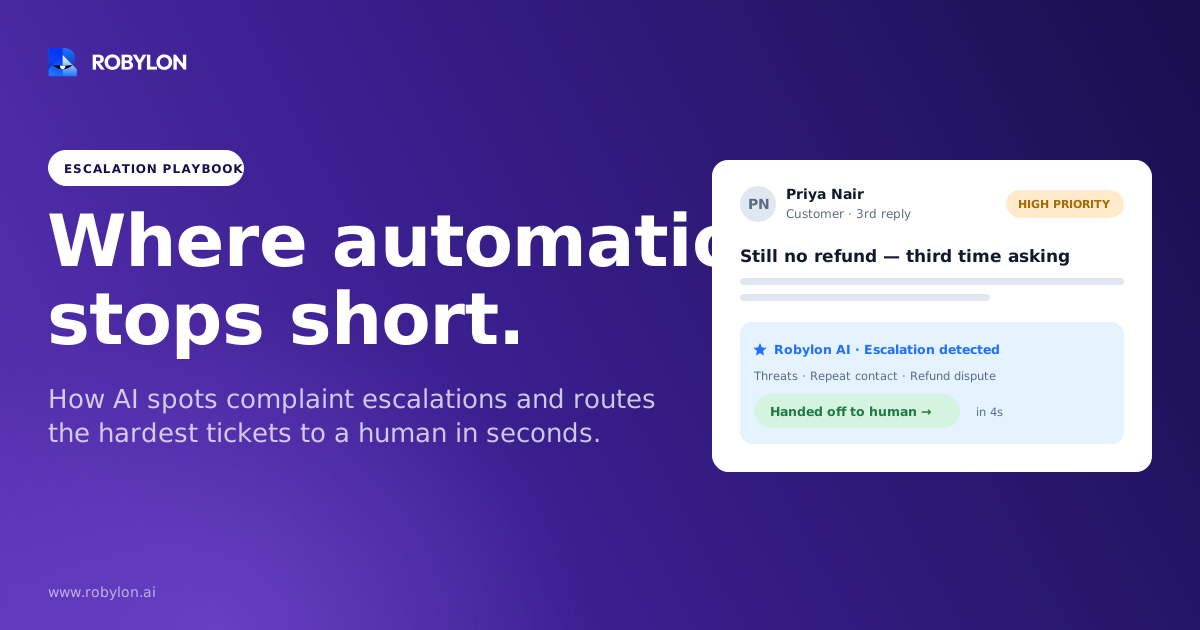
A customer who emailed three days ago about a double charge just sent a fourth message. The subject line is in all caps. The word “lawyer” appears in the second sentence. That email is sitting in a queue of 200, and the agent who opens it next has no idea it’s the most expensive ticket in the inbox.
That is the core problem with complaint escalation. The emails that matter most are the easiest to miss, because volume hides them. By the time a human notices, the customer has often already decided to leave.
The stakes are not abstract. Research cited by Zendesk found that 56% of consumers rarely complain about a bad experience and quietly switch instead, which means the customers who do escalate are the ones still worth saving. Get the escalation right and you keep them. Miss it and you lose them, plus everyone they tell.
What makes a complaint email different from a normal ticket
Most support email is transactional. Where’s my order, how do I reset my password, can I change my shipping address. These have a known answer and a known fix. A complaint escalation email is different in three ways, and each one changes how it should be handled.
First, it carries emotion. The customer is frustrated, and that frustration compounds with every reply that doesn’t resolve it. Second, it usually has history. This is rarely the first contact, it’s the third or fourth, and that history matters for the response. Third, it often carries risk that a single agent can’t see: a churn risk, a chargeback risk, a public-review risk, sometimes a legal or regulatory one.
An ordinary AI auto-reply that treats this like a FAQ lookup will make things worse. The right approach starts by recognizing that a complaint is not a single ticket type, it’s a signal that the normal process already failed.
How AI spots a complaint before a human does
The first job is detection, and this is where AI earns its place. A model reads every inbound email the moment it lands, not when an agent gets to it, triaging each message on the way in. It’s scoring three things at once.
- Sentiment and tone: the emotional charge of the language, including the shift from a customer’s earlier polite message to a sharper one. A drop in tone across a thread is a stronger signal than any single angry word.
- Severity keywords: terms like refund, cancel, legal, chargeback, complaint, or escalate, weighted by context rather than matched blindly.
- Thread history: how many times this person has written, whether an SLA was already breached, and whether the same issue keeps reopening.
Modern systems go past simple sentiment scoring of positive or negative. They detect specific emotions like frustration, urgency, and confusion, and the better ones can explain the trigger rather than just flagging that someone is angry. That matters, because “angry about a billing error mentioned twice already” needs a different response than “angry in general.”
There’s a counterintuitive finding worth sitting with. The most dangerous churn signal often isn’t anger, it’s silence. One analysis found customers who go quiet after a problem are roughly 3x more likely to churn within 30 days than those still actively complaining. So a good system also flags threads that went cold after an unresolved issue, not just the loud ones.
What should trigger an escalation, and to whom
Detection is useless without a clear rule for what happens next. The teams that get this right define their escalation logic once, in plain terms, and let the AI apply it consistently. A practical tier structure looks like this:
- Tier 1, AI resolves directly: the complaint is real but the fix is known and within policy. A late refund the customer is owed, a reshipment for a damaged item, a billing correction. The AI takes the action and closes the loop.
- Tier 2, route to a human agent: the issue needs judgment, an exception to policy, or a personal touch. The AI hands off with a full summary so the agent doesn’t start cold.
- Tier 3, escalate to a manager or specialist: high-value account, legal language, a regulatory flag, or a repeat failure on the same issue. These jump the queue and alert a named owner.
Good AI email escalation knows the difference between resolving an issue and routing it to a human, and that judgment is the whole game. The rule shouldn’t be “escalate every angry email.” It should be “escalate the angry emails where a human will change the outcome.” Everything else the AI can handle faster than a person would, which is the point.
Time-based rules belong here too. If a high-severity ticket goes untouched past its SLA response window, it should escalate on its own, with an alert and a reassignment, before the customer has to chase it. Companies that resolve complaints within an hour see far higher retention than those that take a day, so the clock is part of the trigger.
The handoff is where most automation falls apart
Here’s where a lot of tools quietly fail. They detect the complaint, they decide to escalate, and then they dump a raw email into a human queue with no context. The agent has to read the whole thread, piece together what happened, and figure out what’s already been tried. The handoff added zero value.
A handoff that actually helps carries a package: a two-line summary of the complaint, the customer’s history and value, what the AI already checked, the relevant order or account data pulled from connected systems, and a suggested next action. The agent reads for ten seconds and acts, instead of investigating for ten minutes.
This is the difference between automation that offloads work and automation that just relocates it. The handoff has to make the human faster, or the escalation was only half-built. Tone-shift detection feeds this directly: when the AI catches a customer’s mood sliding from neutral to hostile mid-thread, it can pull a human in before the next reply, not after.
Where AI must escalate, even when it could technically resolve
Honesty about limits is what separates a trustworthy system from a reckless one. There are complaint types where the AI should hand off even if it has the data to act, because the cost of a wrong autonomous move is too high.
- Legal or regulatory language: mentions of lawyers, regulators, formal complaints, or compliance bodies go to a human every time.
- High-value or strategic accounts: your top customers get a person, full stop. The relationship is worth more than the efficiency.
- Anything involving a public threat: “I’m posting this on social” is a brand-risk decision, not a support decision.
- Repeat failures on the same issue: if the customer has complained about this twice and it broke again, more automation is the wrong answer. Escalate to someone who can fix the root cause.
Over-relying on sentiment scoring is its own trap. A model can misread a calm, polite email that is actually a serious complaint, or over-react to mild sarcasm. That’s why the strongest setups treat sentiment as one input among several, and keep a human in the loop for the cases where being wrong is expensive. The goal is augmentation and scale, not removing people from the moments that need them.
What this looks like in practice
Imagine a mid-size ecommerce brand getting 600 support emails a day, maybe 40 of them genuine complaints. Before automation, those 40 sit in the same queue as everything else, sorted by arrival time. The angriest customer might wait six hours behind a stack of “where’s my package” questions.
With an AI layer in front of the inbox, the flow changes. Every email is read on arrival. The 40 complaints are surfaced and scored. Twenty-five of them are issues the AI can resolve under policy, so it issues the refund, sends the reshipment, corrects the charge, and replies in the customer’s language, closing them in minutes. Ten route to agents with a full summary attached. Five, the legal mentions and the top-tier accounts, jump straight to a manager with an alert.
The human team now spends its time on fifteen tickets that need a human, instead of triaging all 600. That’s the operational shift. Robylon delivers this with 60 to 80% autonomous resolution on email, sentiment and tone-shift detection built into the escalation logic, and 60+ write-access integrations so the AI can actually issue the refund or pull the order record rather than just drafting a reply about it.
Getting the setup right
The technology matters less than the rules you give it. A few things make the difference between an escalation system that builds trust and one that erodes it.
Write your escalation tiers down before you automate anything. If your team can’t agree on what counts as Tier 2 versus Tier 3, no AI will fix that ambiguity, it’ll just apply your confusion at scale. Validate the AI against your own historical tickets during onboarding, so you know its resolution rate on real complaints, not a vendor’s demo. And review the escalation decisions weekly at first. The model learns your edge cases, but only if someone checks its calls and corrects the misses.
Done well, complaint escalation stops being the thing that slips through the cracks. It becomes the most reliable part of the inbox, because the highest-stakes emails are the ones the system watches most closely.
Ready to stop losing your most frustrated customers to a crowded inbox? Robylon AI resolves 60 to 80% of customer emails autonomously, with sentiment-aware escalation that takes action across Shopify, Zendesk, Stripe, and 60+ other integrations. See how Robylon handles email support
Frequently asked questions
How does AI decide which complaint emails to escalate?
AI reads each inbound email on arrival and scores it on sentiment, severity keywords, and thread history at the same time. It weighs the emotional tone, looks for high-risk terms like legal or chargeback, and checks whether an SLA was already breached or the same issue keeps reopening. Cases the AI can fix under policy get resolved directly. Anything needing judgment, involving a high-value account, or carrying legal language gets routed to a human with full context attached.
Can AI resolve a complaint without a human at all?
Yes, for a defined set of cases. When a complaint is genuine but the fix is known and within policy, like a refund the customer is owed or a reshipment for a damaged item, AI can take the action and close the loop on its own. Robylon resolves 60 to 80% of email autonomously this way. The remaining cases, especially those needing exceptions or a personal touch, are routed to a person with a summary so they start informed rather than cold.
What complaint types should never be fully automated?
Some complaints should reach a human even when the AI could technically act. These include emails with legal or regulatory language, your highest-value accounts, public threats like “I’ll post this online,” and repeat failures on the same issue. The cost of a wrong autonomous move in these cases is too high, so the safest design keeps a person in the loop. Sentiment scoring should be one input among several, never the sole basis for a high-stakes decision.
Why is the AI-to-human handoff so important?
A handoff only helps if it makes the human faster. Many tools detect a complaint, decide to escalate, then dump a raw email into a queue with no context, which adds no value. A strong handoff carries a summary, customer history, what the AI already checked, and a suggested next action. The agent reads for ten seconds and acts, instead of investigating for ten minutes. Without that package, escalation just relocates the work rather than reducing it.
How fast should a complaint escalation email get a response?
Speed is part of the trigger, not a separate goal. Companies that resolve complaints within one hour see significantly higher retention than those taking a day or more. A good system acknowledges receipt immediately, applies time-based rules so any high-severity ticket past its SLA escalates on its own, and surfaces the most urgent cases ahead of routine questions. The aim is to reach the frustrated customer before they have to chase you a second time.