
Gorgias email automation for e-commerce: review and limits
Gorgias is the go-to helpdesk for Shopify merchants. This review covers how well it automates email, where it stops and what it costs at volume, and links to the full comparison of Gorgias alternatives.
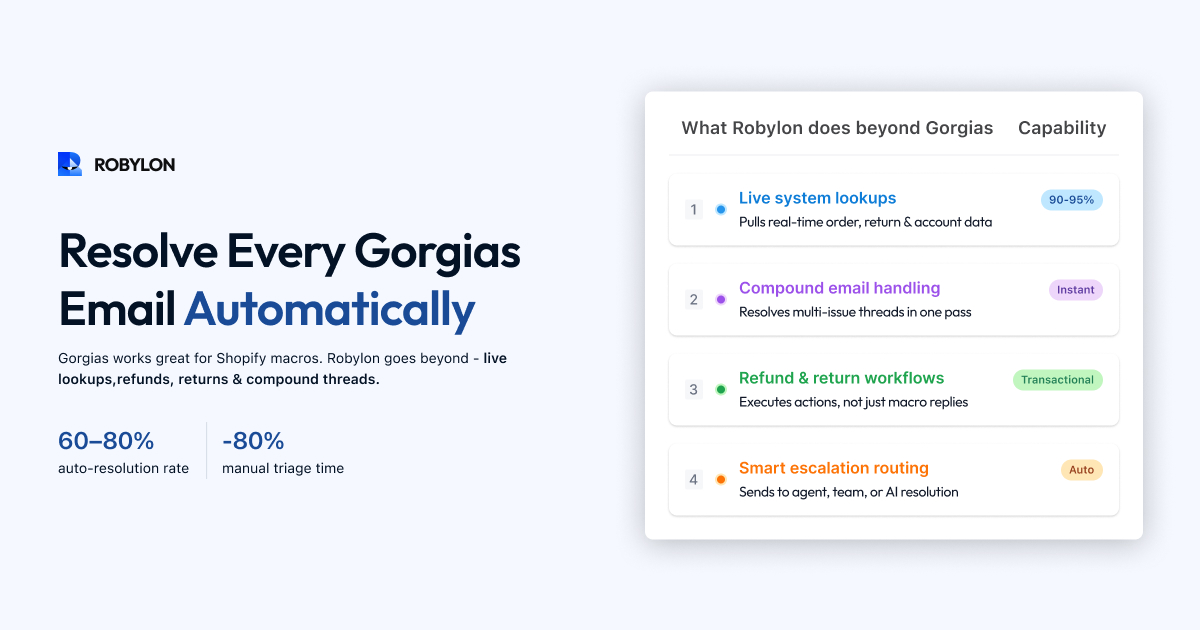
Gorgias is the helpdesk most Shopify brands start with, and its AI Agent is more than macros: it answers from your help center, website and Shopify data, and on Basic and above it cancels, edits and reships Shopify orders without extra setup. What limits it for growing stores is the bill and the scope: a ticket AI Agent resolves is billed twice, and AI Agent works only for Shopify stores inside Gorgias’s own helpdesk.
This review covers what Gorgias’s email automation handles, where it stops and what it costs, from Gorgias’s own pricing page and help centre, read on 7 October 2026.
What Gorgias does well
Deep Shopify integration
From inside the helpdesk, agents see order details, purchase history and subscription status, and can refund, edit, cancel and restock orders from the sidebar. For a team answering order emails by hand, that saves a tab switch on almost every ticket.
AI Agent with Shopify actions
Gorgias AI Agent answers from the help center, website, documents, guidance and Shopify data, in support and shopping-assistant roles. On Basic and above it takes Shopify actions once a store is connected: cancel an unfulfilled order with a full refund and restock, edit a shipping address, remove items with a refund, replace one item, reship an order free and add an order note. App Actions extend it to Loop Returns, Recharge, Skio, Loop Subscriptions, ShipStation, ShipBob, ShipHero and ShipMonk, and custom Actions are built in a visual workflow builder. It replies in more than 80 languages.
Revenue attribution
Gorgias tracks revenue that follows support conversations, so a store can measure what support earns as well as what it costs.
Commerce channels in one inbox
Email, chat, the help center, contact forms, Facebook Messenger, Instagram and WhatsApp sit in one inbox with order context, and voice and SMS are available as add-ons.
Where Gorgias stops for email AI
Resolved tickets are billed twice
Each ticket AI Agent fully resolves costs one helpdesk ticket fee plus one automation fee of $0.90 on annual plans or $1.00 on monthly plans. If AI Agent hands over, or the shopper reaches a person within 72 hours, only the ticket fee applies. On published prices, 3,000 chat and email conversations a month with 60% resolved by the AI come to $2,520 a month on Gorgias Pro with AI Agent, billed monthly.
Ticket-based plans
Plans are priced by ticket volume: Starter is $10 a month for 50 tickets, Basic $60 a month for 300, Pro $360 for 2,000 and Advanced $900 for 5,000 on monthly billing, with extra tickets at $36 to $40 per 100. A sale weekend raises the bill in step with ticket volume.
Shopify and Gorgias only
AI Agent needs a Shopify store connected to Gorgias and works only inside Gorgias’s own helpdesk, with one AI Agent per connected store. AI Agent on WhatsApp, Instagram and Messenger is in open beta as of October 2026.
Voice and SMS cost extra
Voice and SMS are paid add-ons billed per Voice or SMS ticket, from $30 a month for 25 Voice tickets and $20 a month for 25 SMS tickets on monthly billing.
Options beyond Gorgias email AI
Stores that want more from Gorgias on email take one of two routes. They keep Gorgias and add an AI agent that answers inside it on email and chat: Robylon does this from its Business plan, and Gladly’s AI runs inside Gorgias on chat and email. Or they move to a helpdesk with its own AI agent, usually Zendesk or Freshdesk. The Gorgias alternatives guide compares those tools on channels, AI and price.
Staying on Gorgias or switching
Stay with Gorgias when
- You sell on Shopify and your agents use the Gorgias sidebar to refund, edit and cancel orders every day.
- Your ticket volume is steady enough that per-ticket and per-interaction billing is easy to budget.
- Revenue attribution through support matters to how you report on the team.
Add an AI agent inside Gorgias when
- You want the team to stay in Gorgias but stop paying a second fee on every AI-resolved ticket. Robylon answers inside Gorgias on email and chat on its Business plan, from $180 a month, billed by AI credits per conversation; Gorgias still counts each conversation answered from its helpdesk as a ticket.
- You want voice and WhatsApp handled by the same AI setup as email and chat.
Switch away when
- You sell beyond Shopify, through other platforms or marketplaces, and need one helpdesk for all of them.
- You are changing helpdesk anyway and want the AI agent and inbox from one product.
Bottom line
Gorgias is a strong e-commerce helpdesk with deep Shopify actions, and its AI Agent resolves real order requests rather than sending templates. The trade-offs are billing, with a ticket fee plus an automation fee on every resolved ticket, and scope, with AI Agent limited to Shopify stores inside Gorgias. Stores that want to keep Gorgias can add an AI agent inside it; stores changing helpdesk can compare the options in the Gorgias alternatives guide linked above.
Keep Gorgias and change how you pay for email AI. Robylon is an AI customer support platform that resolves tickets across email, chat, voice and WhatsApp, and it answers inside Gorgias on the Business plan. See pricing
Frequently asked questions
How does Gorgias's email automation compare to AI-native platforms?
Gorgias AI Agent is an LLM-based agent, not a macro system: it answers from your help center, website, documents and Shopify data, and on Basic and above it cancels, edits and reships Shopify orders. It needs a connected Shopify store and runs only inside Gorgias.
Is Gorgias good for high-volume e-commerce email support?
Gorgias handles high volume, but its bill grows with every ticket. Pro includes 2,000 tickets a month, then $36 per 100, and each ticket AI Agent resolves also carries $0.90 to $1.00. At 3,000 conversations a month with 60% resolved by AI, Gorgias Pro comes to about $2,520.
What is Gorgias's biggest limitation for email AI?
Billing and scope more than capability. A ticket Gorgias AI Agent resolves is billed twice, once as a helpdesk ticket and once as an automated interaction, and AI Agent works only for Shopify stores, inside Gorgias's own helpdesk. Voice and SMS are paid add-ons billed per ticket.
Should I switch from Gorgias to Robylon for email support?
Not necessarily. Robylon answers inside Gorgias from its Business plan, starting at $180 a month, so a store can keep Gorgias and change only the AI agent. Switching makes sense when the store also wants voice and WhatsApp from one AI setup or is leaving Gorgias anyway.
How does Gorgias pricing compare to Robylon at scale?
On published prices for 3,000 chat and email conversations a month with 60% resolved by AI, billed monthly: Gorgias Pro with AI Agent costs about $2,520 and Robylon on its Business plan about $682, including 3 seats. Gorgias bills per ticket and interaction; Robylon bills AI credits per conversation.