
Shopify Cart Abandonment Recovery With AI Agents
Seven in ten Shopify carts get abandoned, and a static reminder email wins back only a sliver of them. This guide breaks down why carts die, where the email-only playbook falls short, and how AI agents recover more revenue by answering the real objection and taking action on the store's behalf.
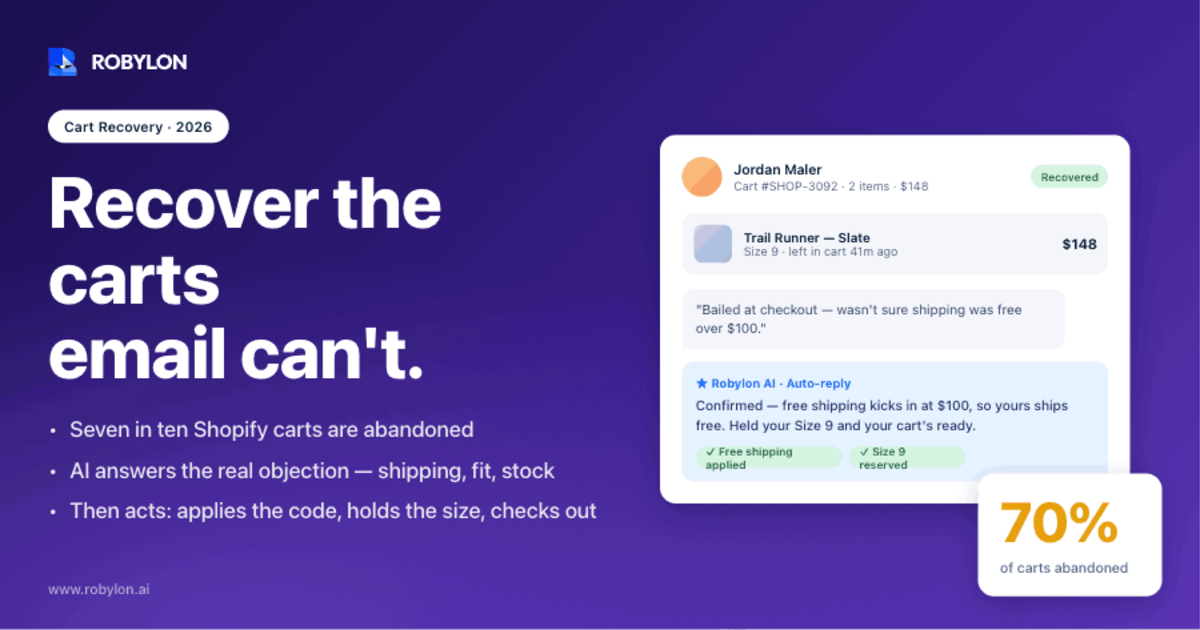
A shopper lands on your Shopify store, adds a $90 pair of boots to the cart, gets to checkout, sees a $14 shipping line they weren’t expecting, and closes the tab. Multiply that by every visitor and you get the number every merchant already knows in their gut: about seven of ten carts never become orders. The cart was full. The intent was real. The sale still walked.
Most stores answer that with a three-email reminder sequence and hope. It helps a little. It also leaves most of the money on the floor, because a reminder treats every abandoner the same and answers none of the questions that made them leave. This is where AI agents change the shape of the problem.
The 70% problem that refuses to budge
Cart abandonment has barely moved in a decade. The Baymard Institute puts the average across e-commerce at roughly 70%, aggregated from dozens of studies, and Shopify sits right on that line. Mobile is worse, hovering in the high-70s, and mobile is now where most of the traffic lives.
The dollar figure is the part that stings. Baymard estimates that stores in the US and EU leave around $260 billion in recoverable orders sitting in dead carts every year. For a single store doing $50K a month, the recoverable slice typically lands somewhere between $11,000 and $25,000 monthly. That’s not a rounding error. That’s a hire, a quarter of ad budget, or the difference between a flat month and a good one.
Why do they leave? When researchers ask, the answers are remarkably consistent year after year:
- Surprise costs at checkout. Shipping, taxes, and fees that weren’t visible earlier are the single biggest driver, cited by nearly half of abandoners.
- Forced account creation. Around a quarter of shoppers bail rather than make an account just to buy one thing.
- Delivery feels too slow. Roughly a quarter leave when the arrival date doesn’t match what they hoped.
- Trust hesitation. About one in five won’t hand over card details to a store that feels unfamiliar.
- A checkout that fights them. Confusing or long checkout flows push another chunk out the door.
Look closely and a pattern shows up. Most of these aren’t pricing problems. They’re unanswered questions. Will it arrive before the weekend? Can I return it if the size is wrong? Is shipping really that much, or is there a free threshold I’m one item away from? The shopper had a doubt, found no fast answer, and left.
Why the reminder email alone leaves money on the floor
The abandoned-cart email is the workhorse of recovery, and it earns its keep. A well-built multi-step flow converts somewhere in the 8 to 15% range, with the best operators reaching the high teens. The first email matters most, and timing is everything: the gap between average and best-in-class recovery comes down largely to whether that first message lands inside the first hour, while intent is still warm.
But notice what a reminder actually does. It says, in effect, “you forgot something.” The shopper didn’t forget. They hesitated, for a specific reason, and a generic nudge doesn’t touch that reason. If they left because they weren’t sure the jacket would arrive before a trip, a coupon code does nothing. If they left because the return policy was unclear, “complete your purchase” is the wrong sentence.
There’s a second cost that quietly compounds. When recovery fails, a large share of those shoppers simply buy the same thing somewhere else. The intent doesn’t evaporate; it relocates to a competitor. So the abandoned cart isn’t just deferred revenue, it’s revenue actively at risk of leaving the building.
Static sequences also tend to lean on discounts as the only lever they have. That works until it trains your best customers to abandon on purpose, because they’ve learned that waiting an hour earns them 10% off. You end up paying margin to people who were going to buy anyway. The blunt tool quietly erodes the thing it was meant to protect.
What an AI agent does that a sequence can’t
An AI agent isn’t a smarter reminder. It’s a different category of thing. A reminder broadcasts; an agent has a conversation, reads the situation, and does something about it. Three capabilities matter most.
It answers the actual objection, in the moment
When a shopper replies to a recovery email asking “does this ship to Canada and how long does it take,” a static flow has no answer. An AI agent reads the question, checks the store’s shipping rules and the cart contents, and replies with the real delivery window for that address. Same for sizing, stock, compatibility, return terms, and the “is there free shipping if I add one more thing” question that turns a hesitation into a larger order.
This is why the conversational approach pulls higher numbers. Where email-only recovery sits in the low double digits, AI-led conversational recovery routinely lands in the 20 to 35% range, because it removes the specific doubt instead of papering over it with urgency. AI-written recovery emails alone roughly double the conversion of plain template emails, and that’s before any back-and-forth even starts.
It takes action, not just sends words
This is the real shift, and it’s the one most “AI” cart tools skip. Answering a question is useful. Resolving the blocker is what recovers the sale. An agent wired into your stack can do the thing the shopper needed done:
- Apply a targeted incentive to a genuinely at-risk cart instead of blasting a sitewide code that bleeds margin.
- Check live inventory and tell the shopper the boots are back in stock in their size, then hold the cart.
- Pull the real order or shipping status for a returning customer who abandoned because they were nervous about a previous delivery.
- Update or confirm a delivery estimate against the actual carrier data, not a generic “5 to 7 days.”
Robylon, for example, ships with more than 60 write-access integrations that let the agent take action across Shopify, the store’s helpdesk, carriers, and payment tools, rather than only drafting a reply for a human to send. The difference between “I’ll let the team know” and “done, your order ships today” is the difference between a recovered cart and another lost one.
It works the channel where the buyer still is
Plenty of cart tools chase shoppers across pop-ups and push notifications. But for considered purchases, the reply happens in the inbox, where the buyer can ask a real question and expect a real answer. An email-first AI agent turns the recovery email from a one-way broadcast into a two-way thread. The shopper hits reply, asks the thing that was bothering them, and gets a grounded answer in seconds instead of waiting a day for a support queue to clear.
What a recovery flow actually looks like on Shopify
Stitching this together on a real store isn’t exotic. A workable AI-driven flow runs through a few stages:
- Detect the abandonment. Shopify fires the checkout-abandoned event with cart contents, captured email, and customer history. That’s the trigger.
- Send a first touch fast. Inside the first hour, while intent is warm, with the cart items, a clear path back, and an open invitation to reply with any question.
- Handle the reply conversationally. When the shopper responds, the agent reads the question, pulls live data, and answers or acts: confirms a delivery date, applies a one-time code to an at-risk cart, checks stock, or clarifies the return window.
- Escalate the gray areas. A bulk order, a custom request, a frustrated returning customer, or anything outside policy gets routed to a human with the full thread attached, so nobody starts cold.
The post-purchase side matters here too. A lot of abandonment is really anxiety about what happens after “buy,” which is why automating order-status and WISMO emails and a clean Shopify returns process feed straight back into recovery. A shopper who trusts that tracking and returns will be painless hesitates less the next time the cart fills up.
Where AI shouldn’t push, even when it could
Honestly, the fastest way to wreck a recovery program is to automate it without judgment. A few hard lines are worth drawing.
Don’t discount your way out of every abandonment. If a cart was always going to convert, an automatic coupon just hands away margin and teaches the shopper to game the flow. The smarter design only deploys an incentive when the agent has real signal that the cart is at risk, and never as the default first move.
Don’t let the agent improvise on policy. Refund eligibility, price-match decisions, fraud-flagged orders, and anything legally sensitive should hit a human. The agent’s job there is to gather context and hand off cleanly, not to invent an answer that the store then has to walk back.
And don’t chase the shopper who clearly said no. Recovery and harassment are separated by a thin line of frequency and tone. One well-timed, genuinely helpful message beats five increasingly desperate ones, which is why tone and sentiment detection should govern when the agent backs off.
The goal isn’t to automate the buyer into submission. It’s to remove the one obstacle that stood between a real intent and a real order, and to know when that obstacle is a human’s problem to solve.
Setting targets you can actually defend
Before you judge any tool, pin down what you’re measuring. Recovery rate, conversion rate, and revenue recovered are three different numbers, and vendors love to quote whichever flatters them most. Decide whether you’re counting recovered carts as a share of all abandoned carts, or conversion on the people who clicked back, and hold every comparison to that definition.
Realistic ranges look roughly like this for a Shopify store running sequenced recovery:
- Email-only flow: recovers in the high single digits to mid-teens, depending on category and timing.
- Conversational AI recovery: commonly 20 to 35%, because it resolves the objection rather than restating the reminder.
- Average order value lift: a real upside when the agent answers “what else goes with this,” often a 15 to 25% bump when done with restraint.
Category matters more than people admit. A $25 skincare refill recovers fast because the decision is small and habitual; a $1,200 sofa recovers slowly because the shopper is genuinely deliberating. Benchmark against your own vertical, not a headline average pulled from a different one.
How Robylon handles Shopify cart recovery
Robylon is an email-first AI support agent that resolves 60 to 80% of customer emails autonomously, validated against a store’s own historical tickets during onboarding rather than promised on a slide. For cart recovery, that means the recovery email becomes a live conversation: the shopper replies, the agent answers the real question, and where it can resolve the blocker, it does.
Because the agent has more than 60 write-access integrations, it doesn’t stop at drafting. It checks Shopify inventory, confirms carrier delivery windows, applies a one-time code to an at-risk cart, or pulls a returning customer’s prior order, then escalates anything sensitive to a human with the whole thread attached. Pricing is usage-based credits, so cost tracks the work done, not the number of agents or seats. Most stores are live in 3 to 7 days, and the agent works across 40+ languages for stores selling internationally. The e-commerce industry overview goes deeper on how this maps to a Shopify support stack.
Ready to turn abandoned carts into recovered orders? Robylon AI resolves 60-80% of customer emails autonomously with AI agents that take action across Shopify, your helpdesk, carriers, and 60+ other integrations. Start free at robylon.ai
Frequently asked questions
How do AI agents recover abandoned carts on Shopify?
They start from Shopify's checkout-abandoned event, which carries the cart contents, captured email, and customer history. The agent sends a fast first touch, then handles any reply conversationally: answering shipping, sizing, stock, or return questions, and taking action like confirming a delivery date or applying a one-time incentive. Unlike a static reminder, an AI agent removes the specific objection that caused the abandonment, which is why conversational recovery tends to outperform email-only flows.
What recovery rate can a Shopify store realistically expect?
An email-only flow usually recovers in the 8 to 15% range depending on category and timing. Conversational AI recovery commonly lands in the 20 to 35% range because it resolves the buyer's actual doubt instead of just reminding them. Results vary by vertical: low-cost, habitual purchases recover faster than high-consideration items like furniture or electronics. Always confirm whether a quoted number measures recovered carts or click-back conversion before comparing tools.
Is sending a discount the best way to recover a cart?
No, and over-using discounts backfires. Blanket coupons erode margin and train shoppers to abandon on purpose, since they learn that waiting earns a code. The better approach deploys an incentive only when there's real signal that a cart is at risk, and never as the default. Often the cart didn't need a discount at all; it needed a clear answer about delivery, returns, or stock, which an AI agent can provide instantly.
When should cart recovery escalate to a human?
Anything outside standard policy should go to a person. That includes bulk or custom orders, refund-eligibility calls, price-match decisions, fraud-flagged carts, and frustrated returning customers where tone matters. A well-designed agent gathers the full context and hands off cleanly with the conversation attached, so the human never starts cold. The aim is to automate the routine objections and route the judgment calls, not to force every case through automation.
How fast can AI cart recovery go live on a Shopify store?
For most stores, deployment runs 3 to 7 days. Setup connects the AI agent to Shopify and the store's helpdesk, syncs products, orders, and policies for context, and validates the agent against historical tickets so accuracy is known before launch. The heavier lift is usually deciding the escalation rules and incentive logic, not the technical integration. Once live, the agent handles recovery replies around the clock without adding headcount.