
The Future of Email Support: 2027–2030
Email support is moving from reply-drafting to autonomous resolution, and the next three years will reshape who answers, who oversees, and who even sends the email. Here is a grounded forecast of where support teams land by 2030, and how to prepare without betting on hype.
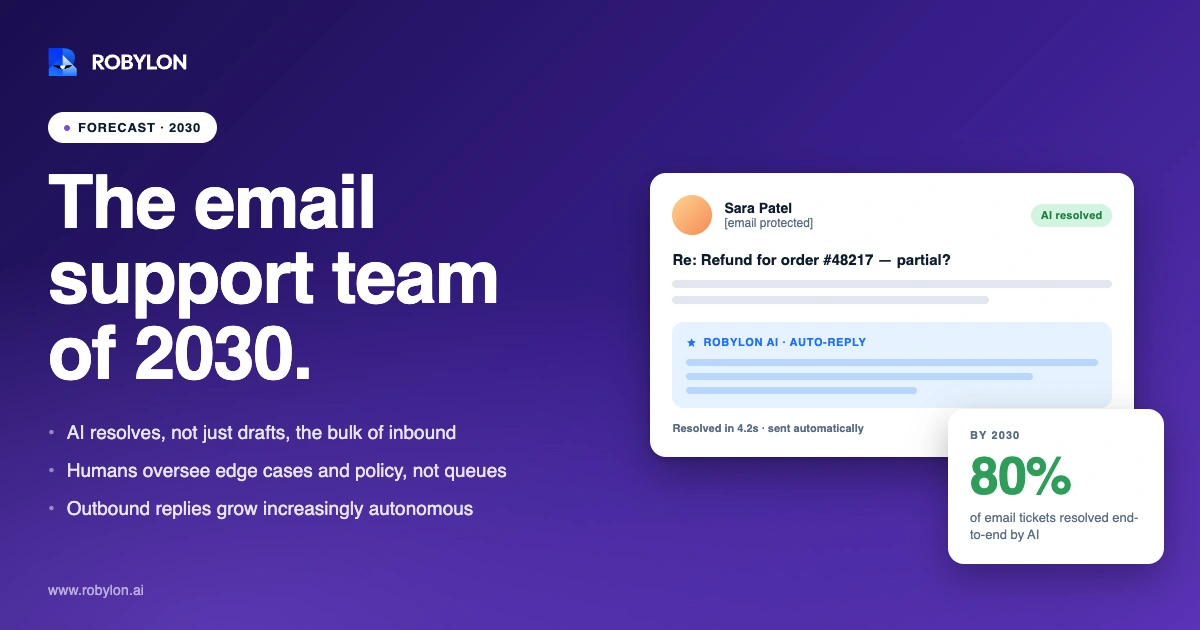
By 2030, a meaningful share of the support emails your team receives won’t be written by a person. They’ll be drafted, sent, and read by AI agents acting on behalf of customers. That single shift breaks most of the assumptions support teams operate on today.
This isn’t a far-off scenario. The pieces are already in production. Forrester projects that 49% of current customer service jobs will be displaced by AI by 2030, and Gartner expects agentic AI to autonomously resolve 80% of common service issues by 2029. The question for anyone running an inbox in 2026 isn’t whether this happens. It’s what your operation looks like on the other side, and what you should be building now so the transition doesn’t run you over.
Here’s a grounded read on the next three years, broken into the shifts that actually matter.
From draft-assist to autonomous resolution
Most email support tools in 2026 still operate as assistants. They suggest a reply, surface a knowledge-base article, summarize a thread. A human stays in the loop on nearly every send. That model is already on its way out.
The distinction that defines 2027–2030 is the gap between deflection and resolution. Deflection answers a question and hopes the customer goes away. Autonomous resolution means the agent actually takes the action: it issues the refund, updates the shipping address, cancels the subscription, reissues the license key. The email thread closes because the underlying problem is solved, not because the customer gave up.
That shift depends entirely on write access. An agent that can only read your help center is a search box with better manners. An agent wired into your order system, billing platform, and CRM can close the loop end to end. This is why AI agents that take action matter more than chat quality for email support specifically, where the requests are dense, multi-part, and tied to account state.
By 2027, Gartner already expects AI to handle around half of all customer service cases, up from roughly 30% in 2026. The teams hitting those numbers aren’t the ones who bought the flashiest demo. They’re the ones who connected the agent to systems where it can do work.
What “common issues” really means
The 80% figure gets quoted without its most important word. Gartner says agentic AI will resolve 80% of common issues, not all issues. Common means the requests that make up the bulk of any inbox: order status, password resets, billing questions, simple returns, address changes, refund requests. These are repetitive, well-defined, and tied to data the agent can verify.
The remaining 20% is where the work gets interesting. Disputes, edge-case fraud, emotionally charged complaints, anything requiring judgment or a policy exception. That’s not a failure of the technology. It’s the natural shape of the workload, and it tells you where humans should be spending their time by 2030.
When the sender is also an AI
This is the shift most teams aren’t planning for, and it’s the one that changes email support at a structural level.
Customers are starting to delegate their own outreach to AI agents. Instead of writing a complaint, a customer’s assistant files it. Instead of comparing your return policy by reading your page, their agent queries it. Gartner has flagged this directly: organizations will need to prepare for a future where AI-driven requests become the norm, and reactive demand from human customers gives way to demand generated by other machines.
What does that do to your inbox? A few things change at once:
- Volume spikes and smooths differently. Agent-generated email arrives in bursts, structured, and often at odd hours. The “9 a.m. Monday backlog” pattern your staffing model assumes starts to dissolve.
- Tone stops mattering, until it does. An AI sender doesn’t need empathy in the reply. But the moment a human takes back the thread, your agent has to detect the handoff and shift register fast.
- Structured beats persuasive. When the reader is a machine, clear data and clean policy language win. Marketing flourish gets ignored or misparsed.
Juniper Research estimates the number of customer interactions automated by AI agents will jump from 3.3 billion in 2025 to more than 34 billion by 2027, a tenfold rise in two years. A large slice of that is machine-to-machine. Support operations built purely around human readers will feel the strain first.
The headcount question, answered honestly
The displacement numbers are real, and pretending otherwise helps no one. Forrester’s 49% figure is steep, and high-volume B2C contact centers will see the sharpest cuts because their work is the most automatable.
But the same research that predicts displacement also predicts a correction. Gartner found that by 2027, half the organizations that planned to slash their support workforce will abandon those plans, and 95% of service leaders intend to keep human agents to define and govern the AI’s role. The job doesn’t vanish. It changes shape.
Here’s the honest version of the 2030 support org. Fewer people answering routine email. More people doing three things the agent can’t:
- Oversight. Reviewing what the agent resolved, catching drift, auditing decisions on refunds and policy exceptions before they compound.
- Edge-case handling. Taking the 20% of threads that need judgment, and bringing context the agent has no way to hold.
- Agent coaching. Tuning escalation rules, updating the knowledge the agent draws on, deciding what should and shouldn’t be automated as the policy changes.
The reps who thrive are the ones who move up this stack. The teams that struggle are the ones that treated AI as a way to fire people rather than a restructuring of what support work is. That difference shows up in retention, in quality, and eventually in the numbers.
Where AI must escalate, even when it could technically resolve
A capable agent will be able to resolve more than it should resolve. Knowing the difference is what separates a support operation people trust from one that quietly erodes that trust.
There’s a well-documented failure case from early 2025 where an AI agent for a major retailer hallucinated an entire loyalty-points refund program and sent detailed claim instructions to hundreds of customers before anyone caught it. The agent was confident. It was also completely wrong. By 2030, the operations that avoid this aren’t the ones with the smartest model. They’re the ones with the clearest rules about when the agent steps back.
The right design holds certain categories for a human regardless of agent confidence. Account closures with a refund above a threshold. Anything where the customer signals distress or legal intent. Fraud-adjacent disputes. Health, safety, or compliance-sensitive requests. The escalation logic here matters more than raw resolution rate, which is why the line between resolving versus routing to a human becomes a core design decision rather than an afterthought.
Tone-shift detection is part of this. An agent that notices frustration mid-thread and hands off before the customer boils over prevents far more damage than one optimizing for a clean containment metric. By 2030, the best teams measure escalation quality, not just deflection percentage.
Why integrations become the whole game
If autonomous resolution depends on write access, then the depth and breadth of integrations is the real moat. This is where a lot of 2027–2030 strategy gets decided, and it’s where many AI projects quietly fail.
Juniper’s research is blunt about it: enterprises will favor platforms that minimize upfront investment and connect to existing systems without costly migration, because agents are only useful when they can reach the data and tools the work requires. A support agent that can read your Shopify order but can’t issue the refund, or can see the Stripe charge but can’t process the credit, leaves the human doing the actual work anyway.
The Model Context Protocol becoming a standard in 2025 accelerated this. It made connecting agents to tools far less custom, which is part of why interaction volume is set to climb so fast. For email support, the practical implication is simple. Evaluate platforms by what the agent can do across your stack, not by how good the drafted reply reads. A platform with deep write-access integrations across your order, billing, and identity systems will outperform a better writer with read-only access every time.
Robylon AI was built around this premise. The agent connects to 60+ systems with write access, so it can take action across order management, billing, and CRM rather than just answering. That’s the difference between an inbox that gets smaller and one that just gets faster replies to the same unsolved problems.
Pricing models will break and reform
Here’s a quieter shift that will hit budgets hard by 2027. Most AI support tools today price per resolution, per agent seat, or per ticket. Every one of those models breaks when volume goes machine-generated.
If a customer’s AI agent files ten structured queries where a human would have sent one email, per-resolution pricing punishes you for automation working as intended. Per-seat pricing made sense when humans did the work. It makes no sense when the work is autonomous. The math gets hard to defend the moment anyone runs it against projected machine-to-machine volume.
Usage-based credit pricing holds up better here because it scales with actual work done rather than an arbitrary unit that agentic volume distorts. We’ve watched teams get burned by per-resolution contracts that looked cheap in a pilot and turned punishing at scale. By 2030, expect the pricing conversation to move from “cost per ticket” to “cost per unit of work,” and budget accordingly.
What to build now, before 2027
None of this requires betting the company on a forecast. The moves that pay off regardless of exactly how fast adoption lands are the unglamorous ones.
- Clean your knowledge. An agent is only as good as the policy and data it draws on. Conflicting return policies and stale macros will sink autonomous resolution faster than any model limitation.
- Map your escalation rules now. Decide which categories stay human before you turn anything on. Retrofitting escalation after a hallucination incident is the expensive way to learn this.
- Connect your systems. The integration work is the long pole. Start wiring the agent into your order, billing, and identity stack early, because that’s what turns deflection into resolution.
- Reskill toward oversight. Move your strongest reps toward agent coaching and edge-case judgment. They’ll be more valuable there in 2030 than answering the password-reset queue.
The teams that handle 2027–2030 well won’t be the ones who automated fastest. They’ll be the ones who automated correctly: clean data, clear escalation, deep integrations, and a workforce plan that treats this as a restructuring of support work rather than a way to cut a line item. For a fuller picture of where the broader function is heading, our breakdown of customer service trends for 2026 maps the near-term groundwork, and the distinction between agentic and generative AI explains why this generation of tools can act rather than just answer.
The inbox of 2030 is smaller, smarter, and increasingly populated by senders that aren’t human. The work that’s left is more interesting than the work that’s leaving. That’s the part worth preparing for.
Ready to move your inbox from drafted replies to resolved issues? Robylon AI resolves 60–80% of customer emails autonomously with agents that take action across Shopify, Stripe, Zendesk, and 60+ other integrations. Explore email support at robylon.ai
Frequently asked questions
Will AI fully replace human email support agents by 2030?
No. Forrester projects that 49% of current customer service jobs will be displaced by 2030, but the role shifts rather than disappears. Routine email resolution moves to AI, while humans concentrate on oversight, edge cases, and agent coaching. Gartner found that 95% of service leaders plan to keep human agents to govern the AI’s role. The 2030 support team is smaller on routine work and larger on judgment, escalation, and quality control.
What does autonomous email resolution actually mean?
Autonomous resolution means the AI agent takes the action that closes the issue, not just drafts a reply. It processes the refund, updates the order, cancels the subscription, or reissues a license, all through write-access integrations with your systems. This differs from deflection, which answers a question and hopes the customer leaves satisfied. Resolution requires the agent to be connected to the tools where the work happens, which is why integration depth matters more than reply quality.
What happens when customers use their own AI agents to email support?
Customer-side AI agents change the shape of your inbox. Volume arrives in structured bursts at all hours, tone-matching becomes less relevant until a human re-enters the thread, and clear data beats persuasive copy. Juniper Research projects automated interactions will rise from 3.3 billion in 2025 to over 34 billion by 2027. Support operations built only around human readers will feel strain first, so designing for machine-to-machine contact is part of preparing for 2027 onward.
When should an AI agent escalate an email to a human?
An agent should escalate based on category and risk, not just confidence. Hold for humans: account closures with large refunds, signals of distress or legal intent, fraud-adjacent disputes, and compliance-sensitive requests. Tone-shift detection should trigger handoff when frustration appears mid-thread. The goal is escalation quality, not maximum containment. A capable agent can resolve more than it should, so clear rules about when it steps back protect customer trust more than a high deflection rate does.
How should support pricing change as AI volume grows?
Per-resolution, per-seat, and per-ticket pricing all break when email volume goes machine-generated. If a customer’s AI files ten structured queries in place of one human email, per-resolution pricing punishes you for automation working correctly. Usage-based credit pricing scales with actual work done rather than an arbitrary unit that agentic volume distorts. By 2030, expect the conversation to shift from cost per ticket to cost per unit of work, so evaluate contracts against projected machine-to-machine volume, not pilot numbers.