
AI Email Support for Marketplaces & Platforms: Buyer-Seller Disputes & Trust
Marketplace platforms must serve buyers and sellers — often in the same dispute. AI triages both sides, applies policies consistently, and resolves 55-65% of cases automatically.
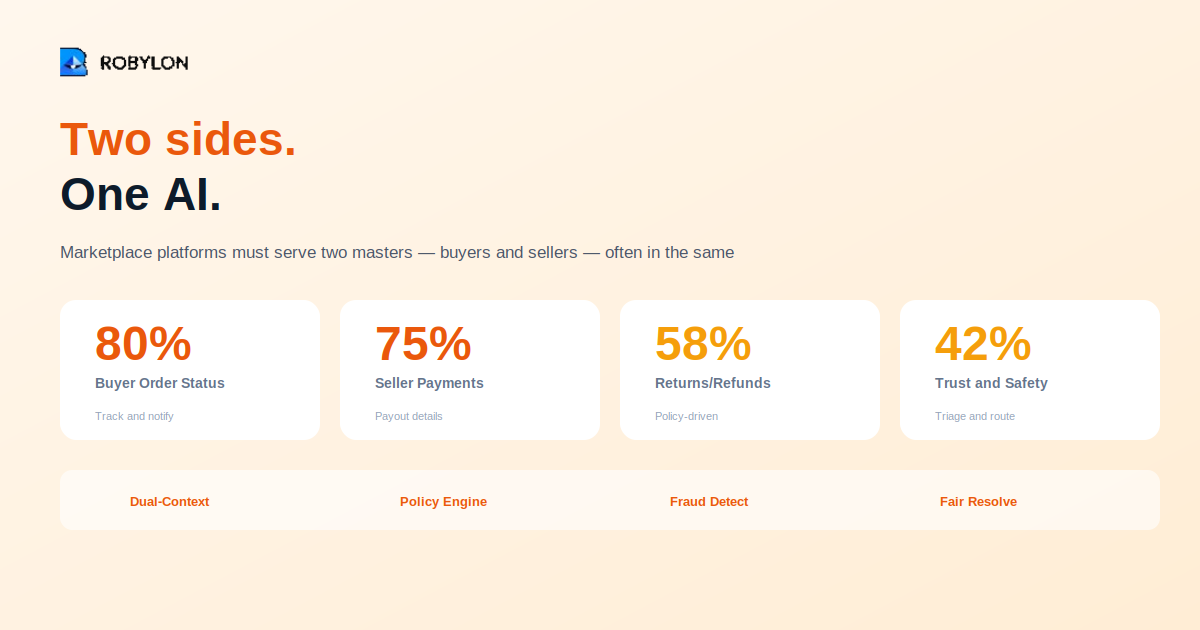
The Marketplace Email Paradox
Two-sided marketplaces face a unique challenge: every dispute has two customers, and helping one often means ruling against the other. The AI must handle both sides fairly, apply policies consistently, and maintain trust with both parties.
Buyer-side inquiries represent 40-45%. Seller-side inquiries account for 30-35%. Trust and safety represents 15-20%. General platform questions cover the remaining 5-10%.
Why Marketplace AI Is Uniquely Complex
Dual-Customer Resolution
The AI maintains separate context for buyer and seller on the same transaction. It gathers information from both parties, cross-references with transaction data, and applies platform resolution policies. This often involves multi-step workflows with parallel communication to both sides.
Policy Consistency at Scale
AI is actually superior to human agents here because it applies policies identically every time. If two sellers with identical violations receive different outcomes, trust erodes. The policy logic must be comprehensive and cover edge cases.
Fraud Detection in Email
The AI flags return fraud, seller fraud, and account manipulation patterns for the trust and safety team rather than processing them through normal workflows.
High-Automation Categories
Order Status for Buyers (75-85% automation)
Standard tracking plus the marketplace layer: if a shipment is delayed, the AI simultaneously notifies the buyer and prompts the seller for an update.
Payment Inquiries for Sellers (70-80% automation)
Payment schedule, processing holds, fee breakdowns, payout failures, and tax documents. The AI explains hold reasons and resolves payout issues by verifying banking details.
Return and Refund Resolution (50-65% automation)
The AI applies return policy to each case: check eligibility, determine refund type, issue refund, and communicate with both parties. High-value or conflicting cases escalate to humans.
Trust and Safety Triage (35-50% automation)
The AI classifies reports, pulls relevant data, checks fraud indicators, and routes to specialist teams with complete case files. Enforcement actions require human approval.
Integration Architecture
Essential systems include transaction database, seller management platform, payment processing, trust and safety tools, product catalog, and shipping APIs.
Bottom Line
Marketplace AI serves two customers with opposing interests. The advantage is policy consistency — identical rules applied to every case. The key is comprehensive resolution policies and separate buyer-seller context.
Serve both sides of your marketplace faster. Robylon AI handles disputes, payment queries, and trust triage — applying policies consistently at scale. Start free at robylon.ai
Frequently asked questions
How does AI handle buyer-seller disputes?
The AI maintains separate context for buyer and seller, gathers information from both, cross-references with transaction data, and applies platform policies consistently. High-value or conflicting cases escalate to humans.
Can AI maintain policy consistency at scale?
Yes — AI's strongest marketplace advantage. It applies identical policies to every case, eliminating inconsistency that erodes trust when human agents make different judgment calls.
How does AI detect fraud in marketplace emails?
The AI flags return fraud, seller fraud, and account manipulation patterns, routing them to trust and safety rather than normal resolution workflows.
What integrations does marketplace AI email need?
Essential systems include transaction database, seller management platform, payment processing, trust and safety tools, product catalog, and shipping APIs.
How do you measure marketplace AI email success?
Track buyer and seller satisfaction separately, dispute resolution time, policy consistency score, fraud detection rate, and seller retention from faster payment resolution.