
Refund Automation for Shopify, With Policy Guardrails That Actually Hold
Refunds are the second most common Shopify support ticket and one of the riskiest to automate. This guide covers how to set up AI refund automation with policy guardrails that decide when to auto-approve, when to review, and when to block.
Refund Automation for Shopify, With Policy Guardrails That Actually Hold
A refund request is the easiest ticket in your queue to automate and the easiest one to get badly wrong. The logic is fixed, the data lives in Shopify, and the math is deterministic. But every approval moves real money out of your account, and a bot that invents a return window or fat-fingers a refund amount doesn’t just annoy a customer. It creates chargebacks and write-offs.
Returns and refunds are the second-largest support category for most Shopify stores, sitting right behind “where is my order?” Handled by hand, a single return runs 15 to 20 minutes once you count the policy lookup, the eligibility check, the label, the inventory update, and the refund itself. A well-built AI agent does the same thing in under a minute. The catch is that speed without guardrails is how you lose money faster.
This guide walks through what refund automation actually involves on Shopify, how to turn a vague policy into rules an agent can follow, and the guardrail design that decides when to pay out, when to pause, and when to say no.
Why refunds are both the best and the worst thing to automate
Returns are about as close to a perfect automation candidate as customer support gets. The steps repeat every single time. Look up the order, confirm it was delivered, check the item against the policy, calculate the refund, process it. There’s no creative judgment required and no two requests that are truly unique.
That’s the upside. The downside is the volume and the money attached to it.
The average ecommerce return rate now sits around 20%, and for Shopify stores specifically it lands in the 17 to 20% range. Apparel runs far higher, often 20 to 40%, because of sizing. So roughly one in five things you sell comes back, each return costs $10 to $20 to process, and a meaningful slice of that volume isn’t legitimate at all. US retail returns hit $849.9 billion in 2025, and somewhere between 9% and 14% of returns are fraudulent.
So you’re automating a high-frequency workflow where each individual decision is simple but the aggregate exposure is large. That combination is exactly why guardrails matter more here than almost anywhere else in AI customer service for Shopify. The goal isn’t to approve refunds faster. It’s to approve the right refunds faster and route the rest to a human before money leaves the building.
What refund automation actually means on Shopify
People hear “refund automation” and picture a chatbot that says “your refund has been processed.” The real work is split across two layers, and only one of them is the conversation.
The first layer is read access. The agent pulls the order from Shopify, confirms it exists, confirms it belongs to the customer asking, and checks the fulfillment status. This is the same order-lookup capability that powers any WISMO answer.
The second layer is write access, and this is where most tools quietly fall short. To genuinely close a refund, the agent has to act through Shopify’s Admin API: issue the refund, calculate the right amount including tax and shipping deductions, apply a restocking fee if your policy calls for one, decide between original payment method and store credit, and restock the item if it’s resalable. A read-only bot that surfaces the order but hands the actual payout back to a human hasn’t automated the refund. It’s automated the lookup. Those are different things, and the difference is most of the time savings.
Shopify gives you real flexibility on the payout itself. You can refund to the original payment method, to store credit, or split across both. Store credit is now a native option rather than a gift-card workaround. You can issue partial refunds and keep issuing them until the original order total is covered. The agent needs to know which of these paths your policy prefers for which situations, because the financial outcome changes depending on the choice.
One detail that trips up naive automations: when you partially refund an order, the customer can still file a chargeback for the full value. If they do, you’re debited the full amount despite having only refunded part of it. Refund math is not just arithmetic. It’s risk math.
The policy layer: writing rules an agent can follow
Here’s the part nobody tells you. The hardest thing about refund automation isn’t the technology. It’s writing your return policy clearly enough that an agent can execute it without guessing.
Most stores have a return policy written for shoppers. It’s full of soft qualifiers, “generally,” “at our discretion,” “in most cases.” That language is fine for a marketing page and useless for an automated decision. The agent needs the operational version, where every condition has an exact value.
An operational refund policy has to answer, without ambiguity:
If your team can’t state these rules precisely, the agent can’t follow them precisely. And vague policies don’t just break automation. They invite abuse, because every soft edge is something a determined returner can argue against. Tightening the policy is usually step zero of automation, and it pays off even before a single ticket gets automated.
Guardrails: auto-approve, send to review, or block outright
This is the heart of it. A guardrail is a rule that runs before the agent acts, and it sorts every refund request into one of three buckets.
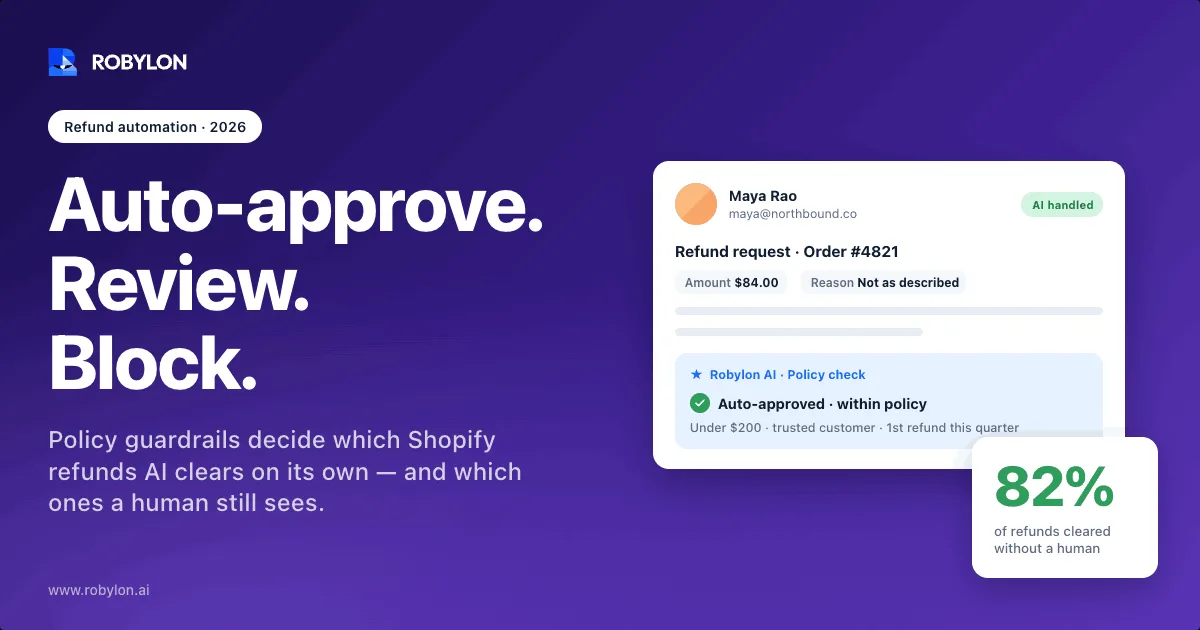
Auto-approve is for the clean, low-risk cases. Order verified, within the window, eligible category, refund amount under your auto-approve ceiling, customer has a normal return history. These should clear in seconds with no human involved. For most stores this is the large majority of refund requests, and it’s where the 60 to 80% autonomous resolution range comes from.
Send to review is for the borderline cases. The refund amount crosses a dollar threshold you set. The return reason is vague or inconsistent. The item is high-value or hard to resell. The agent prepares everything, the order context, the eligibility result, the proposed refund, and hands a human a one-click decision instead of a blank ticket.
Block is for the cases that shouldn’t be auto-processed at all. A return outside the window with no override. A final-sale item. An order flagged for fraud. A customer whose pattern has already crossed into abuse.
The amount threshold is the simplest and most effective guardrail to start with. Auto-approve everything under, say, $50, and route everything above it to review. You can widen that ceiling as you build confidence in the agent’s accuracy, the same way you’d extend trust to a new hire.
Risk-based rules beat one-size-fits-all
The smarter design layers customer history on top of the amount threshold. Not every refund request carries the same risk, and treating them identically either lets fraud through or punishes your best customers.
About 48% of shoppers want faster refunds, and your clean-record, high-lifetime-value customers are exactly the ones you want to reward with instant approval. Meanwhile the same system should add friction where the risk concentrates: shorter effective windows, photo requirements, or a store-credit-only path for accounts showing abuse patterns.
What does an abuse pattern look like? Returning a large share of everything purchased. Repeatedly claiming items never arrived or arrived damaged. Bracketing, where someone orders multiple sizes or variants planning to send most back. Over half of online shoppers admit to bracketing at least sometimes, so this isn’t fringe behavior. The guardrail isn’t to block all of it. It’s to recognize when a specific account has tipped from indecisive into abusive and quietly move that account onto a stricter track, often store credit instead of cash, which protects your margin without a confrontation.
Where automation has to step back
Every honest guide to automation includes the part where automation stops. Refund agents are no exception, and the stores that get this right are the ones that decide the escalation rules up front rather than discovering them after an incident.
Route to a human when the refund is large enough that a mistake is expensive. Route when fraud signals fire, mismatched addresses, a serial-returner flag, an order Shopify’s own risk analysis marked as high. Route when the policy genuinely has no answer, like a one-off goodwill exception for a loyal customer. And route when the email carries emotion or legal weight, a customer threatening a chargeback or a regulator, a complaint that’s really about something bigger than the refund.
Good agents detect that tone shift and hand off cleanly, with the full context attached. If you want the mechanics of that handoff, we’ve written separately about knowing when to route to a human instead of resolving in place. The principle is simple. An agent that escalates well is more trustworthy than one that resolves everything, because the second one is bluffing on the cases it shouldn’t touch.
The chargeback connection
Refund decisions and chargebacks are the same problem wearing two hats, and treating them separately is a common, costly mistake.
When you decline a return that a customer feels entitled to, that dispute often doesn’t end. It reappears as a chargeback, and now you’re paying a dispute fee of $15 to $25 on top of the original sale amount, plus the hit to your processing rates. Professional fraudsters know this and probe across channels, the return form, customer service, the chargeback process, looking for the weakest link.
So the guardrail logic should think about chargeback exposure, not just policy compliance. Sometimes approving a small refund to a low-risk customer is cheaper than the dispute that a denial would trigger. Sometimes a partial refund plus a kept item is the rational settlement. The agent doesn’t need to be a fraud analyst, but the rules behind it should reflect that a denied refund is rarely free.
This is also why the audit trail isn’t optional. Every action the agent takes, order looked up, window checked, eligibility verified, amount calculated, refund processed or escalated, should be logged. When a chargeback does land, that log is your evidence. Without it, every fraudulent return looks identical to a legitimate one, which is precisely the problem most merchants can’t solve manually.
How Robylon handles Shopify refund automation
Robylon is an email-first AI support agent, and refunds are one of the workflows it’s built to close end to end rather than just triage. The agent reads the order from Shopify, runs it against the operational policy you’ve encoded, evaluates the guardrails, and either processes the refund or escalates with full context attached.
A few things make that safe to run on real money. Robylon resolves 60 to 80% of customer emails autonomously, a range validated against your historical tickets during onboarding rather than promised on a slide. It acts through write-access integrations across Shopify and 60+ other tools, so it issues the actual refund, applies the restocking fee, and restocks inventory instead of leaving the work half-done. Human-in-the-loop workflows with tone-shift detection catch the emotional and high-risk cases and hand them off. And every action is logged for the audit trail.
Refunds are also rarely a standalone request. The same email often touches a damaged-item claim or a warranty question, which is why refund handling sits alongside warranty and returns email automation in the same agent rather than scattered across separate bots. Deployment runs 3 to 7 days, and pricing is usage-based credits, with no per-seat or per-agent fees that punish you for scaling.
A rollout sequence that won’t blow up
Don’t flip refund automation on at full power on day one. The teams that succeed phase it in, and the sequence matters.
That sequence builds confidence the same way you’d onboard any new process. Slowly, with the logs open, and with a human watching the cases that matter until the data says they don’t have to. For a deeper look at the email side of this, including how the agent reads intent and drafts the response, see how AI handles refund request emails from first message to resolution.
Ready to turn refunds from your second-biggest ticket pile into a workflow that closes itself safely? Robylon AI resolves 60 to 80% of customer emails autonomously with agents that take action across Shopify, Stripe, your returns app, and 60+ other integrations. Start free at robylon.ai
Frequently asked questions
Can AI process Shopify refunds automatically, or just answer questions about them?
It can do both, but only platforms with write-access to the Shopify Admin API actually process the refund. Many tools only read order data and then hand the payout back to a human, which leaves most of the manual work in place. A genuine refund automation issues the refund, calculates tax and shipping correctly, applies any restocking fee, and restocks the item. Confirm the platform writes through the official Shopify API before assuming a refund is truly automated end to end.
What are policy guardrails in refund automation?
Guardrails are the rules that run before the agent acts, sorting each refund request into auto-approve, send-to-review, or block. They check the return window, item eligibility, refund amount against a dollar threshold, and the customer's return history. The simplest and most effective starting guardrail is an amount ceiling: auto-approve clean requests under it, route larger ones to a human. Good guardrails prevent over-refunds and fraud without slowing down the legitimate majority of requests.
How do I stop AI from approving fraudulent returns?
Use risk-based rules rather than one flat policy. Layer customer history on top of the amount threshold so accounts showing abuse patterns, like returning most of what they buy or repeatedly claiming non-delivery, get extra friction or a store-credit-only path. Require photo proof for damage claims, and route anything Shopify's risk analysis flags to manual review. The goal is to reward clean customers with fast refunds while quietly tightening the track for high-risk accounts.
What refund requests should always escalate to a human?
Escalate when a mistake would be expensive or sensitive: high-value refunds, fraud-flagged orders, returns outside the window needing a judgment call, and any email carrying emotional or legal weight, such as a chargeback or regulator threat. A well-built agent detects the tone shift and hands off with full order context attached. An agent that escalates the right cases is more trustworthy than one that tries to resolve everything, because the cases it shouldn't touch are exactly where errors get costly.
How long does it take to set up Shopify refund automation?
The technical connection is fast. The real timeline depends on how clearly your return policy is written, since the agent can only follow rules stated in exact terms like days, categories, and fees. Most teams spend more time converting a customer-facing policy into operational rules than on the integration itself. With Robylon, deployment typically runs 3 to 7 days, after which automation is phased in starting with low-risk, low-value refunds before thresholds widen.