
8 best Intercom alternatives for customer support teams in 2026
Eight alternatives to the Intercom helpdesk, compared on seat price, channels, the AI agent each includes and where it runs, with prices checked in October 2026.
Key takeaways
- Want a full helpdesk at a lower seat price than Intercom: Zendesk Suite Team from $55 or Freshdesk from $19 per agent a month, billed annually.
- Small team or tight budget: Help Scout, free for up to 5 users, or Zoho Desk, free for 3 users and paid from $7 a user.
- CRM-led team on Salesforce: Service Cloud, where Agentforce runs from the $195 Core edition.
- Online store: Gorgias, priced by tickets from $10 a month, or Tidio, free for 50 conversations a month.
- Want an AI agent that resolves most tickets across email, chat, voice and WhatsApp, inside Intercom or with its own inbox: Robylon, from $25 a month on paid plans.
The strongest Intercom alternatives in October 2026 are Zendesk and Freshdesk for a full helpdesk at a lower seat price, Help Scout and Zoho Desk for smaller teams on a budget, Salesforce Service Cloud for CRM-led enterprises, and Gorgias or Tidio for online stores. Robylon fits teams that want an AI agent to resolve most tickets across email, chat, voice and WhatsApp, either inside Intercom or with Robylon’s own inbox.
Intercom is a polished helpdesk with a strong messenger, help center and proactive messaging. Teams evaluating or running it look elsewhere when every teammate needs a seat priced from $85 a month, when SSO, HIPAA and SLAs sit on the top plan, or when AI and reporting are billed on top of seats. If you want to keep the Intercom helpdesk and replace only the AI agent, the Fin alternatives guide covers that decision. Every tool below is judged on three things: whether its AI takes the action a ticket needs, whether every channel runs from one setup, and whether it fits the stack you already run.
Intercom alternatives at a glance
| Tool | Best for | What the AI does | Billing unit | Free plan | Paid from | G2 |
|---|---|---|---|---|---|---|
| Intercom (baseline) | Messenger-led support with proactive messaging | Fin answers and acts, billed per outcome | Per seat, plus per AI outcome | No; 14-day trial | $85 a seat (Advanced, annual) | 4.5 (3,918) |
| Robylon | AI agent that resolves most tickets, inside Intercom or standalone | Answers and acts in your systems | Per AI credit; seats optional | Free forever, 300 credits a month (about 40 chats) | $25 a month (Pro, 500 credits) | 5.0 (42) |
| Zendesk | A full helpdesk with voice and an AI agent | Answers and acts; one channel type per agent | Per seat, plus per AI resolution | No; 14-day trial | $55 a seat (Suite Team, annual) | 4.3 (7,093) |
| Freshdesk | Value seat pricing with an optional AI agent | Answers and runs workflows with API actions | Per seat, plus per AI session | 2 agents free for 6 months | $19 a seat (Growth, annual) | 4.4 (3,777) |
| Help Scout | Small teams wanting a simple shared inbox | Answers only, in the Beacon widget | Per user, plus per AI resolution | Yes, up to 5 users | $25 a user (Standard, annual) | 4.4 (431) |
| Zoho Desk | Low seat prices, especially with Zoho CRM | Zia drafts replies; Zia Agents billed by tokens | Per user; AI agents per LLM token | Yes, 3 users | $7 a user (Express, annual) | 4.4 (7,976) |
| Salesforce Service Cloud | CRM-led enterprises | Agentforce answers and acts inside Salesforce | Per user, plus per conversation or resolution | No; 30-day trial | $25 a user (Starter Suite, annual) | 4.4 (8,433) |
| Gorgias | Shopify stores | Answers and acts on Shopify orders | Per ticket, plus per AI interaction | No; 30-day trial | $10 a month (Starter, 50 tickets) | 4.6 (582) |
| Tidio | Small online stores starting with live chat | Lyro answers and calls APIs through Actions | Per conversation pack | Yes, 50 conversations a month | $29 a month (Starter, monthly) | 4.6 (1,962) |
Prices checked October 2026 on each vendor's pricing page. G2 ratings read October 2026, with the review count in brackets.
Robylon publishes this page and ranks itself first; every tool on the list, Robylon included, gets the same “Where it falls short” line.
What Intercom does
Intercom is a customer service helpdesk built around a messenger for websites and apps, with a shared inbox, ticketing, a help center, reporting and proactive messaging. The company behind it renamed itself Fin on 12 May 2026 and kept Intercom as the name of the helpdesk; Salesforce completed its acquisition on 10 September 2026. Teams pay per seat (Advanced or Expert), and Fin AI Agent, included on every plan, is billed at $0.99 per outcome. Intercom covers chat, email, WhatsApp, SMS, Facebook Messenger, Instagram, Slack and Discord natively, with voice for select customers through sales.
Why teams look beyond Intercom
Every teammate needs a seat
Intercom’s Advanced seat costs $85 a month billed annually or $99 billed monthly, and Expert costs $132 or $139, according to Intercom’s plans article. The Essential seat’s price was being A/B tested on the pricing page in October 2026, so a buyer cannot plan on one figure for it. For a team of 10, Advanced comes to $850 a month before any AI.
Key controls sit on Expert
SSO and identity management, HIPAA support, SLAs, multibrand Messenger and Help Center, workload management and the real-time dashboard are Expert features. A team that needs any of them pays the Expert seat price for every full seat.
AI and reporting cost extra
Fin AI Agent adds $0.99 per outcome. Copilot gives each full seat 10 free conversations a month, then costs $29 per teammate a month billed annually or $35 monthly. The Pro add-on, which carries CX Score, Topics Explorer, Trends and Monitors, costs $0.20 per conversation with a 500-conversation minimum.
Voice is sold through sales
Fin Voice is available to select customers through sales, and Intercom publishes no voice price as of October 2026. A team that needs phone support alongside chat and email cannot price it from the website.
A new owner since September 2026
Salesforce completed its acquisition of Fin on 10 September 2026, which puts the Intercom helpdesk and Salesforce Service Cloud under one owner. Teams that want a helpdesk vendor outside Salesforce widen the list.
Two paths away from Intercom
Leaving Intercom means one of two things, and they lead to different tools.
- Keep the Intercom helpdesk and change the AI agent. The team stays in the Intercom inbox and the agent in front of customers changes. Robylon answers inside Intercom chat from its Business plan, and the Fin alternatives guide linked above compares the AI agents on their own.
- Replace the helpdesk. The team moves to another inbox. Helpdesk suites with their own AI agent (Zendesk, Freshdesk, Help Scout, Zoho Desk and Salesforce Service Cloud) replace both at once; Gorgias and Tidio do the same for online stores; and Robylon’s own inbox suits teams whose human workload fits a shared inbox with tickets, SLAs and queues.
Zendesk and Freshdesk are the closest like-for-like replacements for a full Intercom helpdesk.
How we compared the tools
We read each vendor’s pricing page, help centre or docs, and trust page on 7 October 2026, and each tool’s G2 page the same day. Where a vendor’s prices differ by region, the table uses the US price. We did not run hands-on tests for this page.
We compared them on what the AI agent can resolve, channels covered, where each runs, billing model, setup effort, and how each works for support agents and team leads.
The 8 best Intercom alternatives
1. Robylon
Best for: teams that want an AI agent to resolve most tickets across every channel, inside the Intercom helpdesk or with Robylon’s own inbox.
What it is for: Robylon is an AI customer support platform that resolves tickets across email, chat, voice and WhatsApp. It works standalone or alongside an existing helpdesk. It takes the action a ticket needs: agents read the systems the answer lives in, act through tools built from your APIs and connected apps, and hand anything they cannot finish to a person with the checking already done. Every channel runs from one setup. And it fits the stack you already run: Robylon answers inside Intercom chat, so a team can keep the Intercom inbox, or it runs standalone with its own inbox and optional human seats.
What the AI does:
- A triage agent routes each conversation to the sub-agent for that topic.
- Agents call tools built from your APIs and from 32 pre-built integrations, among them Shopify, HubSpot, Salesforce and Google Sheets, to look up orders, issue refunds and update accounts.
- The knowledge base answers from your sources, and the KB gap report shows what it could not answer.
- Anything the agent cannot finish goes to a person with the conversation, intent and checks attached.
Channels: email, website and in-app chat, voice, WhatsApp, Instagram, Facebook, SMS through Twilio, YouTube comments, and reviews on Google Play, the App Store and Google My Business, all on the channels page. It runs inside Freshdesk, Zendesk, Zoho Desk, Salesforce, Vtiger, Intercom, Freshchat, SalesIQ and Gorgias, or standalone; running inside Intercom chat starts on the Business plan. Robylon’s inbox gives the human team a shared inbox, tickets, SLAs, queues, canned responses, internal notes and transfers on every seat, with AI Copilot on Advanced (50 uses a month) and Expert (unlimited) seats.
Pricing: by AI credits rather than per seat (see pricing). The Starter plan is free with 300 credits a month, paid plans start at $25 a month for 500 credits, Business starts at $180 a month, and yearly billing takes 10% off. Seats for a human team are optional, at $19 (Basic), $49 (Advanced) or $89 (Expert) per seat a month. G2 rating: 5.0 from 42 reviews (G2, October 2026).
Where it falls short: voice phone calls start on the Business plan at $180 a month, and voice for human agents needs Advanced or Expert seats. Full reporting and the real-time dashboard are on Expert seats only. Credits per conversation vary with the AI model chosen, so cost is harder to forecast than a flat seat price.
Where Intercom does better:
- Proactive messaging: posts, checklists, product tours, surveys and mobile push through Proactive Support Plus. Robylon covers WhatsApp campaigns and proactive messages, not product tours.
- App ecosystem: 450+ apps and integrations against Robylon’s 32 pre-built ones.
- Help center: private and multilingual help centers and a tickets portal on Advanced.
- Multibrand: multibrand Messenger and Help Center, with workload management, on Expert.
- Review volume and compliance breadth: 3,918 G2 reviews against Robylon’s 42, and ISO 42001, HDS and AIUC-1 on Fin’s trust centre.
Pick it if: you want most tickets resolved by an AI agent across email, chat, voice and WhatsApp, and either keep the Intercom inbox or move to a lighter one. Choose Intercom if your team relies on its messenger, product tours and app ecosystem. For the head-to-head, see Robylon vs Intercom.
2. Zendesk: best full-helpdesk replacement
Best for: support teams of any size that want a complete helpdesk with voice and an AI agent from one vendor.
Zendesk covers ticketing, messaging, voice through Zendesk Talk, a help center and reporting in one suite. Since a rollout between May and June 2026, AI agents are on every Suite and Support plan, built from natural-language procedures with actions that read and write data in external systems. Data center location (US, EEA, UK, Japan or Australia) is included from Suite Professional.
What the AI does: answers and takes actions through integrations, in more than 80 languages; each AI agent serves one channel type (messaging, email or voice).
Channels: email, web form, web messaging and live chat, mobile SDKs, voice, WhatsApp, Facebook Messenger, Instagram, X DMs, LINE, WeChat and Slack; SMS through the Text add-on.
Pricing: Suite Team costs $55 per agent a month billed annually or $69 monthly, and Suite Professional $115 or $149; the AI agent adds $1.50 per committed automated resolution or $2.00 pay-as-you-go (Zendesk pricing). G2: 4.3 from 7,093 reviews (G2, October 2026).
Where it falls short: two AI billing models are live at once, and the tier prices for the newer resolution allowance are not published. Copilot costs $50 per agent a month billed annually.
Pick it if: you want the closest like-for-like replacement for a full Intercom helpdesk, with voice included.
3. Freshdesk: best value full helpdesk
Best for: small and mid-size teams that want a full helpdesk at a lower seat price.
Freshworks sells two helpdesks: Freshdesk, email-first, and Freshdesk Omni, multichannel. Freddy AI Agent answers from knowledge sources and runs workflows with API actions, including pre-built integrations with Shopify, Stripe, PayPal and Wix. Chat AI Agents run only on Freshdesk Omni.
What the AI does: answers and runs workflows with API actions, in more than 60 languages for chat.
Channels: email, customer portal, web chat and Facebook Messenger; Freshdesk Omni adds Instagram and WhatsApp. Phone comes through Freshcaller, a separate product.
Pricing: Freshdesk starts at $19 per agent a month billed annually ($23 monthly) and Freshdesk Omni at $29 ($35); Freddy AI Agent costs $49 per 100 sessions (Freshdesk pricing). G2: 4.4 from 3,777 reviews (G2, October 2026).
Where it falls short: there is no free-forever plan, chat AI needs the pricier Freshdesk Omni, and a Freddy session is billed whatever the outcome, including handovers.
Pick it if: you want a full helpdesk at a lower seat price and can choose between the email-first and multichannel editions.
4. Help Scout: best for small teams
Best for: small and mid-size teams that want a simple shared inbox, a knowledge base and a chat widget.
Help Scout combines a shared inbox, Docs knowledge base sites and the Beacon chat widget. Its free plan covers up to 5 users, 1 inbox and 100 contacts a month. AI Answers, powered by the Compass engine, answers visitors in Beacon and charges nothing when the customer asks for more help.
What the AI does: answers only, in the Beacon widget, in more than 50 languages.
Channels: email, live chat (Beacon), WhatsApp, Facebook Messenger, Instagram and SMS through your own Twilio number; phone through Aircall.
Pricing: Standard costs $25 per user a month billed annually or $30 monthly, Plus $45 or $54, and Pro $75 or $90 with a 10-user minimum; AI Answers adds $0.75 per resolution (Help Scout pricing). G2: 4.4 from 431 reviews (G2, October 2026).
Where it falls short: the AI answers but takes no actions in other systems, and Standard caps at 25 users.
Pick it if: you are a small team that wants a clean inbox and help center at a low price.
5. Zoho Desk: best for low seat prices
Best for: small and mid-size teams, especially those already on Zoho CRM, that want the lowest seat prices.
Zoho Desk runs from a free edition for 3 users up to Enterprise. Zia, its built-in AI on Professional and Enterprise, summarises tickets, predicts fields and drafts replies, and Answer Bot handles customer questions from Standard upward. Zia Agents, a separate agent platform, are billed by LLM tokens.
What the AI does: Zia drafts and summarises for agents; Answer Bot answers customers; Zia Agents run custom agents, with the pre-built Desk agents on Enterprise only.
Channels: email, web forms, help centre, X, Facebook and Instagram, and from Standard upward live chat, WhatsApp, Telegram, WeChat and LINE; phone through third-party telephony from Professional.
Pricing: Express costs $7 per user a month billed annually ($9 monthly), Standard $14 ($20), Professional $23 ($35) and Enterprise $40 ($50); Zia Agents on Zoho-hosted models give 30 million tokens a month free, then $1 per million (Zoho Desk pricing). G2: 4.4 from 7,976 reviews (G2, October 2026).
Where it falls short: Zoho publishes no tokens-per-conversation figure, so Zia Agents’ cost per conversation cannot be worked out in advance, and USD prices differ by visitor region.
Pick it if: you want a full helpdesk at the lowest seat price, or you already run Zoho CRM.
6. Salesforce Service Cloud: best for CRM-led teams
Best for: mid-market and enterprise teams that run their customer data in Salesforce.
Service Cloud is Salesforce’s helpdesk, sold in five editions. Agentforce, its AI agent, answers from Salesforce Knowledge and Data 360 and acts through Flows, Apex and API connectors; Agentforce for Service runs from the Core edition upward.
What the AI does: Agentforce answers and takes actions inside Salesforce and connected systems; Agentforce Voice works in English (US, UK and Australia) as of October 2026.
Channels: web chat, in-app, help sites and portals, SMS, WhatsApp, Facebook Messenger, Apple Messages for Business, LINE and voice.
Pricing: Service Cloud editions cost $25 (Starter Suite), $100 (Pro Suite), $195 (Core), $395 (Advanced) and $550 (Max) per user a month billed annually; Agentforce costs $2 per conversation or $2 per resolution for Casey, the help agent (Agentforce pricing). G2: 4.4 from 8,433 reviews (G2, October 2026).
Where it falls short: the AI agent needs the $195 Core edition or above, and chat handovers need Contact Center Digital at $75 per user a month on top.
Pick it if: your company already runs on Salesforce and wants support inside the CRM.
7. Gorgias: best for Shopify stores
Best for: Shopify brands that want a helpdesk built around the store.
Gorgias prices by tickets rather than seats, from 50 tickets a month on Starter to 5,000 on Advanced, with 3 user seats on Starter and 500 from Basic upward. Its AI Agent cancels unfulfilled orders, edits shipping addresses, removes or replaces items, reships orders and adds order notes in Shopify.
What the AI does: answers and acts on Shopify orders and on apps including Loop Returns, Recharge, Skio, Loop Subscriptions, ShipStation, ShipBob, ShipHero and ShipMonk. It needs a connected Shopify store.
Channels: email, chat, help center, contact forms, Facebook Messenger, Instagram and WhatsApp; voice and SMS through paid add-ons.
Pricing: Starter costs $10 a month for 50 tickets, Basic $50 a month billed annually for 300 and Pro $300 for 2,000; AI Agent adds $0.90 to $1.00 per automated interaction on top of the ticket fee (Gorgias pricing). G2: 4.6 from 582 reviews (G2, October 2026).
Where it falls short: the AI Agent needs Shopify, and an AI-resolved ticket is billed twice, as a ticket and as an automated interaction.
Pick it if: you run a Shopify store and want a helpdesk priced by tickets, not seats.
8. Tidio: best for small online stores
Best for: small businesses and online stores starting with live chat.
Tidio runs live chat, email and social messages from one panel, with rule-based Flows and the Lyro AI agent. Its free plan covers 50 conversations a month and up to 10 agents, and self-serve plans allow up to 10 seats.
What the AI does: Lyro answers from your FAQs, website and files, follows multi-step Procedures and calls external APIs through Actions (3 on the Core plan). Its Shopify order-status template is on the Plus and Premium plans and, while in testing, for selected Lyro subscribers.
Channels: live chat, email, Facebook Messenger, Instagram, WhatsApp and live video calls in the chat widget.
Pricing: Starter costs $29 a month billed monthly ($24.17 billed annually) for 100 conversations; Lyro starts at $39 a month for 50 Lyro conversations (Tidio pricing). G2: 4.6 from 1,962 reviews (G2, October 2026).
Where it falls short: self-serve plans stop at 10 seats, and Tidio’s docs list no phone, voice or SMS channel as of October 2026.
Pick it if: you are a small store that wants live chat and an AI agent at a low entry price.
Alternatives by situation
| Situation | Tool or tools |
|---|---|
| Keep the Intercom inbox, change only the AI agent | Robylon |
| Closest full-helpdesk replacement, voice included | Zendesk |
| Full helpdesk at a lower seat price | Freshdesk, Zoho Desk |
| Free plan for a small team | Help Scout (5 users), Zoho Desk (3 users), Tidio (50 conversations a month) |
| Already on Zoho CRM | Zoho Desk |
| Already on Salesforce | Salesforce Service Cloud |
| Shopify store that needs order actions | Gorgias |
| Small online store starting with live chat | Tidio |
| SSO without paying for a top-tier seat | Help Scout (SSO add-on at $100 a month) |
| Data hosted in the EU, UK, Japan or Australia | Zendesk (from Suite Professional) |
| AI agent that acts across email, chat, voice and WhatsApp | Robylon, Zendesk |
| Billing by tickets or conversations rather than seats | Gorgias, Tidio, Robylon (credits) |
What to decide before switching
Actions versus answers
Count what share of your tickets need the agent to act in another system rather than answer from help content. If most need actions, shortlist Robylon, Zendesk, Salesforce Service Cloud with Agentforce, Freshdesk Omni and Gorgias. If most need answers, Help Scout and Zoho Desk cover it at lower cost.
Channels your customers use
List the channels your customers use today, including voice. Zendesk includes voice through Zendesk Talk and Robylon includes voice phone calls from its Business plan; Freshdesk, Help Scout and Zoho Desk route phone through Freshcaller, Aircall or third-party telephony.
Where your team works
Decide whether your human team leaves the Intercom inbox. If it stays, change only the AI agent and keep Intercom. If it moves, check that the new helpdesk has the controls you use today: SLAs, queues, multibrand and reporting.
Pricing at your volume
Seat counts and AI usage both drive cost, and the billing units differ. On published prices for 3,000 chat and email conversations a month, 60% resolved by the AI (1,800 resolutions), 3 human agents and monthly billing:
| Tool | Option | AI cost a month | Seats a month | Total a month | AI cost per resolution |
|---|---|---|---|---|---|
| Robylon | Business, 10,000 credits, Basic seats | $625.00 | $57.00 | $682.00 | $0.35 |
| Help Scout | AI Answers, Standard seats | $1,350.00 | $90.00 | $1,440.00 | $0.75 |
| Freshdesk | Freddy AI Agent, Freshdesk Omni Growth seats | $1,470.00 | $105.00 | $1,575.00 | $0.82 |
| Intercom | Fin on Intercom, Advanced seats | $1,782.00 | $297.00 | $2,079.00 | $0.99 |
| Tidio | Lyro AI Agent (Core), standalone | $2,104.00 | Not counted | $2,104.00 | $1.17 |
| Gorgias | Pro with AI Agent | $2,520.00 | Not counted | $2,520.00 | $1.40 |
| Zendesk | AI agents, Suite Team seats, pay-as-you-go | $3,570.00 | $207.00 | $3,777.00 | $1.98 |
Robylon’s figure is 3,000 conversations at about 7.5 credits each: the Business 10,000-credit tier at $300 plus 13 extra 1,000-credit bundles at $25, and 3 Basic seats at $19. Tidio’s packs stop at 1,000 Lyro conversations, so its figure above that is an extrapolation at $0.70 a conversation, and human replies need a separate Tidio plan not counted here. Zoho Desk is not in the table, because Zia Agents bill by tokens with no published tokens-per-conversation figure.
When to stay on Intercom
- Your team relies on Intercom’s messenger, product tours, checklists and surveys for onboarding and engagement, not only support.
- You use several of Intercom’s 450+ apps and integrations that a new helpdesk would have to replace.
- You need multibrand Messenger and Help Center and are already paying for Expert seats.
- Your team is fluent in Intercom and the cost gap to an alternative is small at your seat count.
- You want the AI agent and the helpdesk from one vendor with per-outcome AI billing.
What usually drives a switch is cost at the seat count a team has reached, or a need the plan structure makes expensive: SSO, HIPAA or SLAs on Expert, AI billed per outcome on top of seats, or voice through sales. If none of those applies, staying is reasonable.
Moving off Intercom
- Decide the path: keep the Intercom inbox and change only the AI agent, or move the team to a new helpdesk.
- Baseline today’s numbers: tickets a month, first response time, resolution rate, CSAT and total monthly cost.
- Export conversations, contacts, help center articles and saved replies from Intercom.
- Rebuild routing, SLAs and saved replies in the new helpdesk, and import the help center.
- Connect the systems the AI agent must act in: orders, billing, CRM and booking.
- Run the new setup on one channel or one team while Intercom handles the rest.
- Compare the numbers against the baseline, then move the remaining channels.
- Keep Intercom available for 30 days in case you need to roll back.
Choosing an Intercom alternative
Intercom is a capable helpdesk with a strong messenger, proactive messaging and a large app ecosystem, and Fin gives it an AI agent billed per outcome. For a team that uses those engagement features every day, it remains a reasonable home, now under Salesforce ownership.
Move when seat prices, Expert-only controls or AI billed on top of seats outgrow your budget. Zendesk and Freshdesk are the closest full replacements, Help Scout, Zoho Desk and Tidio cost less for small teams, Service Cloud fits Salesforce shops and Gorgias fits Shopify stores. Robylon suits teams that want the agent to take the action a ticket needs, run every channel from one setup and fit the stack they already run, Intercom included, and its Starter plan is free to try.
Sources we checked
- Fin and Intercom pricing, read
- Zendesk pricing, read
- Freshdesk pricing, read
- Help Scout pricing, read
- Zoho Desk pricing, read
- Agentforce and Service Cloud pricing, Salesforce, read
- Gorgias pricing, read
- Tidio pricing, read
- Fin and Intercom plans explained, Intercom help centre, read
- Salesforce completes acquisition of Fin, Salesforce press release, read
Frequently asked questions
What are the best Intercom alternatives?
Zendesk and Freshdesk are the closest full-helpdesk alternatives to Intercom, Help Scout and Zoho Desk suit smaller teams, and Salesforce Service Cloud suits CRM-led enterprises. Robylon suits teams that want an AI agent to resolve most tickets across email, chat, voice and WhatsApp, inside Intercom or standalone.
What is a cheaper alternative to Intercom?
Zoho Desk starts at $7 per user a month billed annually and has a free edition for 3 users, and Help Scout is free for up to 5 users. Intercom seats start at $85 a month billed annually for Advanced. Freshdesk starts at $19 per agent a month billed annually.
Which Intercom alternative handles chat, email, voice and WhatsApp?
Robylon and Zendesk both cover chat, email, voice and WhatsApp in one product, Robylon with voice phone calls from its Business plan and Zendesk through Zendesk Talk. Freshdesk Omni covers chat, email and WhatsApp, with phone through Freshcaller, a separate Freshworks product.
Which Intercom alternative has better AI?
Robylon, Zendesk and Salesforce Agentforce all run AI agents that take actions in other systems, not only answer questions. Robylon covers email, chat, voice and WhatsApp from one setup. Help Scout AI Answers only answers, in its Beacon chat widget, and Zoho Desk bills its Zia Agents by LLM tokens.
Can I keep the Intercom helpdesk and change only the AI agent?
Yes. Robylon answers inside Intercom chat from its Business plan, so the team keeps the Intercom inbox and replaces only Fin. Fin itself also runs on other helpdesks, at $0.99 per outcome with a 50-outcome monthly minimum. The Fin alternatives guide compares the AI agents on their own.
Is there a free Intercom alternative?
Yes. Help Scout is free for up to 5 users, Zoho Desk has a free edition for 3 users, and Tidio is free for 50 conversations a month. Robylon has a free Starter plan with 300 credits a month for chat. Intercom has no free plan, only a 14-day trial.
How much does Intercom cost per seat in 2026?
Intercom Advanced costs $85 per seat a month billed annually or $99 monthly, and Expert costs $132 or $139. The Essential seat price was being A/B tested in October 2026. Fin AI Agent adds $0.99 per outcome, and Copilot costs $29 a month billed annually after 10 free conversations.
Who owns Intercom now?
The company renamed itself Fin on 12 May 2026 and kept Intercom as the name of its helpdesk. Salesforce completed its acquisition of Fin on 10 September 2026, so the Intercom helpdesk, Fin AI Agent and Salesforce Service Cloud now share an owner.
Related reading
 Comparisons
9 best Fin alternatives (formerly Intercom Fin) for AI customer support in 2026
Nine AI agent alternatives to Fin, compared on what each agent can do, which channels it covers, where it runs and how it bills, with prices checked in October 2026.
- Email Support
Intercom Fin vs Robylon AI: Email Resolution Head-to-Head
A detailed head-to-head comparison of Intercom Fin and Robylon AI on email ticket resolution, autonomy, pricing, and integrations.
 Comparisons
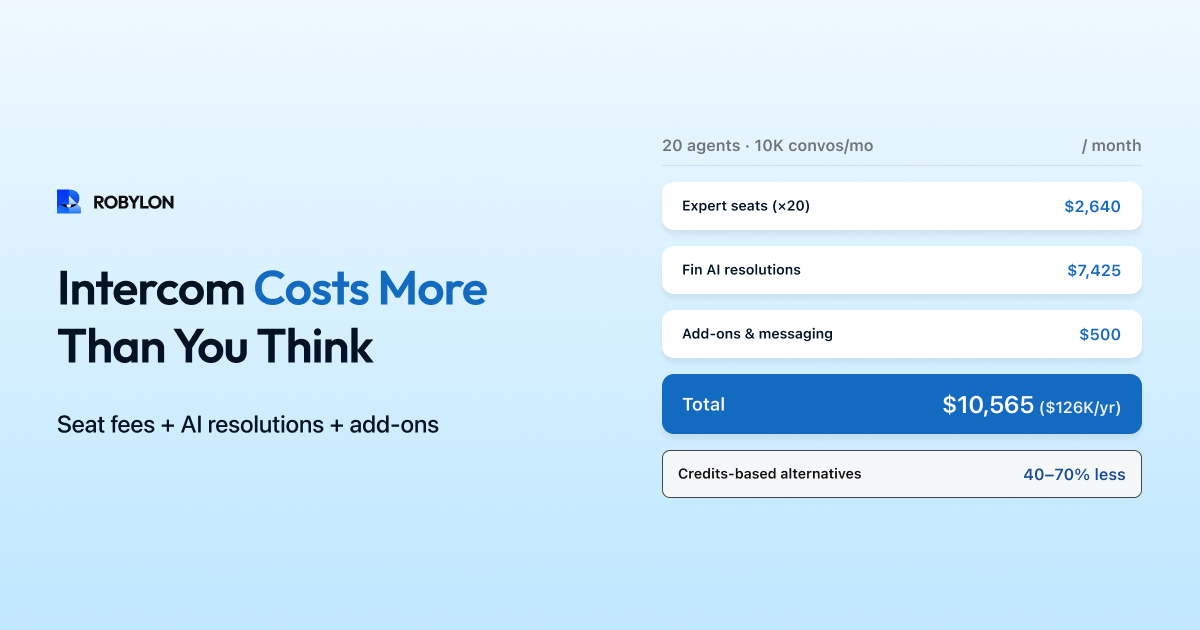
Intercom Pricing 2026: Full Breakdown & Cheaper Alternatives
Intercom's pricing looks simple on the surface but gets complex fast. This guide breaks down every plan, the real cost of Fin AI per resolution, and where the bill surprises you — plus alternatives that cost 40–70% less.