
AI Email Support for Subscription Businesses: Churn, Billing & Plan Changes
Subscription businesses face unique email patterns: cancellation requests, billing disputes, proration questions, and failed payment recovery. This guide shows how AI resolves 65–80% of these emails while routing churn-risk signals to retention specialists.
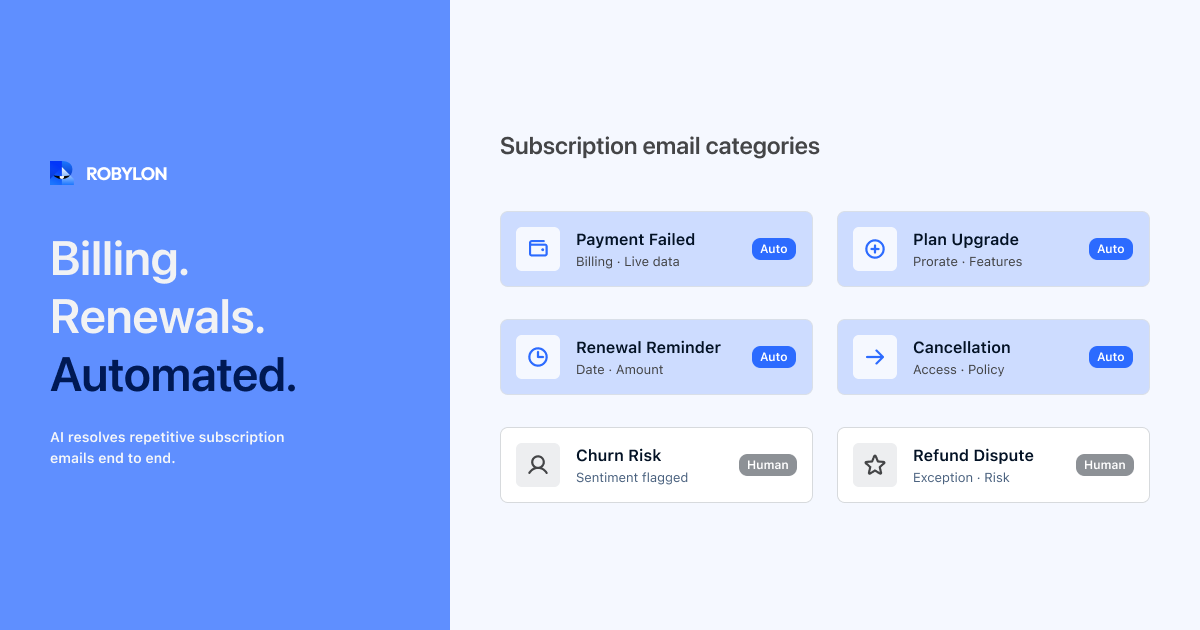
Subscription businesses — SaaS, D2C subscription boxes, streaming services, membership platforms — face a unique email support profile. The stakes are different from one-time purchases: every support interaction either reinforces the customer’s decision to stay subscribed or pushes them closer to cancellation. And a disproportionate share of email tickets involve money: billing questions, proration confusion, payment failures, and the dreaded cancellation request.
AI email automation is particularly valuable here because these queries are data-driven (every answer lives in your billing system), time-sensitive (a failed payment left unresolved for 48 hours often becomes a churn event), and high-volume (subscription businesses see recurring billing-related spikes every month around renewal dates).
The Subscription Email Landscape
- Billing and payment issues (30–40%): Failed payments, unexpected charges, proration questions, invoice requests, payment method updates.
- Plan changes (15–25%): Upgrade requests, downgrade requests, feature access questions, add-on inquiries.
- Cancellation and churn (10–20%): Cancellation requests, pause requests, “what happens if I cancel?” questions.
- Usage and feature questions (15–20%): How to use features, entitlement checks (“does my plan include X?”), limits and quotas.
- Account management (5–10%): Add/remove team members, change billing contact, transfer ownership.
High-Value Workflow: Failed Payment Recovery
Failed payments are the #1 involuntary churn driver for subscription businesses. When a payment fails, the clock starts ticking — if you do not resolve it within 3–7 days, you lose the customer. AI handles this urgently and precisely.
The AI workflow: detect payment failure notification or customer inquiry about failed charge → query billing system (Stripe, Chargebee, Recurly) for failure reason → compose a specific, action-oriented response.
For “card declined — insufficient funds”: “Hi [Name], your subscription renewal of $49/month was declined due to insufficient funds on your Visa ending in 4532. To avoid service interruption, please update your payment method or ensure sufficient balance and we’ll retry automatically in 24 hours. Update here: [billing URL].”
For “expired card”: “Your card ending in 4532 has expired. Please update to a current card here: [URL] to continue your subscription without interruption.”
Speed matters here — the sooner the customer sees the notification and takes action, the higher the recovery rate. AI sends these within seconds of the failure event, while human agents might not reach the email for hours. Businesses implementing AI for failed payment emails see recovery rates improve by 15–25%.
Sensitive Workflow: Cancellation Requests
Cancellation emails require a strategic decision: should AI process the cancellation automatically, or should it route to a human retention specialist? The mechanics shift by industry — in travel and hospitality email support, cancellations hinge on live inventory and fare rules rather than retention offers.
There is no universal answer — it depends on your business model and retention strategy. Here are three approaches:
Approach 1: Full AI Resolution
AI processes the cancellation per your policy (immediate or end-of-billing-period), confirms what happens to the customer’s data, and sends a clear confirmation. Best for businesses where retention efforts via email have historically low success rates, or where you want to respect the customer’s decision without friction.
Approach 2: AI Triage + Human Retention
AI detects the cancellation intent, collects the reason (price, feature gap, switching to competitor, temporary need), and routes to a retention specialist with full context. The specialist sees: customer tenure, plan, usage data, lifetime value, stated reason, and sentiment. This enables a targeted save attempt. Best for high-value subscriptions where a personalized retention conversation can save 10–20% of cancellations.
Approach 3: AI-Powered Retention + Fallback
AI attempts retention first — offering a discount, a plan downgrade, or a pause based on the stated reason and customer profile. “Before we process your cancellation, we’d like to offer [3 months at 50% off / a plan downgrade to $19/month / a 30-day pause]. Would any of these work for you?” If the customer declines, AI processes the cancellation automatically. Best for mid-volume businesses that want retention at scale without staffing a dedicated team.
Standard Workflow: Plan Changes
Upgrade and downgrade requests are straightforward for AI when connected to your billing system:
Upgrade: AI processes the upgrade immediately, calculates proration, and confirms the new plan details. “Hi [Name], you’ve been upgraded to the Pro plan ($79/month) effective immediately. For the remainder of this billing cycle, you’ll see a prorated charge of $34.50. Your new features include [list]. Explore them here: [link].”
Downgrade: AI processes the downgrade effective at the end of the current billing period, explains what changes, and confirms. “Your plan will change from Pro ($79/month) to Basic ($29/month) starting April 1. You’ll retain access to Pro features until then. Note: [features being removed]. Data in those features will be preserved for 90 days after downgrade.”
Entitlement questions: “Does my plan include API access?” AI checks the customer’s current plan against your feature matrix and responds with the specific answer plus upgrade information if the feature requires a higher tier.
Automation rate for plan changes: 75–85%. Standard upgrades/downgrades are fully automated. Custom enterprise changes or complex multi-seat adjustments may escalate.
Billing Confusion: Proration and Charges
Proration is the single most confusing aspect of subscription billing for customers. “I upgraded mid-month and was charged $47.50 instead of $49 — is that wrong?” AI handles this by pulling the exact billing calculation from Stripe/Chargebee and explaining it in plain language.
“Your charge of $47.50 breaks down as follows: You upgraded from Basic ($29/month) to Pro ($79/month) on March 15, with 17 days remaining in your billing cycle. Prorated Pro charge for 17 days: $43.37. Credit for unused Basic: ($15.87). Net charge: $47.50. Your next full charge of $79.00 will be on April 1.”
This level of specific, data-backed explanation is impossible with canned responses and tedious for human agents to calculate manually. AI pulls it from the billing API in seconds.
Subscription-Specific Integrations
- Billing/subscription management: Stripe Billing, Chargebee, Recurly, Zuora — for plan status, invoice data, payment history, proration calculations.
- Product analytics: Mixpanel, Amplitude, or custom — for usage data that informs retention offers (a customer who uses the product daily should get a different retention approach than one who has not logged in for 30 days).
- CRM: For customer lifetime value, tenure, and engagement signals that inform escalation and retention decisions.
- Feature flag system: LaunchDarkly, custom — for real-time plan entitlement checks when customers ask “does my plan include X?”
Churn Signals the AI Should Watch For
Beyond explicit cancellation requests, AI should detect email language that signals churn risk and route these to your retention or customer success team:
- “I’m not really using this anymore” — disengagement signal.
- “We’re evaluating other options” — competitive threat.
- “This is too expensive for what we get” — value perception gap.
- “I’ve been having too many issues” — accumulated frustration.
- “Renewing next month?” from a customer whose invoice is coming up — they are considering whether to stay.
These are not cancellation requests — they are opportunities for proactive retention before the decision is made.
Bottom Line
Subscription email support is where AI has the most direct impact on revenue. Failed payment recovery emails sent in seconds instead of hours improve recovery rates by 15–25%. Billing confusion resolved instantly prevents frustration-driven churn. Plan changes processed in real time reduce the friction that causes customers to give up and cancel instead. And intelligent cancellation routing — whether to AI retention, human specialists, or automatic processing — ensures every churn event is handled per your strategic intent, not left to chance. For gym and wellness memberships specifically, Robylon for health and fitness covers pauses, renewals and refill reminders.
Protect your recurring revenue. Robylon AI auto-resolves billing queries, recovers failed payments, processes plan changes, and routes cancellation signals to the right team — connected to Stripe, Chargebee, and your CRM. Start free at robylon.ai
Frequently asked questions
How does AI recover failed subscription payments via email?
AI detects the payment failure, queries your billing system (Stripe, Chargebee) for the specific failure reason, and sends an immediate, action-oriented email: "Your renewal was declined due to [insufficient funds / expired card]. Update your payment method here: [link] to avoid service interruption." Speed is critical — AI sends within seconds of the failure event vs hours for human agents. Businesses implementing AI for failed payment emails see recovery rates improve 15–25%.
Should AI handle subscription cancellation emails automatically?
Three valid approaches: 1) Full auto-cancellation — respects customer choice, minimal friction. 2) AI triage + human retention — AI collects the reason, routes to a retention specialist with full context (tenure, usage, LTV). 3) AI-powered retention — AI offers a discount, downgrade, or pause based on the stated reason before processing. The right choice depends on your average LTV and historical retention success rates. Many businesses use Approach 2 for high-LTV customers and Approach 1 for low-LTV.
What churn signals should AI detect in subscription emails?
Beyond explicit cancellation requests, AI should flag: "Not really using this anymore" (disengagement), "evaluating other options" (competitive threat), "too expensive for what we get" (value perception gap), "too many issues lately" (accumulated frustration), and "renewing next month?" from a customer near renewal (considering whether to stay). These are not cancellation requests — they are proactive retention opportunities that should route to your customer success team.
What automation rate can subscription businesses expect for email?
Blended 65–80% auto-resolution. Billing queries (75–85% — data-driven lookups), plan changes (75–85% — standard upgrades/downgrades), account management (80–90% — transactional), usage questions (65–75% — KB + entitlement checks). Cancellation handling depends on your strategy — if AI processes cancellations automatically, add 10–20% to the blended rate. If routing to human retention, the rate is lower but churn outcomes are better.
How does AI explain proration to confused subscription customers?
AI pulls the exact calculation from your billing API and translates it to plain language: "You upgraded from Basic ($29/month) to Pro ($79/month) on March 15 with 17 days left in your cycle. Prorated Pro charge: $43.37. Credit for unused Basic: $15.87. Net charge: $47.50. Your next full charge of $79 is on April 1." This data-backed specificity is impossible with templates and tedious for agents to calculate manually.