
AI Email Support for Healthcare: HIPAA-Compliant Automation
Healthcare support teams handle thousands of patient emails daily — appointment requests, billing questions, insurance inquiries, and prescription refills. AI can automate 60–70% of these while maintaining strict HIPAA compliance.
Why Healthcare Email Support Is Different
Patient emails are not like e-commerce or SaaS support tickets. Three factors make healthcare email uniquely complex. First, Protected Health Information (PHI) appears in nearly every message — names, dates of birth, medical record numbers, diagnoses, and treatment details. Any AI system that processes these emails becomes a business associate under HIPAA. Second, patients are often anxious, confused, or in pain. The emotional stakes are higher than a missing package. Third, regulatory requirements vary by state, with some states imposing stricter privacy rules than federal HIPAA standards.
Despite these complexities, the email categories themselves are highly repetitive. Appointment scheduling and rescheduling accounts for 25–30% of inbound volume. Billing and insurance questions represent another 20–25%. Prescription refill requests make up 15–20%. Test result inquiries add 10–15%. The remaining 15–25% covers referrals, medical records requests, and clinical questions that typically require human review.
The HIPAA Compliance Framework for AI Email
Before implementing any AI email system in healthcare, four compliance requirements must be satisfied.
Business Associate Agreement (BAA)
Any AI vendor that processes patient emails must sign a BAA with your organization. This is non-negotiable. The BAA should explicitly cover AI processing of email content, data retention policies for training data, breach notification timelines (HIPAA requires notification within 60 days), and subcontractor chains. Verify that your AI vendor’s BAA covers the entire data flow.
Minimum Necessary Standard
HIPAA’s minimum necessary rule requires that AI systems access only the PHI needed to complete the specific task. For an appointment scheduling email, the AI needs the patient’s name and requested date — not their full medical history. Configure your AI agent to query only the specific data fields required for each email category.
Audit Trails
Every AI-generated email response must be logged with a timestamp, the patient identifier, the data accessed, the AI’s confidence score, and whether the response was auto-sent or human-reviewed. These audit logs must be retained for a minimum of six years under HIPAA.
Encryption Standards
All patient emails in transit and at rest must use AES-256 encryption or equivalent. This applies to the email content, any PHI extracted during AI processing, the AI’s response drafts, and archived conversation threads.
Which Patient Emails Can AI Safely Automate?
High Automation Potential (70–90% auto-resolution)
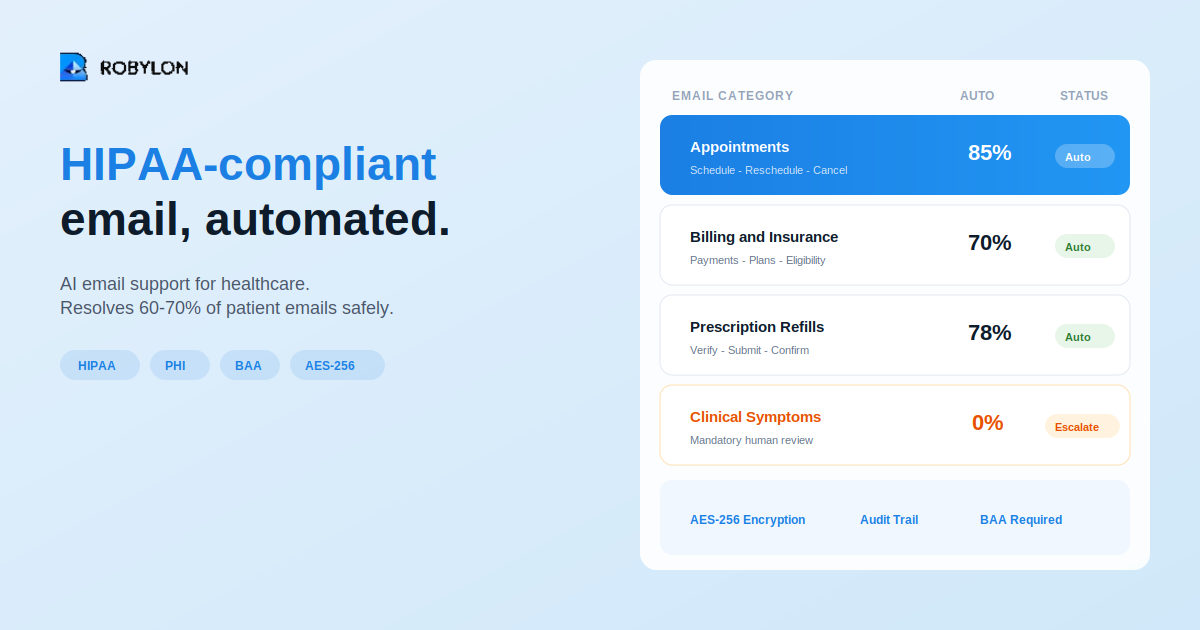
Appointment scheduling works well because the AI needs minimal PHI and the action is straightforward. Billing inquiries about payment plans, accepted insurance, and general pricing can be automated with templates. Prescription refill requests follow a predictable workflow. General facility questions about hours, locations, and parking require zero PHI.
Moderate Automation Potential (40–60% auto-resolution)
Insurance verification requires real-time eligibility checks. Medical records requests must verify patient identity before releasing information. Referral coordination involves multiple parties and scheduling dependencies.
Low Automation Potential (mandatory human review)
Clinical symptom descriptions must always be escalated to clinical staff. Complaint emails about care quality need empathetic human responses. Any email mentioning self-harm, domestic violence, or child abuse triggers mandatory reporting obligations.
Implementation Architecture
PHI Detection Layer
Before the AI processes any email, a PHI detection layer should scan the content and classify data elements. This layer identifies structured PHI (medical record numbers, dates of birth) and unstructured PHI (diagnoses mentioned in free text).
Segmented Processing
Route emails through category-specific AI workflows rather than a single general model. An appointment scheduling workflow accesses only the scheduling system. A billing workflow accesses only the billing system. This enforces the minimum necessary standard by design.
Human-in-the-Loop Thresholds
Set confidence thresholds higher than non-healthcare use cases. Where an e-commerce AI might auto-send at 85% confidence, healthcare should require 92–95% for routine queries and mandatory human review for anything involving clinical content.
Integrations That Matter
EHR integration through HL7 FHIR APIs allows the AI to check appointment availability and verify patient identity. Practice management system integration enables real-time scheduling. Clearinghouse connections let the AI verify insurance eligibility in real time. Pharmacy system integration enables automated refill request processing. Patient portal integration ensures AI email responses are consistent with portal information.
Measuring Success
Track auto-resolution rate by category (target: 65–75% for scheduling, 50–60% for billing). Monitor PHI exposure incidents (target: zero). Measure response time improvement (typical: 4–6 hours down to under 15 minutes). Track patient satisfaction for AI-handled versus human-handled emails. Audit compliance rate should be 100%.
Bottom Line
AI email support in healthcare is becoming necessary as patient email volumes outpace hiring capacity. The key is treating HIPAA compliance as an architectural requirement — build PHI protection into the system design, enforce minimum necessary access by category, maintain comprehensive audit trails, and set confidence thresholds that reflect the stakes of patient communication. For how this fits a clinic’s or wellness brand’s wider support, from appointment booking to membership questions, see AI customer support for health and fitness.
Automate patient emails without HIPAA risk. Robylon AI supports BAA agreements, PHI-safe processing, and healthcare-specific workflows that resolve 60–70% of patient emails automatically. Start free at robylon.ai
Frequently asked questions
What is HIPAA-compliant AI email support?
HIPAA-compliant AI email support processes patient emails while meeting all HIPAA requirements: Business Associate Agreements with the AI vendor, encryption of PHI in transit and at rest, minimum necessary data access, comprehensive audit trails retained for six years, and breach notification protocols.
Which patient emails can AI automate safely?
AI safely automates appointment scheduling (70–90% resolution), billing inquiries (65–80%), prescription refill requests (70–85%), and general facility questions (90%+). Clinical symptoms, care complaints, and emails mentioning self-harm must always escalate to human staff.
Does the AI vendor need a BAA for email support?
Yes, a Business Associate Agreement is mandatory for any AI vendor processing patient emails. The BAA must cover AI processing of email content, data retention, breach notification timelines (60 days under HIPAA), and subcontractor chains.
What confidence threshold should healthcare AI email use?
Healthcare AI email should use 92–95% confidence thresholds for auto-sending routine queries — significantly higher than the 85% typical in e-commerce. Any clinical content requires mandatory human review regardless of confidence.
What integrations does healthcare AI email need?
Essential integrations include EHR systems via HL7 FHIR APIs, practice management systems for scheduling, insurance clearinghouses for eligibility verification, pharmacy systems for refill processing, and patient portal systems for response consistency.