
Zendesk AI Agents: Honest Review & Better Alternatives (2026)
Zendesk AI Agents promise automated resolutions inside your existing Zendesk setup. This review covers what they actually deliver — the strengths, the limitations, the real cost — and compares them to purpose-built AI alternatives.
Zendesk is the largest customer support platform in the world, powering helpdesks for over 100,000 businesses. When they launched AI Agents — their automated resolution product — it was a big deal. The promise: deploy AI that resolves customer conversations directly inside your Zendesk environment, trained on your help center content, without needing a separate platform.
But does it deliver? After reviewing Zendesk AI Agents in production environments and comparing them to purpose-built AI alternatives, the picture is more nuanced than the marketing suggests. Here is an honest breakdown of what works, what does not, what it really costs, and when you should consider a different approach.
What Zendesk AI Agents Actually Do
Zendesk AI Agents sit inside the Zendesk ecosystem and handle customer conversations across chat, email, and messaging channels. Here is how they work:
- Knowledge-based resolution: The AI reads your Zendesk Guide help center articles and generates answers to customer questions. When a customer asks about your return policy, the AI finds the relevant article and provides a summarized response.
- Intent detection: Zendesk pre-trains its AI on common support intents (order status, cancellations, billing questions) and lets you customize additional intents specific to your business.
- Conversation flows: You can build structured flows where the AI asks qualifying questions, collects information, and routes conversations based on the answers.
- Auto-resolution: When the AI successfully handles a conversation end-to-end without needing a human agent, it counts as an “automated resolution” — which is how Zendesk charges for the service.
- Agent assist: For conversations that do reach human agents, the AI suggests responses, summarizes the conversation, and helps agents work faster.
What Works Well
Seamless Zendesk Integration
The biggest advantage of Zendesk AI Agents is that they live natively inside your existing Zendesk environment. If your team already uses Zendesk for ticketing, reporting, and workflows, the AI plugs in without requiring a separate platform, separate login, or data migration. Help center content syncs automatically. Conversation history stays unified. Agent handoff happens within the same workspace.
For large teams deeply embedded in the Zendesk ecosystem, this integration value is significant. It reduces the friction of adding AI to your existing operation.
Pre-Built Intents
Zendesk ships with pre-trained intents for common support scenarios across industries — e-commerce (order tracking, returns), SaaS (billing, account access), and general support (password reset, contact information). This accelerates setup because you do not have to build intent recognition from scratch. You customize and extend rather than starting from zero.
Agent Assist Features
Even when the AI does not fully resolve a conversation, it adds value for human agents. Conversation summaries, tone detection, suggested replies, and ticket classification reduce the cognitive load on agents and speed up handle time. These features are genuinely useful for high-volume teams.
Where Zendesk AI Agents Fall Short
Pricing Is Complex and Expensive
Zendesk AI is not included in base plans. You need to understand three pricing layers:
- Zendesk Suite plan: Starting at $55/agent/month (Team) up to $150+/agent/month (Enterprise). The AI features require Suite Professional or higher.
- Advanced AI add-on: Approximately $50/agent/month extra for the full AI agent capabilities. This is on top of your Suite plan cost.
- Automated resolution charges: Zendesk charges per automated resolution, similar to Intercom’s Fin pricing. At scale, this becomes the dominant cost.
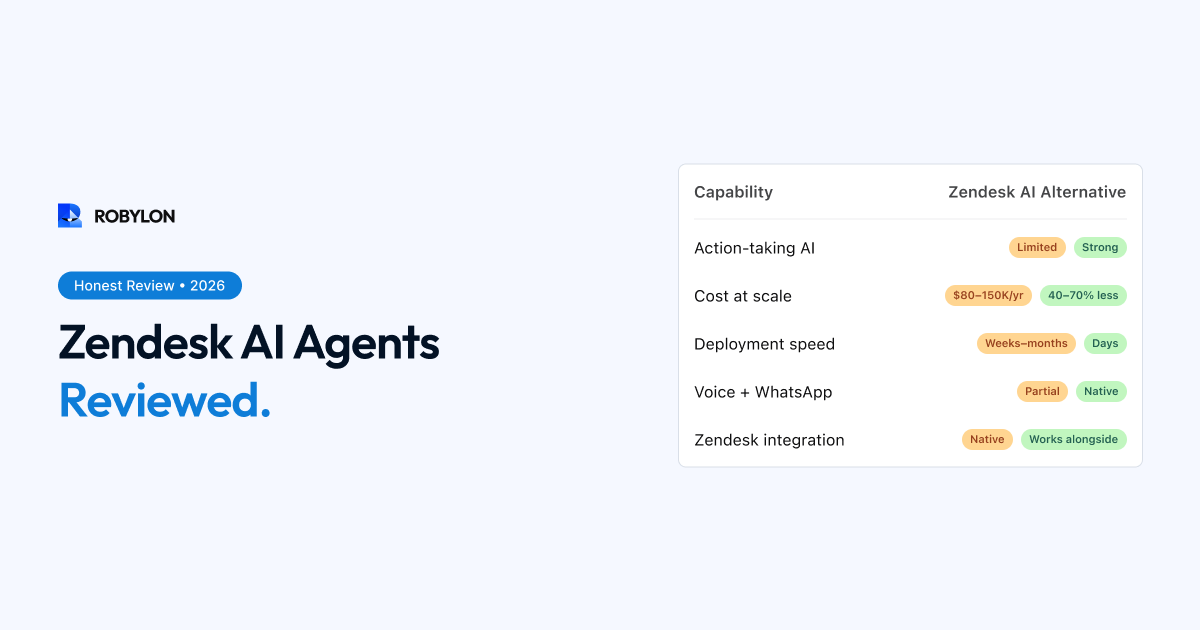
The total for a 15-agent team on Professional + Advanced AI can easily exceed $3,000/month before any resolution charges. Add high-volume automated resolutions and the annual bill can reach $80K–$150K.
Limited Action-Taking Capabilities
This is the most significant functional limitation. Zendesk AI Agents are strongest at answering questions from your help center — but weaker at taking actions. Processing a refund, modifying an order, updating an account, or triggering a workflow in an external system requires custom API development or third-party integrations.
Purpose-built AI agent platforms (like Robylon) are designed from the ground up for action-taking — connecting to your OMS, CRM, and billing system so the AI can actually resolve transactional queries, not just answer informational ones. This is the difference between automating 40% of conversations (answer-only) versus 70–85% (answer + action).
Setup Complexity
While the Zendesk integration is seamless, configuring the AI to work well requires significant effort. You need to structure your help center content for AI consumption (many existing help centers are not optimized for this), configure intents and conversation flows, set up escalation logic, and tune confidence thresholds. Teams report weeks to months of configuration before reaching satisfactory automation rates.
Newer, AI-native platforms often achieve comparable automation in days because they are designed specifically for rapid deployment rather than bolted onto a legacy helpdesk architecture.
Channel Limitations
Zendesk AI Agents work across Zendesk’s supported channels — email, chat, messaging, social. But voice AI is limited, WhatsApp support requires additional configuration and cost, and the AI experience across channels is not always consistent. If you need strong voice AI (automated phone support) or native WhatsApp chatbot capabilities, Zendesk is not the strongest option.
Legacy Architecture Constraints
Zendesk was built as a ticketing system and has evolved over decades. The AI layer is an addition to that architecture, not the foundation. This means some capabilities feel bolted on — the conversational flow builder is less intuitive than purpose-built platforms, the AI training pipeline is less transparent, and the feedback loop (from customer interactions back to AI improvement) is less direct.
Platforms built AI-first (rather than ticketing-first with AI added later) tend to offer faster iteration cycles, more transparent confidence scoring, and tighter integration between the AI engine and the conversation management layer.
Zendesk AI Agents vs. Alternatives: Key Differences
Robylon AI
Best for: Teams that want full AI automation (including action-taking) across chat, email, voice, and WhatsApp at lower cost.
- Credits-based pricing with no per-seat fees for AI interactions — significantly cheaper at scale.
- Designed for action-taking: connects to OMS, CRM, billing, and helpdesk systems to resolve queries end-to-end.
- Deploys in hours/days versus weeks/months.
- Native voice AI and WhatsApp support.
- Works alongside Zendesk as a front-end AI layer if you want to keep Zendesk for ticketing.
Intercom Fin
Best for: SaaS companies that want AI-powered messaging with a polished in-app experience.
- Beautiful messenger UX. Strong product tour and onboarding features.
- Per-resolution pricing ($0.99/resolution) — similar cost dynamics to Zendesk at scale.
- Better for conversational messaging, weaker for traditional ticketing workflows.
Freshdesk (Freddy AI)
Best for: Teams that want a Zendesk-like helpdesk at a lower price point with AI included.
- Lower base pricing ($15–$79/agent/month).
- Freddy AI included in higher tiers without separate per-resolution charges.
- Less mature AI capabilities than Zendesk or purpose-built AI platforms.
Gorgias
Best for: Shopify-focused e-commerce brands that want deep Shopify integration.
- Priced by ticket volume, not per seat.
- Deep Shopify, BigCommerce, and Magento integrations.
- AI automation capabilities are improving but not as mature as Zendesk AI or Robylon.
- Narrow focus — not suitable for non-e-commerce use cases.
When to Stick with Zendesk AI
- Your entire support operation is deeply embedded in Zendesk and migration cost is prohibitive.
- You primarily need answer-based automation (FAQ, policy questions) rather than transactional automation (order changes, refunds).
- Your team values the unified Zendesk reporting and admin experience above all else.
- You have the internal resources (time, Zendesk admin expertise) to configure and optimize the AI over weeks.
When to Choose an Alternative
- Your AI costs are growing faster than your automation rate — the per-resolution pricing is unsustainable at your volume.
- You need the AI to take actions (not just answer questions) — process refunds, look up orders, update accounts, create tickets.
- You need strong voice AI or native WhatsApp chatbot capabilities.
- You want to deploy in days, not weeks — and iterate rapidly based on real customer interactions.
- You want predictable, lower costs — especially at 5,000+ conversations per month.
Bottom Line
Zendesk AI Agents are a solid option if you are already deeply invested in the Zendesk ecosystem and primarily need knowledge-based automation for moderate conversation volumes. The native integration and pre-built intents reduce friction for existing Zendesk customers.
But for teams that need action-taking AI, voice automation, native WhatsApp support, faster deployment, or more cost-effective pricing at scale, purpose-built AI agent platforms deliver better outcomes. The market has moved beyond “AI bolted onto a helpdesk” to “AI-first platforms that integrate with your helpdesk” — and the results are noticeably different.
Keep Zendesk. Add better AI. Robylon AI works alongside your Zendesk instance — resolving conversations across chat, email, voice, and WhatsApp with action-taking capabilities that Zendesk AI alone does not offer. Start free at robylon.ai
Frequently asked questions
Are Zendesk AI Agents included in the base plan?
No. Full AI agent capabilities require three pricing layers: a Zendesk Suite plan (Professional or higher, $89–$150+/agent/month), the Advanced AI add-on (~$50/agent/month extra), and per-resolution charges for automated conversations. A 15-agent team can easily exceed $3,000/month before any resolution fees are applied.
Can Zendesk AI Agents process refunds or cancel orders?
Out of the box, Zendesk AI Agents are strongest at answering questions from your help center — not taking transactional actions. Processing refunds, modifying orders, or updating account records requires custom API integrations or third-party tools. Purpose-built AI agent platforms like Robylon are designed for action-taking from day one, which is why they achieve 70–85% automation versus 40–50% for answer-only systems.
Can I use Robylon AI alongside my existing Zendesk setup?
Yes. Robylon AI integrates with Zendesk as a front-end AI layer — resolving conversations across chat, email, voice, and WhatsApp, then creating or updating Zendesk tickets for anything that reaches a human agent. This lets you keep Zendesk for ticketing and agent workspace while adding more capable AI automation on top, without a full platform migration.
How long does it take to set up Zendesk AI Agents?
Teams typically report weeks to months of configuration before reaching satisfactory automation rates. You need to structure help center content for AI retrieval, configure intents and conversation flows, set up escalation logic, and tune confidence thresholds. AI-native platforms designed for rapid deployment can often achieve comparable automation in days rather than weeks.
Does Zendesk AI support voice and WhatsApp?
Zendesk supports WhatsApp as a messaging channel, but it requires additional configuration and per-message costs. Voice AI capabilities are limited — Zendesk Talk handles call routing and recording, but automated AI voice conversations (where an AI agent speaks to the customer by phone) are not a core strength. If you need strong voice AI or native WhatsApp chatbot automation, purpose-built platforms offer a better experience.
Related reading
 Comparisons
10 Botpress Alternatives in 2026 - No-Code to Open-Source (Compared)
Looking for BotPress competitors? See the best tools in 2026, including free vs paid, ease-of-use, open-source & no-code options.
 Comparisons
10 LiveChat Alternatives in 2026 - Better Features at Half the Price
Find the perfect LiveChat competitor for 2026. Get feature comparisons, free and paid options from tools like Robylon, Intercom, Zendesk Chat, Tidio, and more.
 Comparisons
11 Drift Alternatives in 2026 - Stronger AI, Lower Pricing (Ranked)
Looking for Drift competitors? Explore top live chat, omnichannel & AI-SDR chatbot tools so you can pick the right Drift replacement.