
Hiring vs AI for Email Support: The 2026 Cost Calculator
A practical breakdown of what a human email support hire actually costs in 2026 versus AI automation. Includes fully loaded salary math, cost per ticket, turnover drag, and a breakeven framework you can run on your own volume.
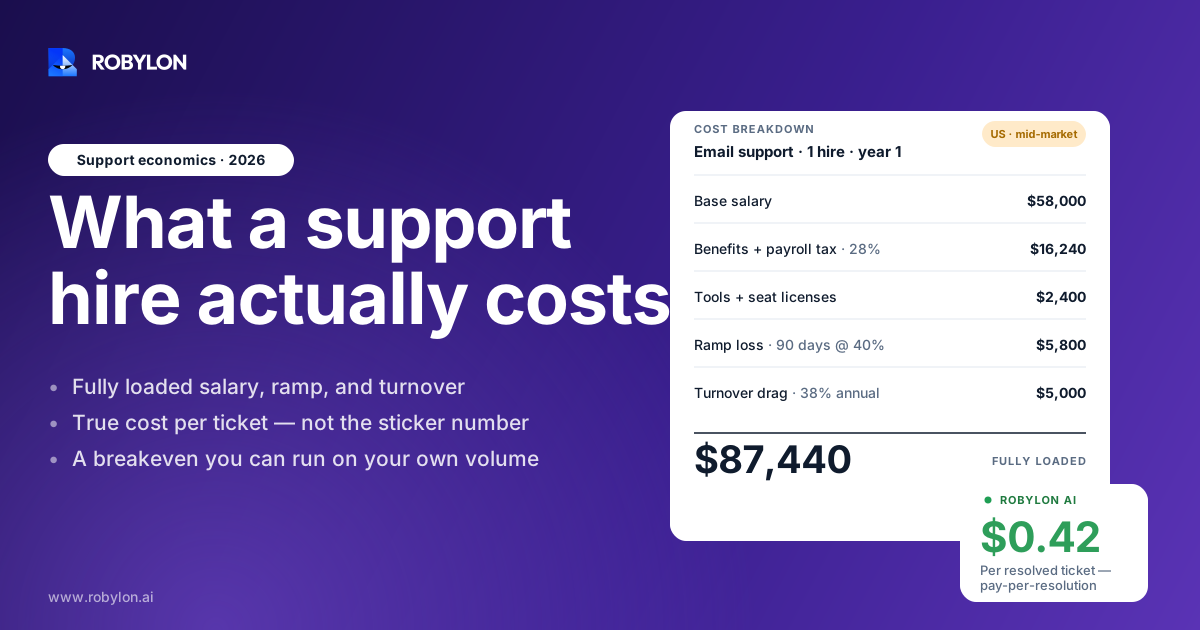
A support lead asked me last month how many agents she needed for an inbox doing 9,000 emails a month. The honest answer was a question back: do you want to hire for that, or do you want to stop hiring for the part of it that doesn’t need a human? Most teams never run that math cleanly. They budget by gut and end up surprised at renewal.
So let’s run it cleanly. This is the full 2026 cost picture for a human email support hire versus AI automation, with real benchmark numbers, the costs people forget, and a breakeven framework you can apply to your own queue.
What a human email support agent actually costs in 2026
The salary is the part everyone quotes and the part that’s least useful on its own. In the US, an email support specialist sits around $50,000 a year in base pay, with most roles falling between roughly $41,000 and $63,000 depending on experience and market. Some sources put a generalist “email support” role closer to $43,000, others push specialist titles past $60,000. Call the base $50,000 for a mid-level hire.
Base pay is not what the agent costs you. Fully loaded cost is.
Fully loaded means base plus everything that rides on top: benefits, payroll taxes, equipment, software seats, office or remote stipend, and the management overhead of someone supervising the team. The benchmark math here is consistent across 2026 reports. Benefits and taxes add 25–40% above base. Management overhead adds another 20–30%. Technology and tooling run $80–$150 per agent per month.
Stack that up and a $50,000 base becomes a fully loaded cost in the $70,000–$85,000 range. Industry guidance for 2026 lands new-hire fully loaded cost between $60,000 and $80,000, plus around $15,000 for recruiting and onboarding before the agent resolves a single ticket. That $15,000 is real money spent on a person who is not yet productive.
The costs that never make it into the budget
Three things quietly inflate the per-agent number, and they’re the ones spreadsheets skip.
- Turnover: Support attrition runs 30–45% a year, and first-year attrition is worse, with 65–70% of new hires gone inside twelve months in some operations. Each departure costs $10,000–$20,000 to replace. For a small team that churns one or two people a year, that’s a recurring line item, not a one-off.
- Ramp time: A new agent isn’t at full speed on day one. The first month or two is shadowing, mistakes, and slower handle times while they learn your product and tone.
- Coverage gaps: One human covers one shift in one timezone. Email that lands at 2 a.m. waits until morning. Holidays, sick days, and PTO all create silent backlog that the next person inherits.
Add it together and the working number for one human email agent in 2026 is roughly $75,000–$95,000 all-in for the first year, settling toward $70,000–$85,000 in steady state once you amortize the one-time hiring cost.
How many emails does that buy you?
This is where the per-ticket math gets interesting, because an agent’s capacity is finite in a way software’s isn’t.
Average handle time for email runs about 8 minutes per ticket in 2026 BPO benchmarks. Realistic throughput, accounting for breaks, meetings, and the fact that nobody resolves tickets for eight straight hours, lands most agents at 25–35 email tickets per day. Some teams report a blended average closer to 17 interactions a day once you fold in every channel and interruption.
Take the middle: 30 tickets a day, roughly 20 working days a month, gives you about 600 resolved emails per agent per month. At a fully loaded cost of $7,000 a month, that’s a cost per ticket of $11–$12 for human email resolution, which lines up almost exactly with the 2026 benchmark of $9–$16 per email resolution.
So the unit economics of hiring are clear: one agent, ~600 emails a month, ~$11 per resolved email. Need to handle 9,000 emails? That’s roughly 15 agents’ worth of capacity if every email needs a human, before you account for volume spikes.
What AI email support costs instead
AI flips the cost structure from per-person to per-volume. You’re not buying a seat that can do 600 emails. You’re buying resolution capacity that scales with your queue.
The honest framing here matters, because the AI vendor space is full of vague claims. AI doesn’t resolve 100% of email. A well-deployed system handles the repetitive, well-documented tickets that make up the bulk of any inbox: order status, refunds, password resets, billing questions, shipping updates. The hard, ambiguous, or emotionally charged emails still go to a human. That’s the design, not a failure.
On cost per ticket, AI-handled email resolution runs $0.50–$2.37 per resolution when the AI takes full ownership of the ticket, comparable to self-service economics but with resolution quality closer to an experienced agent. Compare that to the $9–$16 a human costs for the same email. That’s roughly a 7x to 20x difference on the tickets AI can actually own.
The platform decision comes down to which tickets it can genuinely resolve and how the pricing is structured. We’ve written a full breakdown of AI email support pricing models because the pricing structure is where most teams overspend. Per-seat, per-resolution, and per-conversation pricing can swing an annual bill by tens of thousands of dollars at the same volume, depending on how much the AI actually deflects.
Where the AI math gets misleading
A few cautions, because the savings are real but the marketing often overstates them.
Gartner found that only about 20% of service leaders have actually reduced headcount because of AI. That sounds like a knock against automation, but it isn’t. What usually happens is volume grows into the freed capacity. The AI absorbs the new tickets that would have required the next three hires, so the team handles 3x the volume with the same people instead of cutting the team to a third. The savings show up as avoided hiring, not as layoffs.
The other catch is the resolution rate. A platform that claims 95% automation on a queue where only 60% of tickets are genuinely automatable is either misrepresenting the number or routing failures as “deflected.” Robylon’s resolution rate sits at 60–80% of email volume autonomously, validated against your historical tickets during onboarding rather than promised on a slide. That validation step is the difference between a number you can budget against and a number you find out is wrong in month two.
The breakeven calculator: run it on your own numbers
Here’s the framework. You can do this on a napkin in five minutes.
- Monthly email volume: Pull your actual resolved-email count for a normal month. Call it V.
- Automatable share: Estimate the percentage of those emails that are repetitive and well-documented (order status, refunds, account questions). For most ecommerce and SaaS inboxes this is 60–80%. Call it A.
- Human cost avoided: Multiply V × A × $11 (your human cost per email). That’s what you’d otherwise pay agents to resolve the automatable tickets.
- AI cost: Multiply V × A × your AI cost per resolution (use $1.50 as a working midpoint, or the actual quote). That’s what the AI costs to handle the same tickets.
- Net monthly saving: Subtract AI cost from human cost avoided. Compare against the AI platform’s monthly minimum to confirm you clear it.
Run a real example. An ecommerce brand doing 9,000 emails a month, 70% automatable, pays roughly $69,300 a month for humans to handle those 6,300 tickets (6,300 × $11). The same tickets through AI at $1.50 each cost about $9,450. Net saving on the automatable slice: roughly $59,000 a month, before you account for the agents you no longer need to recruit, train, and replace.
The breakeven is almost immediate. An AI platform capable of replacing the throughput of 3–5 agents typically costs less than one fully loaded human hire. The first 600 emails a month it resolves cover the entire bill. Everything above that is margin.
This is the part that’s hard to argue with once anyone actually does the arithmetic. The reason teams don’t is that the human cost is spread across a dozen budget lines and the AI cost is a single invoice, so the comparison never gets made head to head.
What you should still hire humans for
The calculator makes AI look like an obvious win, and on cost per ticket it is. But the framing of “AI versus hiring” is the wrong frame for most teams. The right one is which work goes where.
Keep humans on the work that needs judgment: angry customers where tone matters, edge cases the documentation doesn’t cover, high-value account escalations, anything with legal or financial weight, and the gray-area tickets where getting it wrong costs more than the ticket. A good system knows the difference and routes accordingly. We’ve gone deep on when AI should resolve versus route to a human, because escalation design is what separates automation that helps from automation that annoys.
The teams that win in 2026 aren’t choosing AI or humans. They’re putting AI on the 60–80% that’s repetitive and freeing their humans to be excellent at the 20–40% that actually needs a person. The agents you keep get better work, less burnout, and lower turnover, which loops back and lowers your hiring cost too.
Why email-first automation changes the math
One reason email is the right place to start automating is that it’s asynchronous and written. There’s a record, there’s time to reason, and the AI can take real action rather than just draft a reply. Robylon connects to 60+ write-access integrations, so the agent can pull an order from Shopify, issue a refund in Stripe, or update a ticket in your helpdesk, not just suggest that a human do it.
That’s the difference between deflection and resolution. A bot that answers “here’s how to check your order status” deflects the ticket back to the customer. An AI email support agent that takes action looks up the order, sees it’s delayed, and tells the customer when it’ll arrive. One creates a follow-up email; the other closes the loop. The cost-per-ticket numbers only hold if the AI genuinely resolves rather than deflects, which is why action-taking matters more than answer quality alone.
Deployment is the last variable. A human hire takes weeks to recruit and months to ramp. A validated AI deployment runs 3–7 days because the work is configuration and historical-ticket validation, not training a person from scratch. For a high-volume ecommerce support operation heading into a seasonal spike, that timeline is the difference between absorbing the surge and drowning in it.
Run your own numbers before you sign off on the next req. The math usually decides the question for you.
Ready to run the math on your own inbox? Robylon AI resolves 60–80% of customer emails autonomously with AI agents that take action across Shopify, Stripe, Zendesk, and 60+ other integrations, deployed in 3–7 days. Start free at robylon.ai
Frequently asked questions
How much does it cost to hire an email support agent in 2026?
A US email support specialist earns around $50,000 in base salary, but the fully loaded cost is what matters for budgeting. Once you add benefits and payroll taxes (25–40% above base), management overhead (20–30%), and tooling, the real number lands at $70,000–$85,000 per year. Add roughly $15,000 for recruiting and onboarding before the agent is productive. First-year all-in cost is typically $75,000–$95,000.
What is the cost per ticket for human versus AI email support?
Human email resolution costs $9–$16 per ticket in 2026 benchmarks, driven by salary, tooling, and the 8-minute average handle time per email. AI email resolution costs $0.50–$2.37 per ticket when the AI takes full ownership. That's a 7x to 20x difference on the tickets AI can genuinely resolve, which is why automating repetitive email is the fastest cost lever in most support budgets.
How many emails can one support agent handle per day?
Most email support agents resolve 25–35 tickets per day, or about 600 a month, based on 2026 productivity benchmarks and an 8-minute average handle time. Blended across channels and interruptions, some teams see closer to 17 interactions a day. Capacity is fixed per person, which is the core limit of hiring: handling 9,000 monthly emails with humans alone needs roughly 15 agents before accounting for volume spikes.
Does AI email support actually reduce headcount?
Often it reduces hiring, not headcount. Gartner found only about 20% of service leaders cut staff because of AI; more commonly, growing volume absorbs the freed capacity. The AI handles the new tickets that would have required the next several hires, so the team scales 3x without expanding. The saving shows up as avoided recruiting, training, and turnover cost rather than layoffs, while existing agents move to higher-value work.
What share of email tickets can AI realistically resolve?
A well-deployed system autonomously resolves 60–80% of email volume, the repetitive, well-documented tickets like order status, refunds, and billing questions. The remaining 20–40% (complex, ambiguous, or emotionally charged emails) routes to a human. Be skeptical of claims above this range without validation; Robylon confirms its resolution rate against your historical tickets during onboarding, so the number you budget against is real rather than aspirational.