
Front vs Robylon: Which Email Platform Handles AI Better?
Front is great for teams that collaborate on email. Robylon is great for teams that want AI to resolve email. This comparison helps you decide which problem to solve first — and why many teams end up using both.
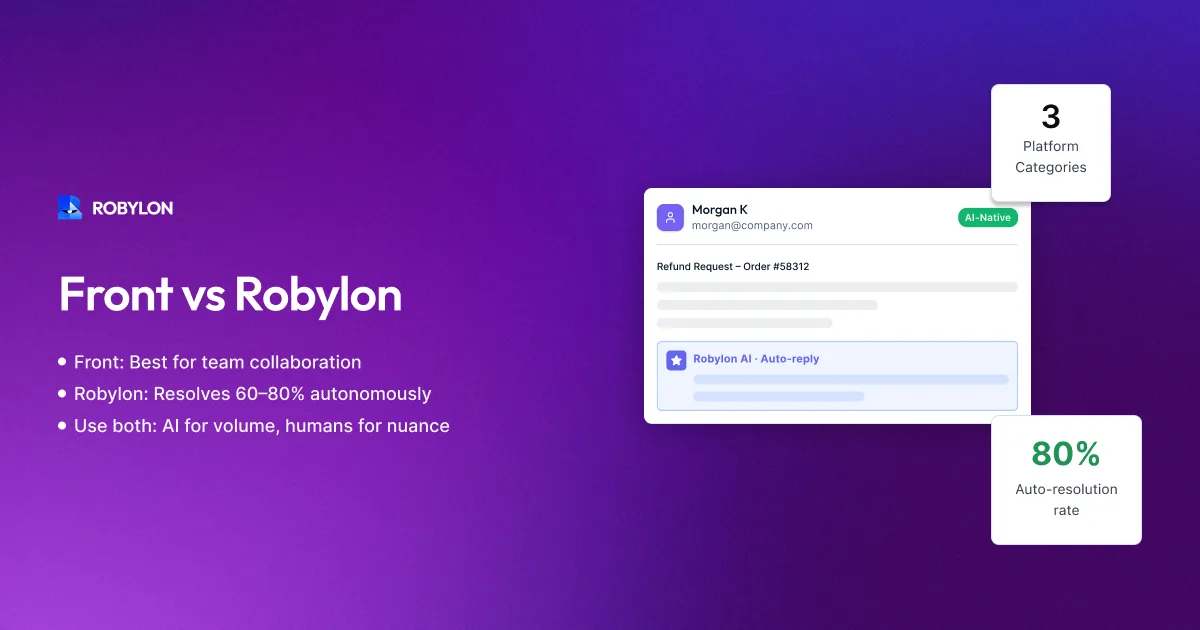
Front and Robylon AI solve different problems in email support, but they show up in the same evaluation shortlists because both handle email and both mention AI in their marketing. The distinction matters: Front is a collaborative shared inbox designed for teams that work on email together. Robylon is an AI resolution engine designed to handle email tickets autonomously. Understanding this difference saves you from choosing the wrong tool — or missing the opportunity to use both.
What Front Does
Front started as a shared inbox and evolved into a customer operations platform. Its core strength is team collaboration on email: shared inboxes with individual and team access, internal comments and @mentions on email threads, shared drafts where multiple people can contribute to a response, assignment rules that distribute emails across team members, and analytics on response times and team workload.
Front connects personal and shared email accounts in one interface, making it popular with operations teams, account management teams, and customer success teams — groups that handle email collaboratively rather than through a traditional ticketing queue.
Front’s AI Features
Front has added AI capabilities that assist agents:
- AI tagging and categorization: Automatically tags incoming emails by topic.
- AI summarization: Condenses long threads for quick context.
- AI draft suggestions: Generates response drafts for agents to review.
- Workflow automation: Rule-based routing and assignment (not AI-powered resolution).
These are useful agent-assist features. They make agents faster at handling email but do not resolve emails autonomously. Every email still requires an agent to review, edit, and send the response.
What Robylon Does Differently
Robylon’s core capability is autonomous email resolution. The AI reads incoming emails, classifies intent, retrieves relevant knowledge, queries live business systems (OMS, CRM, payments), takes actions to resolve the issue, generates a personalized response, and sends it — without agent involvement for 60–80% of tickets.
For the 20–40% of emails that need human attention, Robylon integrates with agent workspace tools — including Front — routing the email with full context so the agent can resolve it quickly.
Comparison: What Matters for Email Support
AI Resolution Depth
Front: Agent-assist AI. Drafts, summaries, and tagging help agents work 30–40% faster. Auto-resolution rate: ~0% (agents always in the loop).
Robylon: Autonomous resolution AI. Handles emails end-to-end for 60–80% of volume. The remaining 20–40% get agent-assist features (context, drafts, suggestions).
Collaboration Features
Front: Excellent. Purpose-built for team collaboration — internal comments, shared drafts, @mentions, multi-team routing. If your team needs to collaborate on complex emails (enterprise accounts, legal reviews, cross-department coordination), Front’s collaboration features are best-in-class.
Robylon: Limited native collaboration features. Robylon is not designed as an agent workspace — it is an AI engine. For collaboration, pair it with Front, Freshdesk, or Zendesk as the agent-facing layer.
Action-Taking
Front: No native action-taking. Front does not connect to your OMS, payment system, or returns platform to execute transactional workflows within email responses. Agents must switch to those systems manually.
Robylon: 40+ native integrations. The AI queries Shopify for order status, processes refunds through Stripe, updates accounts in your CRM, and generates return labels — all within the email response flow.
Pricing
Front: Starter ($19/seat/month), Growth ($59/seat/month), Scale ($99/seat/month), Premier (custom). Enterprise pricing adds up fast — a 15-person team on Growth: $885/month.
Robylon: Credits-based. Free tier available. No per-seat charges. At 5,000 emails/month: $1,500–$3,000/month total — but resolves 60–80% of emails automatically, reducing the number of agents needed.
Best Use Cases
Front excels when: Your team handles complex, high-touch emails that require internal collaboration (enterprise account management, legal coordination, executive escalations). Email is a collaboration tool, not a ticket queue. You need shared drafts where multiple stakeholders contribute to a response before sending.
Robylon excels when: Your email volume is high and dominated by repetitive, data-driven queries (order tracking, refunds, billing, policy questions). Speed and automation matter more than internal collaboration on each email. You want AI to handle the volume so agents only work on emails that need human judgment.
The Complementary Approach: Front + Robylon
The most powerful setup for teams that handle both high-volume repetitive emails and complex collaborative emails is to use both tools together.
How it works: Robylon processes all incoming emails first. The AI resolves 60–80% autonomously (order tracking, refund status, policy questions, account updates). The 20–40% that require human attention are routed to Front, where agents collaborate using Front’s internal comments, shared drafts, and @mentions to craft thoughtful responses.
The result: Agents in Front only see emails that genuinely need their expertise and collaboration. The hundreds of repetitive emails that used to clog their inbox are handled before they arrive. Agent workload drops dramatically, response times improve for both AI-resolved and human-handled emails, and the team’s energy goes toward the high-value interactions where collaboration and human judgment make a real difference.
When to Choose Each
Choose Front If:
- Team collaboration on email is your primary need — shared drafts, internal comments, cross-team routing.
- Your email volume is low-to-moderate (under 2,000/month) and agents can handle it with collaboration tools.
- You handle enterprise account management or complex email workflows where multiple people contribute to each response.
- AI resolution is not a priority — you are optimizing for team coordination, not automation.
Choose Robylon If:
- Email volume is high and dominated by repetitive queries that AI can resolve automatically.
- Your goal is reducing email handling costs and response times through automation, not improving team collaboration.
- You need transactional resolution — the AI must look up orders, process refunds, update accounts.
- You need multi-channel AI coverage (email + voice + WhatsApp + chat).
Use Both If:
- You have high volume AND complex emails — AI handles the volume, Front handles the complexity.
- You want to protect agent time for high-value interactions while automating everything else.
Bottom Line
Front and Robylon are not competitors — they solve different problems. Front makes teams better at handling email together. Robylon makes AI better at handling email alone. If your challenge is team coordination, choose Front. If your challenge is email volume and repetitive queries, choose Robylon. If your challenge is both, use both — and let AI clear the inbox so your team can focus on the emails where human collaboration actually matters.
Let AI handle the volume. Let your team handle the complexity. Robylon AI resolves repetitive emails automatically, routing the complex ones to Front (or your preferred workspace) with full context. Start free at robylon.ai
Frequently asked questions
Is Front a good choice for AI-powered email support?
Front is excellent for team collaboration on email — shared drafts, internal comments, @mentions, multi-team routing. Its AI features (tagging, summarization, draft suggestions) help agents work 30–40% faster. But Front does not offer autonomous email resolution — agents are always in the loop. If your goal is AI that resolves emails without human involvement, Front is not the right tool. If your goal is better team coordination on complex emails, Front is best-in-class.
What is the main difference between Front and Robylon?
Front is a collaborative shared inbox that makes teams better at handling email together. Robylon is an AI resolution engine that handles email tickets without teams. Front optimizes how agents work. Robylon reduces whether agents need to work (for 60–80% of emails). They solve different problems — collaboration vs automation — which is why many teams use both: Robylon for volume, Front for complexity.
Can I use Front and Robylon together?
Yes — this is the recommended approach for teams with both high volume and complex emails. Robylon processes all incoming emails, resolving 60–80% autonomously (order tracking, refunds, policy questions). The 20–40% needing human attention routes to Front, where agents collaborate using internal comments, shared drafts, and @mentions. Agents in Front only see the emails that genuinely need their expertise — the repetitive ones never arrive.
Does Front have action-taking capabilities like Robylon?
No. Front does not natively connect to your OMS, payment system, or returns platform to execute transactional workflows within email responses. Agents must switch to those systems manually to process refunds, check orders, or update accounts. Robylon has 40+ native integrations — the AI queries Shopify for order status, processes refunds through Stripe, updates CRM records, and generates return labels automatically within the email response.
When should I choose Front over Robylon for email support?
Choose Front when: team collaboration is the primary need (shared drafts, internal comments, cross-department coordination), email volume is manageable (under 2,000/month), and you handle enterprise accounts where multiple stakeholders contribute to each response. Choose Robylon when: email volume is high with repetitive queries, you need autonomous AI resolution, and you want to reduce headcount rather than coordinate more people. Choose both when you have high volume AND complex emails.