
Intercom Pricing 2026: Full Breakdown & Cheaper Alternatives
Intercom's pricing looks simple on the surface but gets complex fast. This guide breaks down every plan, the real cost of Fin AI per resolution, and where the bill surprises you — plus alternatives that cost 40–70% less.
Intercom is one of the most recognized names in customer messaging. It pioneered the in-app messenger, built a powerful product for SaaS companies, and more recently launched Fin — an AI agent that resolves support conversations automatically. The product is genuinely good.
The pricing, however, is where things get complicated. What looks like a straightforward plan on the pricing page turns into a significantly larger bill once you factor in per-seat costs, Fin AI resolution charges, add-ons for advanced features, and overage fees. Many teams report their actual Intercom spend being 2–3x what they initially expected.
This guide breaks down exactly how Intercom pricing works in 2026, where the costs add up, and which alternatives deliver comparable (or better) value at a lower total cost.
How Intercom Pricing Works in 2026
Intercom structures its pricing around three core plans, with AI usage charged separately on top. Here is how each layer works.
Base Plans
Intercom offers three tiers:
- Essential — $29/seat/month: Basic shared inbox, ticketing, help center, and messenger. Suitable for very small teams just getting started. Limited automation and reporting capabilities.
- Advanced — $85/seat/month: Adds workflows, multiple team inboxes, assignment rules, side conversations, and more robust reporting. This is where most growing teams land.
- Expert — $132/seat/month: Adds workload management, SLA rules, custom roles, and advanced security features. Designed for larger support operations with complex routing needs.
These are per-seat prices. A team of 10 agents on the Advanced plan pays $850/month just for seats — before any AI usage.
Fin AI Agent — Per Resolution Pricing
Intercom’s AI chatbot, Fin, is priced per resolution — meaning you pay every time Fin successfully resolves a customer conversation without human involvement. The current rate is approximately $0.99 per resolution.
This sounds reasonable until you do the math at scale:
- 1,000 Fin resolutions/month = $990/month on top of your seat costs.
- 5,000 resolutions/month = $4,950/month.
- 10,000 resolutions/month = $9,900/month.
For a growing e-commerce brand or SaaS company with high support volume, Fin charges alone can exceed the cost of the entire base platform. And here is the catch — as your chatbot improves and resolves more conversations (which is the whole point), your Fin bill goes up proportionally. You are effectively penalized for better automation.
Add-Ons and Hidden Costs
Several features that many teams consider essential are not included in the base plans:
- Proactive Support (outbound messaging): Targeted messages, product tours, and banners are add-on features with usage-based pricing.
- WhatsApp and SMS: Messaging on these channels incurs additional per-message fees.
- Custom bots and workflows: Advanced bot capabilities beyond Fin require higher-tier plans.
- Data export and API access: Some reporting and data features are gated to higher tiers.
- Overage charges: If you exceed plan limits on contacts or messages, overage fees apply.
What Intercom Actually Costs: Realistic Scenarios
Let us calculate what real teams actually pay, not just the headline price.
Scenario 1: Early-Stage Startup (3 agents, 500 conversations/month)
- Advanced plan: 3 seats × $85 = $255/month
- Fin AI (assuming 60% resolution rate): 300 resolutions × $0.99 = $297/month
- Total: ~$552/month ($6,624/year)
Scenario 2: Growing D2C Brand (8 agents, 3,000 conversations/month)
- Advanced plan: 8 seats × $85 = $680/month
- Fin AI (70% resolution): 2,100 resolutions × $0.99 = $2,079/month
- WhatsApp add-on: ~$200/month
- Total: ~$2,959/month ($35,508/year)
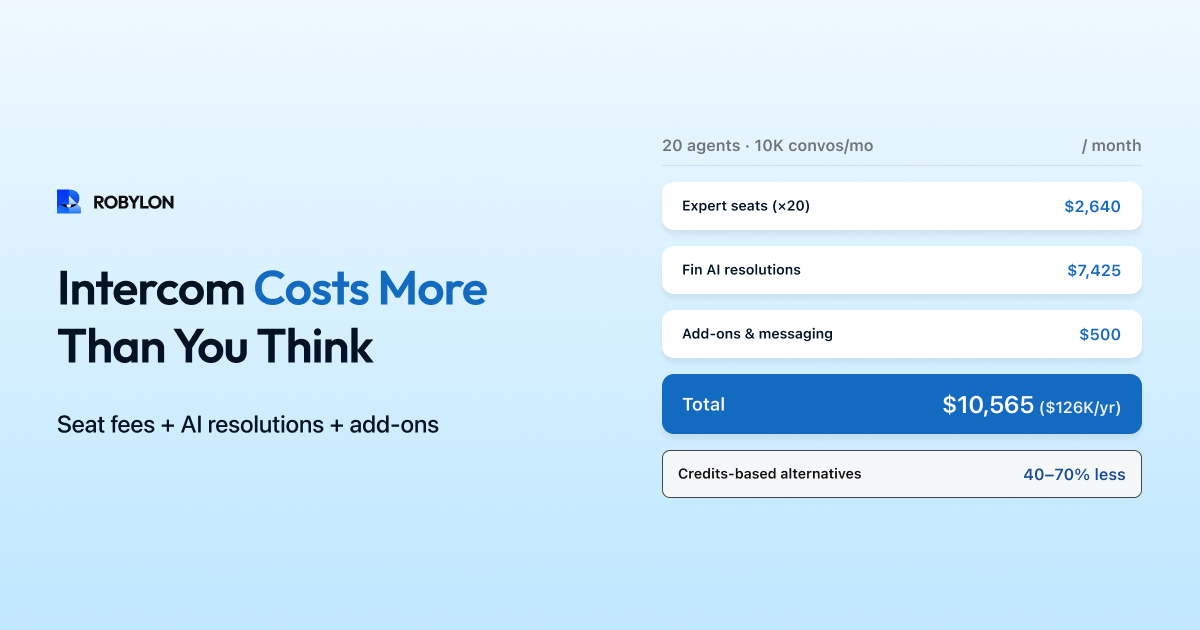
Scenario 3: Mid-Market SaaS (20 agents, 10,000 conversations/month)
- Expert plan: 20 seats × $132 = $2,640/month
- Fin AI (75% resolution): 7,500 resolutions × $0.99 = $7,425/month
- Proactive messaging add-on: ~$500/month
- Total: ~$10,565/month ($126,780/year)
At mid-market scale, Intercom’s annual cost can exceed $100K — with Fin AI charges making up the majority of the bill.
Where Intercom’s Pricing Gets Frustrating
The product is strong, but several pricing dynamics frustrate customers:
- Success is expensive. The better Fin performs (more resolutions), the more you pay. This creates a perverse incentive where improving your automation directly increases your costs.
- Per-seat + per-resolution double billing. You pay for human agent seats AND for AI resolutions. Many competitors charge one or the other — not both at premium rates.
- Feature gating. Capabilities like SLA management, workload balancing, and custom roles are locked to the Expert tier ($132/seat). These are standard features on many competing platforms at lower price points.
- Difficult to predict costs. With per-resolution AI pricing, your monthly bill fluctuates based on conversation volume and Fin’s resolution rate. Budgeting becomes a guessing game.
- Ecosystem lock-in. Intercom works best when you use Intercom for everything — messenger, help center, product tours, outbound messaging. Mixing Intercom with other tools (e.g., Zendesk for ticketing) creates friction.
5 Intercom Alternatives That Cost Less
If Intercom’s pricing does not work for your budget, here are alternatives that deliver comparable capabilities at lower total cost.
1. Robylon AI
Best for: Teams that want full AI automation across chat, email, voice, and WhatsApp at a predictable, lower cost.
- Pricing model: Credits-based — you pay for what you use, with no per-seat fees for AI agent interactions. Free tier available.
- AI capabilities: LLM-powered AI agents that resolve conversations, take actions (order lookups, refund processing, ticket creation), and escalate with full context.
- Channels: Web chat, email, voice, WhatsApp, in-app — all from one platform.
- Key advantage over Intercom: No per-resolution fee that scales linearly with volume. Better automation economics at high conversation volumes. Voice AI support that Intercom does not offer.
- Typical savings: 40–70% less than Intercom at equivalent volume.
2. Freshdesk (Freddy AI)
Best for: Teams that want a mature helpdesk with AI features at mid-range pricing.
- Plans start at $15/agent/month (Growth) up to $79/agent/month (Enterprise).
- Freddy AI for auto-resolution and agent assist included in higher tiers.
- Stronger ticketing and SLA management than Intercom at lower price points.
- Less polished messenger experience compared to Intercom.
3. Zendesk
Best for: Enterprise teams with complex routing, SLA requirements, and large agent workforces.
- Suite plans range from $55 to $150+/agent/month.
- AI features (Advanced AI add-on) cost extra — approximately $50/agent/month.
- Extremely deep ticketing and reporting capabilities.
- Total cost can match or exceed Intercom at enterprise scale. Stronger for traditional helpdesk operations, weaker for conversational messaging.
4. HubSpot Service Hub
Best for: Teams already in the HubSpot ecosystem who want unified CRM + support.
- Free tier with basic ticketing. Professional at $90/month (includes 5 seats).
- Tight CRM integration — customer data, deal history, and support in one platform.
- AI chatbot capabilities are less mature than Intercom or Robylon.
- Best value when you are already paying for HubSpot CRM/Marketing.
5. Tidio
Best for: Small businesses and solo operators who need a simple, affordable chatbot with live chat.
- Free plan available. Paid plans from $29/month.
- Lyro AI chatbot included in paid plans for automated responses.
- Easy setup, friendly interface, good Shopify integration.
- Limited in sophistication — teams with complex workflows or high volume will outgrow it.
How to Decide: Intercom or an Alternative?
Intercom is Worth the Cost If:
- You are a SaaS company and the in-app messenger is central to your product experience.
- You need product tours, outbound messaging, and help center deeply integrated in one platform.
- Your conversation volume is moderate (under 2,000/month) so Fin costs stay manageable.
- You value design polish and UX — Intercom’s messenger is still best-in-class.
An Alternative is Better If:
- Your conversation volume is high (5,000+/month) and per-resolution pricing makes Intercom prohibitively expensive.
- You need omnichannel support including voice and WhatsApp — Intercom’s voice capabilities are limited.
- You want AI automation without double billing (per-seat + per-resolution).
- You operate in e-commerce, fintech, or logistics where transactional support (order lookups, refund processing) is the primary use case.
- You need predictable monthly costs for budgeting.
Bottom Line
Intercom is a well-built product — but its pricing structure means the bill grows faster than most teams expect, especially once Fin AI resolutions scale up. Before committing, model your actual cost using realistic conversation volumes and resolution rates, not the headline per-seat price.
If the math does not work, there are strong alternatives that deliver equivalent AI-powered support at 40–70% lower cost — particularly for high-volume e-commerce, fintech, and customer support teams where predictable pricing and omnichannel capabilities matter more than Intercom’s messenger-centric experience.
Want Intercom-level AI without Intercom-level bills? Robylon AI delivers AI agents across chat, email, voice, and WhatsApp with credits-based pricing — no per-seat fees, no per-resolution surcharges. Start free at robylon.ai
Frequently asked questions
How much does Intercom actually cost per month?
It depends on team size and AI usage. A realistic example: 8 agents on the Advanced plan ($85/seat) with 2,100 Fin AI resolutions/month ($0.99 each) totals roughly $2,960/month ($35,500/year) — before add-ons like WhatsApp or proactive messaging. The headline per-seat price significantly underestimates the real bill once Fin AI resolution charges are factored in at scale.
How does Intercom's Fin AI pricing work?
Fin AI charges $0.99 per automated resolution — each time Fin successfully resolves a customer conversation without human involvement. This is on top of your per-seat plan cost. At 1,000 resolutions/month that is $990 extra; at 5,000 it is $4,950. The more effective your AI becomes, the higher your bill grows — which creates a counter-intuitive dynamic where better automation costs more.
Is Intercom too expensive for startups?
For very early-stage teams (1–3 agents, under 500 conversations/month), Intercom's Essential plan at $29/seat is manageable. But costs escalate quickly as you add agents, enable Fin AI, and need features like workflows or WhatsApp — which require the Advanced ($85/seat) or Expert ($132/seat) tiers. Startups with limited budgets often find credits-based platforms like Robylon AI more predictable and 40–70% cheaper at equivalent usage.
What are the hidden costs in Intercom pricing?
Several features carry extra charges beyond the base plan: Fin AI resolutions ($0.99 each), proactive messaging (outbound messages and product tours), WhatsApp and SMS (per-message fees), and overage charges if you exceed contact or conversation limits. SLA management, workload balancing, and custom roles are also locked to the highest-tier Expert plan at $132/seat.
What is the best Intercom alternative for lower cost?
Robylon AI is the most direct alternative for teams seeking comparable AI automation at lower cost. It uses credits-based pricing with no per-seat fees for AI interactions, supports chat, email, voice, and WhatsApp from one platform, and includes action-taking capabilities (order lookups, refund processing) that Intercom's Fin does not. Typical savings are 40–70% compared to Intercom at equivalent conversation volumes.
Related reading
 Comparisons
10 Botpress Alternatives in 2026 - No-Code to Open-Source (Compared)
Looking for BotPress competitors? See the best tools in 2026, including free vs paid, ease-of-use, open-source & no-code options.
 Comparisons
10 LiveChat Alternatives in 2026 - Better Features at Half the Price
Find the perfect LiveChat competitor for 2026. Get feature comparisons, free and paid options from tools like Robylon, Intercom, Zendesk Chat, Tidio, and more.
 Comparisons
11 Drift Alternatives in 2026 - Stronger AI, Lower Pricing (Ranked)
Looking for Drift competitors? Explore top live chat, omnichannel & AI-SDR chatbot tools so you can pick the right Drift replacement.