
Comparisons
9 best Sierra AI alternatives for AI customer support in 2026
Nine alternatives to Sierra AI, compared on what each agent can do, which channels it covers, where it runs and how you buy it, with prices checked in October 2026.
Chief Technical Officer, Robylon
Mayank Shekhar is the co-founder and CTO of Robylon. He leads engineering and the AI systems behind Robylon's autonomous support agents, from retrieval-grounded language models to the agent orchestration and integrations that let AI act across helpdesks and business tools. He writes about building production-grade, trustworthy AI for customer experience.
Nine alternatives to Sierra AI, compared on what each agent can do, which channels it covers, where it runs and how you buy it, with prices checked in October 2026.
Meta Business Agent is the AI agent Meta built into WhatsApp, Messenger and Instagram. It is free up to an allowance in the WhatsApp Business app, and costs $2 per million tokens (about 4 to 5 cents a message) on the WhatsApp Business Platform. This guide covers what it can do, how the pricing works, the businesses it excludes and the signs you need something more.
An AI agent is a thing you deploy; agentic AI is a property that describes how much a system plans and acts on its own. This guide walks through the spectrum of agency, shows one refund request handled at four levels, and lists the questions that expose agent washing.
A warm transfer means the first agent briefs the next person before the caller is connected; a cold transfer sends the caller on with no introduction. This guide covers both call flows, the related terms, the metrics that show whether transfers are hurting you, and how AI voice agents change the choice.
When a customer asks why your AI sent them the wrong answer, most support teams cannot say. This deep dive covers the trace model for email agents: what a span is, which attributes to record, why reason codes matter more than confidence scores, and how to reconstruct any ticket end to end.
LLM-as-judge is the only practical way to score support reply quality at volume, and it fails in patterned ways. Covers verbosity and position bias, calibration against human labels with Cohen's kappa, judge drift, and where humans stay in the loop.
A golden set is the fixed benchmark every change to an AI email agent should clear before it reaches a customer. Covers stratified sampling, labelling outcomes rather than reply text, what to actually measure, and how golden sets rot.
Prompt changes fix one thing and quietly break three others. This is the engineering playbook for regression testing an AI email agent: turning production incidents into permanent test cases, writing assertions that survive paraphrase, and wiring the suite into CI so a deploy can actually fail.
Most AI governance committees die of vagueness within two quarters. This playbook covers the six seats that matter, the four approval gates worth owning, a monthly agenda that takes 45 minutes, and the decisions the committee should deliberately leave alone.
Security questionnaires increasingly ask AI support vendors for model documentation, and most responses are marketing PDFs. This is a working template for a support AI system card, covering what the system is, what it's allowed to do, how well it works, and how it fails.
Security questionnaires ask about NIST AI RMF alignment and get a paragraph about commitment to safety in return. Nobody wanted a paragraph. Here is what Govern, Map, Measure and Manage look like inside an email queue, and the six artefacts that answer the question properly.
Saying you disclose is easy. Proving that one customer, on one date, was told an AI was answering is a different problem, and most support stacks cannot do it. Here is the evidentiary chain a regulator will actually ask for.
Chat you can take offline. Email is already in the inbox. This is the hour-by-hour runbook for the first 24 hours after an AI email agent sends something it should not have — kill switch, blast radius, correction, notification, and root cause.
The pretext used to be aimed at a tired rep on a night shift. Now it is aimed at a model with a very different set of weaknesses. What attackers try, why knowledge-based verification stopped working, and how to design checks an agent cannot be argued out of.
An AI email agent reads untrusted content, holds private data, and can send externally. That combination is an exfiltration path by design. Here is what the attack patterns look like in a real inbox, and which controls actually reduce the blast radius.
Most email agents are one box with one credential, so a single malicious message reaches everything the agent can reach. The stronger defence is architectural: the component that reads untrusted email should not be the component that can change anything.
A support agent reads mail from strangers, holds access to customer data, and can send email externally. That combination is the whole security problem. This is the architecture that contains it, layer by layer.
Support teams harden the email body against injection and leave the attachment untouched. It is the larger surface. This is where instructions hide in PDFs, screenshots, and spreadsheets, and what to do about it.
Most teams test their AI email agent for accuracy and never test it for adversity. This is the suite to run before launch: seven attack categories, how to write and score each case, and where to fix what you find.
Security teams already have a framework for why AI agents get compromised: the lethal trifecta of untrusted content, private data access, and external communication. An email support agent has all three by definition. This explains what that means operationally and which leg to constrain on each workflow.
Your support inbox is an open port that any stranger can write into, and an AI agent reads every word of it as potential instruction. This is what prompt injection looks like in a support queue, why filters don't close it, and the architectural controls that actually bound the damage.
The Agent Payments Protocol shipped as a formal A2A extension in April 2026, and refund email is where it lands first. This explains the three mandates in support terms, what changes about proving authorization, and the new dispute class nobody has a playbook for yet.
Internal multi-agent orchestration is a solved problem. Handing work to a carrier's or vendor's agent is not. This deep dive covers the three handoff patterns, the six-point contract both sides need, and the four ways cross-company handoffs break in production.
A well-formed refund request from a customer's AI assistant raises three separate questions, not one. Here's how domain authentication, signed agent cards and delegation tokens fit together, and what to do about the majority of agent email that carries no credential at all.
An Agent Card is how another company's AI agent discovers what your support team can do. A practical guide to the required v1.0 fields, skill design, authority limits, signing, and what to leave off the public card.
MCP connects your AI agent to your tools. A2A connects your agent to other companies' agents. This explainer translates both protocols into support-operations consequences: what an agent card is, what changes in your queue, and what to ask vendors before signing.
An agent card is the public manifest that tells other companies' AI agents what your support organisation can do. This guide covers the fields, the public-versus-gated decision, skill descriptions, signing, and versioning, with a conservative starter card you can adapt.
Vendors publish resolution rates and almost never publish failure rates. This article catalogues nine failure modes for AI email agents with measured frequency, how each one gets caught, how long it stays hidden, and which fixes actually move the number.
A single blended resolution rate tells you almost nothing about whether an AI email agent will work on your queue. This benchmark breaks resolution down across thirteen ticket categories, with volume shares, quartile ranges, reopen rates and how long each category takes to mature.
Two companies buy the same AI email agent and get results 28 points apart. The difference is almost never the model. Across 42 deployments, knowledge base quality correlated with week-12 resolution rate at r = 0.81, while the number of articles in the knowledge base correlated at 0.11. This is the curve, the four things we score, and what to fix first.
Vendor resolution rates are useless without knowing your own ceiling. The Email Autonomy Index scores five factors that determine how automatable a support queue actually is, and maps where twelve industries typically land. Score yours in about twenty minutes.
Across 40 accounts over nine months, autonomous resolution climbed from 58% to 71% while CSAT held steady, and reopen rate rose from 8.1% to 13.6%. Reopen rate is the only metric that catches confidently wrong answers, and almost nobody reports it.
Getting the WhatsApp Business API isn't one form. It's Meta verification, a dedicated number, approved templates, and a platform to run it on. Here's the full step-by-step, plus the shortcuts that make it faster.
A step-by-step look at what Robylon actually does when a customer messages your WhatsApp number, from intent classification to taking action in Shopify or Zendesk. Covers escalation design, the onboarding validation that produces the 60-80% resolution figure, what it costs to run, and where this is the wrong tool.
The WhatsApp Business API doesn't come with an app, and that one fact shapes how it's priced, approved, and run. This guide walks through app versus API, the Cloud API, the full setup path, message templates, the 24-hour window, how pricing works in 2026, and where an AI agent layer fits on top.
Meta retired the On-Premises WhatsApp API in October 2025, leaving the Cloud API as the only supported path. This guide explains what the Cloud API is, why the switch happened, and how AI agents run on top of it.
WhatsApp is where customers write the way they speak, which means code-mixed Hinglish, three-word questions and voice notes in a dialect your bot has never seen. This guide covers what actually breaks in multilingual WhatsApp support and how to build a setup that holds up across languages.
The most common AI support deployment on Zendesk in 2026 isn't Zendesk's own AI. It's a separate agent layered on top for autonomous resolution. Here's why teams split the helpdesk and the AI layer, and how to run it.
Choosing an AI agent isn't the same decision as choosing a helpdesk. This three-way comparison breaks down Zendesk AI, Intercom Fin and Robylon on per-resolution cost, how each defines a resolution, and how deep the agent can act, so you can pick the right layer.
Zendesk bills an automated resolution after 72 hours of inactivity plus a secondary AI check. Here is exactly how that mechanic works, what the May 2026 verification tiers changed, and why the count can still drift from real satisfaction.
Rule-based WhatsApp bots are cheap and predictable but break the moment a customer goes off-script. LLM bots understand messy phrasing but cost more and need guardrails. Here is how to decide, and why most teams end up running both.
The hardest part of WhatsApp AI support isn't what the agent resolves, it's how it hands off what it can't. This guide covers the escalation triggers, context passing, and design rules that make an AI-to-human handoff feel smooth instead of like starting over.
Away messages and greeting replies were the first version of WhatsApp auto-reply, and they still only buy time. This guide shows what modern auto-reply looks like when an AI agent reads intent, pulls live data, and closes the query instead of parking it.
Agentic AI gets used loosely. On WhatsApp specifically, it means something concrete: an agent that reads context, calls your systems, takes the action a customer needs, and hands off to a human when it should. This explainer breaks down what agentic actually means on WhatsApp and why it matters more here than on any other channel.
"Where is my order?" is the single most common message any support team gets on WhatsApp. This walks through how an AI agent actually resolves it end to end, from reading a vague message to pulling live tracking, and where it should stop and escalate.
A return is not one message, it's a chain of them across several systems. This shows how an AI agent runs a returns flow on WhatsApp end to end, why action-chaining is the hard part, and where guardrails have to stop it from refunding money it shouldn't.
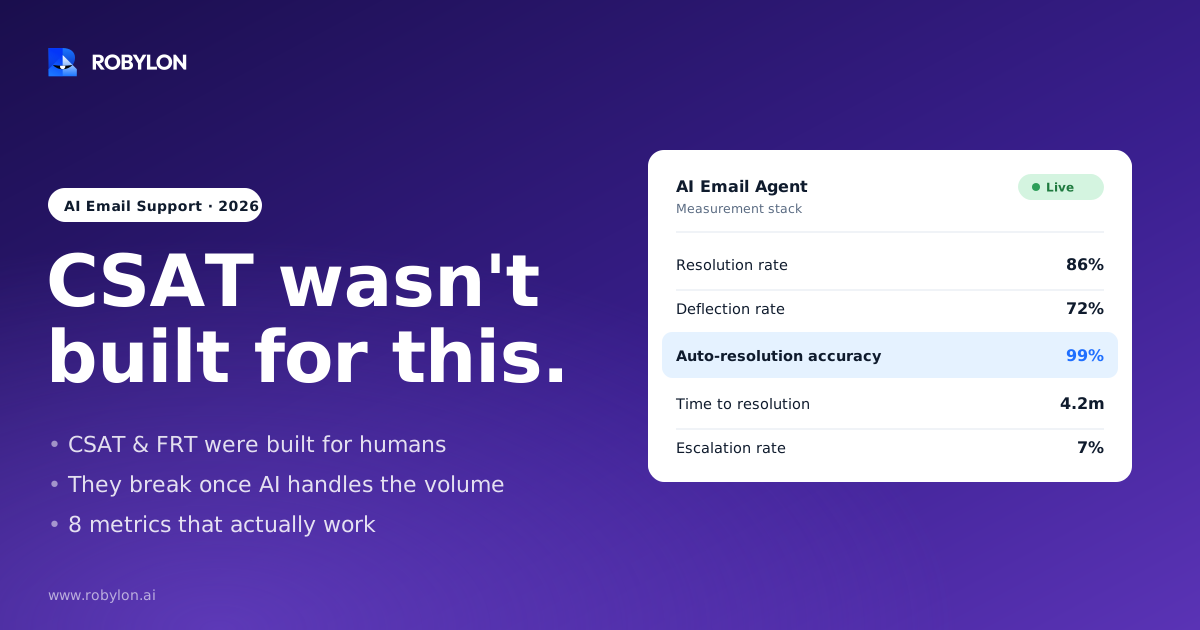
CSAT and first response time were designed for human-only support. They quietly break once AI starts resolving most of your email volume. This deep dive covers the eight metrics that actually tell you whether your AI email agent is working, and how to wire them into a measurement stack you can trust.
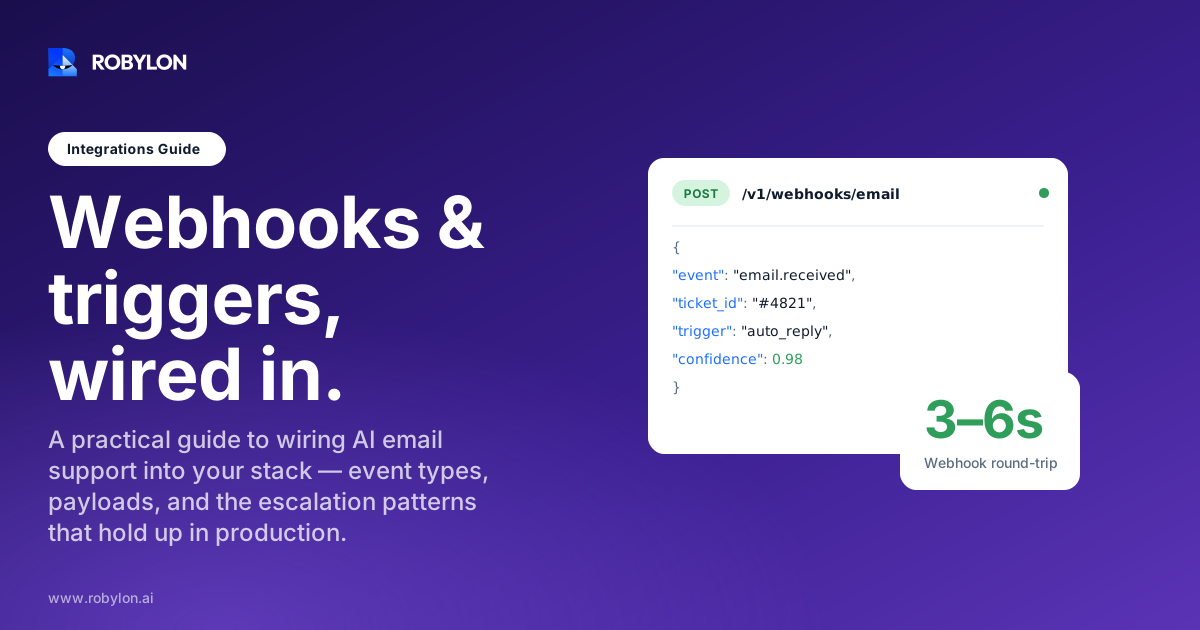
A practical guide to wiring AI email support into your stack using webhooks and triggers. Covers event types, payload design, common workflow patterns, escalation triggers, and the gotchas that hurt teams in production.
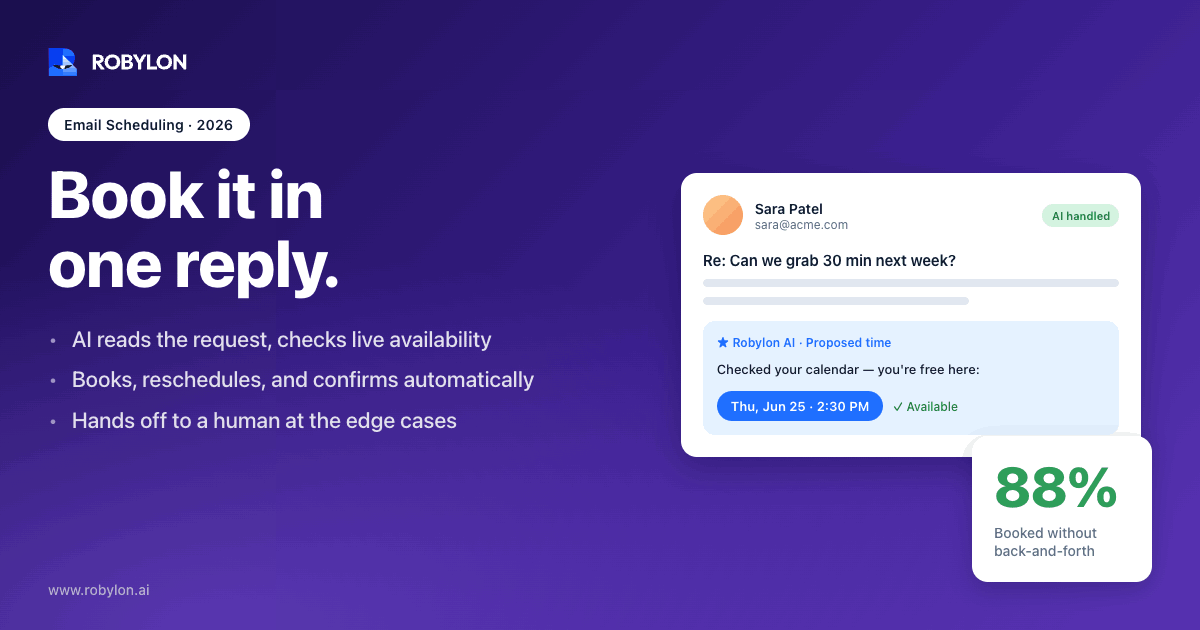
Scheduling by email still eats hours of back-and-forth. This guide shows how AI reads the request, checks live availability, books or reschedules, and confirms, plus where it should hand off to a human.
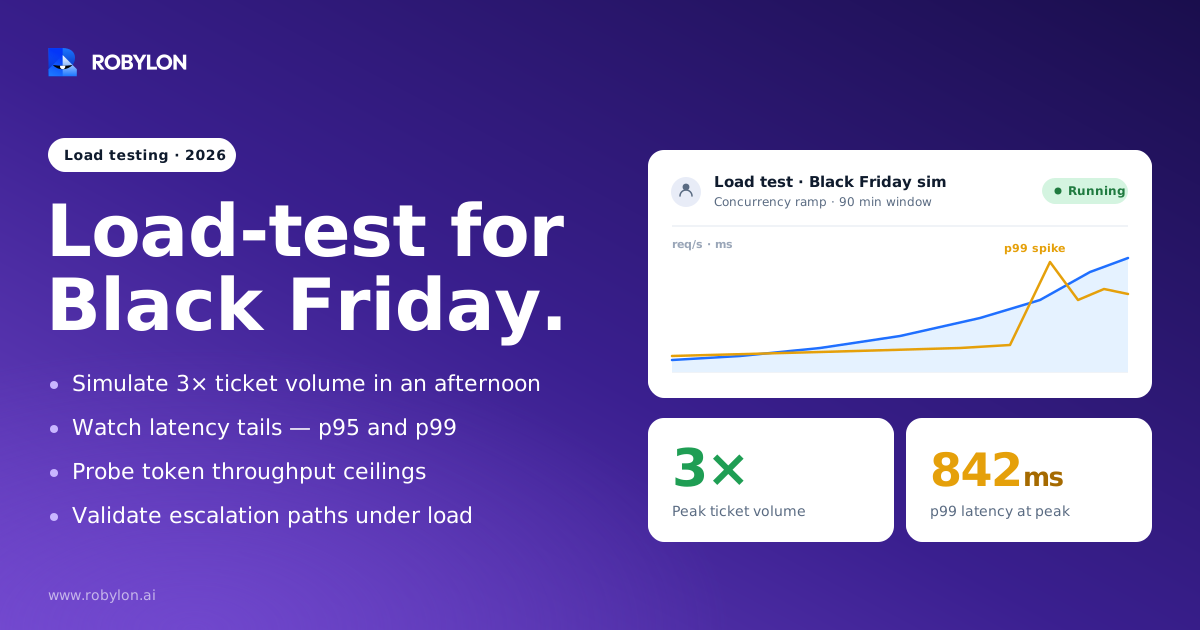
Black Friday breaks AI support systems in ways a normal Tuesday never reveals. This guide walks through how to load test concurrency, latency tails, token throughput, and escalation paths so your AI holds up when ticket volume jumps 3x in an afternoon.
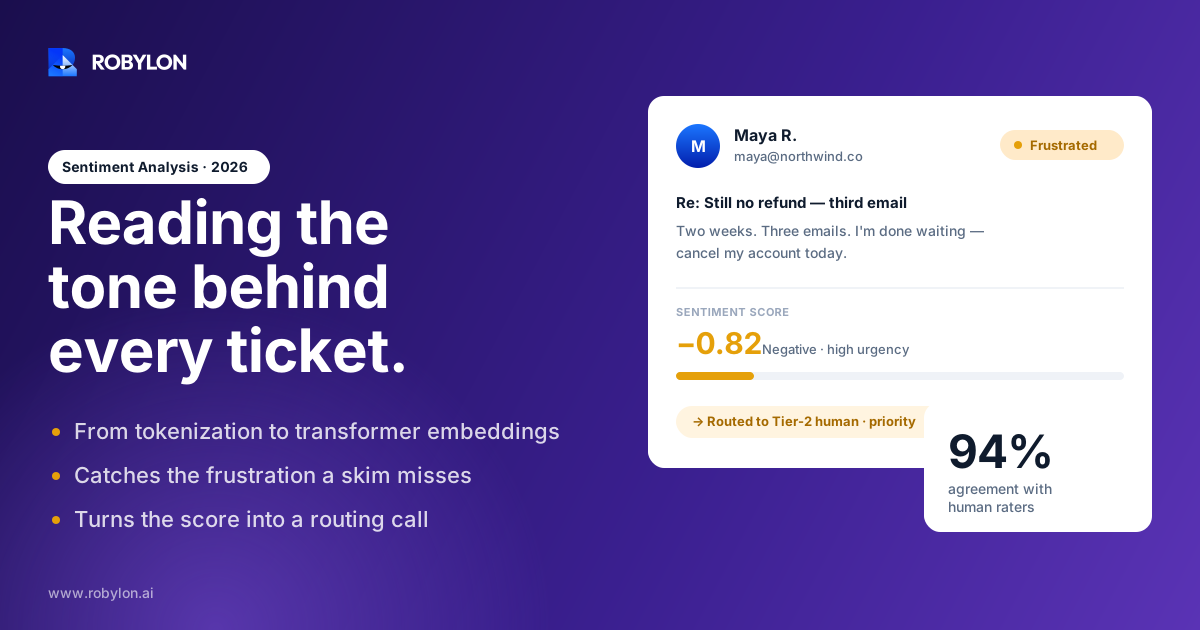
A practitioner walkthrough of how AI reads emotional tone in support emails, from tokenization to transformer embeddings. Covers what it gets right, where sarcasm and negation still trip it up, and how to turn a sentiment score into a routing decision instead of a vanity metric.
Nine alternatives to Ada, compared on what each AI agent can do, which channels it connects natively, where it runs and how you buy it, with prices checked in October 2026.
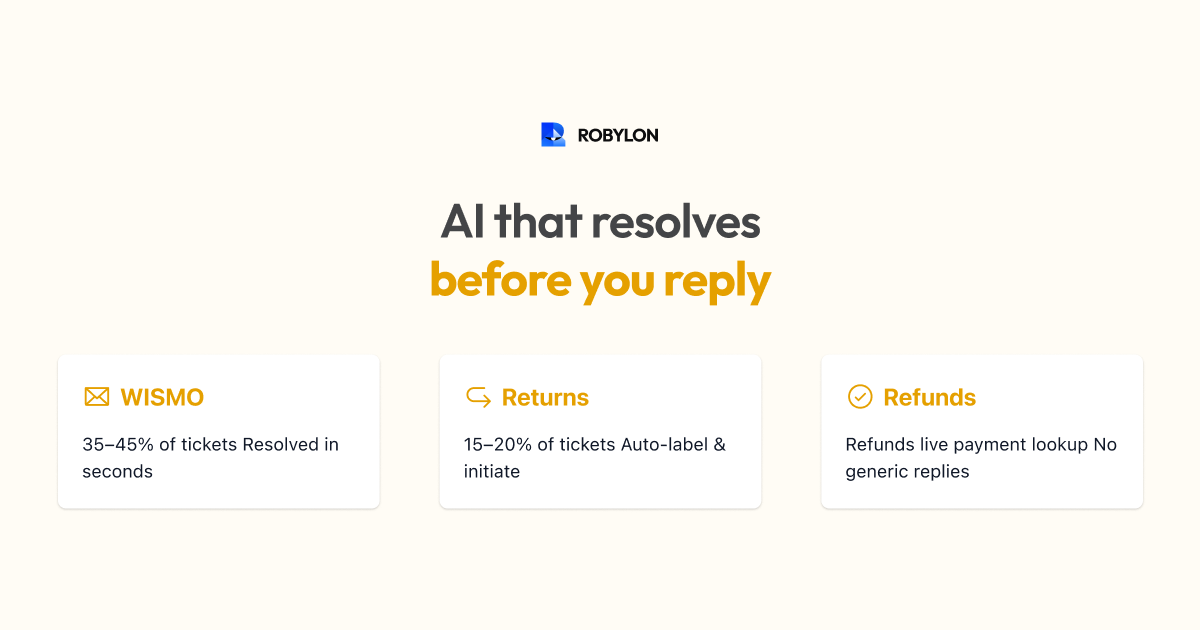
E-commerce email support is dominated by 4 ticket types that AI handles exceptionally well. This guide shows exactly how AI resolves WISMO, returns, refunds, and product queries end-to-end — with Shopify integration examples and benchmark metrics.
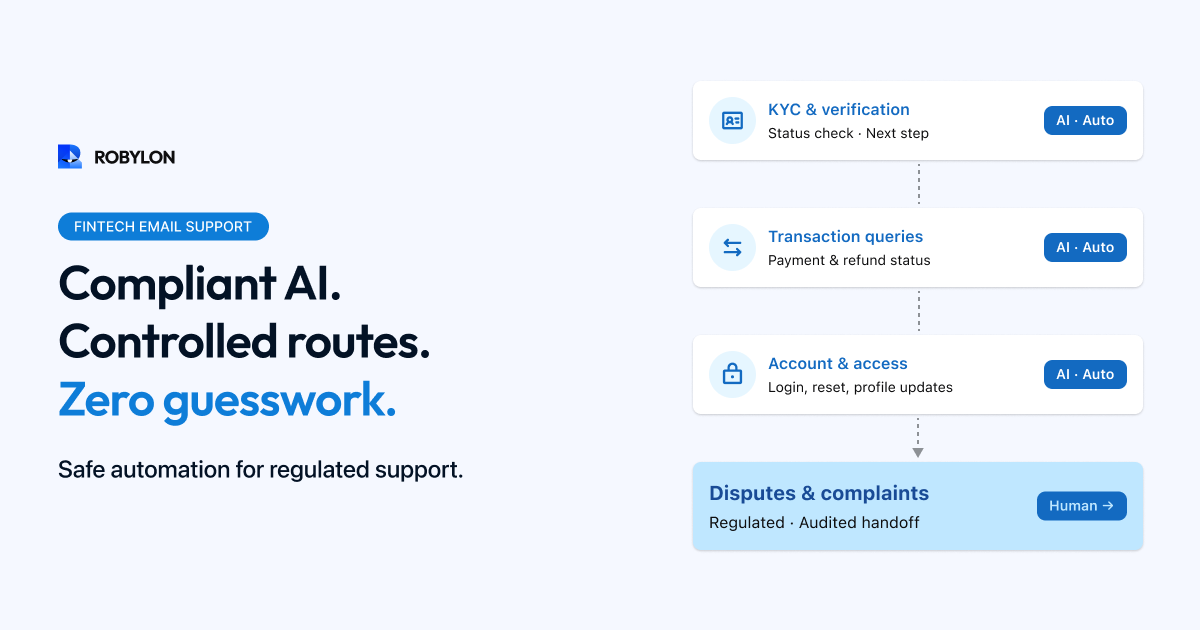
Fintech email support requires accuracy, compliance guardrails, and audit trails that other industries don't. This guide covers how AI handles KYC queries, transaction disputes, and account issues while staying within regulatory boundaries.
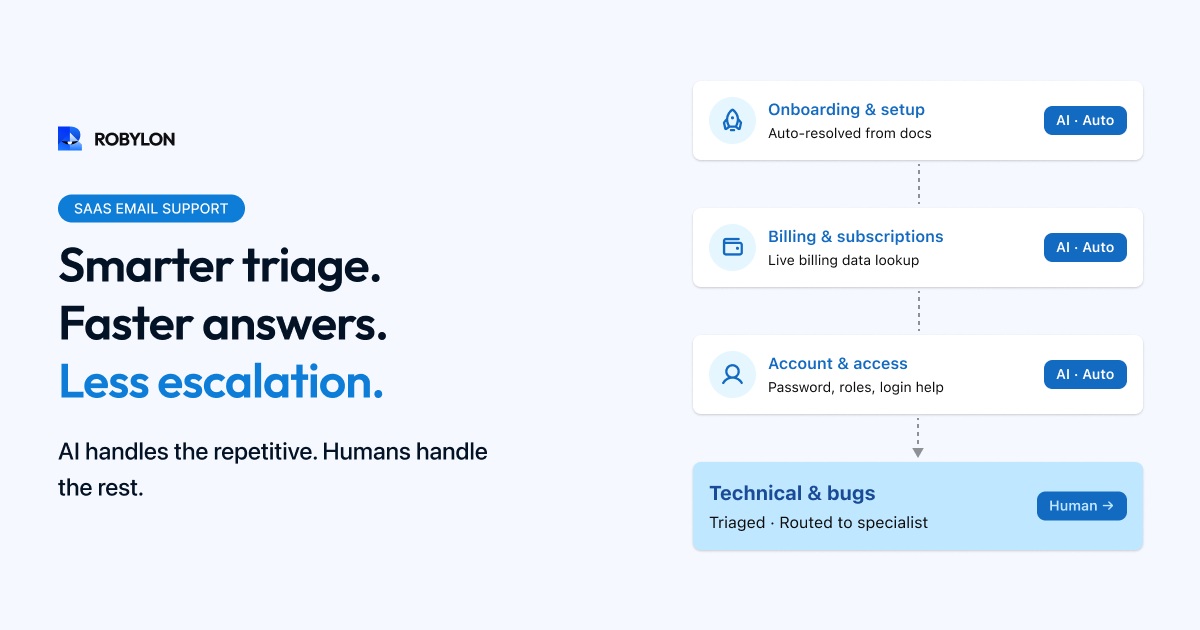
SaaS email support spans everything from "how do I set up SSO?" to "why was I charged twice?" This guide breaks down the 6 major SaaS email categories, the AI workflows that resolve them, and what automation rates to expect.
"Where is my order?" accounts for 35–45% of e-commerce email tickets. This deep dive shows how AI auto-resolves WISMO emails by parsing 50+ phrasings, extracting order IDs, querying your OMS, and delivering real-time tracking data — with a 90–95% resolution rate.
Eight alternatives to Gorgias for online stores, compared on what each AI agent can do in Shopify, which channels it covers, where it runs and how its bill behaves at peak volume, with prices checked in October 2026.
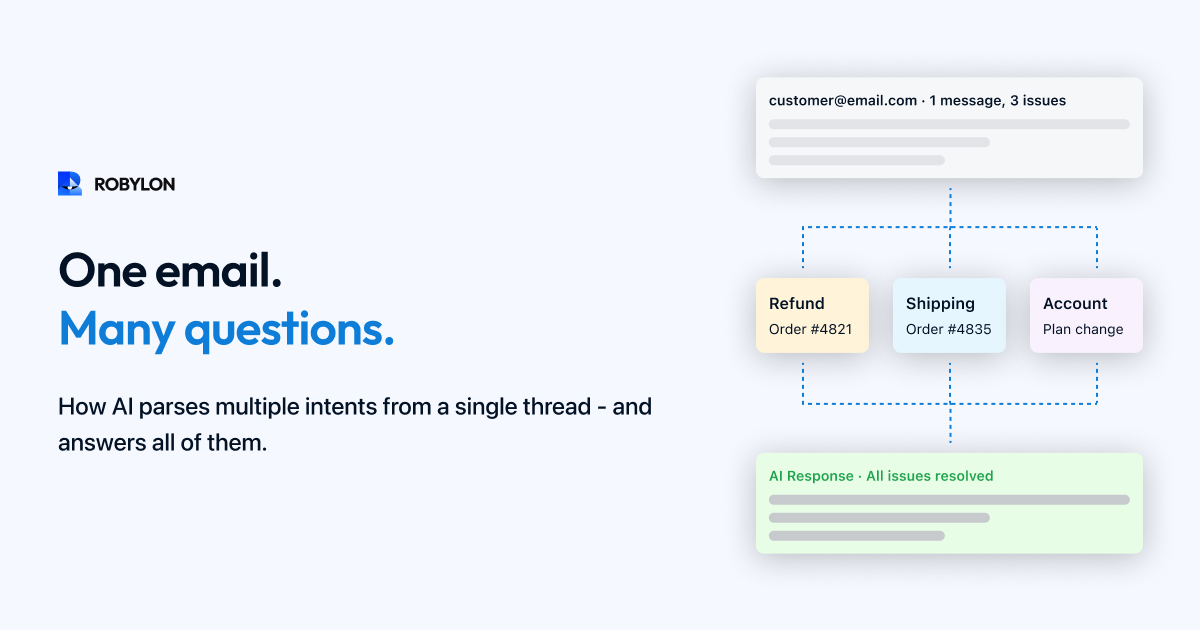
Multi-issue emails are the trickiest challenge in email AI. A customer asks about their order status, requests a return on a different order, AND wants to update their address — all in one email. This guide shows how AI handles compound emails without missing any point.
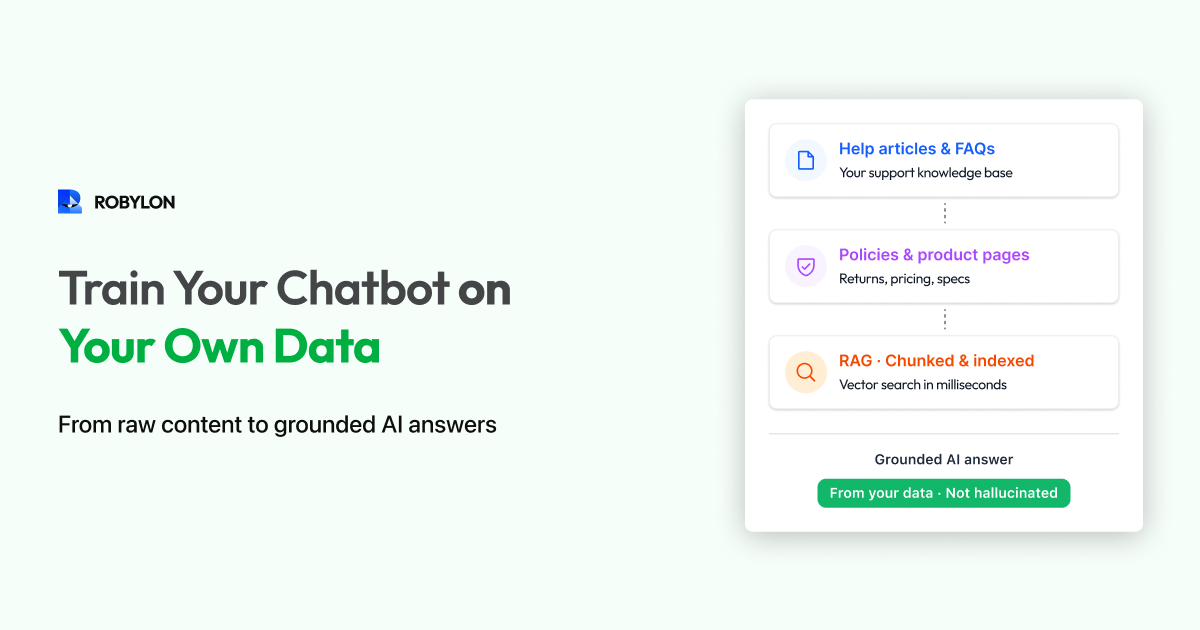
Generic AI chatbots give generic answers. This guide shows you how to train a chatbot on your own business data so it answers like your best support agent — accurately, consistently, and on-brand.
Agentic AI vs. Generative AI: definitions, architectures, and KPIs to choose the right stack and ship safely with examples from MidJourney and Stability AI.
Discover how AI voice agents are reshaping business communication in 2026 and how you can achieve smarter support, faster automation, and natural conversations with them.
Twelve AI tools that answer and resolve e-commerce support, from order tracking to refunds, grouped into five kinds and priced on a normal month and a Black Friday month, with prices checked in October 2026.
Explore how AI chatbots work, from NLP and ML to real-world use cases for smarter, faster customer interactions.
Practical 2026 playbook to cut support costs without hurting CSAT. Deploy self-service, AI chatbots, live chat, and smart routing to raise FCR and reduce AHT.
Seven alternatives to Retell AI, from voice infrastructure for developers to support platforms that include voice, compared on billing, actions, channels and fit, with prices checked in October 2026.
Explore how conversational AI, predictive analytics, and automated dialing make AI sales calls the future of enterprise outreach
Nine alternatives to Verloop.io, compared on what each AI agent can do, which channels it covers (email included), where it runs and how you buy it, with prices checked in October 2026.
Discover the top AI voice trends reshaping enterprise call centers from hyper-natural speech to multilingual agents, context-aware dialogue, and voice analytics.
AI agents are autonomous systems that make decisions, complete tasks, and learn over time redefining customer support, workflows, and automation across industries.
Nine alternatives to Zendesk, compared on seat price, the AI agent each includes, channels and billing, with the option of keeping Zendesk and adding an AI agent.
Discover 2026’s best AI agents for retail: voice, chat, and shopping assistants. Compare features, pricing, and ROI to boost CX, conversions, and margins.
Chatbots vs voice agents: Which fits your funnel? Explore use cases, multilingual reach, pros/cons, cost, latency, telephony, and CX impact and deployment checklists.
Compare the 10 best customer service channels, including email, phone, live chat, chatbots, video, social, SMS, and more, to cut FRT/AHT and boost FCR and CSAT
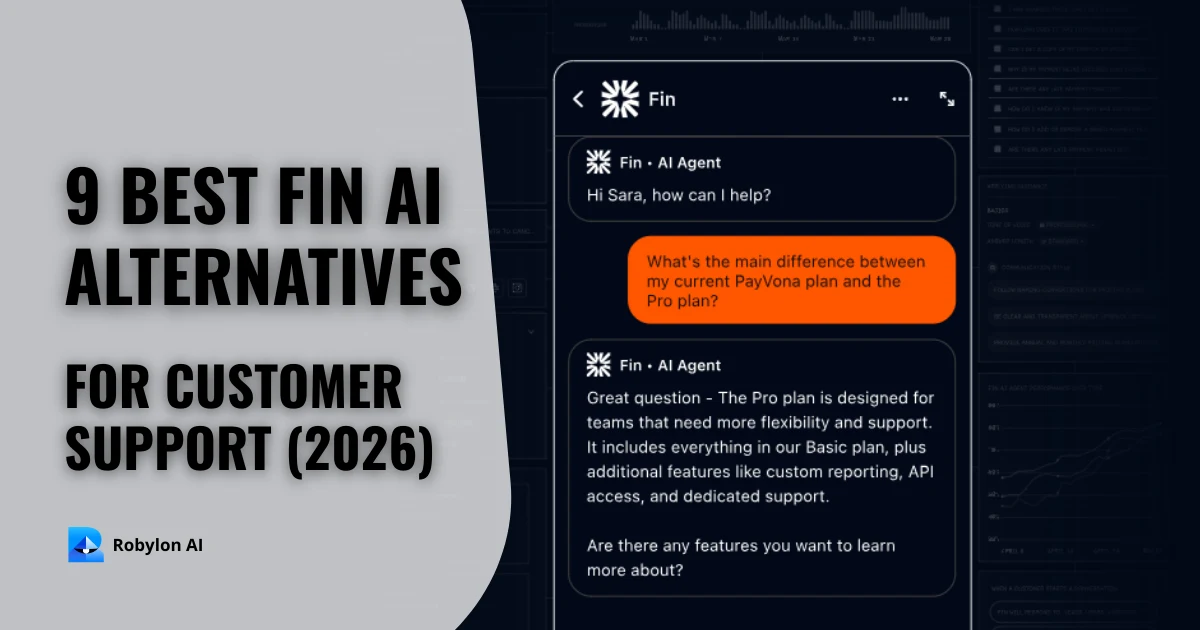
Nine AI agent alternatives to Fin, compared on what each agent can do, which channels it covers, where it runs and how it bills, with prices checked in October 2026.
Nine alternatives to tawk.to and its AI Assist add-on, compared on what each AI can do, which channels it covers, free plans and how each one bills, with prices checked in October 2026.
Compare the best AI agent builders in 2026, from no-code to enterprise, decentralized agent collaboration, pay-per-query, and the latest on Google Vertex AI Agent Builder.
Compare AI agents vs traditional software and automation tools in 2026. See differences in autonomy, analytics, cost, implementation, and customer service outcomes.
Learn how to build an AI agent step by step. Discover how to design, develop, and deploy AI agents for business, support, and automation use cases.
Compare the best AI coding agents 2026. See pricing per seat, enterprise features, and picks for distributed teams and code review SaaS.
Rolling out AI voice agents? Avoid 10 AI call rollout mistakes and learn how to recover with a proven enterprise framework.
Maximize ROI from AI voice agents; reduce call center costs, accelerate break-even, and improve CX with real metrics & strategies.
Implement AI voice agents in finance: Stepwise process, real use cases, technical tips, and compliance advice for 2026
See how AI voice agents turn repetitive outbound calls into automated workflows and save your team hours with better ROI.
Discover everything about AI knowledge bases in 2026, from definition and benefits to building steps, top tools like Robylon, Zendesk, Guru, Korra, and best practices for implementation.
Learn how multilingual voice AI drives global sales growth, enables real-time translation, and reduces costs. Explore use cases, ROI, challenges, and implementation best practices today.
Discover 10 proven ways to improve customer support 2026: AI automation, self-service, and omnichannel playbooks to boost CSAT/NPS, cut FRT/AHT, and raise FCR.
Unpack the AI agent frameworks powering today’s enterprise automation from open-source tools to multi-agent systems and highly customizable architectures.
Automate chat, voice, WhatsApp & email with agentic AI + human handoff. Faster resolutions, higher FCR/CSAT, no-code setup, helpdesk/CRM integrations.



![Multilingual Voice AI for Global Sales [2026]](/assets/blog/multi-lingual-voice-ai.webp)