
Handling Multi-Issue Emails with AI: When Customers Ask 5 Things at Once
Multi-issue emails are the trickiest challenge in email AI. A customer asks about their order status, requests a return on a different order, AND wants to update their address — all in one email. This guide shows how AI handles compound emails without missing any point.
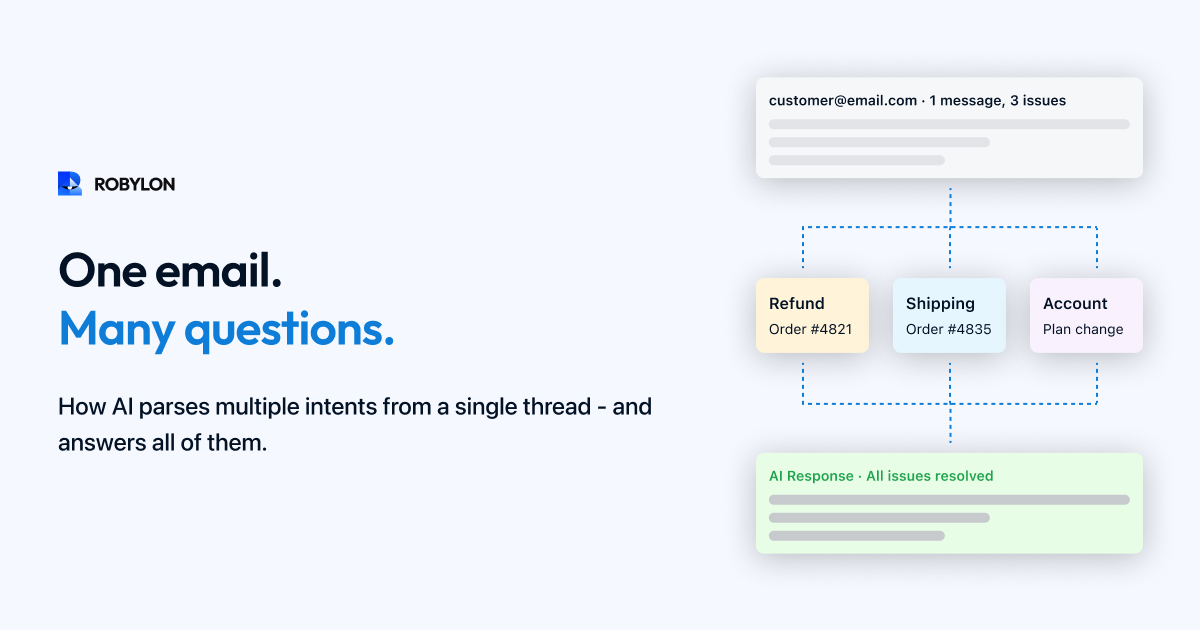
Chat is sequential — customers ask one thing at a time. Email is not. Customers treat email like a brain dump: they write everything they need in one long message because they know it might take hours for a response and they do not want to send five separate emails.
The result: 15–20% of all support emails contain two or more distinct questions, requests, or issues. And this is where most AI email tools fail. They detect the first intent, generate a response for it, and ignore everything else. The customer writes back: “Thanks, but you didn’t answer my other question.” Now you have two tickets instead of one, a frustrated customer, and a longer resolution time than if a human had handled it in the first place.
This is a solvable problem. AI platforms with multi-intent parsing can detect every question in a compound email, retrieve the relevant data and knowledge for each one, and compose a single coherent response that addresses all of them. Here is how it works and why it matters.
What Multi-Issue Emails Look Like
Here is a real-world example (anonymized) that contains four distinct intents:
“Hi, a few things: 1) Can you check the status of order #45721? I haven’t received any tracking update. 2) For order #45698 that I received last week, the blue shirt was the wrong size — I need to exchange it for a Large. 3) Also, can you update my shipping address to 45 MG Road, Bangalore 560001 for future orders? 4) One more thing — do you ship to Dubai? My friend wants me to send something to her. Thanks, Sarah”
Four intents, two different order numbers, one account update, and one policy question — all in 90 words. This is what AI needs to handle seamlessly.
How AI Parses Multi-Issue Emails
Step 1: Full Email Analysis
The AI reads the entire email before attempting to respond. This is critical — some intents only make sense in the context of others. “Also, for that order” refers back to a previously mentioned order number. The AI needs the complete picture before parsing individual intents.
Step 2: Intent Segmentation
The AI identifies each distinct intent in the email and segments them. For the example above:
- Intent 1: Order tracking for #45721
- Intent 2: Exchange request for #45698 (blue shirt → Large)
- Intent 3: Address update (45 MG Road, Bangalore 560001)
- Intent 4: International shipping inquiry (Dubai)
Each intent is processed independently — with its own data retrieval, knowledge lookup, and response generation.
Step 3: Entity Mapping
The AI maps entities (order numbers, products, addresses, locations) to the correct intents. This is where naive approaches fail: a simple AI might see two order numbers and not know which one is for tracking and which is for exchange. LLM-powered parsing understands the contextual relationship between entities and intents.
Step 4: Independent Resolution Per Intent
Each intent follows its own resolution path:
- Intent 1: Query OMS for order #45721 tracking status.
- Intent 2: Check exchange eligibility for #45698, verify Large availability, initiate exchange.
- Intent 3: Update shipping address in customer database.
- Intent 4: Retrieve international shipping policy from knowledge base for UAE/Dubai.
Step 5: Coherent Response Composition
This is the hardest step — and where the quality of the AI matters most. The AI takes four separate resolution outputs and composes a single, well-structured email that addresses each point clearly without feeling like four auto-responses pasted together.
Good multi-issue response structure:
- Brief opening that acknowledges the multi-part nature: “Hi Sarah, I’ve got answers for everything — let me go through each one.”
- Each issue addressed with a clear label or paragraph break so the customer can scan.
- Specific data for each point (tracking numbers, exchange details, confirmed address, shipping rates).
- A closing that invites follow-up if anything was missed.
Step 6: Aggregated Confidence Scoring
The AI scores confidence for each intent independently, then aggregates. If three intents score 95% but one scores 65%, the system has options: auto-resolve the three high-confidence intents and escalate the fourth, or present the entire email as a draft with the low-confidence section flagged for agent review.
The configurable approach: resolve what you can, flag what you cannot, and make sure the customer gets answers for the easy parts immediately rather than waiting for a human to handle the entire email because one part was hard.
Why Multi-Issue Handling Matters for Metrics
If your AI only addresses the first question in a compound email, the downstream impact is significant:
- Reply rate increases: Customers write back to ask about the unanswered questions. Your ticket volume goes up, not down.
- CSAT drops: Getting a partial answer is frustrating — it feels like the agent (or AI) did not read the full email.
- Resolution time increases: What should have been resolved in one exchange becomes 2–3 back-and-forth emails.
- False resolution metrics: The first email might be “auto-resolved” in your system, but the customer did not consider it resolved. Your auto-resolution rate looks good on paper but does not reflect reality.
Proper multi-issue handling turns one compound email into one complete resolution. Partial handling turns it into multiple tickets.
How to Optimize for Multi-Issue Emails
Structure Your Knowledge Base for Independent Retrieval
Each topic in your knowledge base should be self-contained — a section on returns should not be buried inside a section on shipping. When the AI needs to retrieve content for four different intents, it needs to pull from four clearly distinct knowledge base sections. Cross-references between sections are fine, but each section should stand alone.
Test Specifically for Multi-Issue Parsing
Include compound emails in your test suite. Create test emails with 2, 3, and 4+ intents and verify that the AI addresses every single one. Test with intents that are similar (two different returns on two different orders) and intents that are dissimilar (a return + a shipping question + a feedback comment).
Monitor “Reply After Resolution” Rate
Track how often customers reply after their email is marked as resolved. A high reply rate (above 15%) often indicates that the AI is not fully addressing multi-issue emails — customers are writing back to ask about the parts that were missed.
Ask Your AI Platform Explicitly
Not all AI email platforms handle multi-intent emails. During evaluation, send a compound email through the platform’s demo and check: did it detect all intents? Did the response address each one? Or did it only answer the first question? This is a critical differentiator between platforms and should be a hard requirement in your evaluation criteria.
Bottom Line
Multi-issue emails are the hidden challenge of email AI — and the hidden opportunity. Handle them well, and you resolve 15–20% of your email volume in a single exchange that would otherwise generate multiple follow-up tickets. Handle them poorly, and you create the frustrating experience that makes customers say “AI doesn’t work.” The capability exists — you just need a platform that was built for it and a knowledge base structured to support it.
Every question answered, every time. Robylon AI parses multi-intent emails, resolves each issue independently, and composes a single coherent response that addresses everything the customer asked. Start free at robylon.ai
Frequently asked questions
What percentage of support emails contain multiple questions?
15–20% of all support emails contain two or more distinct questions, requests, or issues in a single message. This is significantly higher than chat (where customers tend to ask one thing at a time) because email customers write everything at once knowing the response may take hours. If your AI only answers the first question, these become multi-ticket interactions — increasing volume and frustrating customers.
How does AI parse an email with multiple different questions?
Five-step process: 1) Full email analysis — reads the entire message before parsing. 2) Intent segmentation — identifies each distinct question as a separate intent. 3) Entity mapping — maps order numbers, products, and details to the correct intents. 4) Independent resolution — each intent goes through its own data retrieval and response generation. 5) Coherent composition — combines all individual responses into one well-structured email that addresses every point clearly.
What happens if AI is confident about some issues but not others in the same email?
The AI scores confidence independently per intent. The configurable approach: auto-resolve the high-confidence intents and flag the low-confidence ones for agent review, or present the entire email as a draft with the low-confidence section highlighted. The best option is usually to resolve what you can immediately — the customer gets 3 out of 4 answers instantly, and the remaining question gets agent attention — rather than holding the entire email for a human because one part is tricky.
How do I test my AI for multi-issue email handling?
Include compound emails in your test suite with 2, 3, and 4+ intents. Test both similar intents (two returns on different orders) and dissimilar intents (a return + a shipping question + a feedback comment). For each test, verify: did the AI detect ALL intents? Did the response address EACH one with specific data? Did entity mapping work correctly (right order number for the right question)? This should be a hard requirement during platform evaluation.
How do I know if my AI is missing questions in compound emails?
Track your "reply after resolution" rate — how often customers reply after their ticket is marked resolved. A rate above 15% often indicates the AI is only addressing part of multi-issue emails. Also monitor for replies containing "you didn't answer my other question" or "what about the [second topic]?" — these are explicit signals. If you see these patterns, check your AI platform's multi-intent capabilities and test with compound emails.