
How AI Detects Customer Sentiment in Emails
A practitioner walkthrough of how AI reads emotional tone in support emails, from tokenization to transformer embeddings. Covers what it gets right, where sarcasm and negation still trip it up, and how to turn a sentiment score into a routing decision instead of a vanity metric.
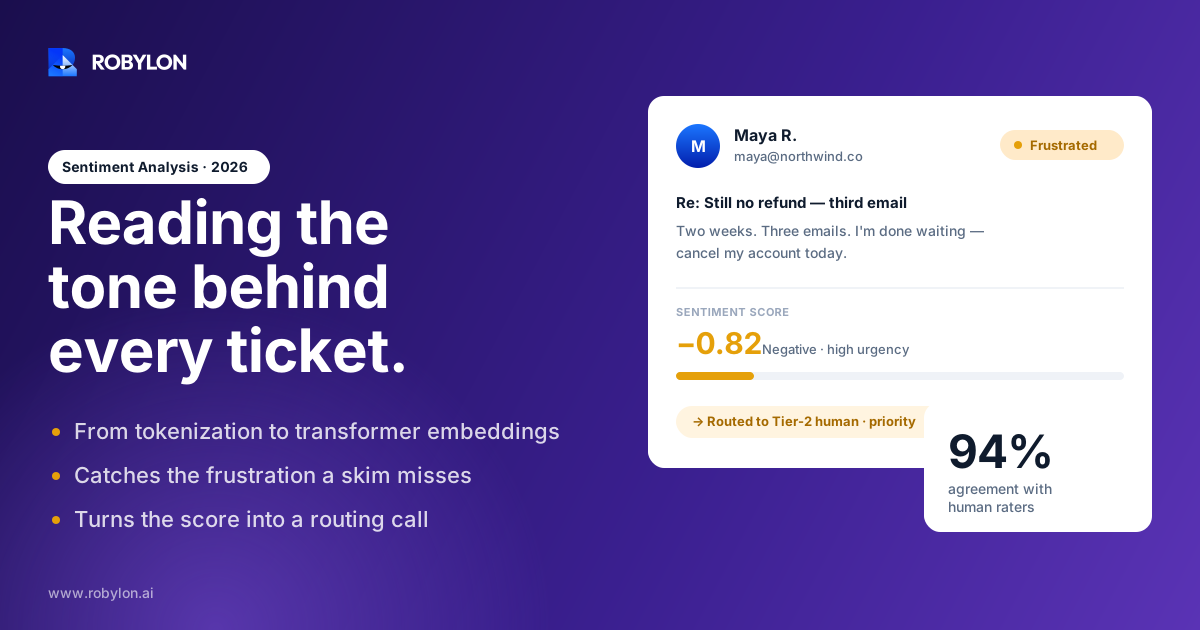
A customer writes: “Great, another broken order. Love that for me.” Every word in that sentence is positive. The customer is furious. That single line is the whole problem with email sentiment detection, and it’s why the naive approaches fail in production.
Sentiment detection in email isn’t magic and it isn’t mood-reading. It’s a pipeline of fairly specific steps that turn raw text into a number, a label, or a routing decision. Some of those steps are solved problems. A few of them are still genuinely hard, and the vendors who pretend otherwise are the ones you should trust least.
This is a look under the hood: what actually happens between the moment an email lands and the moment a system decides it’s an angry one.
What “sentiment” even means in a support inbox
Most people picture sentiment as a three-way split: positive, negative, neutral. That framing is fine for product reviews. It’s close to useless for support.
In a support inbox, the question isn’t really “is this person happy.” It’s closer to “how much trouble is this email, and how fast does it need a human.” Those are different axes. A calm, polite cancellation request is negative sentiment but low urgency. A panicked “I NEED this fixed before my event tonight” might be neutral in tone and a five-alarm fire in priority.
So the better systems track more than one signal at once:
- Polarity: the basic positive-to-negative score most people mean by “sentiment.”
- Emotion: a finer label such as frustrated, anxious, confused, or grateful. This is where the actual coaching and routing value lives.
- Urgency and intensity: how strongly the feeling is expressed, which often matters more than its direction.
- Trajectory: whether a thread is getting hotter or cooling down across replies. A thread that started friendly and turned cold is a churn risk that a single-email score will miss entirely.
If a tool only gives you positive/negative/neutral, it’s reading the surface. The useful work is in the other three.
The pipeline, step by step
Here’s what happens to an email between arrival and label. The early stages are unglamorous and they’re also where most accuracy is won or lost.
Cleaning the text first
Support emails are messy in ways reviews never are. They carry signatures, legal disclaimers, quoted reply chains, forwarded headers, and the customer’s actual message buried somewhere in the middle. Feed all of that into a model and the “Sent from my iPhone” and the three-paragraph confidentiality footer become noise that drags the score around.
So the pipeline starts by stripping it down. Quoted history gets separated from the new reply. Signatures and disclaimers get removed. HTML gets flattened to text. This step sounds trivial. It isn’t. A model scoring the wrong half of the email is the single most common reason a sentiment number looks random.
Turning words into tokens
Once the text is clean, it gets broken into tokens, the small units a model actually reads. Modern systems don’t split on whole words; they use subword pieces so that “refund,” “refunding,” and “refunded” share structure, and so a typo like “reciept” doesn’t become a complete unknown. This is also the stage that handles the awkward stuff: emojis, all-caps, repeated punctuation. A row of exclamation marks and a 😡 carry real emotional signal, and a decent tokenizer preserves rather than discards them.
Reading words in context
This is the part that changed everything. Older sentiment tools used lexicons: dictionaries that scored each word and added the scores up. “Love” is +2, “broken” is –1, sum it, done. The catch is obvious once you see it. “This is not good” scores positive because “good” outweighs “not,” which a counter doesn’t understand.
Transformer models fixed the core of this. Instead of scoring words in isolation, they read the whole sentence at once and let each word’s meaning shift based on the words around it. BERT and its descendants process text bidirectionally, so “not” actually flips the meaning of “good” the way it does in real reading. That’s why negation, which used to wreck lexicon scores, is mostly a solved problem now.
The model turns the cleaned email into a set of context-aware number representations, and a final classification layer maps those to a sentiment label and a confidence score. The confidence score matters as much as the label, and we’ll come back to why.
Where it still breaks
Here’s the honest part most vendor pages skip. Transformers are very good. They are not done.
Sarcasm is the headline failure. “What a great experience, I love waiting three hours for support” reads as glowing praise to a model scoring the literal words. Research is blunt about this: even state-of-the-art transformer models still stumble on sarcasm and irony, and on some benchmarks the biggest general-purpose models do worse than smaller ones tuned specifically for the task. Sarcasm doesn’t follow step-by-step logic, so more reasoning doesn’t reliably help.
A few other places it slips:
- Domain language: a model trained on general text may not know that “my account is locked” is high-distress in fintech, or that “sick” can be a compliment.
- Mixed signals: “Your team was lovely but I’m still cancelling” has praise and a loss in one breath, and a single label flattens it.
- Cultural and translated tone: politeness norms vary, and a literal translation can read as colder or warmer than the writer meant.
- Short or terse replies: “ok.” with a period can be agreement or icy resignation, and there’s often not enough text to tell.
None of this means sentiment detection is unreliable. It means the score is a strong signal, not a verdict. The teams that get value from it treat it that way.
From a score to an actual decision
A sentiment label sitting in a dashboard is a vanity metric. The point isn’t to know a customer is angry. It’s to do something different because they are.
This is where sentiment stops being analytics and becomes part of how incoming email gets triaged. A frustration signal can bump a ticket up the queue ahead of a routine one that arrived earlier. It can change the tone of a drafted reply from efficient to apologetic. And it can decide whether the AI answers at all.
That last one is the most important. A confident, low-distress email about order status is exactly the kind of thing an AI agent should resolve end to end. A high-intensity email from a long-time customer who is clearly about to walk is exactly the kind of thing that should land with a human, fast, with the full context attached. The skill isn’t detecting the emotion. It’s knowing what to do with each band of it.
The mechanism that makes this safe is tone-shift detection paired with escalation. When the model sees frustration climbing across a thread, or a confidence score that’s too low to trust, the right move is to hand off rather than guess. We’ve found that the difference between a sentiment feature people trust and one they switch off comes down almost entirely to whether escalation is wired into the same loop. Detection without a handoff is just a number.
Sentiment as a coaching tool, not just a router
There’s a second use that often pays for the first. Run sentiment across a whole inbox over time and patterns surface that no single ticket shows.
Maybe negative sentiment spikes every Monday because weekend orders pile up unanswered. Maybe one macro reply consistently leaves customers colder than the issue warranted. Maybe a product change quietly doubled frustrated mentions of one feature. These are operational facts you can act on, and they only show up when you analyze sentiment across tickets in aggregate rather than ticket by ticket.
Aggregate sentiment is also a cleaner quality signal than most manual QA. Instead of a manager spot-checking a random handful of conversations, the system flags the ones where the customer ended unhappier than they started. That’s a far better use of review time than reading transcripts at random.
How Robylon uses sentiment in email support
Robylon reads sentiment as part of resolving the email, not as a separate analytics product bolted on afterward. The same pass that understands what the customer is asking also reads how they’re feeling, and both feed the decision about whether to act autonomously or escalate.
For low-distress, well-understood requests, the AI resolves the email end to end, taking real action across 60+ write-access integrations rather than just drafting a polite reply. Across a typical inbox that lands at 60–80% autonomous resolution, validated against your own historical tickets during onboarding so the number is yours, not a brochure figure.
When tone shifts, the human-in-the-loop workflow takes over. Frustration climbing across a thread, a confidence score below threshold, or language that signals a customer about to churn all trigger a handoff with full context attached, so the agent who picks it up isn’t starting cold. It runs across 40+ languages, which matters because tone in a customer’s second language is exactly where naive scoring goes wrong. For the wider picture of how this fits an inbox, the complete guide to AI email support walks through the full setup.
Frequently Asked Questions
How accurate is AI sentiment detection in emails?
On clear, direct emails, modern transformer-based models are highly accurate and reliably handle negation like “not good” that older tools got wrong. Accuracy drops on sarcasm, irony, and mixed messages where praise and a complaint sit in the same sentence. The practical takeaway is to treat the score as a strong signal paired with a confidence value, not a final verdict. Low-confidence reads should route to a human rather than be acted on automatically, which is what keeps the overall system trustworthy.
Can AI tell the difference between frustration and urgency?
Good systems treat them as separate signals, because they often don’t move together. A polite cancellation is negative but low urgency, while a calm “I need this before tonight” is neutral in tone but high priority. Detecting only polarity misses this entirely. The more useful setups score emotion and intensity alongside positive-negative, so a quietly desperate email gets prioritized correctly instead of being buried because it didn’t use angry words.
Why does sentiment analysis still struggle with sarcasm?
Sarcasm inverts meaning while keeping positive words on the surface, so “love waiting three hours” scores as praise to a model reading literally. Research shows even the largest models still miss it, and extra step-by-step reasoning doesn’t reliably help because sarcasm isn’t a logical process. The safe design isn’t to chase perfect sarcasm detection but to flag low-confidence or contradictory reads for human review, so the hard cases get a person instead of a wrong automated answer.
Does sentiment detection work across different languages?
Yes, modern models support many languages, but tone is harder to read in translation than literal meaning. Politeness norms differ, and a direct translation can sound colder or warmer than the writer intended. This is where naive scoring fails most often. A practical system handles tone in 40+ languages natively rather than translating first and scoring second, and it leans on escalation when confidence is low, since a misread emotion in someone’s second language is an easy way to make a frustrated customer angrier.
How is email sentiment turned into a useful action?
Detection only matters if it changes what happens next. A frustration signal can move a ticket up the queue, shift a drafted reply toward an apologetic tone, or decide that the AI shouldn’t answer at all and a human should. The mechanism that makes this safe is tone-shift detection tied to escalation: when emotion climbs across a thread or confidence is too low, the system hands off with full context instead of guessing. Without that loop, a sentiment score is just a number on a dashboard.
Ready to route support email by how customers actually feel? Robylon AI resolves 60–80% of customer emails autonomously, reading tone and urgency on every message and escalating the hard ones with full context across Gmail, Zendesk, Shopify, and 60+ other integrations. Start free at robylon.ai
Frequently asked questions
How accurate is AI sentiment detection in emails?
On clear, direct emails, modern transformer-based models are highly accurate and reliably handle negation like “not good” that older tools got wrong. Accuracy drops on sarcasm, irony, and mixed messages where praise and a complaint sit in the same sentence. The practical takeaway is to treat the score as a strong signal paired with a confidence value, not a final verdict. Low-confidence reads should route to a human rather than be acted on automatically, which is what keeps the overall system trustworthy.
Can AI tell the difference between frustration and urgency?
Good systems treat them as separate signals, because they often don’t move together. A polite cancellation is negative but low urgency, while a calm “I need this before tonight” is neutral in tone but high priority. Detecting only polarity misses this entirely. The more useful setups score emotion and intensity alongside positive-negative, so a quietly desperate email gets prioritized correctly instead of being buried because it didn’t use angry words.
Why does sentiment analysis still struggle with sarcasm?
Sarcasm inverts meaning while keeping positive words on the surface, so “love waiting three hours” scores as praise to a model reading literally. Research shows even the largest models still miss it, and extra step-by-step reasoning doesn’t reliably help because sarcasm isn’t a logical process. The safe design isn’t to chase perfect sarcasm detection but to flag low-confidence or contradictory reads for human review, so the hard cases get a person instead of a wrong automated answer.
Does sentiment detection work across different languages?
Yes, modern models support many languages, but tone is harder to read in translation than literal meaning. Politeness norms differ, and a direct translation can sound colder or warmer than the writer intended. This is where naive scoring fails most often. A practical system handles tone in 40+ languages natively rather than translating first and scoring second, and it leans on escalation when confidence is low, since a misread emotion in someone’s second language is an easy way to make a frustrated customer angrier.
How is email sentiment turned into a useful action?
Detection only matters if it changes what happens next. A frustration signal can move a ticket up the queue, shift a drafted reply toward an apologetic tone, or decide that the AI shouldn’t answer at all and a human should. The mechanism that makes this safe is tone-shift detection tied to escalation: when emotion climbs across a thread or confidence is too low, the system hands off with full context instead of guessing. Without that loop, a sentiment score is just a number on a dashboard.