
AI for Email Support in E-commerce: WISMO, Returns & Refunds
E-commerce email support is dominated by 4 ticket types that AI handles exceptionally well. This guide shows exactly how AI resolves WISMO, returns, refunds, and product queries end-to-end — with Shopify integration examples and benchmark metrics.
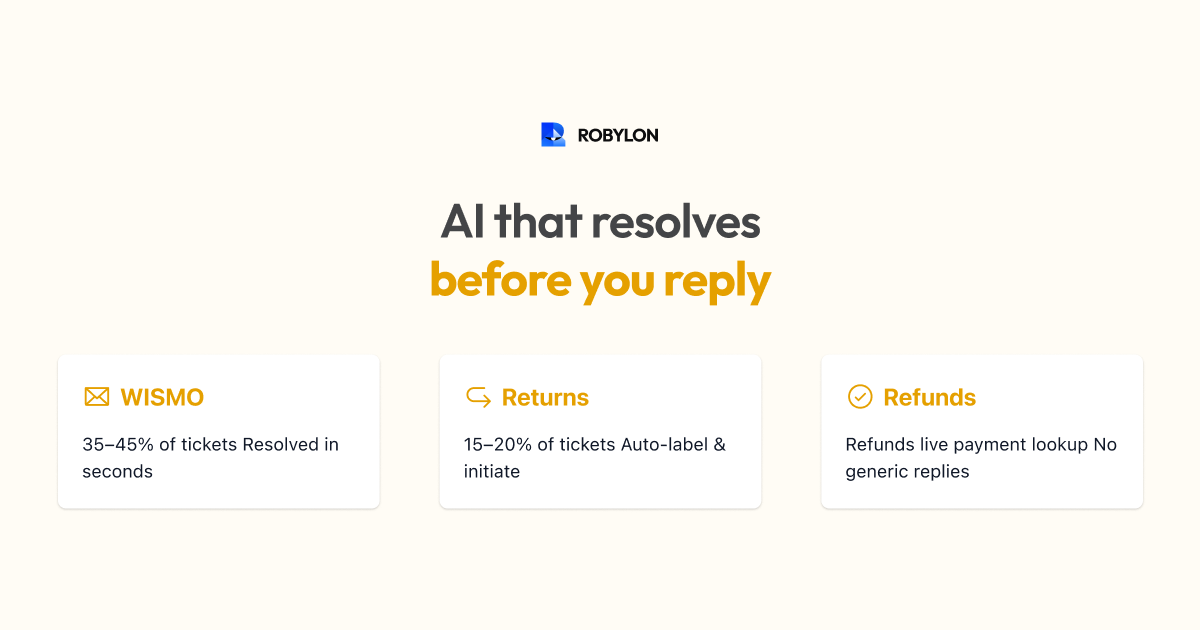
E-commerce support inboxes are predictable. Not in a boring way — in a useful way. The same four categories dominate every online retailer’s email queue: “Where is my order?”, “I want to return this,” “When will I get my refund?”, and “Does this come in my size?” Together, these account for 65–80% of all email tickets.
This predictability is exactly what makes e-commerce email the ideal candidate for AI automation. Each of these categories follows a structured workflow, relies on data from your order management system, and has clear resolution paths. An AI agent connected to your Shopify, WooCommerce, or custom OMS can resolve the vast majority of these emails without a human agent ever reading them.
This guide covers each of the four major e-commerce email categories in detail — the workflow AI follows to resolve them, the system integrations required, the edge cases to handle, and the automation rates you should expect.
The E-commerce Email Landscape
Before diving into workflows, here is the typical volume breakdown for an online retailer processing 3,000–10,000 email tickets per month:
- WISMO / Order tracking (35–45%): The single largest category. Customers want to know where their order is, when it will arrive, or why it has not arrived yet.
- Returns and exchanges (15–22%): Return requests, exchange requests, return status inquiries, and questions about return eligibility.
- Refund inquiries (10–15%): When will my refund be processed? How much will I get back? Why was my refund less than expected?
- Product questions (10–15%): Size/fit guidance, product availability, material details, compatibility questions, and stock alerts.
- Everything else (15–25%): Payment issues, account problems, complaints, discount code issues, and miscellaneous.
The top four categories represent 70–85% of volume and have the highest automation potential because they are data-driven and follow consistent resolution patterns.
Workflow 1: WISMO (Where Is My Order?)
How AI Resolves It
WISMO is the highest-volume and easiest email category to fully automate. Here is the AI workflow:
- Detect WISMO intent. The AI reads “Where is my order?”, “Has my order shipped?”, “Delivery update for order 45721,” or any of the hundreds of ways customers ask this question.
- Extract order identifier. The AI pulls the order number from the email text, or identifies the customer by email address and looks up their most recent order.
- Query the OMS. The AI calls the Shopify Orders API (or WooCommerce, Magento, or custom OMS) to retrieve: order status (processing, shipped, delivered, cancelled), carrier name and tracking number, current location and transit history, and estimated delivery date.
- Generate response. The AI composes a personalized email with all relevant details: “Hi Sarah, your order #45721 shipped on March 18 via FedEx. Tracking number: 789123456. It’s currently in transit in Mumbai and expected to arrive by March 22. Track it here: [link].”
- Auto-send. Confidence is typically 95%+ for WISMO because the data comes directly from the OMS. Auto-send rate: 90–95%.
Edge Cases to Handle
- Order not yet shipped: “Your order was placed on March 16 and is being prepared. Estimated ship date: March 19. We’ll email your tracking info as soon as it ships.”
- Tracking shows delivered but customer says not received: Escalate to human agent — this requires investigation (carrier claim, address verification, replacement decision).
- Multiple orders from same customer: AI asks which order they are inquiring about, or provides status for all recent orders if there are only 2–3.
- International shipment with customs delay: “Your order has cleared export from India and is in transit to the UK. International deliveries typically take 7–14 business days once shipped. Current estimated arrival: March 28.”
Automation Benchmark
WISMO emails achieve 85–95% full auto-resolution when the AI is connected to your OMS. The remaining 5–15% are edge cases (lost packages, address issues, carrier disputes) that appropriately route to humans.
Workflow 2: Returns and Exchanges
How AI Resolves It
- Detect return/exchange intent and extract details. “I want to return the blue hoodie from order #45721” → intent: return, order: #45721, item: blue hoodie.
- Verify order and check eligibility. The AI queries the OMS to confirm: Does the order exist? Was the item delivered? Is the return within the return window (e.g., 30 days from delivery)? Is the item eligible (not final-sale, not customized)?
- Apply policy logic. This is where your knowledge base content matters. The AI uses your documented return policy to make the decision — and handles edge cases explicitly documented in your KB: “Sale items purchased at 50%+ discount are final sale and not eligible for return.”
- Take action. For approved returns: the AI creates a return request in your returns system (Loop Returns, Returnly, or native Shopify returns), generates a prepaid shipping label, and composes the response with instructions and the label attached. For exchanges: the AI also checks stock for the replacement item.
- Generate response and send. “Hi Sarah, your return for the Blue Hoodie (order #45721) is approved. Here’s your prepaid return label [attached]. Pack the item in its original packaging and drop it at any FedEx location. Once we receive it, your refund of $49.99 will be processed within 3–5 business days.”
Edge Cases to Handle
- Outside return window: AI declines politely and offers alternatives (store credit, exchange at a reduced rate) per your policy.
- Item arrived damaged: Different policy path — AI may approve return regardless of window, offer a replacement without requiring return, or escalate based on damage severity.
- Gift recipient wanting to return: AI verifies the original order email and processes the return, or escalates if the recipient cannot provide order details.
- Exchange item out of stock: AI notifies the customer, offers alternatives (different color, size, or store credit), and lets them choose.
Automation Benchmark
Return and exchange emails achieve 70–85% auto-resolution. The straightforward cases (eligible, in-window, item in stock) resolve automatically. Edge cases (damage claims, out-of-window exceptions, multi-item returns) appropriately escalate.
Workflow 3: Refund Inquiries
How AI Resolves It
- Detect refund inquiry intent. “When will I get my refund?” or “I returned my order two weeks ago and haven’t been credited yet.”
- Identify the return and query payment system. The AI finds the associated return in your returns system, then checks your payment processor (Stripe, Razorpay, PayPal) for the refund status: processed, pending, or not yet initiated.
- Generate specific response. “Hi Sarah, your return for order #45721 was received on March 10. Your refund of $49.99 was processed on March 12 and credited to your Visa ending in 4532. Depending on your bank, it may take 5–7 business days to appear — so you should see it by March 19. If it hasn’t appeared by then, reply here and we’ll follow up with the payment provider.”
Edge Cases to Handle
- Return received but refund not yet initiated: AI checks if there is a processing delay, provides an ETA, or escalates if the delay is unusual.
- Partial refund: AI explains the breakdown — “Your refund is $42.99 (original price $49.99 minus $7.00 restocking fee as per our return policy).”
- Refund to different method than original payment: Escalate — this typically requires manual processing.
Automation Benchmark
Refund inquiry emails achieve 80–90% auto-resolution because they are pure data lookups — the AI just needs to check the refund status and relay it accurately.
Workflow 4: Product Questions
How AI Resolves It
- Detect product question intent and extract product details. “Is the Classic Tee available in XL in navy?” or “What material is the Weekend Bag made of?”
- Query product catalog and knowledge base. The AI searches your Shopify product catalog for the specific item — checking availability by variant (size, color), retrieving product descriptions, materials, care instructions, and dimensions.
- Generate helpful response. “Hi Sarah, the Classic Tee is available in Navy XL — here’s the direct link: [product URL]. It’s made from 100% organic cotton, runs true to size, and we recommend machine washing cold. Want me to add it to your cart?”
Edge Cases to Handle
- Item out of stock: “The Classic Tee in Navy XL is currently out of stock. Based on recent restocking patterns, we expect it back in 2–3 weeks. Want me to notify you when it’s available? In the meantime, here are similar options: [recommendations].”
- Comparison questions: “What’s the difference between the Classic Tee and the Premium Tee?” — AI retrieves both product descriptions and generates a concise comparison.
- Sizing guidance: AI uses your sizing chart data to provide specific recommendations based on the customer’s measurements if provided.
Automation Benchmark
Product question emails achieve 60–75% auto-resolution. The rate depends heavily on how comprehensive your product catalog data is. Stores with detailed descriptions, sizing charts, and material information see higher automation. Stores with sparse product data see lower rates.
System Integrations Required
To achieve the automation rates described above, your AI email platform needs to connect to:
- Order Management System: Shopify, WooCommerce, Magento, or custom. Provides order status, tracking data, item details, and customer order history. This is the most critical integration — without it, WISMO and return emails cannot be resolved.
- Returns Management: Loop Returns, Returnly, Shopify native returns, or custom. Enables return initiation, label generation, and return status tracking.
- Payment Processor: Stripe, Razorpay, PayPal, or custom. Enables refund status lookups and refund amount verification.
- Product Catalog: Typically via the same OMS (Shopify Products API). Enables product availability, variant lookup, and pricing queries.
- Customer Database/CRM: For customer identification, order history, loyalty status, and personalized responses.
Robylon Tip: Robylon offers pre-built connectors for Shopify, WooCommerce, Stripe, Razorpay, Loop Returns, and 40+ other e-commerce tools. Most e-commerce teams connect their full stack and go live on email in under a day. Start free at robylon.ai
Measuring E-commerce Email AI Performance
Track these metrics by email category to understand where AI is delivering and where it needs improvement:
- Auto-resolution rate by category: WISMO should be 85–95%. Returns 70–85%. Refunds 80–90%. Product questions 60–75%. If a category is below its benchmark, investigate — it is usually a knowledge base gap or a missing integration.
- First response time: AI-resolved emails should respond in under 5 minutes. Compare to your previous human average (typically 4–8 hours).
- CSAT by category: Compare AI-resolved vs human-resolved satisfaction. For e-commerce, AI typically matches or exceeds human CSAT because of speed and accuracy.
- Escalation reasons: When AI escalates, why? Damage claims, out-of-window exceptions, and lost packages are expected. If AI is escalating simple WISMO queries, there is a configuration issue.
- Revenue impact: Track orders recovered through AI product recommendations, cart recovery nudges, and cross-sell suggestions in support emails.
Bottom Line
E-commerce email support is the single best use case for AI email automation. The queries are repetitive, data-driven, and follow clear resolution paths. With the right system integrations (OMS, returns, payments, catalog), AI resolves 70–85% of the total email volume — saving thousands of agent hours per month while delivering faster, more consistent customer experiences.
The playbook is clear: connect your Shopify or e-commerce stack, train the AI on your policies, and deploy. The ROI shows up in the first month.
Built for e-commerce email. Robylon AI connects to Shopify, WooCommerce, Stripe, and your returns system to resolve WISMO, returns, refunds, and product questions end-to-end. Start free at robylon.ai
Frequently asked questions
What automation rate should I expect for e-commerce email support?
With proper system integrations and a well-structured knowledge base, expect a blended 70–85% auto-resolution rate across all e-commerce email categories. WISMO achieves the highest (85–95%), followed by refund inquiries (80–90%), returns (70–85%), and product questions (60–75%). The remaining 15–30% are edge cases (lost packages, damage claims, complaints) that appropriately route to human agents.
How does AI handle product recommendation emails?
When a customer emails asking "Is the Classic Tee available in XL?" or "What moisturizer is best for oily skin?", the AI searches your Shopify product catalog by attributes (size, color, category, material), checks real-time availability including variant-level stock, and responds with specific recommendations including product links and images. If the requested item is out of stock, the AI suggests alternatives and can offer to notify the customer when it is back.
What Shopify integrations does AI need for email support?
Five essential integrations: 1) Shopify Orders API — for order status, tracking, and item details. 2) Returns system (Loop Returns, Returnly, or Shopify native) — for return initiation and label generation. 3) Payment processor (Stripe, Razorpay) — for refund status and payment verification. 4) Product catalog API — for availability, variant lookup, and pricing. 5) Customer database — for identification, order history, and personalization.
Can AI handle return emails where the item arrived damaged?
Yes — with proper policy configuration. Damage claims typically follow a different policy path than standard returns: the AI may approve the return regardless of the return window, waive return shipping costs, or offer an immediate replacement without requiring the damaged item back. Configure these as explicit rules in your knowledge base: "If customer reports item arrived damaged, approve return under damaged goods policy regardless of return window."
What are the main e-commerce email ticket types AI can automate?
Four categories dominate e-commerce email: WISMO/order tracking (35–45%) — auto-resolved at 85–95% by querying your OMS. Returns and exchanges (15–22%) — 70–85% automation with policy-based eligibility checks and label generation. Refund inquiries (10–15%) — 80–90% automation via payment system lookups. Product questions (10–15%) — 60–75% automation depending on catalog data quality. Together these represent 70–85% of total email volume.