
AI Email Support for Fintech: Compliance, KYC & Transaction Queries
Fintech email support requires accuracy, compliance guardrails, and audit trails that other industries don't. This guide covers how AI handles KYC queries, transaction disputes, and account issues while staying within regulatory boundaries.
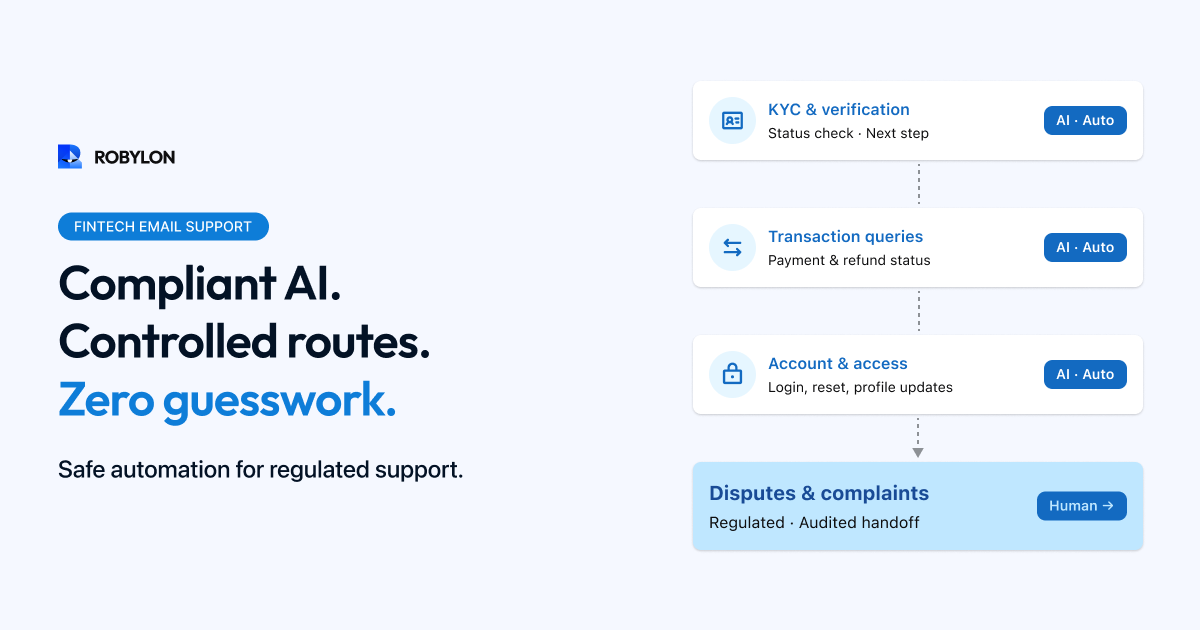
Fintech support is uniquely high-stakes. When a customer emails about a failed transaction, a frozen account, or a KYC verification issue, the anxiety is real — it is their money on the line. And the support team operates under constraints that most industries do not face: regulatory compliance requirements, PII handling rules, audit trail obligations, and strict guardrails on what the AI can and cannot say.
Despite these constraints, fintech email support is highly automatable. The queries are repetitive (transaction status, KYC document requirements, account verification, investment-related FAQs), the data is structured (every answer lives in your core banking or payment system), and the resolution paths are well-defined. The key is deploying AI with the right guardrails — not avoiding AI altogether.
This guide covers the major fintech email categories, the compliance guardrails AI needs, and how to achieve 55–70% auto-resolution without crossing regulatory lines.
The Fintech Email Support Landscape
A typical fintech company (payments, lending, wealth management, crypto, or neobanking) processing 2,000–10,000 email tickets per month sees:
- Transaction and payment queries (25–35%): “My payment failed,” “Why was I charged twice?”, “When will my withdrawal arrive?”, “Transaction shows pending for 3 days.”
- KYC and verification (15–25%): “What documents do I need for verification?”, “My KYC was rejected — why?”, “How long does verification take?”, “I uploaded my ID but status still shows pending.”
- Account access and security (10–20%): Password resets, 2FA issues, frozen accounts, suspicious activity alerts.
- Product and policy questions (10–15%): “What are your charges?”, “How does your investment product work?”, “What is the withdrawal limit?”
- Disputes and escalations (5–10%): Unauthorized transactions, chargeback requests, regulatory complaints.
- Onboarding and setup (5–10%): Bank linking, fund transfer setup, portfolio configuration.
The Compliance-First AI Framework
Before automating any fintech email, you need guardrails that prevent the AI from crossing regulatory boundaries. Here is the framework:
Rule 1: Never Give Financial Advice
The AI must never recommend investments, predict returns, suggest financial decisions, or make claims about product performance. For questions like “Should I invest in X?” or “Is this a good return?”, the AI responds: “I can share factual information about how our product works, but I’m not able to provide personalized financial advice. For investment decisions, we recommend consulting with a qualified financial advisor.”
This is a hard guardrail — configure it as a system-level instruction that cannot be overridden by knowledge base content.
Rule 2: PII Handling
Fintech emails frequently contain sensitive data — Aadhaar numbers, PAN numbers, bank account details, transaction IDs. The AI must handle PII carefully: never echo sensitive details back in full (mask to last 4 digits), never store PII in conversation logs beyond what is needed for resolution, and comply with data residency requirements (DPDP Act in India, GDPR in EU).
Rule 3: Audit Trail for Every Resolution
Every AI-resolved email must generate an audit trail: what was asked, what data was accessed, what action was taken, what response was sent, and the confidence score. Regulators expect records. If an AI auto-resolves a transaction dispute and the customer later escalates to a regulator, you need to show exactly what happened. Audit logging is one of several controls worth verifying before deployment — our enterprise AI email security checklist covers the full set, from encryption standards and access controls to AI-specific risks like prompt injection and data leakage.
Rule 4: Mandatory Escalation Triggers
Certain email types must always route to humans regardless of AI confidence:
- Unauthorized transaction reports (potential fraud — requires investigation and regulatory reporting).
- Regulatory complaints or legal threats.
- Requests involving large transaction amounts above a configurable threshold.
- Emails from regulatory bodies or law enforcement.
- Account closure requests with compliance implications.
Workflow: Transaction and Payment Queries
The most common fintech email. The AI reads the query, identifies the customer, queries your core system (payment gateway, ledger, or banking API), and provides the specific transaction status.
For a “payment failed” email: AI checks the transaction log → identifies the failure reason (insufficient balance, bank decline, limit exceeded, technical error) → provides the specific reason and next steps. “Your transfer of ₹50,000 on March 18 was declined by your bank with code ‘insufficient funds.’ Please ensure adequate balance and retry, or try a different payment method.”
For pending transactions: AI checks the processing timeline → “Your withdrawal of ₹25,000 was initiated on March 17 at 3:42 PM. It is currently being processed and will be credited to your HDFC account (ending 4532) within 1–2 business days.”
Automation rate: 70–85%. Most transaction queries are straightforward data lookups. Disputed or unauthorized transactions escalate to humans.
Workflow: KYC and Verification
KYC emails fall into two sub-categories: questions about what is needed (pure knowledge base) and issues with submitted documents (requires checking verification status).
For document requirements: “To complete your KYC, please upload: 1) PAN card (front), 2) Aadhaar card (front and back), and 3) a selfie. Upload here: [verification link]. Verification typically completes within 24–48 hours.”
For rejected verification: AI checks the verification system for the rejection reason → “Your KYC was not approved because the uploaded Aadhaar image was blurry. Please re-upload a clear photo of your Aadhaar card (front and back) here: [link]. Make sure the text and photo on the document are clearly visible.”
Automation rate: 65–80%. Standard requirements and clear rejection reasons automate well. Complex rejection cases (document mismatch, sanctions screening issues) escalate.
Workflow: Account Access and Security
Password resets, 2FA recovery, and locked accounts follow predictable flows. The AI verifies the customer’s identity (email verification, registered phone confirmation), then triggers the appropriate reset or unlock process.
For suspicious activity alerts: AI explains what triggered the alert and provides next steps — “We noticed a login from an unrecognized device in Delhi on March 18. If this was you, no action needed. If not, please change your password immediately: [link] and reply to this email so we can secure your account.”
Automation rate: 60–75%. Standard resets automate well. Account freezes due to suspected fraud always escalate to the security team.
Workflow: Product and Policy Questions
These are pure knowledge-base queries: fee structures, product explanations, regulatory disclosures, limits, and terms. The AI retrieves accurate, up-to-date information from your documentation — but with the financial advice guardrail firmly in place.
“Our savings product currently offers 7.5% p.a. interest, calculated daily and credited monthly. This rate is subject to change based on RBI monetary policy. For complete terms, see: [link]. Note: This is factual product information, not investment advice.”
Automation rate: 80–90%. High, because these are straightforward lookups — as long as your documentation is comprehensive and current.
Fintech-Specific Integrations
- Core banking / payment system: For transaction status, account balance, and payment history lookups.
- KYC / identity verification system: Onfido, DigiLocker, or custom — for verification status and rejection reasons.
- Fraud detection system: For suspicious activity context and account freeze reasons.
- Compliance logging: WORM-compliant storage for all AI interactions and decisions.
- CRM: Salesforce, HubSpot, or custom — for customer tier, product holdings, and interaction history.
Bottom Line
Fintech email support is automatable — you just need to do it with guardrails. The compliance-first framework (no financial advice, PII handling, audit trails, mandatory escalation triggers) protects you and your customers while still allowing 55–70% blended auto-resolution. The volume categories (transactions, KYC, account access, policy questions) are data-driven and repetitive — exactly what AI handles well. The key is not avoiding AI because of compliance concerns, but deploying AI with compliance built into the foundation.
Compliant AI email support for fintech. Robylon AI resolves transaction queries, KYC inquiries, and account issues with built-in PII handling, audit trails, and financial advice guardrails. Start free at robylon.ai
Frequently asked questions
Can AI handle fintech email support without violating compliance rules?
Yes — with a compliance-first framework. Four guardrails: 1) Never give financial advice — hard system instruction, no exceptions. 2) PII handling — mask sensitive data, comply with DPDP/GDPR. 3) Audit trail — log every AI decision for regulatory review. 4) Mandatory escalation — unauthorized transactions, legal threats, and large-value requests always route to humans. With these guardrails, fintech teams achieve 55–70% blended auto-resolution safely.
What fintech email types should always escalate to humans?
Five mandatory escalation categories: 1) Unauthorized transaction reports (potential fraud requiring investigation). 2) Regulatory complaints or legal threats. 3) Requests involving amounts above a configurable threshold. 4) Emails from regulators or law enforcement. 5) Account closure requests with compliance implications. These are hard rules — the AI routes to humans regardless of its confidence in a response.
How does AI handle KYC email queries?
Two sub-categories: Document requirements (pure KB lookup) — "Upload PAN card, Aadhaar, and a selfie here: [link]. Verification typically completes within 24–48 hours." Rejected verification (system query) — AI checks the verification system for the rejection reason and provides specific guidance: "Your KYC was not approved because the Aadhaar image was blurry. Please re-upload a clear photo here: [link]." Automation rate: 65–80%.
What automation rate can fintech companies expect for email support?
Blended 55–70% auto-resolution. By category: product and policy questions (80–90%), transaction status (70–85%), KYC queries (65–80%), account access (60–75%). Lower overall than e-commerce due to compliance escalation rules that route sensitive topics to humans. The 30–45% that escalates is appropriate — these are legitimately complex or compliance-sensitive issues that require human judgment and audit documentation.
How does AI handle failed payment emails in fintech?
AI queries your payment gateway for the failure reason and provides a specific, action-oriented response. For "insufficient funds": "Your transfer of ₹50,000 was declined due to insufficient balance. Please ensure adequate funds and retry." For "expired card": "Your card ending in 4532 has expired. Update here: [link]." The AI includes the exact transaction amount, date, failure reason, and next step — never a generic "payment failed, contact your bank."