
Automating Order Status Emails: The AI Approach to WISMO Tickets
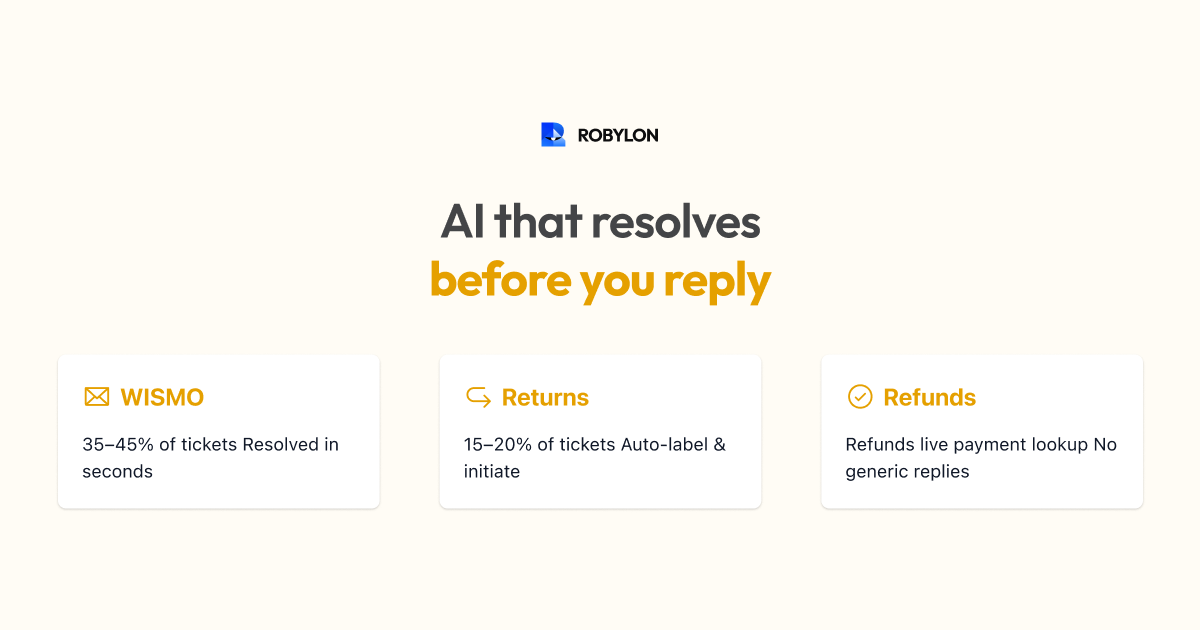
"Where is my order?" accounts for 35–45% of e-commerce email tickets. This deep dive shows how AI auto-resolves WISMO emails by parsing 50+ phrasings, extracting order IDs, querying your OMS, and delivering real-time tracking data — with a 90–95% resolution rate.
Key takeaways
- Where is my order accounts for 35-45% of e-commerce email tickets, which makes it the highest-volume single intent most teams have.
- A well-built WISMO flow resolves 90-95% of those emails without a human, because the answer is a database lookup rather than a judgement call.
- The pipeline is five steps: detect intent across 50+ phrasings, identify the order, query the OMS, generate a status-specific reply, then confidence-check before sending.
- The edge cases decide whether it works in production - tracking marked delivered but the customer says otherwise, and shipments stuck in transit.
“Where is my order?” These four words generate more support emails than any other query in e-commerce. Across D2C brands, marketplaces, and retailers, WISMO consistently accounts for 35–45% of total email ticket volume. Each one takes an agent 5–8 minutes to handle — open the email, find the order number, log into the OMS, look up tracking, compose a response, and send. Multiply that by hundreds of daily WISMO emails and you have multiple full-time agents doing nothing but copy-pasting tracking information.
AI eliminates this entirely. A well-connected AI email agent resolves WISMO tickets in 3–5 seconds with 90–95% accuracy — and the remaining 5–10% are legitimate edge cases that genuinely need human attention.
Why WISMO Is the Perfect Starting Point
If you are automating email for the first time, start with WISMO. It has the highest volume, the most predictable pattern, the simplest data requirements (one API call to your OMS), and the highest auto-resolution rate. It is the easiest win that demonstrates AI email value to your entire organization.
The WISMO automation ROI is immediately quantifiable. If you handle 1,500 WISMO emails per month at $7 per ticket (agent time + overhead), that is $10,500/month. AI resolves 90% automatically at $1.50 per resolution = $2,025. Plus 150 human-handled edge cases at $7 = $1,050. New total: $3,075. Monthly savings: $7,425. Annual: $89,100. From one email category.
The 50+ Ways Customers Ask “Where Is My Order?”
One of the reasons WISMO is so automatable is that despite the infinite phrasings, they all mean the same thing. AI handles this variation naturally through language understanding rather than keyword matching. Here is a sample of real customer phrasings:
- “Where is my order?” / “Where’s my stuff?” / “Order status?”
- “Has my order shipped yet?” / “Did you ship it?”
- “When will I receive my package?” / “ETA on delivery?”
- “Tracking update for order 45721 please”
- “It’s been a week and I haven’t received anything”
- “My order was supposed to arrive yesterday”
- “I need my order by Friday — will it make it?”
- “Did the courier attempt delivery? I was home all day”
- “Tracking shows delivered but I didn’t get it” (escalation case)
LLM-powered AI recognizes all of these as WISMO intent without needing a separate rule for each phrasing. Keyword-based systems would need dozens of rules and still miss creative phrasings.
The AI WISMO Resolution Workflow
Step 1: Intent Detection
AI reads the email and classifies it as WISMO. It also detects sub-intents: simple status check, delivery timeline concern, late delivery complaint, or “delivered but not received” dispute. Each sub-intent triggers a slightly different workflow.
Step 2: Order Identification
The AI extracts the order number from the email text. Customers mention it in various formats: “#45721”, “order 45721”, “45721”, “Order Number: 45721”, or embedded in a forwarded confirmation email. If no order number is present, the AI identifies the customer by email address and pulls their most recent order — or their most recent undelivered order if they have multiple.
Step 3: OMS Query
The AI calls your order management system API — Shopify, WooCommerce, Magento, or custom. It retrieves a complete data set: order date, items ordered, order status (processing/shipped/out-for-delivery/delivered/cancelled), carrier name, tracking number, tracking URL, current shipment location, transit history timestamps, and estimated delivery date.
Step 4: Response Generation by Status
The response varies based on order status:
Not yet shipped: “Hi [Name], your order #45721 was placed on March 16 and is currently being prepared for shipment. Estimated ship date: March 19. We’ll send your tracking information as soon as it ships.”
Shipped and in transit: “Hi [Name], your order #45721 shipped on March 18 via FedEx. Tracking number: 789123456. It’s currently in transit in Mumbai and expected to arrive by March 22. Track it live here: [tracking URL].”
Out for delivery: “Great news — your order #45721 is out for delivery today with FedEx. You should receive it by end of day. Tracking: [URL].”
Delivered: “Your order #45721 was delivered on March 20 at 2:15 PM to the address on file. If you haven’t received it, please check with other household members or your building reception. If you still can’t locate it, reply here and we’ll investigate with the carrier.”
Cancelled: “Your order #45721 was cancelled on March 17. If you didn’t request this cancellation, please reply and we’ll look into it immediately.”
Step 5: Confidence Check and Send
WISMO responses have inherently high confidence because the data comes directly from the OMS — there is no ambiguity about order status. Auto-send rate is typically 90–95%. The 5–10% that escalate are genuine edge cases.
The Edge Cases: When WISMO Gets Complex
Tracking Shows Delivered But Customer Says Not Received
This is the #1 WISMO escalation. The tracking system says delivered, but the customer did not receive the package. The AI cannot resolve this — it requires investigation (carrier claim, address verification, photo of delivery, possible theft). Route to human agent with all tracking data pre-attached.
Shipment Stuck in Transit
Tracking has not updated for 3+ days. The AI detects this pattern and adjusts the response: “Your order shipped on March 14 but tracking hasn’t updated since March 16. This sometimes happens when packages move between carrier hubs. We expect an update within 1–2 days. If there’s no movement by March 20, reply here and we’ll investigate with the carrier directly.”
International Shipment with Customs Hold
The AI detects an international order with a customs-related tracking status and explains the delay: “Your order cleared export from India on March 15 and is currently being processed by UK customs. This typically takes 2–5 business days. You may be contacted by the carrier regarding duties/taxes. Updated ETA: March 25–28.”
Split Shipment
Order contains 3 items shipping from different warehouses. The AI provides status for each shipment: “Your order contains 3 items shipping separately. Item 1 (Blue Hoodie): delivered March 18. Items 2–3 (White T-Shirt, Black Jeans): shipped March 19 via DTDC, expected March 23.”
Pre-Order Not Yet Released
Customer ordered a product that has not shipped because it is a pre-order or back-order. The AI checks the release date: “Your pre-order for [Product] is scheduled to ship on April 5. We’ll send tracking as soon as it ships. Current delivery estimate: April 8–12.”
Optimizing WISMO Automation
Proactive WISMO Prevention
The best WISMO email is the one that never gets sent. Use your AI platform to send proactive shipping notifications via email or WhatsApp — order confirmed, order shipped (with tracking), out for delivery, delivered. Businesses that implement proactive notifications see WISMO ticket volume drop 25–40% because customers get the information before they need to ask.
Carrier-Specific Knowledge
Different carriers have different tracking terminology and delivery patterns. Add carrier-specific context to your knowledge base: FedEx “in transit” means different things at different scan points. DTDC delivery windows vary by region. India Post tracking updates can be delayed by 24–48 hours. This context helps the AI give more accurate ETAs and set appropriate expectations.
Seasonal Volume Preparation
WISMO volume spikes 3–5x during sale events (Black Friday, Diwali sales, end-of-season clearance). Prepare your AI by updating carrier timelines (shipping is slower during peak periods), adjusting response templates to acknowledge delays, and ensuring your OMS integration can handle the API call volume.
Bottom Line
WISMO is the single highest-impact email category to automate. It has the most volume, the simplest data requirements, the highest auto-resolution rate, and the most straightforward ROI calculation. If your AI email automation does nothing else, automating WISMO alone will save your team hundreds of hours per month and deliver response times that customers genuinely appreciate.
Automate your #1 email ticket type. Robylon AI connects to your OMS, resolves WISMO emails in seconds with live tracking data, and handles edge cases with intelligent escalation. Start free at robylon.ai
Frequently asked questions
How does AI identify the order when customers don't include an order number?
The AI identifies the customer by their sender email address, matches it against your customer database, and pulls their recent order history. If there is only one recent undelivered order, the AI uses it automatically. If there are multiple, the AI asks: "I found 2 recent orders on your account — #45721 (Blue Hoodie, shipped March 18) and #45698 (White T-Shirt, processing). Which one are you asking about?" This eliminates the back-and-forth that wastes hours.
What percentage of WISMO emails can AI auto-resolve?
90–95% when connected to your OMS. WISMO is the highest-automation email category because every answer is a data lookup — order status, carrier, tracking number, delivery ETA. The 5–10% that escalate are genuine edge cases: lost packages (tracking says delivered, customer says not received), shipments stuck in transit with no updates, international customs holds, and split shipments with complex tracking.
What is the ROI of automating WISMO emails specifically?
For a business handling 1,500 WISMO emails/month at $7/ticket: manual cost = $10,500/month. AI resolves 90% at $1.50/resolution ($2,025) + 150 human-handled at $7 ($1,050) = $3,075/month. Monthly savings: $7,425. Annual: $89,100. From automating a single email category. This makes WISMO the highest-ROI starting point for any email AI deployment.
How should AI handle 'delivered but not received' emails?
This is the #1 WISMO escalation case and should always route to a human agent. The AI provides helpful context: "Our tracking shows your order was delivered on March 20 at 2:15 PM. Please check with other household members or your building reception. If you still cannot locate it, reply here and we will investigate with the carrier." If the customer confirms non-receipt, the AI escalates to an agent with all tracking data pre-attached for carrier claim investigation.
How do I reduce WISMO email volume proactively?
Send proactive shipping notifications before customers need to ask: order confirmed, order shipped (with tracking), out for delivery, delivered. Businesses implementing proactive notifications see WISMO ticket volume drop 25–40% because customers get the information before they need to request it. Use email or WhatsApp (98% open rate) for these notifications. The remaining WISMO emails are from customers who missed the notification or have a genuine tracking issue.