12 best Freshdesk alternatives for customer support teams in 2026
Twelve alternatives to Freshdesk and Freddy AI, compared on seat price, channels, what the AI agent does and how it bills, with prices checked in October 2026.
Key takeaways
- If you want to keep Freshdesk and replace only Freddy AI: Robylon, which answers inside Freshdesk from its Business plan at $180 a month, or Fin at $0.99 per outcome with a 50-outcome monthly minimum.
- If you want a like-for-like helpdesk instead: Zendesk Suite Team from $55 or Zoho Desk from $7 per agent a month, billed annually.
- If you are a small team on a tight budget: Help Scout, free for up to 5 users, or Zoho Desk, free for 3 users.
- If you run support from the CRM: HubSpot Service Hub, whose customer agent bills $0.50 per resolution from Professional, or Salesforce Service Cloud, with Agentforce from the $195 Core edition.
- If support shares email with other teams or lives in Gmail: Front from $25 a seat, or Hiver from $25 a user, both billed annually.
- If you sell online: Gorgias for Shopify stores from $10 a month, or Kustomer and Gladly for larger consumer brands, both quote only.
Robylon fits teams that want an AI agent to resolve tickets across email, chat, voice and WhatsApp, either inside the Freshdesk helpdesk they keep or with Robylon’s own inbox. Fin is the other way to keep Freshdesk and replace Freddy AI, billed per outcome. Zendesk and Zoho Desk are the closest like-for-like helpdesks, Help Scout suits small teams, HubSpot Service Hub and Salesforce Service Cloud suit teams that run support from their CRM, Front and Hiver suit teams that work from shared email, and Gorgias, Kustomer and Gladly suit online stores and consumer brands.
Freshdesk is an established helpdesk with seats from $19 per agent a month billed annually. Teams evaluating or running it look elsewhere when the AI agent is billed per session whether or not it resolves anything, when chat AI and WhatsApp need the pricier Freshdesk Omni, or when phone support means buying a second product. The first decision is whether to replace the AI agent, the helpdesk, or both. Every tool below is judged on three things: whether its AI takes the action a ticket needs, whether every channel runs from one setup, and whether it fits the stack you already run.
Freshdesk alternatives at a glance
| Tool | Best for | What the AI does | Billing unit | Free plan | Paid from | G2 |
|---|---|---|---|---|---|---|
| Freshdesk (baseline) | Value seat pricing, email-first or multichannel | Freddy AI Agent answers and runs API workflows | Per seat, plus per AI session | 2 agents free for 6 months | $19 a seat (Growth, annual) | 4.4 (3,777) |
| Robylon | AI agent that resolves tickets, inside Freshdesk or standalone | Answers and acts in your systems | Per AI credit; seats optional | Free forever, 300 credits a month (about 40 chats) | $25 a month (Pro, 500 credits) | 5.0 (42) |
| Zendesk | One suite with tickets, voice and an AI agent | Answers and acts; one channel type per agent | Per seat, plus per AI resolution | No; 14-day trial | $55 a seat (Suite Team, annual) | 4.3 (7,093) |
| Fin | Keeping Freshdesk and paying per AI outcome | Answers and acts through Procedures | Per outcome; 50-outcome monthly minimum | No; 14-day trial | $0.99 per outcome | 4.5 (3,918) |
| Zoho Desk | Lowest seat prices, especially with Zoho CRM | Zia drafts replies; Zia Agents billed by tokens | Per user; AI agents per LLM token | Yes, 3 users | $7 a user (Express, annual) | 4.4 (7,976) |
| Help Scout | Small teams wanting a simple shared inbox | Answers only, in the Beacon widget | Per user, plus per AI resolution | Yes, up to 5 users | $25 a user (Standard, annual) | 4.4 (431) |
| HubSpot Service Hub | Teams that run sales and marketing on HubSpot | Customer agent answers and acts, from Professional | Per seat, plus credits per AI resolution | Yes, free tools for 2 users | $20 a seat (Starter list price) | 4.4 (3,018) |
| Front | B2B teams sharing customer work across teams | Autopilot answers, routes and updates records | Per seat, plus per AI conversation outcome | No; 14-day trial | $25 a seat (Starter, annual) | 4.7 (2,515) |
| Hiver | Teams that run support from Gmail or Outlook | AI Agents answer in chat; Skills act on email | Per user; no separate AI price published | No; 7-day trial of Elite | $25 a user (Growth, annual) | 4.6 (1,293) |
| Salesforce Service Cloud | CRM-led enterprises on Salesforce | Agentforce answers and acts inside Salesforce | Per user, plus per conversation or resolution | No; 30-day trial | $25 a user (Starter Suite, annual) | 4.4 (8,433) |
| Gorgias | Shopify stores | Answers and acts on Shopify orders | Per ticket, plus per AI interaction | No; 7-day trial | $10 a month (Starter, 50 tickets) | 4.6 (582) |
| Kustomer | High-volume consumer brands buying through sales | Concierge answers and acts through configured tools | Per seat or per conversation; AI per engaged conversation | None published | Custom quote | 4.4 (566) |
| Gladly | Retail brands that want AI to sell and serve | Answers and acts on Shopify orders and returns | Per active user; AI per resolution and assist | None published | Custom quote | 4.7 (1,114) |
Prices checked October 2026 on each vendor's pricing page. G2 ratings read October 2026, with the review count in brackets.
Robylon publishes this page and ranks itself first; every tool on the list, Robylon included, gets the same “Where it falls short” line.
What Freshdesk does
Freshdesk is Freshworks’ customer service helpdesk for small and mid-sized support teams, sold as two products: Freshdesk, an email-first helpdesk, and Freshdesk Omni, which adds full live chat, WhatsApp and Instagram to the same inbox. Both include ticketing, a customer portal and a knowledge base, priced per agent seat on Growth, Pro and Enterprise. Freddy AI Agent, built in AI Agent Studio, answers from knowledge sources and runs workflows with API actions; it is billed per session in packs of 100, and its chat version runs only on Freshdesk Omni. Phone comes through Freshcaller, a separate Freshworks product.
Why teams look beyond Freshdesk
AI billed per session
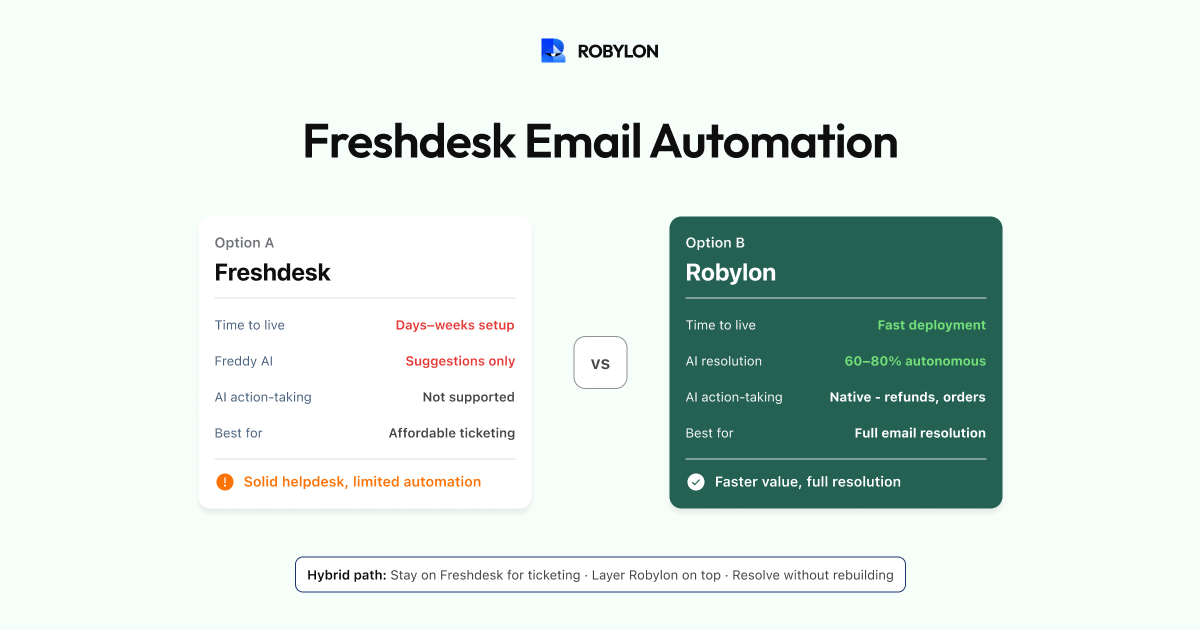
Freddy AI Agent is sold in packs of 100 sessions at $49 on every plan. A session covers one customer for 24 hours on chat or 72 hours on email, whatever the outcome, and Freshworks’ sessions FAQ lists no refund for sessions that end in a handover as of October 2026. Previews while you build an agent use sessions too. The Freshdesk email automation review covers Freddy on email in detail.
Packs that expire monthly
Session packs expire with the billing cycle and unused sessions do not carry over. When they run out, the AI agent stops: chats go to human agents, and self-service widgets stop without a handover. The 500 complimentary sessions for new accounts are given once.
Chat AI only on Omni
Freshdesk, from $19 per agent a month billed annually, is email-first and gets the Email AI Agent only. Chat AI Agents, WhatsApp and Instagram need Freshdesk Omni, from $29 per agent. Freshdesk accounts created from December 2025 no longer get WhatsApp at all.
Phone sold as another product
The phone channel comes through Freshcaller, a separate product priced per agent from $15 a month billed annually or $18 monthly, plus per-minute charges (Freshcaller pricing), or through your own telephony on Freshdesk Omni Pro and Enterprise.
Copilot only on upper plans
Freddy AI Copilot costs $29 per agent a month billed annually and is sold only on Pro and Enterprise. A Growth team that wants it first moves every seat to Pro, at $55 a month on Freshdesk or $79 on Freshdesk Omni.
Two paths away from Freshdesk
Leaving Freshdesk means one of two things, and they lead to different tools.
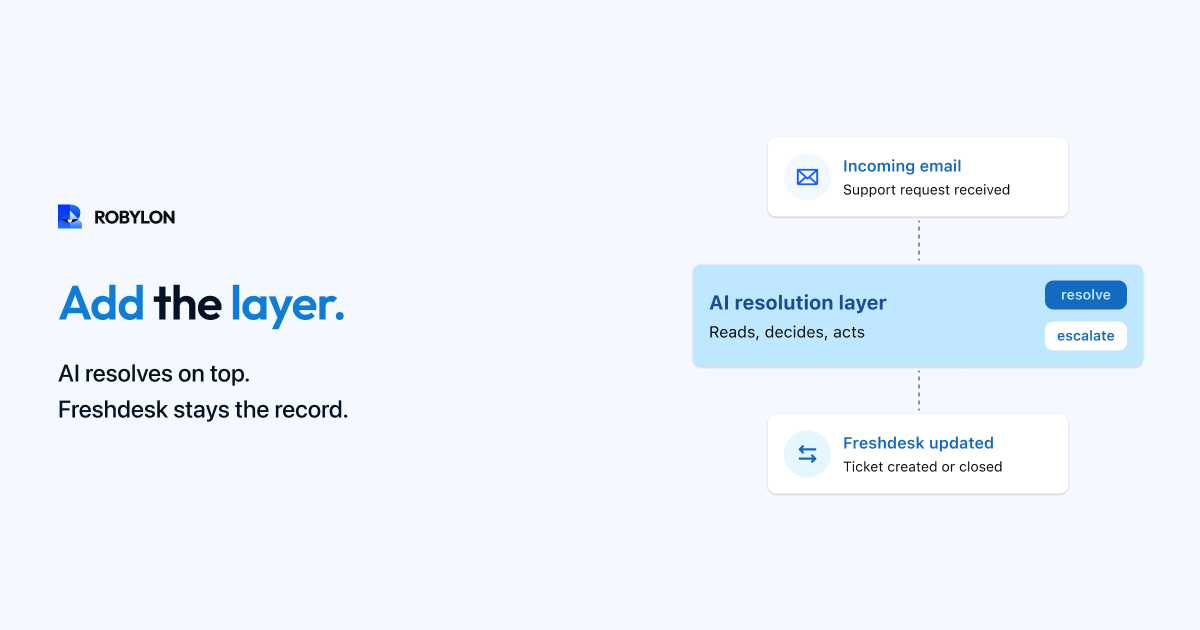
- Keep the Freshdesk helpdesk and change the AI agent. The team stays in the Freshdesk inbox and Freddy AI is switched off. Robylon answers inside Freshdesk tickets and Freshchat conversations from its Business plan. Fin, from the company formerly called Intercom, also runs inside Freshdesk and Freshchat at $0.99 per outcome with a 50-outcome monthly minimum (Fin pricing).
- Replace the helpdesk. Helpdesk suites with their own AI agent (Zendesk, Zoho Desk, Help Scout, HubSpot Service Hub, Front, Hiver, Salesforce Service Cloud, Kustomer and Gladly) replace both at once; Gorgias does the same for Shopify stores; and Robylon’s own inbox suits teams whose human workload fits a shared inbox with tickets, SLAs and queues.
Zendesk and Zoho Desk are the closest like-for-like replacements for a full Freshdesk helpdesk.
How we compared the tools
We read each vendor’s pricing page, help centre or docs, and trust page between 7 and 16 October 2026, and each tool’s G2 page in the same period. We did not run hands-on tests for this page.
We compared them on what the AI agent can resolve, channels covered, where each runs, billing model, setup effort, and how each works for support agents and team leads.
The 12 best Freshdesk alternatives
1. Robylon
Best for: teams that want an AI agent to resolve tickets across every channel, inside the Freshdesk helpdesk they keep or with Robylon’s own inbox.
What it is for: Robylon is an AI customer support platform that resolves tickets across email, chat, voice and WhatsApp. It works standalone or alongside an existing helpdesk. It takes the action a ticket needs, through tools built from your APIs and connected apps. Every channel runs from one setup, with no session clock and no separate product for chat. And it fits the stack you already run: Robylon answers inside Freshdesk, so a team keeps its Freshdesk inbox, or it runs standalone with its own inbox and optional human seats. A US logistics enterprise cut its query resolution time by 95% with Robylon.
What the AI does:
- A triage agent routes each conversation to the sub-agent for that topic.
- Agents call tools built from your APIs and from 32 pre-built integrations, among them Shopify, HubSpot, Salesforce and Google Sheets, to look up orders, issue refunds and update accounts.
- The knowledge base answers from your sources, and the KB gap report shows what it could not answer.
- Anything the agent cannot finish goes to a person with the conversation, intent and checks attached; inside Freshdesk, your team picks it up where it already works.
Channels: email, website and in-app chat, voice, WhatsApp, Instagram, Facebook, SMS through Twilio, YouTube comments, and reviews on Google Play, the App Store and Google My Business, all on the channels page. It runs inside Freshdesk, Zendesk, Zoho Desk, Salesforce, Vtiger, Intercom, Freshchat, SalesIQ and Gorgias, or standalone. Robylon’s unified inbox gives a human team tickets, SLAs and queues on every seat, with AI Copilot on Advanced (50 uses a month) and Expert (unlimited) seats.
Pricing: by AI credits rather than per seat (see pricing). The Starter plan is free with 300 credits a month (about 40 conversations, chat only), paid plans start at $25 a month for 500 credits, Business starts at $180 a month, and yearly billing takes 10% off. WhatsApp and email start on Pro; voice phone calls and the Freshdesk integration start on Business. Seats for a human team are optional, at $19 (Basic), $49 (Advanced) or $89 (Expert) per seat a month. G2 rating: 5.0 from 42 reviews (G2, October 2026).
Where it falls short: running inside Freshdesk and voice phone calls both start on the Business plan at $180 a month. Full reporting and the real-time dashboard are on Expert seats only. Credits are spent on every conversation, resolved or not, and credits per conversation vary with the AI model chosen, so cost is harder to forecast than a fixed session price.
Where Freshdesk does better:
- Helpdesk depth: multiple SLA policies from Pro; skill-based routing and sandbox on Enterprise.
- Data hosting choice: the US, the EEA, the UAE, India or Australia, chosen at sign-up; Robylon offers US data residency.
- A fixed AI unit price: $49 per 100 Freddy sessions, simpler to budget than credits.
- Low AI volume: up to 300 AI conversations a month, three Freddy packs ($147) cost less than the $180 Business plan Robylon needs to run inside Freshdesk.
- Compliance breadth and review volume: SOC 1, SOC 2 and SOC 3, ISO 27001 and 27701, CSA STAR and TX-RAMP, and 3,777 G2 reviews against Robylon’s 42.
Pick it if: you want an AI agent resolving tickets across email, chat, voice and WhatsApp, inside Freshdesk or with a lighter inbox. Choose Freshdesk if your team relies on its routing depth and regional hosting. For the head-to-head, see Robylon vs Freshdesk.
2. Zendesk: best full-suite replacement
Best for: support teams of any size that want one suite for ticketing, messaging, voice and an AI agent.
Zendesk is a long-running ticketing suite with a help centre, routing, SLAs, reporting, voice through Zendesk Talk and 1,800+ Marketplace apps. Since a May to June 2026 rollout, AI agents are on every Suite and Support plan; voice AI agents became generally available in September 2026.
What the AI does: answers and takes actions that read and write data in external systems, in 80+ languages; each AI agent serves one channel type (messaging, email or voice).
Channels: email, web form, messaging and live chat, mobile SDKs, voice, WhatsApp, Facebook Messenger, Instagram, X DMs, LINE, WeChat and Slack; SMS through the Text add-on.
Pricing: Suite Team costs $55 per agent a month billed annually ($69 monthly) and Suite Professional $115; after 5 included automated resolutions per agent a month, the AI agent costs $1.50 per committed resolution or $2.00 pay-as-you-go (Zendesk pricing). G2: 4.3 from 7,093 reviews (G2, October 2026).
Where it falls short: two AI billing models are live at once, the newer one with unpublished tier prices, and Copilot costs $50 per agent a month billed annually.
Pick it if: you want the closest like-for-like replacement for Freshdesk, with voice and the AI agent in the same product. The Zendesk alternatives guide covers the reverse decision.
3. Fin: best for keeping Freshdesk
Best for: teams that want to keep Freshdesk, swap Freddy AI for another agent, and pay only when the AI reaches an outcome.
Fin is the AI agent from the company formerly called Intercom, which renamed itself Fin on 12 May 2026 and has been owned by Salesforce since 10 September 2026. Fin runs inside Freshdesk and Freshchat, and its integrations page also lists Zendesk, Salesforce Service Cloud and HubSpot Service Hub; it comes with Intercom’s own helpdesk for teams that want to move the inbox too.
What the AI does: answers from your knowledge sources and acts through Procedures, plain-language instructions that call any REST API or MCP connector, in more than 45 languages for chat, email and social messaging. Fin Voice is sold to select customers through sales.
Channels: on Freshdesk, the Freshdesk ticket and Freshchat channels Fin is connected to; on Intercom, Messenger chat, email, WhatsApp, SMS, Facebook Messenger, Instagram, Slack and Discord.
Pricing: $0.99 per outcome, at most once per conversation, with a 50-outcome monthly minimum on a helpdesk other than Intercom; Freshworks customers can trial it self-serve for 14 days (Fin pricing). G2: 4.5 from 3,918 reviews (G2, October 2026).
Where it falls short: every extra resolution adds $0.99, so the bill grows at the same rate as the agent improves, some conversations a person touched are still billed as outcomes, and voice needs a sales contract.
Pick it if: you want to keep Freshdesk and pay per outcome rather than per session. The Fin alternatives guide compares the AI agents on their own.
4. Zoho Desk: best low-cost helpdesk
Best for: small and mid-size teams, especially those on Zoho CRM, that want a full helpdesk at the lowest seat price.
Zoho Desk runs from a free edition for 3 users to Enterprise, with light agents at $6 a month each on paid editions.
What the AI does: Zia drafts replies, summarises tickets and predicts fields on Professional and Enterprise, and Answer Bot answers customers from Standard upward. Zia Agents run custom agents; pre-built Desk agents are Enterprise only.
Channels: email, web forms, help centre, X, Facebook and Instagram, and from Standard upward live chat, WhatsApp, Telegram, WeChat and LINE; phone through third-party telephony from Professional.
Pricing: Express costs $7 per user a month billed annually, Standard $14, Professional $23 and Enterprise $40; Zia Agents on Zoho-hosted models give 30 million tokens a month free, then $1 per million (Zoho Desk pricing). G2: 4.4 from 7,976 reviews (G2, October 2026).
Where it falls short: Zoho publishes no tokens-per-conversation figure, so the cost of a Zia Agents conversation cannot be worked out in advance, and USD prices differ by visitor region.
Pick it if: you want a full helpdesk at the lowest paid seat price, or you already run Zoho CRM.
5. Help Scout: best for small teams
Best for: small and mid-size teams that want a simple shared inbox, a knowledge base and a chat widget.
Help Scout’s free plan covers up to 5 users and 100 contacts a month.
What the AI does: AI Answers answers visitors in the Beacon widget from Docs, websites and files, in more than 50 languages. It answers only.
Channels: email, live chat (Beacon), WhatsApp, Facebook Messenger, Instagram and SMS through your own Twilio number; phone through Aircall.
Pricing: Standard costs $25 per user a month billed annually ($30 monthly), Plus $45 ($54) and Pro $75 ($90) with a 10-user minimum; AI Answers adds $0.75 per resolution (Help Scout pricing). G2: 4.4 from 431 reviews (G2, October 2026).
Where it falls short: the AI takes no actions in other systems, its docs list no AI Answers on email as of October 2026, and Standard caps at 25 users.
Pick it if: you are a small team that wants a clean inbox at a low price.
6. HubSpot Service Hub: best for CRM
Best for: teams already on HubSpot’s CRM that want tickets on the same record as marketing and sales.
Service Hub puts ticketing, a knowledge base and a customer portal on HubSpot’s CRM. Its customer agent moved to $0.50 per resolved conversation on 14 April 2026.
What the AI does: the customer agent, on Professional and Enterprise only, answers from the knowledge base, website pages and files, and runs up to 20 actions: enrol a visitor in a workflow, update a CRM object, book a meeting, qualify a lead or call an external API. Voice is a public beta for inbound calls.
Channels: email, live chat, forms, Facebook Messenger, WhatsApp (Professional and above) and calling; SMS (beta) through a Twilio add-on; WeChat, Telegram, LINE, Viber and Slack through Marketplace apps.
Pricing: Starter lists at $20 per seat a month (a limited-time $7 billed annually for new customers) and Professional costs $90 a seat billed annually; the customer agent uses 50 HubSpot Credits ($0.50) per resolved conversation, with 3,000 credits a month included on Professional (HubSpot Service Hub pricing). G2: 4.4 from 3,018 reviews (G2, October 2026).
Where it falls short: the customer agent needs Professional, which has no month-to-month price, and a conversation counts as resolved when the visitor does not ask for a person within 72 hours, so a workflow or manual reassignment does not stop the charge.
Pick it if: your company runs sales and marketing on HubSpot and wants support on the same customer record.
7. Front: best for cross-team B2B work
Best for: B2B teams whose customer work spans support, operations and account management in one shared inbox.
Front is a shared inbox with ticketing that it says serves 9,300+ businesses, and since 6 October 2026 it hosts other vendors’ AI agents on every plan.
What the AI does: Autopilot, a paid add-on, tags, routes, summarises, drafts and sends replies and, through Connectors, updates records in other systems; Front’s examples are an order management system and Salesforce. It is optimised for English only.
Channels: email, Front Chat, web forms, customer portal, Slack, Facebook, Instagram, X and Telegram; WhatsApp through an add-on; SMS and voice through partner integrations.
Pricing: Starter costs $25 per seat a month billed annually, Professional $65 and Enterprise $105; Autopilot charges each conversation once, at $0.05 for Triage, $0.39 for Handoff or $0.89 for Resolution (Front pricing). G2: 4.7 from 2,515 reviews (G2, October 2026).
Where it falls short: Starter takes one channel type only, phone and SMS need a partner, and a conversation Autopilot drafts on before a human takes over is still billed $0.39.
Pick it if: several teams share customer conversations in one inbox.
8. Hiver: best for Gmail teams
Best for: support and operations teams that run shared inboxes in Gmail or Outlook and want ticketing on top of email.
Hiver sells two products at the same prices: Hiver in Gmail, a Chrome extension that turns Gmail into a helpdesk, and Hiver Omni, a standalone web app over Gmail, Outlook and other mailboxes that adds chat, Slack, voice, SMS and WhatsApp. Hiver says more than 10,000 teams use it.
What the AI does: AI Agents answer website chat visitors from your help centre, web pages and files and hand over by confidence or rules; Hiver’s help centre documents them on Pro and Elite, in early access. Skills act on email conversations: they tag, assign, draft or send replies, read and write HubSpot records and make API calls.
Channels: email (Gmail, Outlook and Microsoft 365), live chat, web forms, help centre, Slack and a customer portal (Pro and above), and WhatsApp in Hiver Omni since 30 September 2026; voice through the Hiver Voice add-on, Dialpad or Aircall, and SMS through your own Twilio number.
Pricing: Growth costs $25 per user a month billed annually ($35 monthly), Pro $55 ($65) and Elite $85 ($95); Hiver publishes no separate price for AI Agents, and Voice costs $30 per voice seat a month with 1,000 pooled minutes (Hiver pricing). G2 (Hiver in Gmail): 4.6 from 1,293 reviews (G2, October 2026).
Where it falls short: the help centre documents AI Agents on chat only and Skills on email only, Growth caps at 10 users, and there is no free plan, only a 7-day trial of Elite.
Pick it if: your team works from shared email and wants a helpdesk without leaving Gmail or Outlook.
9. Salesforce Service Cloud: best for Salesforce
Best for: mid-market and enterprise teams that run their customer data in Salesforce.
Service Cloud is Salesforce’s helpdesk, sold in five editions. Salesforce has also owned Fin since 10 September 2026, so Service Cloud, the Intercom helpdesk and Fin AI Agent share a parent company.
What the AI does: Agentforce answers from Knowledge and Data 360 and acts in Salesforce and other systems through Flows, Apex and API connectors; Casey, the help agent, bills only on resolution. Salesforce’s pages list no email channel for the customer-facing agent as of October 2026.
Channels: web chat, in-app, help sites and portals, SMS, WhatsApp, Facebook Messenger, Apple Messages for Business, LINE and voice (English only as of October 2026).
Pricing: Service Cloud editions cost $25 (Starter Suite), $100 (Pro Suite), $195 (Core), $395 (Advanced) and $550 (Max) per user a month billed annually; Agentforce costs $2 per conversation, or $2 per resolution for Casey (Agentforce pricing). G2: 4.4 from 8,433 reviews (G2, October 2026).
Where it falls short: the AI agent needs the $195 Core edition or above, Core is billed annually only, and chat handovers need Contact Center Digital at $75 per user a month on top.
Pick it if: your company already runs on Salesforce and wants support inside the CRM.
10. Gorgias: best for Shopify stores
Best for: Shopify brands that want a helpdesk built around the store.
Gorgias prices by tickets rather than seats, from 50 tickets a month on Starter to 5,000 on Advanced.
What the AI does: answers from the help centre and Shopify data, and on Basic and above cancels unfulfilled orders, edits shipping addresses, removes or replaces items, reships orders and adds order notes in Shopify. It needs a connected Shopify store.
Channels: email, chat, help centre, contact forms, Facebook Messenger, Instagram and WhatsApp; voice and SMS through paid add-ons.
Pricing: Starter costs $10 a month for 50 tickets and Pro $300 a month billed annually for 2,000; AI Agent adds $0.90 per automated interaction on annual plans or $1.00 on monthly plans, on top of the ticket fee (Gorgias pricing). G2: 4.6 from 582 reviews (G2, October 2026).
Where it falls short: the AI Agent needs Shopify, and an AI-resolved ticket is billed twice, as a helpdesk ticket and as an automated interaction.
Pick it if: you run a Shopify store and want a helpdesk priced by tickets.
11. Kustomer: best for consumer brands
Best for: mid-size and enterprise consumer brands that want every order, message and call on one customer timeline.
Kustomer is a helpdesk built on a CRM-style data model, used by more than 600 companies, among them Skims, Glossier, Sweetgreen and Vuori. Its AI agent for customers is called Concierge and its AI for reps Envoy, names adopted on 1 June 2026.
What the AI does: Concierge answers from knowledge bases and acts through OpenAPI and MCP tools, with identity checks before protected tools. Its Shopify tool reads orders; refunds and cancellations run through tools you configure or a human rep. Concierge is a paid add-on on Enterprise and Ultimate.
Channels: email, chat, voice, SMS, WhatsApp, Facebook Messenger, Instagram, TikTok Shop messages and forms. Kustomer’s help centre lists Concierge on email, chat, SMS, forms, Facebook Messenger and WhatsApp, and says it is not generally available on Kustomer Voice.
Pricing: quote only, on a seat-based or conversation-based contract; Concierge bills per engaged conversation, and Kustomer Voice starts at $0.02 a minute (Kustomer pricing). G2: 4.4 from 566 reviews (G2, October 2026).
Where it falls short: no published seat or AI price and no trial, and a conversation counts as engaged, and billed, once Concierge opens it or attempts a reply, handovers included.
Pick it if: you run a high-volume consumer brand that wants a CRM-style timeline and buys through sales.
12. Gladly: best for retail brands
Best for: mid-size and enterprise retail brands that want one conversation per customer and an AI that sells as well as serves.
Gladly keeps every chat, call and email with a customer in one lifelong conversation, worked by human agents in Gladly Team. Its AI agent, called Gladly since the Sidekick rename on 28 January 2026, runs on Gladly’s own platform and, through Gladly AI for Helpdesks, on Zendesk and Gorgias. Customers on its site include Nordstrom, Ulta Beauty, Crate & Barrel and Tory Burch.
What the AI does: answers and acts through Guides and Workflows. In Shopify it looks up orders, updates shipping addresses, cancels orders, issues refunds and creates replacement orders; it also acts in Loop Returns, Recharge, Skio and ShipHero, and a shopping assistant recommends products and checks shoppers out in the conversation.
Channels: chat, in-app chat, email, voice with IVR, SMS, Facebook Messenger, Instagram and WhatsApp in Gladly Team. Gladly’s help centre lists the AI on chat, email, Facebook, Instagram, SMS and voice, without WhatsApp.
Pricing: quote only, with seats per active user and the AI billed on resolutions and assists; Voice AI adds $0.06216 a minute on top of telephony (Gladly on AI pricing). G2: 4.7 from 1,114 reviews (G2, October 2026).
Where it falls short: no public seat or AI price and no free plan or self-serve signup, Voice AI is English only, and a handover is billed as an assist.
Pick it if: you run a retail brand that wants service and sales in one conversation and can buy through sales.
Alternatives by situation
| Situation | Tool or tools |
|---|---|
| Keep the Freshdesk inbox, replace only Freddy AI | Robylon (Business plan), Fin |
| Closest like-for-like replacement for Freshdesk | Zendesk, Zoho Desk |
| Free plan for a small team | Help Scout (5 users), Zoho Desk (3 users), HubSpot free tools (2 users) |
| Growing mid-market team that needs skills-based routing and IVR | Zendesk (Suite Professional) |
| Already on HubSpot CRM | HubSpot Service Hub |
| Already on Salesforce | Salesforce Service Cloud |
| Several teams sharing customer conversations | Front |
| Team that wants to stay inside Gmail or Outlook | Hiver |
| Shopify store that needs order actions | Gorgias |
| High-volume consumer or retail brand buying through sales | Kustomer, Gladly |
| AI billed per resolution or outcome, not per session | Zendesk, Help Scout, HubSpot Service Hub, Fin |
| Fewer than 300 AI conversations a month, staying on Freshdesk | Freshdesk (Freddy AI Agent) |
| AI agent that acts across email, chat, voice and WhatsApp | Robylon, Zendesk |
What to decide before switching
Actions versus answers
Count what share of your tickets need the agent to act in another system rather than answer from help content. If most need actions, shortlist Robylon, Zendesk, Fin, HubSpot Service Hub, Front, Salesforce Service Cloud, Gladly and Gorgias. If most need answers, Help Scout and Zoho Desk cost less.
Channels your customers use
List the channels your customers use today, including voice. Zendesk includes voice through Zendesk Talk, and Robylon includes voice phone calls from its Business plan. Freshdesk, Help Scout, Zoho Desk, Front and Hiver route phone through Freshcaller, Aircall, third-party telephony, an add-on or a partner.
Where your team works
Decide whether your human team leaves the Freshdesk inbox. If it stays, change only the AI agent: Robylon and Fin both run inside Freshdesk. If it moves, check the new helpdesk for the SLA policies, routing, portal and reporting you use today.
Pricing at your volume
The billing units differ: Freshdesk bills every AI session, Zendesk, Help Scout, HubSpot and Fin bill resolutions, Front bills handoffs as well as resolutions, and Robylon bills credits per conversation. On published prices for 3,000 chat and email conversations a month, 60% resolved by the AI (1,800 resolutions), 3 human agents and monthly billing:
| Tool | Option | AI cost a month | Seats a month | Total a month | AI cost per resolution |
|---|---|---|---|---|---|
| Robylon | Business, Basic seats | $625.00 | $57.00 | $682.00 | $0.35 |
| Robylon inside Freshdesk | Business, Freshdesk Omni Growth seats kept, Freddy off | $625.00 | $105.00 | $730.00 | $0.35 |
| HubSpot Service Hub | Customer agent, Professional seats | $870.00 | $300.00 | $1,170.00 | $0.48 |
| Help Scout | AI Answers, Standard seats | $1,350.00 | $90.00 | $1,440.00 | $0.75 |
| Freshdesk | Freddy AI Agent, Omni Growth seats | $1,470.00 | $105.00 | $1,575.00 | $0.82 |
| Fin inside Freshdesk | Freshdesk Omni Growth seats kept, Freddy off | $1,782.00 | $105.00 | $1,887.00 | $0.99 |
| Front | Autopilot, Professional seats | $2,070.00 | $255.00 | $2,325.00 | $1.15 |
| Gorgias | Pro with AI Agent | $2,520.00 | Not counted | $2,520.00 | $1.40 |
| Zendesk | AI agents, Suite Team seats, pay-as-you-go | $3,570.00 | $207.00 | $3,777.00 | $1.98 |
Robylon’s figure is 3,000 conversations at about 7.5 credits each: the Business 10,000-credit tier at $300 plus 13 extra 1,000-credit bundles at $25, and 3 Basic seats at $19. The two “inside Freshdesk” rows keep the same 3 Freshdesk Omni Growth seats at $35 as the Freddy row, so only the AI line changes; Fin’s AI cost is its “Fin on another helpdesk” figure. Freshdesk counts one session per conversation at $49 per 100 and leaves out the one-time 500 complimentary sessions; an email thread that runs past 72 hours can use a second session. Salesforce Service Cloud’s Core edition is billed annually only; on yearly billing, Casey with Core and Contact Center Digital seats comes to $4,410.00 a month. Zoho Desk, Hiver, Kustomer and Gladly are not priced: Zia Agents bill by tokens, and the other three publish no AI price.
The alternatives cost less in some cases. Freddy’s session packs cost less than Robylon up to 300 AI conversations a month: three packs come to $147, against the $180 Business plan Robylon needs to run inside Freshdesk. Robylon’s credits are spent on every conversation, so at 3,000 conversations a month, counting AI cost alone, Fin’s $0.99 per outcome costs less than Robylon below about 21% AI resolution and HubSpot’s customer agent below about 44%, counting the 3,000 credits Professional includes. Voice is left out of every row, because Robylon publishes no voice price.
When to stay on Freshdesk
- Your team relies on Freshdesk’s SLA policies, skill-based routing, sandbox or custom objects.
- You staff occasional agents on day passes.
- You need your account hosted in the EEA, the UAE, India or Australia.
- Your AI volume stays under about 300 conversations a month, where three Freddy packs cost less than adding Robylon’s Business plan.
- Most of your AI conversations resolve, so $49 per 100 sessions is easy to budget.
- Your team is fluent in Freshdesk and the cost gap to an alternative is small.
What usually drives a switch is AI billed per session whatever the outcome, chat AI that needs Freshdesk Omni, or phone sold as a separate product. If the only problem is the AI agent, changing the agent and keeping Freshdesk is the smaller move.
Adding an AI agent to Freshdesk
These steps put Robylon in front of Freshdesk; the Freshdesk integration guide covers the email setup.
- Baseline tickets a month by channel, first response time, resolution rate, CSAT, Freddy sessions used and the cost of seats and session packs.
- Confirm the plan: Robylon answers inside Freshdesk from its Business plan, from $180 a month.
- Connect Freshdesk under Settings → Channels → All Channels through its Allow Access form.
- Add the knowledge sources the agent answers from and check its answers with bulk testing.
- Connect the systems the agent must act in (orders, billing, CRM and bookings) as tools, and build the top intents first.
- Add Freshdesk as a workflow trigger for one queue (how a conversation reaches an agent) and leave Freddy on the rest.
- Compare against the baseline after 30 days, then widen to the remaining queues.
- Buy no new Freddy session packs for the queues Robylon covers, since unused sessions do not carry over, and keep the Freddy AI Agent setup for 30 days in case you need to roll back.
Choosing a Freshdesk alternative
Freshdesk is a capable, well-priced helpdesk with deep routing on its upper plans and regional hosting. For a team whose AI conversations mostly resolve and whose customers rarely call, it remains a reasonable home.
Move when per-session AI billing, Omni-only chat AI or a separate phone product stop fitting. Fin replaces Freddy while you keep Freshdesk, Zendesk and Zoho Desk are the closest full replacements, Help Scout costs less for small teams, HubSpot Service Hub and Salesforce Service Cloud fit CRM-led teams, Front and Hiver fit email-led teams, and Kustomer and Gladly fit consumer brands. Robylon suits teams that want an agent that takes the action a ticket needs, runs every channel from one setup and fits the stack they run, Freshdesk included; its Starter plan is free.
Sources we checked
- Freshdesk pricing, read
- Freshdesk Omni pricing, read
- Freddy AI Agent and chatbot sessions FAQs, Freshworks support, read
- Freshcaller pricing, read
- Zendesk pricing, read
- Fin pricing for an existing helpdesk, read
- Fin helpdesk integrations, fin.ai, read
- Salesforce completes acquisition of Fin, Salesforce press release, read
- Zoho Desk pricing, read
- Help Scout pricing, read
- HubSpot Service Hub pricing, read
- Understand the customer agent, HubSpot knowledge base, read
- Front pricing, read
- Hiver pricing, read
- Agentforce and Service Cloud pricing, Salesforce, read
- Gorgias pricing, read
- Kustomer pricing, read
- Engaged conversations, Kustomer help centre, read
- AI pricing: deflection versus outcomes, Gladly, read
Frequently asked questions
What are the best Freshdesk alternatives?
Zendesk and Zoho Desk are the closest like-for-like alternatives to Freshdesk, Help Scout suits small teams, HubSpot Service Hub and Salesforce Service Cloud suit CRM-led teams, and Front and Hiver suit email-led teams. Robylon suits teams that want an AI agent resolving tickets across email, chat, voice and WhatsApp, inside Freshdesk or standalone.
What is a cheaper alternative to Freshdesk?
Zoho Desk has the lowest regular seat price, at $7 per user a month billed annually against $19 for Freshdesk Growth, and its free edition covers 3 users. Help Scout is free for up to 5 users. Freshdesk has no free-forever plan, only a 14-day trial and a 6-month Free Program for 2 agents.
What are the best alternatives to Freddy AI?
Robylon and Fin both replace Freddy AI while the team keeps the Freshdesk inbox. Robylon answers inside Freshdesk from its Business plan, from $180 a month, and covers chat, voice and WhatsApp from the same setup. Fin runs on Freshdesk at $0.99 per outcome with a 50-outcome monthly minimum.
Which Freshdesk alternative has better AI?
Robylon, Zendesk, Fin, HubSpot Service Hub and Salesforce Agentforce all run AI agents that take actions in other systems. Robylon covers email, chat, voice and WhatsApp from one setup and bills by credits. Freddy AI Agent also runs API workflows, but each session is billed whether or not it resolves the conversation.
Which Freshdesk alternative handles chat, email, voice and WhatsApp?
Robylon and Zendesk both cover chat, email, voice and WhatsApp in one product, Robylon with voice phone calls from its Business plan and Zendesk through Zendesk Talk. HubSpot Service Hub adds calling and WhatsApp on Professional. Freshdesk routes phone through Freshcaller, a separate Freshworks product.
Which Freshdesk competitors are better for growing mid-market support teams?
Zendesk suits growing mid-market teams that need skills-based routing, IVR and a chosen data location, all on Suite Professional at $115 per agent a month billed annually. Salesforce Service Cloud suits teams whose customer data lives in Salesforce, and Front suits B2B teams sharing conversations across support and operations.
Can I keep Freshdesk and add a different AI agent?
Yes, Robylon answers inside Freshdesk tickets and Freshchat conversations, so agents keep working in Freshdesk while Robylon resolves what it can. The Freshdesk and Freshchat integrations start on the Business plan at $180 a month. Fin also runs inside Freshdesk and Freshchat, billed per outcome, with a self-serve trial for Freshworks customers.
Is there a free Freshdesk alternative?
Yes, Help Scout is free for up to 5 users and 100 contacts a month, Zoho Desk has a free edition for 3 users, and HubSpot offers free tools for 2 users. Robylon has a free Starter plan with 300 credits a month for chat. Freshdesk is free only for 2 agents for 6 months.
How does Freshdesk charge for Freddy AI Agent?
Freshdesk charges $49 per pack of 100 Freddy AI Agent sessions, the same on every plan. A session covers one customer for 24 hours on chat or 72 hours on email, whatever the outcome. Packs expire with the billing cycle, and new accounts get 500 complimentary sessions once.
Related reading
- Email Support
How to Connect AI Email Support to Freshdesk (Integration Guide)
Freshdesk is the most popular helpdesk for mid-market teams. This guide shows how to layer Robylon AI on top of your existing Freshdesk setup — adding autonomous email resolution while keeping your agents, automations, and reporting exactly where they are.
- Email Support
Freshdesk email automation and Freddy AI: review and limits
Freshdesk is one of the most popular helpdesks for email support. This review covers how well Freddy AI automates email tickets, where it stops and what it costs, and links to the full comparison of Freshdesk alternatives.
- Comparisons
12 best Zendesk alternatives for customer support teams in 2026
Twelve alternatives to Zendesk, compared on seat price, the AI agent each includes, channels and billing, with the cost of keeping Zendesk and adding an AI agent.