The 11 best AI chatbots for customer support in 2026
Eleven AI chatbots that answer and resolve customer support chats, grouped into three kinds and compared on actions, channels, where each runs and how each bills, with prices checked in October 2026.
Key takeaways
- Keep your helpdesk and add a chatbot that acts in your systems: Robylon (paid plans from $25 a month) or Fin ($0.99 per outcome).
- Staying with your helpdesk's own AI: Zendesk at $1.50 to $2.00 per automated resolution, HubSpot at $0.50 per resolved conversation, Freshdesk at $49 per 100 sessions.
- Small team or store starting free: Tidio (50 conversations a month on its free plan) or Chatbase (50 message credits a month).
- Shopify store whose chats are mostly order questions: Gorgias AI Agent, at $0.90 to $1.00 per automated interaction plus the helpdesk ticket fee.
- At 3,000 conversations a month with 60% resolved, the monthly bill ranges from $350 (Chatbase) to $3,777 (Zendesk pay-as-you-go) on published prices.
An AI chatbot for customer support answers customers in your website chat, app and messaging channels from your help content, and the stronger ones take the action the request needs, such as tracking an order or changing a booking, before handing anything they cannot finish to a person. The strongest choices depend on where your team works: Robylon’s AI chat agent or Fin if you keep your helpdesk, Zendesk, HubSpot or Freshdesk for your helpdesk’s own AI, Gorgias for a Shopify store, Tidio or Chatbase to start free, and Ada for an enterprise buying through sales.
For general AI assistants such as ChatGPT, Gemini and Claude, see the best AI chatbots overall. The eleven tools below are compared on what the bot resolves, the channels it covers, where it runs and how it bills, with prices checked in October 2026. Robylon’s case rests on three points: it takes the action a ticket needs, runs every channel from one setup, and fits the helpdesk you already run.
Support chatbots at a glance
| Tool | Best for | What the AI does | Billing unit | Free plan | Paid from | G2 |
|---|---|---|---|---|---|---|
| Robylon | Resolving chats and every other channel, standalone or inside your helpdesk | Answers and acts in your systems | Per AI credit; seats optional | Free forever, 300 credits a month (about 40 chats) | $25 a month (Pro, 500 credits) | 5.0 (42) |
| Fin | Per-outcome AI on Intercom or another helpdesk | Answers and acts through Procedures | Per outcome, plus seats on Intercom | No; 14-day trial | $0.99 per outcome; seats from $85 | 4.5 (3,918) |
| Zendesk | Teams staying on Zendesk messaging | Answers and acts; one channel type per agent | Per automated resolution, plus seats | No; 14-day trial | $1.50 to $2.00 per resolution; seats from $55 | 4.3 (7,093) |
| Tidio | Small stores starting on a free plan | Answers and calls APIs through Actions | Per Lyro conversation, in monthly packs | Yes; 50 conversations a month | $39 a month for 50 Lyro conversations | 4.6 (1,962) |
| HubSpot | Teams whose CRM is HubSpot | Answers and acts through up to 20 actions | Per resolved conversation, plus seats | Free tools, no AI agent | $0.50 per resolution; seats from $90 | 4.4 (3,018) |
| Gorgias | Shopify stores answering order chats | Answers and acts on Shopify orders | Per automated interaction, plus per ticket | No; 7-day trial | $0.90 per interaction; plans from $10 | 4.6 (582) |
| Freshdesk | Budget teams on Freshdesk Omni | Answers and runs workflows with API actions | Per AI session, plus seats | No; 14-day trial | $49 per 100 sessions; seats from $29 | 4.4 (3,777) |
| Ada | Enterprise CX teams running the agent themselves | Answers and acts through API, code and MCP tools | Per conversation; per resolution for some | None published | Custom quote | 4.6 (174) |
| eesel AI | Adding AI to a helpdesk at a fixed monthly price | Answers and acts through helpdesk and Shopify actions | Per credit (one ticket or chat) | No; 100-credit trial | $299 a month for 500 credits | 4.6 (20) |
| Chatbase | A low-cost bot trained on your own content | Answers and acts through up to 12 actions | Per message credit | Yes; 50 message credits a month | $40 a month (Hobby) | 4.8 (46) |
| Botpress | Teams that build their own agent | Answers and acts through integrations and code | Per conversation, plus AI usage at cost | Yes; 100 conversations | $189 a month (Plus) | 4.5 (514) |
Prices checked October 2026 on each vendor's pricing page. G2 ratings read October 2026, with the review count in brackets.
Robylon publishes this page and ranks itself first; every tool on the list, Robylon included, gets the same “Where it falls short” line.
What support chatbots must handle
A support chatbot is judged on what it finishes, and five jobs separate one that resolves chats from one that deflects them.
- Actions in other systems. “Where is my order” needs an order lookup and “cancel my order” needs a cancellation, not a link to the policy page. Gartner predicts that by 2029 agentic AI will resolve 80% of common customer service issues without a human, which only an agent that acts can do (Gartner, 5 March 2025).
- Identity before account changes. A bot that changes an address or issues a refund has to know who is asking. HubSpot’s customer agent, for one, can match or verify an email address before it runs an action.
- A handover with the work attached. The person who takes over needs the conversation, the intent and what the bot already checked, inside the tool they work in.
- Channels beyond the website widget. Customers who start on the website come back on WhatsApp, Instagram or email, and a web-chat-only bot leaves those to people.
- A bill that matches the result. Some tools bill only when the AI resolves a chat; others bill every conversation it joins, including handovers. The same 3,000 chats a month cost $350 or $3,777 depending on the tool.
Kinds of support chatbots
AI chatbots for customer support come in three kinds, and they suit different teams.
Agents that work with your helpdesk
AI agents sold separately from the helpdesk, which answer inside the helpdesk your team already uses or hand over to it. Robylon, Fin, eesel AI and Ada are this kind. All four answer and act in other systems. Robylon and Fin also bring their own inbox; eesel AI has none and lives inside your helpdesk; Ada hands over to the helpdesk or contact centre you keep and is sold through sales.
AI built into the helpdesk
The helpdesk vendor’s own agent, sold with its seats or tickets and working only in that helpdesk. Zendesk, HubSpot, Freshdesk and Gorgias are this kind. All four answer and act through integrations or actions, and all four bill the AI separately from the seats or tickets. Gorgias is built for Shopify stores and needs a connected store.
Chat widgets and chatbot builders
Tools that start with a chat widget or a bot builder and add a lighter inbox. Tidio, Chatbase and Botpress are this kind. All three have free plans, all three answer from your content and call APIs, and all three bill by conversation or credit whether or not the chat resolves. Botpress suits teams with developers who want to build the agent themselves.
How we chose the tools
We read each tool’s pricing page, help centre or docs, and trust page between 7 and 23 October 2026, and its G2 listing in the same weeks. We did not run a hands-on test of every tool. We compared them on what the bot resolves without a person, channels, the helpdesks it works inside, the billing unit and the price at a stated volume, setup effort, and security and compliance. A feature we could not confirm on the vendor’s own pages is not listed.
Every tool Google’s AI Overview named for this query in October 2026, and every tool on three or more of the five top-ranking lists, is here except Netomi: its website showed one holding page on 24 October 2026, saying new engagements are by referral, with no product or pricing pages to check. Billing units differ across the list, so the ranking follows fit for a support team, not price.
The 11 best support chatbots
1. Robylon
Best for: support teams that want chats resolved end to end, with actions in other systems, alongside email, voice and WhatsApp from one setup.
What it is for: Robylon is an AI customer support platform that resolves tickets across email, chat, voice and WhatsApp. It works standalone or alongside an existing helpdesk. It takes the action a ticket needs: agents read the systems the answer lives in, including orders, accounts and bookings, act through tools built from your APIs and connected apps, and hand anything they cannot finish to a person with the checking already done. Every channel runs from one setup, sharing the same agents, knowledge base and analytics. And it fits the stack you already run, answering inside the helpdesk your team keeps or running standalone with its own inbox.
What the AI does:
- A triage agent routes each chat to the sub-agent for its topic, so order status, refunds and account changes each follow their own instructions.
- Agents call tools built from your APIs and from 32 pre-built integrations, among them Shopify, HubSpot, Salesforce and Google Sheets, to look up an order, cancel it or update an account.
- The knowledge base answers from your sources in over 40 languages, and the KB gap report shows the questions it could not answer.
- Proactive messages open a chat on the pages where visitors usually get stuck.
- Anything the agent cannot finish goes to a person with the conversation, intent and checks attached, assigned by your rules.
- Evaluations score answers against your criteria before and after a change. For one gaming company, Robylon’s agent resolves over 95% of queries automatically.
Channels: website and in-app chat (JavaScript snippet, React, Android, iOS, React Native and Flutter SDKs), email, voice, WhatsApp, Instagram, Facebook, SMS through Twilio, YouTube comments and app-store reviews. Robylon runs standalone with its own inbox and optional human seats, or answers inside Intercom, Freshchat, Zoho SalesIQ and Zendesk messaging chats and Freshdesk, Zendesk, Zoho Desk, Salesforce, Vtiger and Gorgias tickets.
Pricing: by AI credits rather than per seat (see pricing). The Starter plan is free with 300 credits a month (about 40 conversations), paid plans start at $25 a month for 500 credits, Business starts at $180 a month, and yearly billing takes 10% off. Seats for a human team are optional, at $19 to $89 per seat a month. G2 rating: 5.0 from 42 reviews (G2, October 2026).
Where it falls short: the free Starter plan covers website chat only, so WhatsApp and email start on Pro at $25 a month. Answering inside Zendesk, Freshdesk, Intercom chat or Freshchat, and voice, need the Business plan at $180 a month. Credits per conversation vary with the AI model chosen, which makes the bill harder to forecast than a flat per-outcome price, and 42 G2 reviews is a small sample next to Fin’s 3,918.
Pick it if: you want a chatbot that resolves chats and takes actions across every channel, inside the helpdesk you keep or standalone. Pick Fin instead if you run the Intercom helpdesk and want nothing billed when a customer asks for a person.
2. Fin: best for per-outcome billing
Best for: teams that want an AI agent billed only for outcomes, on Intercom Messenger or on Salesforce, HubSpot, Freshdesk and other helpdesks.
Fin, formerly Intercom’s AI agent and the company’s name since 12 May 2026, answers from knowledge sources and acts through Procedures: instructions in plain language with conditions, code steps and data connectors to any REST API. Salesforce completed its acquisition of Fin on 10 September 2026, and Fin keeps serving its existing customers. One price covers Fin on chat and email.
What the AI does: answers and takes actions through Procedures, data connectors and MCP connectors, with templates for Shopify, Stripe and Statuspage.
Channels: Messenger chat on web, iOS and Android, email, WhatsApp, SMS, Facebook Messenger, Instagram, Slack and Discord; Fin Voice for select customers through sales. Runs on the Intercom helpdesk or inside Salesforce Service Cloud, HubSpot, Freshdesk, Freshchat and Zendesk.
Pricing: $0.99 per outcome on chat and email, plus Intercom seats from $85 a month billed annually (Intercom pricing); on another helpdesk, $0.99 per outcome with a 50-outcome monthly minimum. 4.5 from 3,918 reviews (G2, October 2026).
Where it falls short: some conversations a person joins are still billed: a teammate joining after Fin answered, or a frustrated customer who leaves without asking for more help, counts as an outcome under Fin’s outcome rules.
Pick it if: you run the Intercom helpdesk, or want per-outcome billing on Salesforce or HubSpot. For the head-to-head, see Robylon vs Fin.
3. Zendesk: best for Zendesk teams
Best for: teams that run Zendesk and want its own AI agent on messaging, email and voice.
Zendesk rolled AI agents that answer and take actions out to every Suite and Support plan between May and June 2026. Agents are built from natural-language procedures and call integrations that read and write data in other systems.
What the AI does: answers and takes actions through procedures and integrations; each AI agent serves one channel type, and messaging agents need a Suite plan.
Channels: Web Widget messaging and live chat, iOS, Android and Unity SDKs, email, web form, voice through Zendesk Talk, WhatsApp, Facebook Messenger, Instagram, X, LINE, WeChat and Slack. Runs in Zendesk only.
Pricing: $1.50 per committed automated resolution or $2.00 pay-as-you-go, plus Suite seats from $55 a month billed annually (Zendesk pricing). 4.3 from 7,093 reviews (G2, October 2026).
Where it falls short: one AI agent covers one channel type, so a team answering chat and email builds and maintains two, per Zendesk’s migration guide. At $2.00 a resolution, it is the most expensive per-resolution price on the list.
Pick it if: your team works in Zendesk and wants the AI from the same vendor. For the head-to-head, see Robylon vs Zendesk AI.
4. Tidio: best for free starts
Best for: small businesses and Shopify or WooCommerce stores that want live chat and an AI agent on a free or low-cost plan.
Tidio’s Lyro answers from FAQs, your website, imported Zendesk articles and files, follows multi-step Procedures and recommends products from Shopify and WooCommerce catalogues. Tidio prices by conversation, never per seat.
What the AI does: answers and calls external APIs through Actions (3 on the Core plan, up to 10 on Plus); a Shopify order status template returns order details and a tracking link on Plus and Premium.
Channels: live chat widget, email tickets, Facebook Messenger, Instagram, WhatsApp, live video calls and a chat page. Runs in Tidio’s own panel; Lyro Connect, which adds Lyro to another helpdesk, is on Plus and Premium only.
Pricing: a free plan with 50 conversations a month and 50 Lyro conversations once; Lyro from $39 a month for 50 Lyro conversations billed monthly (Tidio pricing). 4.6 from 1,962 reviews (G2, October 2026).
Where it falls short: Tidio’s docs list no phone, voice or SMS channel as of October 2026, and monthly packs stop at 1,000 Lyro conversations; above that, Plus starts at $300 a month plus usage, through sales.
Pick it if: you run a small store, want to start free and need live chat and social messages in one panel.
5. HubSpot: best for HubSpot CRM teams
Best for: teams already on HubSpot’s CRM that want the support agent working from the same customer records as marketing and sales.
HubSpot’s customer agent, called Breeze Customer Agent in HubSpot’s April 2026 announcement, answers from the knowledge base, synced website pages, files and other HubSpot content. Since 14 April 2026 it bills per resolved conversation instead of per conversation.
What the AI does: answers and takes up to 20 configured actions, from booking a meeting to calling an external API, with optional identity checks, and reads or updates up to 10 contact properties.
Channels: live chat, email, forms, Facebook Messenger, WhatsApp and calling (beta). Runs in HubSpot’s own inbox and help desk only.
Pricing: 50 HubSpot Credits ($0.50) per resolved text conversation, on Service Hub Professional from $90 a seat a month billed annually, which includes 3,000 credits a month (HubSpot pricing). 4.4 from 3,018 reviews (G2, October 2026).
Where it falls short: the customer agent needs Professional or Enterprise, so the free tools and Starter have none. Its credits are shared with every other credit-using HubSpot feature, and with only included credits the agent stops taking new conversations until the monthly reset (HubSpot knowledge base).
Pick it if: your sales, marketing and service teams already run on HubSpot.
6. Gorgias: best for Shopify stores
Best for: Shopify brands whose chats are mostly order status, returns and address changes.
Gorgias AI Agent answers from the help center, website and Shopify data, and takes Shopify Actions once the store is connected: cancel an unfulfilled order with a full refund and restock, edit a shipping address, reship an order and more.
What the AI does: answers and acts on Shopify orders, with app Actions for Loop Returns, Recharge, ShipStation and others, and custom Actions on Basic and above.
Channels: chat, email, help center and contact forms, with Instagram, Facebook Messenger and WhatsApp in open beta and voice and SMS on add-ons. Runs in the Gorgias helpdesk only, one AI Agent per Shopify store.
Pricing: $0.90 per automated interaction on annual plans, $1.00 monthly, on top of helpdesk plans from $10 a month (Gorgias pricing). 4.6 from 582 reviews (G2, October 2026).
Where it falls short: it needs a connected Shopify store, and a conversation AI Agent resolves is billed twice, as an automated interaction and as a helpdesk ticket (Gorgias billing).
Pick it if: you sell on Shopify and want the helpdesk and the AI agent from one vendor built for stores.
7. Freshdesk: best for low seat prices
Best for: small and mid-sized teams that want a low-cost omnichannel helpdesk with an AI agent from the same vendor.
Freshdesk’s Freddy AI Agent is built in AI Agent Studio, answers from knowledge sources and runs workflows with conditional logic and API actions, including pre-built Shopify, Stripe, PayPal and Wix actions. The Chat AI Agent runs only on Freshdesk Omni, the multichannel product; Freshdesk itself gets the Email AI Agent.
What the AI does: answers and runs agentic workflows with an Actions Library and API actions, on Growth, Pro and Enterprise.
Channels: web chat, email, customer portal, Facebook, Instagram and WhatsApp on Freshdesk Omni; phone through Freshcaller, a separate product. Runs in Freshworks’ helpdesk only.
Pricing: $49 per pack of 100 AI sessions, plus Freshdesk Omni seats from $29 a month billed annually (Freshdesk pricing). 4.4 from 3,777 reviews (G2, October 2026).
Where it falls short: a session covers every AI interaction with one customer in a 24-hour chat window and is billed whatever the outcome, and when sessions run out the AI agent stops (Freshworks session FAQs).
Pick it if: you want a low seat price and the chatbot from your helpdesk vendor.
8. Ada: best for in-house CX teams
Best for: enterprise CX teams that want to run and change the agent themselves, without engineering.
Ada’s single Reasoning Engine serves chat, email, voice and social, answers from knowledge in 60 languages and acts through API, code and MCP tools.
What the AI does: answers and acts through Ada Computer tools, with playbooks for multi-step workflows and built-in PII redaction.
Channels: web chat, in-app chat through iOS, Android and React Native SDKs, voice, email and Instagram; WhatsApp, Facebook Messenger and SMS through Zendesk Sunshine Conversations. Hands conversations to Zendesk, Salesforce, Gorgias, Freshchat and other helpdesks.
Pricing: per conversation for most customers, per resolution for some enterprises, by quote (Ada platform). 4.6 from 174 reviews (G2, October 2026).
Where it falls short: under conversation pricing every conversation is billed, including the ones handed to a person, and there is no published price or self-serve signup.
Pick it if: your CX team wants to own the agent day to day and buys through sales.
9. eesel AI: best for flat pricing
Best for: support teams that keep their helpdesk and want an AI agent inside it at a fixed monthly price with unlimited seats.
eesel AI answers from past tickets, help docs, macros and connected knowledge, and works inside Zendesk, Freshdesk, Intercom, HubSpot, Gorgias, Help Scout, Front, Salesforce and other helpdesks.
What the AI does: answers and acts through built-in integrations: replies, notes, tags and routing in the helpdesk, and in Shopify order lookups, returns, refunds, cancellations of unfulfilled orders and address changes.
Channels: inside the connected helpdesk, website chat, email, Slack, Microsoft Teams and Google Chat; phone calls enabled by the eesel team on request. Has no human-agent inbox of its own.
Pricing: Teammate plans from $299 a month for 500 credits, where one ticket or chat is one credit (eesel AI pricing). 4.6 from 20 reviews (G2, October 2026).
Where it falls short: the people who handle what it cannot finish need a helpdesk of their own, and its pricing page counts every ticket the agent works on without saying whether a handed-over ticket is excluded.
Pick it if: you want a predictable monthly bill and your team stays in its current helpdesk.
10. Chatbase: best for low-cost content bots
Best for: businesses that want an AI agent trained on their own content, at a low monthly price, with a helpdesk added later.
Chatbase trains an agent on files, websites, text, Q&A and Notion pages, and on Pro on past support tickets. It added its own Helpdesk inbox in May 2026 and inbound phone calls in April 2026.
What the AI does: answers from its training content and takes actions on Hobby and above (5 per agent on Hobby, 12 on Pro): Shopify order status, returns and refunds, Stripe links, bookings and escalation tickets in Zendesk, HubSpot and others.
Channels: website chat, iOS and Android SDKs, email, WhatsApp, Facebook Messenger, Instagram and Slack; phone through your own Twilio number or SIP trunk on Standard and above.
Pricing: a free plan with 50 message credits a month; Hobby at $40 a month and Standard, which adds the Helpdesk, at $150 a month (Chatbase pricing). 4.8 from 46 reviews (G2, October 2026).
Where it falls short: credits are charged per AI model request, 1 to 6 per request depending on the model, so every reply before a handover is billed and the monthly cost moves with model choice (Chatbase FAQ). Free-plan agents are deleted after 14 days of inactivity.
Pick it if: you want the lowest monthly bill on a bot that answers from your content and can grow into a helpdesk.
11. Botpress: best for building your own
Best for: developers and support teams that want to build their own AI agent in a visual builder, in plain language or in code.
Botpress agents are built in Botpress Studio, Botpress Viber or the ADK on every plan, including Free, with the LLM chosen per step. Botpress Desk, its own AI helpdesk, launched on 5 June 2026.
What the AI does: answers from knowledge bases and acts through Hub integrations and custom code: HubSpot and Salesforce records, Stripe payment links, Zendesk tickets and any API.
Channels: webchat, email, WhatsApp, Facebook Messenger, Instagram, Telegram, Slack, Microsoft Teams and Discord; SMS through your own Twilio or Vonage account; voice on Enterprise. Runs in Botpress Desk or in front of Zendesk and Intercom.
Pricing: a free plan with 100 conversations; Plus at $189 a month billed monthly ($150 billed annually) for 250 conversations, with AI usage included up to $0.10 a conversation (Botpress pricing). 4.5 from 514 reviews (G2, October 2026).
Where it falls short: handing a chat to a human needs Plus or higher (Botpress handoff docs), every conversation counts the same whether the AI resolves it or not, and the agent is something your team builds and maintains.
Pick it if: you have people who want to build and own the agent’s logic and model choices.
Best tool by situation
| Situation | Tool |
|---|---|
| Starting free at under 100 chats a month | Tidio, Chatbase, Botpress, Robylon |
| Keeping Zendesk and adding another AI agent | Robylon, Fin, eesel AI, Ada |
| Running the Intercom helpdesk | Fin |
| Sales, marketing and support on HubSpot | HubSpot |
| Website chat, email, WhatsApp and phone from one vendor | Robylon, Zendesk, Ada |
| Shopify store with order questions in chat | Gorgias, Robylon, Chatbase |
| Order lookups with live tracking, not a FAQ link | Gorgias, Robylon, eesel AI |
| No AI charge when the chat goes to a person | Fin, Zendesk, HubSpot |
| Billed by credits or plan, not per resolution | Robylon, eesel AI, Chatbase, Botpress |
| A fixed monthly AI bill with unlimited seats | eesel AI |
| Developers building custom agent logic | Botpress |
| Early-stage startup with no helpdesk yet | Robylon, Fin |
| Enterprise procurement and security reviews | Ada, Fin |
What to decide first
Actions versus answers
Count how many of your last 100 chats needed something done in another system: an order looked up, a booking changed, a refund issued. If it is most of them, shortlist only bots that act in those systems on the plan you would buy. A bot that answers from articles alone resolves the questions your help centre already answers.
Channels beyond the website widget
Website chat is rarely the only channel. If customers also message on WhatsApp, Instagram or email, a bot that covers those from the same setup saves writing the same instructions twice; Zendesk, for one, builds a separate AI agent per channel type, and Tidio’s docs list no phone channel.
Where your team works
Decide whether the people who handle what the bot cannot will stay in their current helpdesk. If they will, choose an agent that runs inside it (Robylon, Fin, eesel AI, Ada). If you have no helpdesk yet, a bot with its own inbox, such as Robylon’s, Tidio’s or Chatbase’s, is enough to start; a helpdesk earns its seats once the human share of the work needs queues and SLAs.
Pricing at your volume
On a standard scenario of 3,000 chat and email conversations a month, 60% resolved by the AI (1,800 resolutions), 3 human agents and monthly billing, published prices give these monthly totals: Chatbase $350.04 (Standard, assuming 3 credits a conversation on the default model), Robylon $682.00 (Business, 10,000 credits, Basic seats), eesel AI $1,149.00 (Teammate, 3,000 credits), HubSpot $1,170.00 (customer agent on Professional seats), Freshdesk $1,575.00 (Freddy AI Agent on Freshdesk Omni Growth seats), Botpress $1,689.00 (Team), Fin $1,782.00 on another helpdesk or $2,079.00 on Intercom Advanced seats, Tidio $2,104.00 (Lyro alone, extrapolated past its 1,000-conversation packs), Gorgias $2,520.00 (Pro with AI Agent) and Zendesk $3,777.00 (Suite Team seats, pay-as-you-go resolutions). Per resolution, that is $0.19 for Chatbase, $0.35 for Robylon, $0.48 for HubSpot, $0.64 for eesel AI, $0.82 for Freshdesk, $0.94 for Botpress, $0.99 for Fin, $1.17 for Tidio, $1.40 for Gorgias and $1.98 for Zendesk. Ada quotes by contract.
The billing unit decides more than the headline price. Per-credit, per-session and per-conversation pricing charges for chats the AI hands over; per-outcome pricing charges only when the AI finishes, so it costs more per resolution and less in a week when the bot struggles.
Choosing a support chatbot
Match the kind of tool to where your team works. A team keeping its helpdesk gets the most from an agent that runs inside it: Robylon or Fin, eesel AI for a fixed bill, Ada for an enterprise. A team that wants one vendor takes its helpdesk’s own AI from Zendesk, HubSpot or Freshdesk; a Shopify store starts with Gorgias; and a small team starting free picks Tidio or Chatbase, or Botpress if it has developers.
Robylon is the pick when chat is one of several channels and the bot has to act, not just answer. It takes the action a ticket needs, runs website chat, email, voice and WhatsApp from one setup, and fits the helpdesk you already run, with a free Starter plan to try the agent on chat first.
Sources we checked
- Gartner prediction on agentic AI in customer service, 5 March 2025, read
- Intercom pricing, read
- Fin AI Agent outcomes, Intercom help centre, read
- Zendesk pricing, read
- Migrating to the unified AI agent experience, Zendesk help centre, read
- Tidio pricing, read
- Lyro, the conversational AI agent, Tidio help centre, read
- HubSpot Service Hub pricing, read
- Understand the customer agent, HubSpot knowledge base, read
- Gorgias pricing, read
- How you are billed for Gorgias, Gorgias docs, read
- Freshdesk pricing, read
- Freddy AI Agent sessions FAQs, Freshworks, read
- Ada platform and pricing models, read
- eesel AI pricing, read
- Chatbase pricing, read
- Chatbase FAQ, read
- Botpress pricing, read
- Botpress human handoff docs, read
- Netomi, read
Frequently asked questions
Which AI chatbot is best for customer support?
Robylon suits a team that wants chats resolved, with orders looked up or accounts changed, across chat, email, voice and WhatsApp from one setup. Fin suits a team on the Intercom helpdesk that wants per-outcome billing, and Zendesk a team that wants AI from its existing helpdesk vendor.
Is there a free AI chatbot for customer support?
Tidio has a free plan with 50 conversations a month and 50 Lyro AI conversations once. Chatbase gives 50 message credits a month, Botpress 100 conversations, and Robylon's Starter plan 300 credits a month, about 40 conversations. Each free plan covers a small volume and fewer channels than the paid plans.
How much does an AI customer support chatbot cost?
Chatbase came to $350 a month at 3,000 conversations with 60% resolved, and Robylon to $682 with three human seats, the two lowest of the published prices compared here. HubSpot came to $1,170, Fin to $1,782 on another helpdesk and Zendesk to $3,777 on pay-as-you-go resolutions. Ada quotes by contract.
Which AI chatbots charge nothing when a customer asks for a person?
Fin bills nothing when the customer asks for a human, Zendesk bills only resolutions its AI agent completes, and HubSpot does not bill a text conversation the visitor hands over. Freshdesk sessions, Tidio Lyro conversations, Botpress conversations and Chatbase credits are used whether or not the chat ends with a person.
Which AI customer support platforms cover chat, email, social and phone?
Robylon covers website and app chat, email, voice, WhatsApp, Instagram, Facebook and SMS from one setup. Zendesk covers messaging, email and voice with a separate AI agent per channel type, and Ada and Chatbase add phone. Tidio's docs list no phone, voice or SMS channel as of October 2026.
Can an AI chatbot look up an order and reply with live tracking?
Gorgias AI Agent reads Shopify orders and can cancel, edit or reship them once Shopify is connected. Robylon, Chatbase and eesel AI look up Shopify orders through their integrations, and Tidio's order status template returns a tracking link on Plus and Premium. A bot that answers only from articles can just link the tracking page.
Can I add an AI chatbot to Zendesk without replacing it?
Robylon answers Zendesk tickets and Zendesk messaging chats while your team keeps working in Zendesk, on its Business plan from $180 a month. Fin, eesel AI and Ada also work alongside Zendesk. Zendesk's own AI agents are the option that keeps every part with one vendor.
What is the best AI chatbot for a startup?
Robylon's free Starter plan and $25 Pro plan fit a startup that wants an AI agent before it has a helpdesk. Fin's Early Stage program gives startups that raised up to $10 million the Advanced plan with 2 seats for $33 a month in year one, with 300 free Fin outcomes a month.
Which AI model is best for customer support?
Robylon lets each agent run on a model you choose from Google, OpenAI and Anthropic, and retries a failed call on a backup model. Botpress also picks the model per step. Fin runs on its own Apex models with no choice. Test your own past tickets on two or three models before deciding.
What is the difference between an AI chatbot and an AI agent?
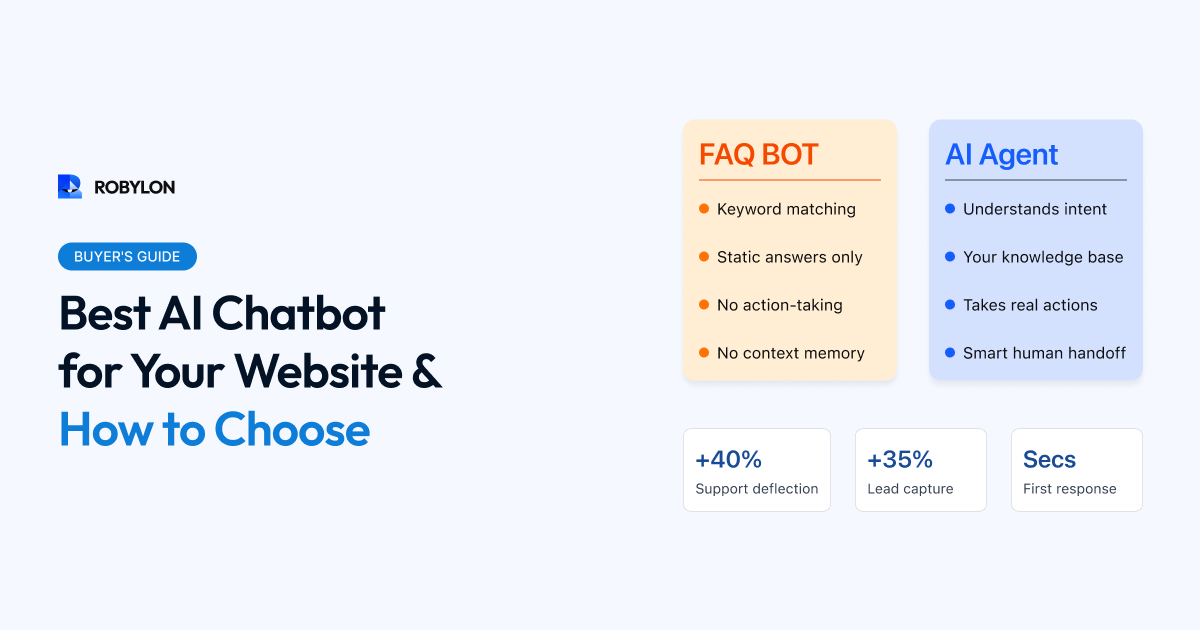
Tidio Flows and HubSpot's free bots follow rules you script, while an AI agent such as Robylon, Fin or Zendesk's AI agents reads the question, answers from your content and calls your systems to finish the request, such as cancelling an order or changing a booking.
Related reading
- Comparisons
The 11 best AI email support agents in 2026
Eleven AI agents that answer and resolve customer support email, grouped into four kinds and compared on actions, channels, where each runs and how each bills, with prices checked in October 2026.
- Chatbots
Best AI Chatbot for Website: How to Choose (2026)
Not all website chatbots are equal. This guide breaks down the 10 features that matter, compares the top platforms, and gives you a decision framework to pick the right AI chatbot for your site.
- Email Support
Intercom Fin vs Robylon AI: Email Resolution Head-to-Head
A detailed head-to-head comparison of Intercom Fin and Robylon AI on email ticket resolution, autonomy, pricing, and integrations.