8 best Gorgias alternatives for e-commerce customer support in 2026
Eight alternatives to Gorgias for online stores, compared on what each AI agent can do in Shopify, which channels it covers, where it runs and how its bill behaves at peak volume, with prices checked in October 2026.
Key takeaways
- Want one AI agent across email, chat, voice and WhatsApp with Shopify actions, standalone or inside the Gorgias you keep: Robylon, with paid plans from $25 a month and Gorgias support from the $180 Business plan.
- Closest like-for-like Shopify helpdesk with AI order, subscription and returns actions: Richpanel, from $299 a month for one seat plus the AI minimum, billed annually.
- Mid-size or enterprise retail brand that wants one conversation history per customer, voice included: Gladly, quote only as of October 2026.
- Selling on Amazon, eBay and other marketplaces as well as a web store: eDesk, from $39 per user a month billed annually plus $0.99 per AI outcome.
- Small store on a tight budget: Tidio, free for 50 conversations a month.
- Full helpdesk with voice beyond the store: Zendesk Suite Team from $55 or Freshdesk from $19 per agent a month, billed annually.
The strongest Gorgias alternatives in October 2026 are Richpanel for a Shopify helpdesk with AI order and subscription actions, Gladly for larger retail brands, eDesk for marketplace sellers, Zendesk and Freshdesk for a full helpdesk, Tidio for small stores and Fin for a per-outcome AI agent. Robylon fits stores that want one AI agent for e-commerce support across email, chat, voice and WhatsApp with Shopify actions, standalone or inside the Gorgias they keep.
Gorgias is a capable Shopify helpdesk, priced by tickets, whose AI Agent cancels, edits and reships orders. Teams evaluating or running Gorgias look elsewhere when an AI-resolved ticket is billed twice, when the store is not on Shopify, when calls need an AI agent, or when Black Friday pushes volume past the plan’s tickets. Every tool below is judged on three things: whether its AI takes the action a ticket needs, whether every channel runs from one setup, and whether it fits the stack you already run.
Gorgias alternatives at a glance
| Tool | Best for | What the AI does | Billing unit | Free plan | Paid from | G2 |
|---|---|---|---|---|---|---|
| Gorgias (baseline) | Shopify brands wanting a store-focused helpdesk | Answers and acts on Shopify orders | Per ticket, plus per AI interaction | No; 30-day trial | $10 a month (Starter, 50 tickets) | 4.6 (582) |
| Robylon | One AI agent on every channel with Shopify actions, standalone or inside Gorgias | Answers and acts in your systems | Per AI credit; seats optional | Free forever, 300 credits a month (about 40 chats) | $25 a month (Pro, 500 credits) | 5.0 (42) |
| Richpanel | Shopify brands replacing their helpdesk | Answers and acts on orders, subscriptions and returns | Per seat, plus AI credits by usage | No; 2-week trial after a demo | $299 a month (1 seat plus AI minimum, annual) | 4.7 (94) |
| Gladly | Mid-size and enterprise retail brands | Answers and acts in Shopify and store apps | Per active user, plus per AI resolution or assist | None published | Custom quote | 4.7 (1,114) |
| Zendesk | Stores wanting a full helpdesk with voice | Answers and acts; one channel type per agent | Per seat, plus per AI resolution | No; 14-day trial | $55 a seat (Suite Team, annual) | 4.3 (7,093) |
| Freshdesk | Value seat pricing with an optional AI agent | Answers and runs workflows with API actions | Per seat, plus per AI session | 2 agents free for 6 months | $19 a seat (Growth, annual) | 4.4 (3,777) |
| Tidio | Small stores starting with live chat | Lyro answers and calls APIs through Actions | Per conversation pack | Yes, 50 conversations a month | $29 a month (Starter, monthly) | 4.6 (1,962) |
| Fin | Per-outcome AI agent on Intercom or another helpdesk | Answers and acts through Procedures | Per outcome, plus seats on Intercom | No; 14-day trial | $0.99 per outcome; seats from $85 | 4.5 (3,918) |
| eDesk | Sellers on marketplaces and web stores | Answers and acts on returns, refunds and cancellations | Per user, plus per AI outcome | No; 14-day trial | $39 a user (Essential, annual) | 4.5 (80) |
Prices checked October 2026 on each vendor's pricing page. G2 ratings read October 2026, with the review count in brackets.
Robylon publishes this page and ranks itself first; every tool on the list, Robylon included, gets the same “Where it falls short” line.
What Gorgias does
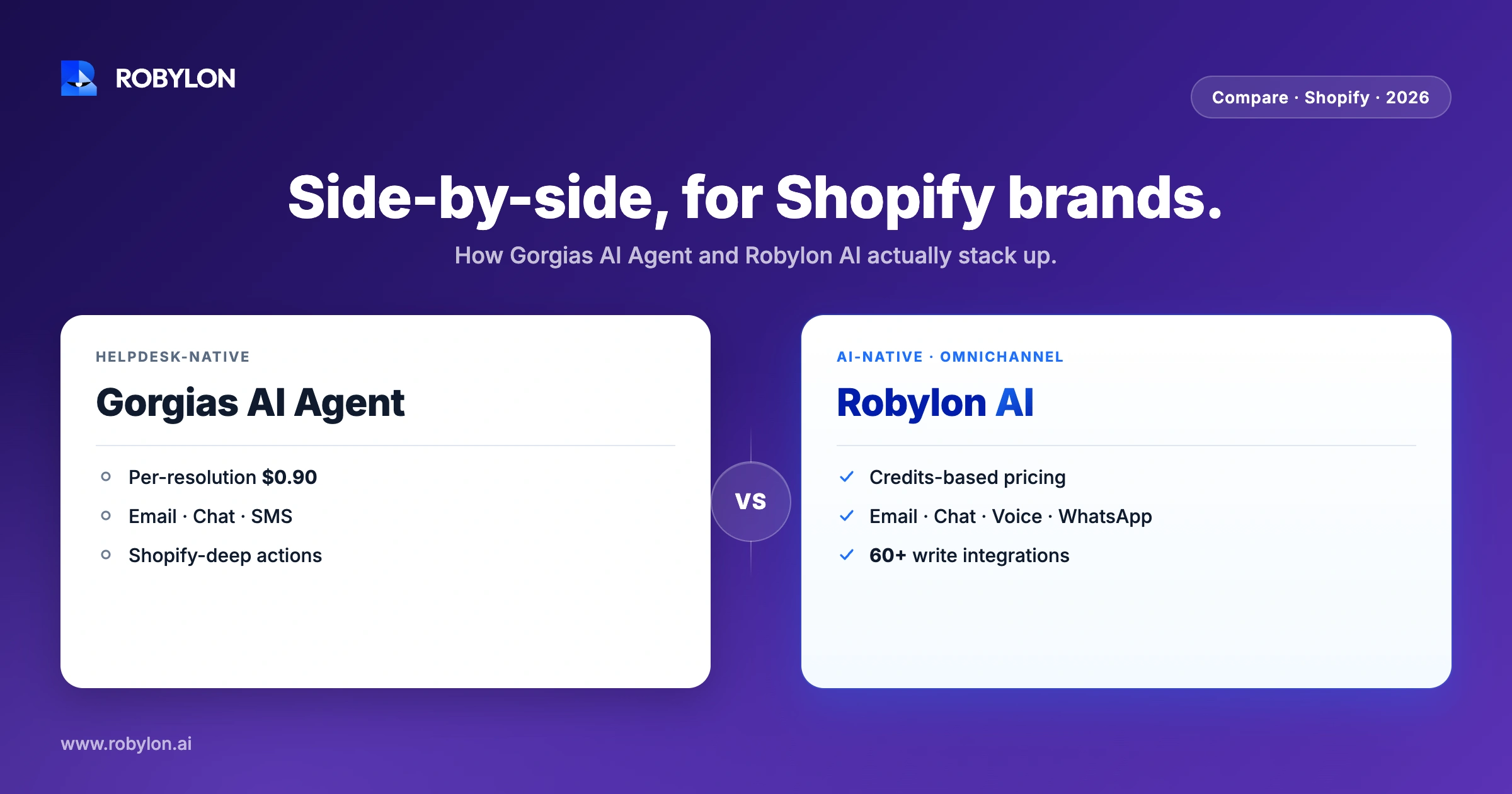
Gorgias is a helpdesk for Shopify brands, priced by tickets (50 to 5,000 a month on self-serve plans) rather than per agent, with 500 user seats from the Basic plan. It brings email, chat, a help center, contact forms, Facebook Messenger, Instagram and WhatsApp into one inbox, with voice and SMS as paid add-ons. AI Agent, also an add-on, answers from the help center and Shopify data and, from Basic, cancels, edits and reships Shopify orders. It bills $0.90 per automated interaction on annual plans or $1.00 monthly, on top of the ticket fee.
Why teams look beyond Gorgias
AI resolutions billed twice
A ticket AI Agent fully resolves costs one helpdesk ticket fee plus one automation fee, according to Gorgias’s billing article, for accounts created from 28 May 2025. If the shopper reaches a person within 72 hours, only the ticket fee applies.
Ticket caps and overage
Starter includes 50 tickets, then $0.40 per extra ticket; Basic includes 300, then $40 per 100; Pro includes 2,000 and Advanced 5,000, then $36 per 100. A peak month past the plan’s tickets bills overage on every extra ticket, plus the automation fee on each AI-resolved one.
AI Agent needs Shopify
WooCommerce connects on every plan, BigCommerce from Basic and Magento from Pro, but AI Agent’s setup requires a connected Shopify store. A store on another platform gets the helpdesk without the AI agent.
No AI agent on calls
Voice is an add-on from $30 a month for 25 Voice tickets, and Gorgias’s docs list no AI Agent on voice as of October 2026. AI Agent on Instagram, Messenger and WhatsApp is in open beta; the WhatsApp beta opened on 9 September 2026.
Works only inside Gorgias
AI Agent runs only in Gorgias’s own helpdesk, one AI Agent per connected Shopify store. A team that wants the same agent on another helpdesk or on more channels cannot take Gorgias AI Agent with it.
Four kinds of Gorgias alternatives
Four kinds of product get called Gorgias alternatives, and they solve different problems.
- E-commerce support tools: a helpdesk and AI agent built around store or marketplace orders. Richpanel, Gladly and eDesk all act on orders; Gladly also runs inside Gorgias.
- AI agent platforms: an agent that answers and acts across channels. Robylon runs standalone or inside Gorgias; Fin runs on Intercom or on Gorgias through sales.
- Helpdesk suites: Zendesk and Freshdesk, with phone (Freshdesk through Freshcaller) and an AI agent billed on top that reaches store data through integrations.
- Chatbots and live chat: Tidio, whose Lyro AI agent mostly answers from content.
For Shopify-native depth, the first kind fits; for voice and WhatsApp, or the helpdesk you have, the second fits.
Keeping Gorgias, adding an AI agent
A store can keep the Gorgias inbox and put a different AI agent in front of it:
- Robylon answers inside Gorgias on email and chat from its Business plan, at $180 a month, and the same agents also take voice calls and WhatsApp conversations through Robylon’s own channels.
- Gladly AI for Helpdesks has run inside Gorgias since 25 March 2026, on chat and email only, and per Gladly’s setup article creates a Gorgias ticket only when it hands over. Quote only.
- Fin runs on Gorgias through sales, at $0.99 per outcome with a 50-outcome monthly minimum.
Gorgias charges its automation fee only on resolutions by its own AI Agent and automation features, so an outside agent avoids that fee. Gorgias still bills a helpdesk ticket for each conversation answered from the Gorgias helpdesk, whoever sends the reply, and Robylon bills its own credits for the conversations it handles. “Where is my order” questions are the usual first job: the agent looks up the order in Shopify and replies with its status and tracking link. The Gorgias email automation review covers what Gorgias automates in email on its own.
How we compared the tools
We read each vendor’s pricing page, docs and trust page, and each tool’s G2 page, on 7 and 8 October 2026. We did not run hands-on tests for this page.
We compared them on what the AI agent can resolve, channels covered, where each runs, billing model, setup effort, and how each works for support agents and team leads.
The 8 best Gorgias alternatives
1. Robylon
Best for: online stores that want one AI agent to resolve tickets across email, chat, voice and WhatsApp with Shopify actions, standalone or inside the Gorgias helpdesk they keep.
What it is for: Robylon is an AI customer support platform that resolves tickets across email, chat, voice and WhatsApp. It works standalone or alongside an existing helpdesk. It takes the action a ticket needs: agents read the systems the answer lives in, including Shopify orders, act through tools built from your APIs and connected apps, and hand anything they cannot finish to a person with the checking already done. Every channel runs from one setup. And it fits the stack you already run, inside Gorgias or standalone with its own inbox.
What the AI does:
- A triage agent routes each conversation to the sub-agent for that topic, so order status, returns and address changes each follow their own instructions.
- Agents act in Shopify with the permissions you grant: look up an order and its tracking, cancel an unfulfilled order, update an address or create a return. Shopify events can start workflows, so a cancelled order can trigger a WhatsApp message.
- Tools built from your APIs reach subscription, returns and shipping apps; custom API integrations are on the Business plan.
- The knowledge base answers from your sources, and the KB gap report shows what it could not answer (Pro plan and above).
- Anything the agent cannot finish goes to a person with the conversation, intent and checks attached.
Channels: email, website and in-app chat, voice, WhatsApp, Instagram, Facebook, SMS through Twilio, YouTube comments, and reviews on Google Play, the App Store and Google My Business, all on the channels page. Robylon runs standalone with its own inbox and optional human seats, or inside Freshdesk, Zendesk, Zoho Desk, Salesforce, Vtiger, Intercom, Freshchat, SalesIQ and Gorgias. WhatsApp and email start on the Pro plan; voice phone calls and the Freshdesk, Zendesk, Zoho Desk, Intercom, Freshchat and Gorgias integrations start on Business.
Pricing: by AI credits rather than per ticket (see pricing). The Starter plan is free with 300 credits a month (about 40 conversations), paid plans start at $25 a month for 500 credits, Business starts at $180 a month, and yearly billing takes 10% off. Seats for a human team are optional, at $19 to $89 per seat a month. G2 rating: 5.0 from 42 reviews (G2, October 2026).
Where it falls short: voice phone calls and running inside Gorgias start on the Business plan at $180 a month, and Robylon publishes no per-minute voice price. Credits are spent on every conversation, resolved or handed over, and vary with the AI model chosen, so the bill is harder to forecast than a fixed ticket allowance. Plan changes go through an account manager, because self-serve billing is not live yet.
Where Gorgias does better:
- Shopify setup: Gorgias’s Shopify Actions need no setup once the store is connected; Robylon’s Shopify app and tools are set up by the Robylon team.
- Store-app actions: ready-made actions for Loop Returns, Recharge, Skio, Loop Subscriptions, ShipStation, ShipBob, ShipHero and ShipMonk, which are custom API tools on Robylon’s Business plan.
- App ecosystem: 150+ app integrations against Robylon’s 32 pre-built ones.
- Seasonal agents: 500 user seats from Basic, where Robylon seats cost $19 to $89 each.
- Trial: 30 days with every feature; Robylon’s free Starter plan is chat only.
Pick it if: you want one AI agent to take Shopify actions across email, chat, voice and WhatsApp, inside Gorgias or with Robylon’s own inbox. Choose Gorgias if your support is Shopify email and chat and you want order actions with no setup. For the head-to-head, see Gorgias AI Agent vs Robylon.
2. Richpanel: best Shopify helpdesk replacement
Best for: Shopify and DTC brands that want to replace Gorgias with a store-focused helpdesk whose AI takes order, subscription and returns actions.
Richpanel sells one plan, helpdesk seats plus AI usage metered in credits, with no ticket fee. Its AI agent acts in Shopify and CheckoutChamp (cancel or hold an unshipped order, edit an order, change an address, refund in full, by line or as store credit), in Recharge, Loop Subscriptions, Skio, Appstle and Stay.ai for subscriptions, and in Richpanel Returns and AfterShip Returns. Richpanel counted 14 Shopify order actions, 16 Recharge actions and 12 Richpanel Returns actions on 24 September 2026, each set to “Always allow” or “Require approval”. An included self-service portal lets shoppers track and update orders, start returns and manage subscriptions without a ticket.
What the AI does: answers and takes order, subscription, returns and shipping actions in connected apps, on its one plan.
Channels: email, live chat, self-service portal, Facebook, Instagram, WhatsApp through 360dialog, SMS and TikTok Shop messages; Richpanel Voice entered beta on 1 October 2026, and phone also connects through partners.
Pricing: seats cost $99 a month on an annual commitment, $119 monthly or $129 on demand, and AI credits come to about $0.20 per AI-handled conversation at the annual rate, with a $200 monthly AI minimum; one seat plus the minimum starts at $299 a month (Richpanel pricing). G2: 4.7 from 94 reviews (G2, October 2026).
Where it falls short: no free plan or self-serve signup, and the 2-week trial starts after a demo. AI credits are spent on handed-over conversations too, Richpanel does not list which channels the AI replies on, and no EU hosting region is listed.
Pick it if: you want the closest Shopify helpdesk to Gorgias, with deeper subscription and returns actions and no ticket fee.
3. Gladly: best for enterprise retail
Best for: mid-size and enterprise retail brands that want one conversation history per customer across every channel, with an AI agent and a human workspace from one vendor.
Gladly keeps each customer’s chats, emails, calls and messages in one timeline. Its AI agent, called Sidekick until January 2026, updates addresses, cancels orders, issues refunds and creates replacement orders in Shopify, and acts in BigCommerce, Loop Returns, Recharge, Skio and ShipHero.
What the AI does: answers, takes actions in store and subscription apps, and recommends products; Voice AI answers calls in English only.
Channels: chat, in-app chat, email, voice, SMS, Facebook Messenger, Instagram, WhatsApp and a help center; Gladly’s docs do not list WhatsApp among the AI agent’s channels.
Pricing: quote only. Seats bill per active user, and the AI bills on resolutions and on “assists”, where it hands a conversation to a person (Gladly’s pricing explainer). Voice AI adds $0.06216 a minute. G2: 4.7 from 1,114 reviews (G2, October 2026).
Where it falls short: no public seat or AI price, no free plan or trial, and a handover is a billable outcome.
Pick it if: you want voice, messaging and AI on one customer timeline.
4. Zendesk: best full helpdesk with voice
Best for: multi-brand stores and larger teams that want a full helpdesk with voice and an AI agent from one vendor.
Since a rollout in May and June 2026, Zendesk’s AI agents are on every Suite and Support plan, each serving one channel type: messaging, email or voice. The Zendesk Marketplace lists 1,800+ apps.
What the AI does: answers and takes actions through integrations, in more than 80 languages.
Channels: email, web form, messaging and live chat, mobile SDKs, voice, WhatsApp, Facebook Messenger, Instagram, X DMs, LINE, WeChat and Slack; SMS through an add-on.
Pricing: Suite Team costs $55 per agent a month billed annually or $69 monthly; the AI agent adds $1.50 per committed automated resolution or $2.00 pay-as-you-go (Zendesk pricing). G2: 4.3 from 7,093 reviews (G2, October 2026).
Where it falls short: two AI billing models are live at once, with unpublished tier prices for the newer one, and every human agent needs a seat.
Pick it if: you want a general helpdesk with voice and many brands more than a Shopify-specific one.
5. Freshdesk: best value full helpdesk
Best for: small and mid-size teams that want a full helpdesk at a low seat price.
Freshworks sells Freshdesk, email-first, and Freshdesk Omni, multichannel. Freddy AI Agent answers from knowledge sources and runs workflows with API actions, including pre-built integrations with Shopify, Stripe, PayPal and Wix.
What the AI does: answers and runs workflows with API actions; chat AI, WhatsApp and Instagram are on Freshdesk Omni only.
Channels: email, customer portal, web chat and Facebook Messenger, with Instagram and WhatsApp on Freshdesk Omni; phone through Freshcaller, a separate product.
Pricing: Freshdesk starts at $19 per agent a month billed annually ($23 monthly) and Freshdesk Omni at $29 ($35); Freddy AI Agent costs $49 per 100 sessions (Freshdesk pricing). G2: 4.4 from 3,777 reviews (G2, October 2026).
Where it falls short: a session is billed whatever the outcome, including handovers.
Pick it if: you want a general helpdesk at a lower seat price and your store actions fit its Shopify integration.
6. Tidio: best for small stores
Best for: small Shopify and WooCommerce stores starting with live chat.
Tidio runs live chat, email and social messages from one panel. Its free plan covers 50 conversations a month, and human agents on Growth can cancel and refund Shopify orders from the panel.
What the AI does: Lyro answers from your content, recommends products and calls external APIs through Actions (3 on Core); its Shopify order-status template is on Plus and Premium.
Channels: live chat, email, Facebook Messenger, Instagram, WhatsApp and video calls in the chat widget.
Pricing: Starter costs $29 a month billed monthly for 100 conversations; Lyro starts at $39 a month for 50 Lyro conversations (Tidio pricing). G2: 4.6 from 1,962 reviews (G2, October 2026).
Where it falls short: Lyro packs stop at 1,000 conversations a month before a quote-only plan, and Tidio’s docs list no phone or SMS channel as of October 2026.
Pick it if: you run a small store that wants live chat and a starter AI agent at a low price.
7. Fin: best per-outcome AI agent
Best for: stores that want an AI agent billed per outcome, on the Intercom helpdesk or on top of another helpdesk.
Fin, formerly Intercom Fin, runs on Intercom’s helpdesk or inside Salesforce Service Cloud, HubSpot, Freshdesk and Freshchat, with Gorgias and others through sales. Salesforce completed its acquisition of Fin on 10 September 2026.
What the AI does: answers and takes actions through Procedures, plain-language instructions that call REST APIs and MCP connectors, with Shopify templates for both; Fin for Ecommerce needs an Intercom plan.
Channels: chat, email, WhatsApp, SMS, Facebook Messenger, Instagram, Slack and Discord; Fin Voice through sales.
Pricing: $0.99 per outcome, with nothing charged when the customer asks for a person; Intercom seats start at $85 a month billed annually, and on another helpdesk there is a 50-outcome monthly minimum (Fin pricing). G2: 4.5 from 3,918 reviews (G2, October 2026).
Where it falls short: voice has no published price, and a Procedure that ends in a handover is billed as an outcome.
Pick it if: you want a published per-outcome price and a 14-day trial, on Intercom or your current helpdesk.
8. eDesk: best for marketplace sellers
Best for: sellers who support customers on Amazon, eBay, Walmart, Etsy and other marketplaces as well as a web store.
eDesk puts marketplace messages, email, chat and social in one inbox with order data beside each ticket. Plans are per user with unlimited tickets, capped by stores connected: 1 on Essential, 5 on Growth, 10 on Professional.
What the AI does: AI Agent follows Procedures and, without a person, accepts or refuses returns and cancellations, issues refunds, cancels orders and sends return labels, as far as the store or marketplace allows.
Channels: marketplace messaging, email, live chat, contact forms, Facebook Messenger, Instagram, X and TikTok Shop; WhatsApp and voice as add-ons.
Pricing: Essential costs $39 per user a month billed annually ($49 monthly), and AI Agent bills $0.99 per outcome (eDesk pricing). G2: 4.5 from 80 reviews (G2, October 2026).
Where it falls short: eDesk does not list AI Agent’s channels beyond email-based queries, Essential lacks rule-based automations and reports, and eDesk publishes no security certification.
Pick it if: you want AI that acts on marketplace orders.
Alternatives by situation
| Situation | Tool or tools |
|---|---|
| Keep the Gorgias inbox, change the AI agent | Robylon, Gladly, Fin |
| Closest Shopify helpdesk replacement | Richpanel |
| AI agent on phone calls | Robylon, Gladly, Zendesk |
| Selling on Amazon, eBay or Walmart | eDesk |
| Store on WooCommerce, BigCommerce or Magento | Richpanel, eDesk, Gladly |
| Free plan for a small store | Tidio, Robylon (chat only) |
| No per-ticket fee at peak volume | Richpanel, eDesk, Robylon |
| A cap that pauses AI spend for the month | eDesk |
| Full helpdesk with voice for many brands | Zendesk |
| Lowest seat price for a full helpdesk | Freshdesk |
What to decide before switching
Actions versus answers
Count the share of tickets that need the agent to act in another system rather than answer from help content. If most need actions, shortlist Robylon, Richpanel, Gladly and eDesk. If most are order status and policy questions, Tidio and Freshdesk cost less.
Channels your customers use
List the channels your customers use, including voice and WhatsApp. Robylon includes voice phone calls from its Business plan, Gladly and Zendesk include voice, Richpanel’s voice is in beta, and Gorgias, Freshdesk and eDesk sell phone as an add-on or separate product.
Where your team works
Decide whether your human team stays in Gorgias. If it stays, change only the AI agent with Robylon, Gladly or Fin. If it moves, check store platform support, macros, SLAs and seasonal seat costs.
Pricing at your volume
The units differ: tickets plus automated interactions on Gorgias, credits on Robylon and Richpanel, outcomes on Fin and eDesk, sessions on Freshdesk. On published prices for 3,000 chat and email conversations a month, 60% resolved by the AI (1,800 resolutions), 3 human agents and monthly billing:
| Tool | Option | AI cost a month | Seats a month | Total a month | AI cost per resolution |
|---|---|---|---|---|---|
| Robylon | Business, 10,000 credits, Basic seats | $625.00 | $57.00 | $682.00 | $0.35 |
| Richpanel | Seats and AI credits, monthly commitment | $720.00 | $357.00 | $1,077.00 | $0.40 |
| Freshdesk | Freddy AI Agent, Freshdesk Omni Growth seats | $1,470.00 | $105.00 | $1,575.00 | $0.82 |
| Fin | Fin on another helpdesk | $1,782.00 | Not counted | $1,782.00 | $0.99 |
| eDesk | Essential with AI Agent | $1,782.00 | $147.00 | $1,929.00 | $0.99 |
| Tidio | Lyro AI Agent (Core), standalone | $2,104.00 | Not counted | $2,104.00 | $1.17 |
| Gorgias | Pro with AI Agent | $2,520.00 | Not counted | $2,520.00 | $1.40 |
| Zendesk | AI agents, Suite Team seats, pay-as-you-go | $3,570.00 | $207.00 | $3,777.00 | $1.98 |
Robylon’s figure is 3,000 conversations at about 7.5 credits each: the Business 10,000-credit tier at $300 plus 13 extra 1,000-credit bundles at $25, and 3 Basic seats at $19. Gorgias Pro’s $550 a month includes 2,000 tickets and 190 automated interactions; the other 1,000 tickets add $360 and the other 1,610 interactions $1,610. Tidio’s figure above 1,000 Lyro conversations is an extrapolation. Gladly is quote only. On yearly billing the scenario comes to $652 on Robylon, $897 on Richpanel and $2,280 on Gorgias Pro.
Black Friday billing by tool
Each billing unit grows differently when volume jumps:
- Gorgias: tickets past the allowance cost $0.40 each on Starter or $36 to $40 per 100 on paid plans, and each AI-resolved ticket adds $0.90 annual or $1.00 monthly. Extra agents are free from Basic.
- Robylon: credits are spent on every conversation, with extra 1,000-credit bundles at $25; seasonal agents need seats from $19.
- Richpanel: credits follow token use, topped up in $100 blocks; with no commitment the scenario above comes to $1,167 a month.
- Fin: $0.99 per outcome, so the bill rises in step with resolutions.
- eDesk: $0.99 per outcome, with an optional monthly limit that pauses AI automations.
- Zendesk: $2.00 per automated resolution pay-as-you-go, or $1.50 bought in advance.
- Freshdesk: $49 per 100 sessions whatever the outcome; when sessions run out the AI agent stops.
- Tidio: monthly plans move up a Lyro pack at 95% of the quota.
- Gladly: active users above the contract are trued up at the contracted rate.
When to stay on Gorgias
- Your support is mostly Shopify email and chat, and Gorgias AI Agent’s Shopify Actions already handle your order changes.
- You rely on Gorgias actions for Loop Returns, Recharge, Skio, ShipStation or ShipBob.
- You add many seasonal agents and want 500 user seats from Basic.
- Your volume fits your plan’s tickets, so the automation fee stays small.
What usually drives a switch is peak-volume cost or a need Gorgias does not cover: an AI agent on calls, a store outside Shopify, or one agent on more channels. If none applies, staying is reasonable.
Moving off Gorgias
- Decide the path: keep the Gorgias inbox and change the AI agent, or move helpdesk.
- Baseline tickets, resolution rate, CSAT and monthly cost, including the last peak month.
- Export tickets, macros, rules and help center articles.
- Connect the systems the AI agent must act in: Shopify, subscriptions, returns and shipping.
- Build the top intents first and test them in bulk against past tickets.
- Run the new setup on one channel or one store while Gorgias handles the rest.
- Compare against the baseline, then move the remaining channels well before Black Friday.
- Keep Gorgias available for 30 days in case you need to roll back.
Choosing a Gorgias alternative
Gorgias is a strong Shopify helpdesk: ticket pricing with plenty of seats and an AI Agent that changes Shopify orders with no setup. For a store whose support is email and chat, it remains a sound home.
Move when double-billed AI resolutions, peak overage or missing channels outgrow the plan. Richpanel is the closest Shopify replacement, Gladly suits larger retail brands, eDesk suits marketplace sellers, Zendesk and Freshdesk are full helpdesks and Tidio suits small stores. Robylon suits stores that want the agent to take the action a ticket needs, run every channel from one setup and fit the stack they already run, Gorgias included, and its Starter plan is free to try.
Sources we checked
- Gorgias pricing, read
- How you are billed for using Gorgias, Gorgias help centre, read
- AI Agent Shopify Actions, Gorgias help centre, read
- Richpanel pricing, read
- Richpanel AI actions catalog, read
- Resolutions and assists pricing, Gladly, read
- Set up the Gladly AI Gorgias integration, Gladly help centre, read
- Zendesk pricing, read
- Freshdesk pricing, read
- Tidio pricing, read
- Fin and Intercom pricing, read
- eDesk pricing, read
Frequently asked questions
What are the best Gorgias alternatives?
Richpanel is the closest Shopify helpdesk alternative to Gorgias, Gladly suits larger retail brands, eDesk suits marketplace sellers, Zendesk and Freshdesk are full helpdesks, and Tidio suits small stores. Robylon suits stores that want one AI agent with Shopify actions across email, chat, voice and WhatsApp, standalone or inside Gorgias.
What is a cheaper alternative to Gorgias?
Robylon costs about $682 a month for 3,000 chat and email conversations with 60% resolved by AI and 3 agents, against $2,520 on Gorgias Pro with AI Agent on monthly billing. Richpanel comes to $1,077 in the same scenario. Tidio is free for 50 conversations a month.
Which Gorgias alternative has better AI?
Richpanel, Gladly, Robylon and eDesk all run AI agents that act on orders, not only answer questions. Richpanel counts 14 Shopify order actions plus subscription and returns actions, Gladly adds voice, and Robylon covers email, chat, voice and WhatsApp from one setup. Tidio Lyro mostly answers from content.
Which Gorgias alternative handles chat, email, voice and WhatsApp?
Robylon covers chat, email, voice phone calls and WhatsApp with one AI agent, with voice from its Business plan. Gladly and Zendesk include voice and WhatsApp in the helpdesk, though Gladly's AI is not listed on WhatsApp. Gorgias sells voice as an add-on with no AI agent on calls.
What is the best Gorgias alternative for Shopify stores?
Richpanel is the closest Shopify-focused replacement, with AI actions in Shopify, Recharge, Skio and its own returns app. Gladly suits larger Shopify brands buying through sales. Robylon suits Shopify stores that want the same AI agent on voice and WhatsApp too, standalone or inside Gorgias.
Which Gorgias alternative won't spike my bill during Black Friday?
eDesk lets you set a monthly outcome limit that pauses AI automations when reached, at $0.99 per outcome. Robylon sells extra credits in 1,000-credit bundles at $25, and Richpanel tops up AI credits in $100 blocks. Gorgias bills ticket overage plus up to $1.00 per automated interaction.
Can I add an AI agent on top of Gorgias instead of replacing it?
Yes. Robylon answers inside Gorgias on email and chat from its Business plan, at $180 a month, so the team keeps the Gorgias inbox. Gladly AI for Helpdesks has run inside Gorgias on chat and email since 25 March 2026, quote only. Fin runs on Gorgias through sales, at $0.99 per outcome.
Can I automate WISMO replies without replacing Gorgias?
Yes. Gorgias AI Agent answers order status questions from Shopify data inside Gorgias, at $0.90 to $1.00 per automated interaction plus the ticket fee. Robylon can do the same inside Gorgias from its Business plan, and also answer the same question on voice and WhatsApp.
Does Gorgias have a free plan?
No. Gorgias has no free plan, only a 30-day trial with all features and no card. Starter costs $10 a month for 50 tickets. Tidio is free for 50 conversations a month, and Robylon has a free Starter plan with 300 credits a month for chat.
Related reading
- Comparisons
13 best Fin AI alternatives (formerly Intercom Fin) for customer support in 2026
Thirteen AI agent alternatives to Fin, compared on what each agent can do, which channels it covers, where it runs and how it bills, with prices checked in October 2026.
- Comparisons
Gorgias AI Agent vs Robylon AI: Side-by-Side for Shopify Brands
An honest side-by-side of Gorgias AI Agent and Robylon AI for Shopify brands. Pricing math at 5,000 tickets/month, resolution rates, channel coverage, integration depth, and three buyer profiles with a named pick for each.
- Email Support
Gorgias email automation for e-commerce: review and limits
Gorgias is the go-to helpdesk for Shopify merchants. This review covers how well it automates email, where it stops and what it costs at volume, and links to the full comparison of Gorgias alternatives.