
Tidio Alternatives: 10 Best AI Chatbots for 2026
Tidio is a popular entry-level chatbot, but growing teams often outgrow it. This guide compares 10 alternatives by AI capabilities, channels, integrations, and pricing — so you can find the right upgrade.
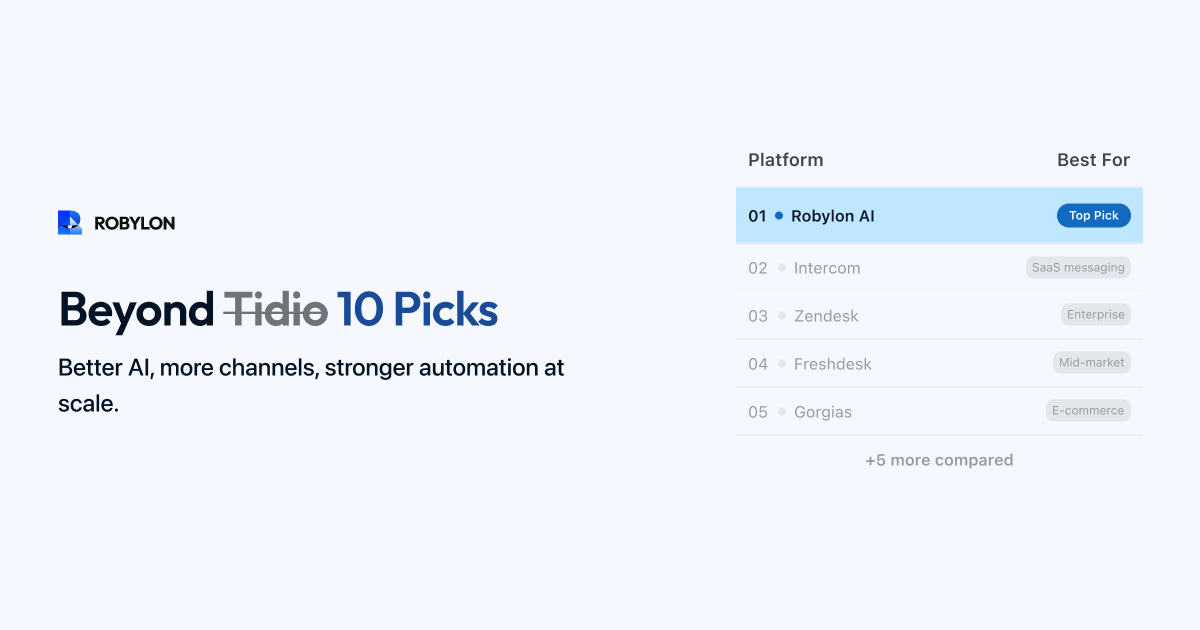
Tidio is one of the most popular entry-level chatbot platforms — and for good reason. It offers an approachable interface, a functional free tier, and a quick setup that gets small businesses up and running fast. For solo operators and early-stage stores handling a few hundred conversations a month, it does the job.
But as businesses grow, Tidio’s limitations become more apparent. The AI capabilities (Lyro) are constrained in what they can handle. There is no voice support. Action-taking beyond basic responses is limited. Integrations with enterprise helpdesks are thin. And the pricing, while affordable at the low end, climbs steeply as you add features and conversations.
If you have outgrown Tidio — or are evaluating it and wondering whether something better fits your needs — this guide compares the 10 strongest alternatives in 2026, organized by what they do best.
Why Teams Switch from Tidio
Based on common feedback from teams that have moved away from Tidio, these are the most frequent reasons:
- Limited AI depth. Tidio’s Lyro AI handles basic FAQ responses but struggles with multi-turn conversations, context switching, and nuanced queries. Teams that need deeper automation hit a ceiling.
- No voice or phone support. Tidio is chat-only. If your customers call you — or if you want to automate phone-based support — you need a separate tool.
- Weak action-taking. Tidio can answer questions and collect lead information, but it cannot process refunds, look up orders in real time, update accounts, or trigger workflows in your CRM or helpdesk without significant custom work.
- Limited omnichannel. WhatsApp, email, and social media automation are either unavailable or require higher-tier plans with limited functionality compared to dedicated omnichannel platforms.
- Scaling costs. Tidio’s pricing increases quickly once you exceed the free tier limits. At 2,000+ conversations per month, purpose-built platforms often cost the same or less while delivering significantly more.
- Insufficient analytics. Reporting is basic — resolution rates, conversation topics, and performance trends require manual analysis or are not available at the depth growing teams need.
Tidio alternatives at a glance
| Tool | Best for | Pricing |
|---|---|---|
| Robylon AI | Growing businesses that need full AI automation across chat,… | Credits-based model — pay for what you use. Free tier… |
| Intercom | SaaS companies that want a polished in-app messenger with… | Pricing escalates fast — per-seat ($29–$132/seat) plus… |
| Zendesk | Enterprise teams that need a mature helpdesk with deep ticketing,… | Base suite ($55–$150+/agent) plus AI add-on ($50/agent)… |
| Freshdesk | Teams that want Zendesk-level helpdesk features at a lower price… | Plans from $15/agent/month (Growth) to $79/agent/month… |
| Chatbase | Teams that want a simple, fast way to build a ChatGPT-style bot… | — |
| HubSpot Service Hub | Teams already using HubSpot CRM who want unified sales + support | Professional from $90/month (5 seats included) |
| Drift | B2B sales teams focused on lead qualification, ABM, and meeting… | — |
| Gorgias | Shopify-centric e-commerce brands that want deep order management… | — |
| LiveChat | Teams that prioritize a polished live chat experience with… | Plans from $20/agent/month |
| Crisp | Startups and small teams that want an all-in-one messaging… | Pro plan from $25/month per workspace (not per seat) |
The 10 Best Tidio Alternatives
1. Robylon AI
Best for: Growing businesses that need full AI automation across chat, email, voice, and WhatsApp — with action-taking capabilities.
- AI capabilities: LLM-powered AI agents that go beyond answering questions — they process refunds, look up orders, update CRM records, create tickets, and execute multi-step workflows. This is the biggest upgrade over Tidio’s answer-only Lyro.
- Channels: Web chat, email, voice (inbound and outbound), WhatsApp, and in-app messaging — all from one platform with one knowledge base.
- Integrations: 40+ pre-built connectors — Zendesk, Freshdesk, Shopify, Zoho, Salesforce, Gorgias, and more.
- Analytics: Bot resolution rate, CSAT by channel, confidence scores, KB gap analysis, agent quality scoring, and handle time dashboards.
- Pricing: Credits-based model — pay for what you use. Free tier available. No per-seat charges for AI interactions.
- Deployment: Most teams go live within a day.
- Why switch from Tidio: If you need AI that takes actions, supports voice and WhatsApp, and scales affordably beyond 1,000 conversations/month, Robylon is the most direct upgrade.
2. Intercom
Best for: SaaS companies that want a polished in-app messenger with AI-powered support.
- Beautiful messenger UX with product tours, tooltips, and onboarding flows.
- Fin AI resolves conversations using your help center content.
- Strong ecosystem for SaaS product-led growth.
- Watch out for: Pricing escalates fast — per-seat ($29–$132/seat) plus per-resolution ($0.99 each) for Fin AI. A 10-person team with 3,000 resolutions/month can easily exceed $3,000/month.
- vs. Tidio: Far more sophisticated, but far more expensive. Justified for SaaS teams where the in-app messenger is core to the product experience.
3. Zendesk
Best for: Enterprise teams that need a mature helpdesk with deep ticketing, routing, and SLA management.
- The industry standard for large-scale support operations. Powerful ticketing, macros, and reporting.
- AI Agents add-on for automated resolutions (requires Suite Professional + Advanced AI add-on).
- Watch out for: Complex, layered pricing. Base suite ($55–$150+/agent) plus AI add-on ($50/agent) plus per-resolution charges. Setup and optimization takes weeks.
- vs. Tidio: Massive capability upgrade, but designed for 20+ agent teams with dedicated admins. Overkill for small businesses, right-sized for mid-market and enterprise.
4. Freshdesk (Freddy AI)
Best for: Teams that want Zendesk-level helpdesk features at a lower price point.
- Plans from $15/agent/month (Growth) to $79/agent/month (Enterprise).
- Freddy AI included in higher tiers for auto-triage, suggested responses, and basic automation.
- Good ticketing, knowledge base, and SLA management.
- Watch out for: Freddy AI is less capable than purpose-built AI platforms. Better as a helpdesk with some AI versus an AI-first platform.
- vs. Tidio: Stronger helpdesk and ticketing. Weaker conversational AI. Good fit if your primary need is structured ticket management rather than chat automation.
5. Chatbase
Best for: Teams that want a simple, fast way to build a ChatGPT-style bot trained on their documents.
- Upload PDFs or point to a URL — get a working chatbot in minutes.
- Clean interface, non-technical setup, affordable pricing.
- Good for content-based Q&A and lead capture.
- Watch out for: Limited integrations and action-taking. No voice support. Not suited for transactional support (orders, refunds, account changes).
- vs. Tidio: Simpler AI but with better LLM capabilities for knowledge-based Q&A. Lateral move rather than an upgrade if you need more than FAQ automation.
6. HubSpot Service Hub
Best for: Teams already using HubSpot CRM who want unified sales + support.
- Free tier with basic ticketing. Professional from $90/month (5 seats included).
- Deep CRM integration — every support interaction linked to the contact record, deal pipeline, and marketing history.
- AI chatbot capabilities are improving but still behind dedicated AI platforms.
- vs. Tidio: Better if you are a HubSpot shop. The value is CRM unification, not AI depth.
7. Drift (Salesloft)
Best for: B2B sales teams focused on lead qualification, ABM, and meeting booking.
- Purpose-built for B2B buyer journeys. Strong Salesforce and HubSpot integrations.
- AI-powered conversation routing, lead scoring, and meeting scheduling.
- Watch out for: Enterprise pricing — not practical for SMBs. Weak for customer support use cases.
- vs. Tidio: Completely different category. Only relevant if your primary need is B2B lead gen, not customer support.
8. Gorgias
Best for: Shopify-centric e-commerce brands that want deep order management integration.
- Native Shopify, BigCommerce, and Magento integrations with order lookup, refunds, and returns inside the helpdesk.
- Priced by ticket volume, not per seat — better economics for small teams with high volume.
- AI automation capabilities are expanding but still maturing.
- vs. Tidio: Significantly better for Shopify stores. If e-commerce support is your primary use case, Gorgias is a more natural fit than Tidio.
9. LiveChat
Best for: Teams that prioritize a polished live chat experience with agent-centric features.
- Excellent live chat UX — sneak peek (see what customers type before sending), canned responses, file sharing, chat ratings.
- AI chatbot available through ChatBot (sister product) integration.
- Plans from $20/agent/month.
- vs. Tidio: Better live chat features for human agents. Similar AI capabilities. The upgrade is in live agent experience, not automation depth.
10. Crisp
Best for: Startups and small teams that want an all-in-one messaging platform at a low price.
- Shared inbox, live chat, chatbot, knowledge base, and CRM in one tool.
- Free plan for 2 seats. Pro plan from $25/month per workspace (not per seat).
- Good for teams that want broad functionality without paying for separate tools.
- vs. Tidio: Similar positioning and price point. Crisp’s per-workspace pricing can be cheaper for small teams. AI capabilities are comparable — neither is best-in-class.
How to Choose the Right Alternative
By Primary Use Case
- Customer support automation (chat + email + voice + WhatsApp): Robylon AI, Zendesk, Freshdesk.
- E-commerce support (Shopify-centric): Robylon AI, Gorgias.
- SaaS in-app messaging: Intercom.
- B2B lead generation: Drift.
- Simple FAQ chatbot: Chatbase, Crisp.
- CRM-unified support: HubSpot Service Hub.
By Budget
- Free / under $50/month: Robylon AI (free tier), Tidio (current), Crisp, HubSpot (free tier), Chatbase.
- $50–$500/month: Robylon AI, Freshdesk, LiveChat, Gorgias.
- $500–$3,000/month: Intercom, Zendesk, Robylon AI (high volume).
- $3,000+/month: Zendesk Enterprise, Intercom Expert, Drift.
By Team Size
- 1–3 agents: Robylon AI, Crisp, Chatbase, Tidio (if staying).
- 4–15 agents: Robylon AI, Freshdesk, Intercom, Gorgias.
- 15+ agents: Zendesk, Robylon AI, Intercom Expert.
Migration Checklist: Switching from Tidio
If you have decided to switch, here is a practical migration plan:
- Export your data. Download your conversation history, contact list, and canned responses from Tidio.
- Audit your knowledge base. Document the questions your Tidio chatbot handles today, plus the ones it cannot. This becomes your training data for the new platform.
- Set up the new platform in parallel. Configure the new chatbot on a staging page or subdomain. Train it on your knowledge base and test with real questions.
- Run both in parallel for 1 week. Deploy the new chatbot alongside Tidio (on a subset of pages or for a percentage of traffic) to validate accuracy and performance.
- Switch over. Once the new chatbot matches or exceeds Tidio’s performance, swap the embed code and deactivate Tidio.
- Redirect your integrations. Update any Zapier automations, CRM connections, or webhook configurations that pointed to Tidio.
The entire migration typically takes 3–7 days for a clean switch.
Bottom Line
Tidio is a solid starting point for small businesses exploring chatbots for the first time. But as your conversation volume grows, your support channels expand, and your need for AI-powered automation deepens, you will likely need a platform that offers more — more AI depth, more channels, more integrations, and more action-taking capabilities.
The right alternative depends on your primary use case, budget, and scale. For teams that want the broadest upgrade — AI that takes actions, supports voice and WhatsApp, integrates with your helpdesk, and scales affordably — Robylon AI is the most direct path forward from Tidio.
Outgrown Tidio? Robylon AI gives you LLM-powered AI agents across chat, email, voice, and WhatsApp — with 40+ integrations, action-taking capabilities, and a free tier to get started. Try it free at robylon.ai
Frequently asked questions
Why do teams switch from Tidio?
The most common reasons: limited AI depth (Lyro struggles with multi-turn and nuanced queries), no voice support (chat only), weak action-taking (cannot process refunds or look up orders without custom work), limited omnichannel (WhatsApp and email automation are basic), scaling costs (pricing increases steeply past the free tier), and basic analytics that do not give growing teams the visibility they need.
What is the best Tidio alternative for e-commerce?
For e-commerce, the top alternatives are Robylon AI (full AI automation across chat, email, voice, and WhatsApp with Shopify integration and action-taking) and Gorgias (deep Shopify/BigCommerce integration with ticket-based pricing). Robylon is the stronger choice if you need AI agents that resolve queries end-to-end — order tracking, returns, refunds — across multiple channels. Gorgias is better if your primary need is a helpdesk with native Shopify order management.
Is there a free Tidio alternative with better AI?
Yes. Robylon AI offers a free tier with LLM-powered conversations, knowledge base training, and deployment across web chat and WhatsApp — which is a significant AI upgrade over Tidio's free plan. Chatbase also has a free tier for document-trained chatbots, though it is more limited on integrations and action-taking. HubSpot Service Hub offers free basic ticketing with chatbot capabilities if you are already in the HubSpot ecosystem.
How do I migrate from Tidio to another platform?
A clean migration takes 3–7 days: 1) Export conversation history and contacts from Tidio. 2) Audit the questions your Tidio bot handles today plus the ones it cannot. 3) Set up the new platform on a staging page and train it on your knowledge base. 4) Run both in parallel for a week to validate. 5) Swap the embed code and deactivate Tidio. 6) Update any Zapier or CRM integrations that pointed to Tidio.
Can I use a Tidio alternative for voice and phone support?
Tidio does not support voice at all, so any alternative with voice AI is an upgrade. Robylon AI offers both inbound and outbound AI voice agents — handling phone calls with human-like conversations, real-time data lookups, and seamless transfer to human agents. Zendesk offers call routing through Zendesk Talk but with limited AI voice automation. For teams where phone support is a meaningful share of volume, Robylon is the strongest Tidio alternative.
Related reading
 Comparisons
10 Botpress Alternatives in 2026 - No-Code to Open-Source (Compared)
Looking for BotPress competitors? See the best tools in 2026, including free vs paid, ease-of-use, open-source & no-code options.
 Comparisons
10 LiveChat Alternatives in 2026 - Better Features at Half the Price
Find the perfect LiveChat competitor for 2026. Get feature comparisons, free and paid options from tools like Robylon, Intercom, Zendesk Chat, Tidio, and more.
 Comparisons
11 Drift Alternatives in 2026 - Stronger AI, Lower Pricing (Ranked)
Looking for Drift competitors? Explore top live chat, omnichannel & AI-SDR chatbot tools so you can pick the right Drift replacement.