.png)
TL;DR
Multilingual conversational AI voice agents let brands handle support and sales calls in many languages with low latency, high call quality, and clean handoffs to humans. This guide compares the 7 best multilingual AI voice agents in 2026.
- Robylon - Multilingual AI voice and chat agents for global sales and support.
- Retell AI - Low-latency AI phone agents for live calls.
- Synthflow AI - No-code multilingual voice bots for quick launch.
- Vapi - Developer-first multilingual voice AI with flexible APIs.
- PolyAI - Enterprise multilingual voice agents for complex conversations.
- Dialogflow CX - Voice and chat agents for contact centres.
- Talkdesk - AI voice agents built into the CX platform.
Introduction
Customers do not live in one language anymore. A single support queue now gets calls in English, Hindi, Spanish, Arabic, and a mix of all of them. Voice is still the first channel people reach for when a payment fails, an order goes missing, or a flight changes.
This is where multilingual voice AI comes in. Modern conversational AI voice agents can listen, understand, and reply in many languages with natural speech. They work as AI phone agents on your IVR, and as a voice bot layer on WhatsApp, web, and in-app chat.
This guide compares the 10 best multilingual conversational AI voice agents in 2026. You will see how they differ on language coverage, regional depth, latency, call quality, integrations, pricing, and build options like no-code vs API-first.
Book a demo to know more.
What Is Multilingual Voice AI?
Multilingual voice AI lets people speak in the language, accent, and style they use every day. Modern multilingual conversational AI voice agents listen, understand, and respond in natural voice across multiple languages, not just English. These systems power AI voice agents across support, sales, and service.
It often runs on phone lines, WhatsApp, mobile apps, and web widgets. They plug into CRMs and contact center tools, allowing them to view tickets, past orders, or open tasks before responding.
What Makes the Best Conversational AI Voice Agents?
These are the criteria that matter in practice.
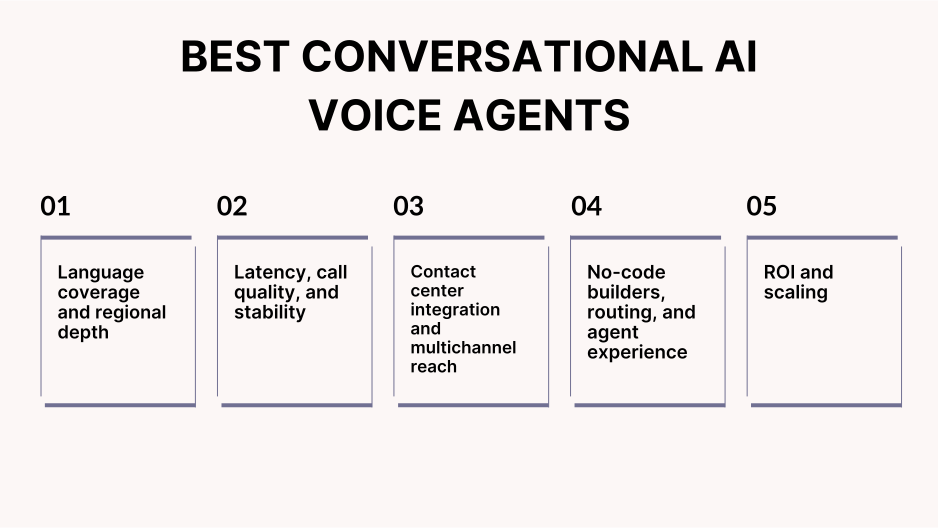
1. Language coverage and regional depth
Regional depth is what saves or breaks a call. Key things to check
- How many supported languages are production-ready?
- How well does the agent work in regional languages such as Hindi, Tamil, Spanish for Latin America, or Arabic for the Gulf?
- How it behaves with mixed speech, where callers blend local language with English.
The best AI voice agents keep the same quality in smaller markets as they do in English.
2. Latency, call quality, and stability
The “best” model is the one that gives
- Low latency on your routes and carriers
- High accuracy in your target languages and accents
- Stable performance with your expected call volumes
Some teams use one model for English and another for multilingual voice AI in regional languages. Others prefer a single large model tuned for all markets.
3. Contact center integration and multichannel reach
Good AI voice agents for contact centers plug into your stack instead of sitting outside it. Look for
- CRM integration - Access to tickets, customer profiles, plans, orders, and notes.
- CCaaS and phone integration - Direct links with your contact center platform, SIP, or cloud telephony.
- Help desk and knowledge base links - So the agent can read policies, FAQs, and internal articles while speaking.
The same agent can answer calls, update tickets, and hand off to humans with clean context.
4. No-code builders, routing, and agent experience
A strong platform offers a no-code multilingual AI voice agent builder, allowing product and CX teams to shape their own journey. Useful features
- Visual flows for new call paths, prompts, and language rules
- Easy setup of business hours, queues, and fallbacks
- Simple tools to add, test, and publish changes without a full release cycle
Routing also matters; the best setup uses AI as the first line. The agent answers simple queries, collects details, and then routes complex issues to humans.
5. ROI and scaling
To measure ROI from multilingual voice AI, track both savings and gains
- Reduction in human call volume and overtime spent
- Lower average handling time and fewer repeat calls
- Higher first call resolution rate
- Improved CSAT or NPS after voice automation
- Extra revenue from saved or recovered customers in sales and retention flows
Over a year, many teams see that the spend on multilingual AI voice agents is lower than the cost of hiring and training new full-time agents in every region.
Top 7 Multilingual Conversational AI Voice Agents in 2026
Below is a comparison of AI voice agent platforms for 2026.
1. Robylon: Multilingual Voice AI for Global Support and Sales
Robylon AI offers multilingual voice AI agents for contact centers with a strong focus on support, sales, and ticket automation. Its AI agents work across voice, chat, email, and WhatsApp, backed by a unified multilingual voice bot and chat agent layer.
Language and regional capabilities
- Strong coverage for English and 40+ major global languages.
- Built for AI voice agents for regional languages (Hindi, Tamil, Spanish, etc.) in real use.
- Good fit for teams in the Americas, Europe, Asia, the Middle East, and global D2C brands.
Core features and use cases
- Handles AI voice agents for global customer service across web and phone.
- Supports AI voice agents for sales: lead capture, upselling, and renewals.
- Utilizes ASR, NLU, and TTS optimized for service teams and multilingual workflows.
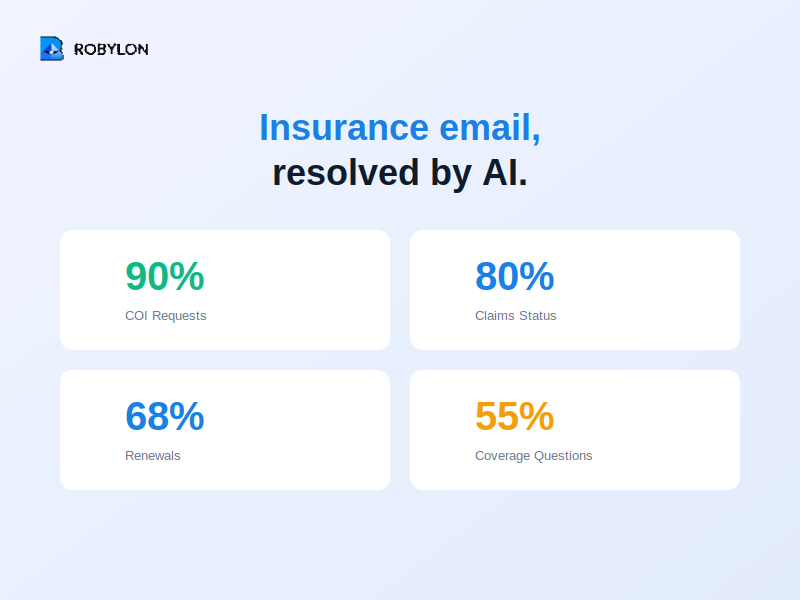
- High automation rates (90%+ workflows) plus human-in-the-loop oversight for edge cases.
Integrations
- Native integrations with CRMs, help desks, and messaging tools.
- Easy webhooks for internal systems and data warehouse sync.
- Visual builder for CX teams, with APIs for developers.
Industry Fit
Works best for ecommerce, logistics, SaaS, and mid-market to enterprise teams that want high automation across channels.
2. Retell AI: Real-Time Multilingual Voice Agents
Retell AI focuses on low-latency AI phone agents that sound natural on live calls. It offers multilingual agents across phone and VoIP channels.
Language and regional capabilities
- Supports over 30 languages, including key European and Asian ones.
- Works well for brands serving North America, Europe, and LATAM.
Core features and use cases
- AI voice agents for sales and support, outbound calls, and lead qualification.
- Uses robust ASR, NLU, and TTS pipelines to create seamless multilingual voice bots for call centers.
- Streaming AI voice agents that handle live calls with human-like turn-taking and interruptions.
Integrations
- Developer-first APIs and SDKs for custom flows.
- Ideal for teams with in-house engineering.
Industry Fit
Works well for outbound sales, appointment booking, collections, and support teams that want to “outsource” calls to AI.
3. Synthflow AI: No-Code Multilingual Voice Bot Builder
It is a no-code platform to build AI phone agents and multilingual voice bots. It targets brands that want fast deployment without heavy engineering.
Language and regional capabilities
- Supports many languages across Europe, Asia, and Latin America.
- Handle AI voice agents for regional languages in markets like India when combined with its language pack list.
Core features and use cases
- Support for multilingual calling, including regional markets, with routing to human agents when needed.
- Minutes-based plans with bundled concurrent calls for predictable scaling.
Integrations
- Drag-and-drop builder for flows and prompts.
- Connectors for CRMs, ticketing tools, and analytics.
- APIs are available for deeper control.
Industry Fit
Strong fit for agencies, SaaS, local services, and BPOs that want to launch voice automation without building infrastructure.
4. Vapi: Developer-First Multilingual Voice AI Infrastructure
Vapi is a developer-first platform for building advanced phone agents that run over PSTN and VoIP. It is used by teams that want API-native multilingual voice bots instead of a packaged contact center tool.
Language and regional capabilities
- Supports conversations in more than 100 languages worldwide.
- Suitable for AI voice agents for regional languages, as well as English and major European languages
Core features and use cases
- Let teams build custom conversational AI voice agents
- Used for modern IVR, support lines, sales, and support
- Great when flexibility and control matter more than UI
- Real-time ASR, NLU, and TTS with streaming for low latency
Integrations
- Everything is managed through APIs and webhooks, made for developers.
- Integrates with CRMs, billing systems, and internal services.
Industry Fit
Ideal for SaaS vendors, AI infra companies, and teams building custom contact center or product-embedded voice experiences.
5. PolyAI: Enterprise-Grade Multilingual Voice Agents
It builds enterprise conversational AI voice agents that handle bookings, support, and complex queries over the phone.
Language and regional capabilities
- Supports multiple languages for Europe and North America.
- Good fit for global phone lines with shared numbers.
Core features and use cases
- Voice agents for customer support with long, natural calls.
- Used for bookings, order checks, and AI voice agents for sales and support.
- Advanced ASR and TTS tuned for natural, human-like dialog and long calls.
Integrations
- Integrates with contact center tools, CRMs, and booking engines.
- Often deployed with help from a professional services team.
Industry Fit
Best for large hospitality, retail, banking, and service organizations that want a premium, brand-aligned voice experience.
6. Google Dialogflow CX: Multilingual Platform for Contact Centers
Dialogflow CX is Google’s advanced conversational platform for building AI voice agents and chatbots. It is widely used in contact centers that already rely on Google Cloud.
Language and regional capabilities
- Supports many languages and variants, including many European and Asian languages.
- Works well when paired with Google speech and translation tools.
Core features and use cases
- Used to modernize IVR and self-service flows.
- Powers multilingual voice bots for call centers and digital channels.
- Visual flow builder (CX) for complex dialog, state management, and testing.
Integrations
- Connects to CCaaS, telephony, and CRMs via connectors and APIs.
- Visual builder for flows plus Cloud Functions for custom logic.
Industry Fit
Good fit for enterprises, telcos, and public sector teams standardizing on Google Cloud for contact center and automation projects.
7. Talkdesk: Multilingual Contact Center Automation
Talkdesk offers AI-powered voice agents as part of its CX platform for contact centers. Its AI phone agents work across voice and digital channels to automate self-service and routing.
Language and regional capabilities
- Supports many languages, including slang and idioms.
- Fit for global customer support across regions.
Core features and use cases
- Automates self-service for high-volume tasks.
- Best suited to teams ready to standardize on Talkdesk as the core platform.
- Virtual agents that handle common queries (orders, returns, billing) via voice and digital channels.
Integrations
- Deeply integrated with Talkdesk routing, CRMs, and analytics.
- Designed for CX teams seeking a unified CCaaS stack.
Industry Fit
Well-suited to mid-market and enterprise contact centers in retail, healthcare, finance, and BPOs standardising on Talkdesk.
Why Multilingual AI Voice Agents Matter for Global Customer Support
1. From single-language IVR to multichannel
Most contact centers still use IVR menus. Callers press numbers, wait in queues, and often end up in the wrong place.
These multilingual conversational AI voice agents can
- Answer phone calls
- Handle WhatsApp voice notes
- Respond from a web or in-app widget
Because it is linked to tickets and customer history, replies stay consistent across channels.
2. 24/7 multilingual customer service expectations
Customers now expect help at any time, from any time zone, and in their own language. They want quick, clear answers, not repeated explanations.
With 24/7 multilingual customer service, one deployed system can
- Answer calls in multiple languages, around the clock
- Greet users by name and recall past interactions
- Resolve common issues in a single call, without transfers
These voice agents bridge time zone gaps, switch between English, Spanish, Hindi, and other languages in real-time. They utilize CRM context so that each AI phone agent avoids repetitive questions.
3. Accessibility and inclusive experiences
Support also needs to be accessible. Multilingual AI phone support gives another path. Callers who struggle with long emails or chats can speak to an AI voice agent in their own language. The agent can slow down, repeat key details, and send a short SMS recap after the call.
With multilingual conversational AI, users explain the issue in the language they trust most, while the agent still understands, routes correctly, and responds clearly.
Where Multilingual Voice Bots Win?
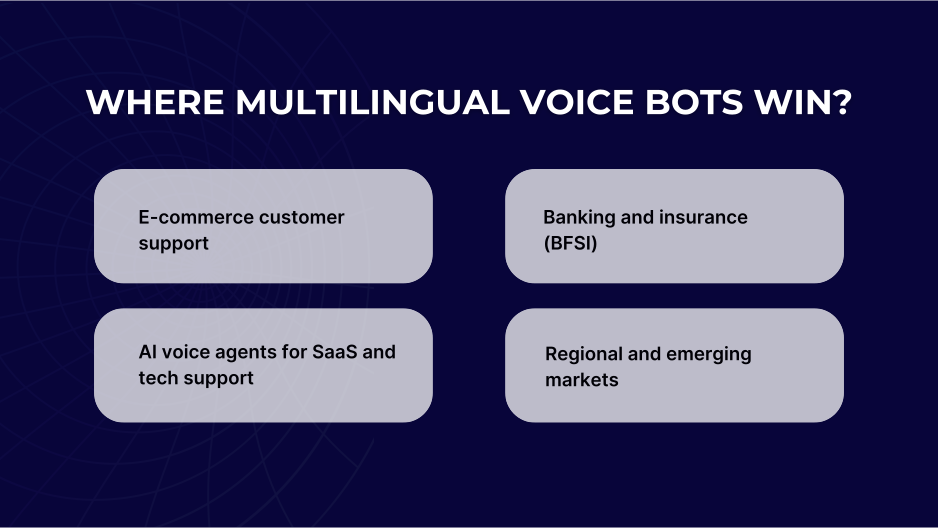
1. E-commerce customer support
Retail and D2C brands rely on AI voice agents for ecommerce customer support to manage high order volumes. Voice agents confirm delivery dates, check stock, handle cancellations, and guide users through return rules.
They call buyers to confirm COD orders, reduce fake deliveries, and share simple return steps. For brands that ship to many regions, this becomes a core part of global customer support, helping to keep costs stable as order volume grows.
2. Banking and insurance (BFSI)
Banks and insurers deploy multilingual AI voice agents to manage repetitive yet sensitive journeys in the BFSI industry. Agents send KYC, EMI, and premium reminders, and explain policy or loan status in clear, simple language.
With AI voice agents, calls stay compliant and recorded. The agent reads verified data, masks sensitive fields, and sends short SMS or email summaries, while human teams focus on disputes, restructuring, and high-value customers.
3. AI voice agents for SaaS and tech support
Software companies rely on AI voice agents to cover onboarding and tier-1 issues. Voice agents assist users in logging in, resetting passwords, understanding plans, and activating key features.
When a case needs an expert, the agent logs error details, device info, and attempted steps, then passes it on. Engineers receive structured context, which reduces back-and-forth and keeps queues under control during major releases.
4. Regional and emerging markets
In many markets, the first point of contact is the local language. AI voice agents bridge global products with local expectations, handling mixed sentences that blend native language with English brand terms.
These agents are trained to recognize code-mixed speech and varied accents: Hinglish, Latin American Spanish, Gulf Arabic, and Nigerian English. They stay accurate even on noisy mobile networks.
How To Choose the Best Multilingual AI Voice Agent?
Checklist: from use case to tech fit
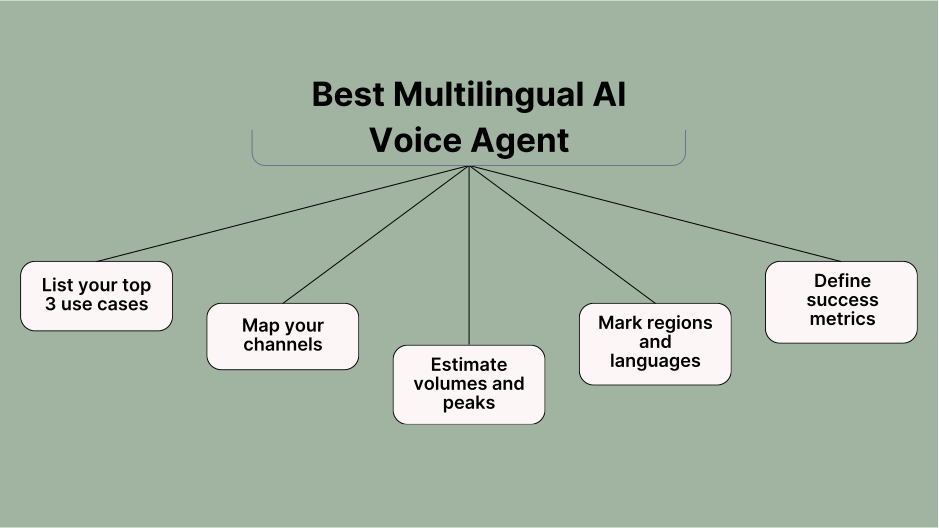
Before comparing vendors, map your own needs first.
- List your top 3 use cases: Order tracking, KYC reminders, failed payment recovery, onboarding, etc. Tag each as support, sales, or operations.
- Map your channels: Decide whether you need a phone-only option or a combination of phone & WhatsApp, web chat, and apps. Note where you want AI phone agents first and where chat is enough.
- Estimate volumes and peaks: Capture daily call volume, peak hours, and seasonal spikes. This will shape pricing, infra, and model choice.
- Mark regions and languages: List countries and key languages. Flag where you need AI voice agents for regional languages (Hindi, Tamil, Spanish, etc.).
- Define success metrics: Set targets for call deflection, AHT, CSAT, or revenue per call.
Conclusion
Voice is still the most human channel for support and sales. The shift now is that multilingual AI voice agents can handle a big share of these calls on their own. The right platform answers in many languages, resolves routine issues in seconds, and passes complex cases to humans with clean context.
When you evaluate tools, focus on: language depth, latency, call quality, stability, contact center integration, no-code controls, agent experience, pricing, and ability to scale into new markets without constant hiring.
Choose AI voice agents that respect your customers’ languages and support your team. That’s how multilingual voice AI becomes a core part of global support.
FAQs
What is multilingual voice AI?
Multilingual voice AI lets customers speak in their preferred language, accent, or a mix of languages. AI voice agents listen, understand, and respond naturally across multiple languages on phone, WhatsApp, and web.
Which are the best multilingual AI voice agents in 2026?
Some of the best multilingual AI voice agents in 2026 include Robylon AI, Retell AI, Synthflow AI, Vapi, PolyAI, Google Dialogflow CX, and Talkdesk, each with different strengths in regions, integrations, and control.
How do I choose the right multilingual AI voice agent platform?
Start with your use cases, volumes, and regions, then compare platforms on language coverage, latency, call quality, integrations, no-code vs API-first options, pricing, and how well they fit your contact center stack.
Do the best AI voice agents support regional languages and mixed speech?
Yes, top multilingual conversational AI voice agents are trained for regional languages and code-mixed speech (e.g., Hinglish, Latin American Spanish, Gulf Arabic). They can stay robust on noisy mobile networks.
Can I build a multilingual AI voice agent without coding?
Yes, platforms such as Robylon and Synthflow AI, offer no-code builders for flows, prompts, routing, and language rules. Developers can still use APIs for custom logic or advanced integrations.
How do multilingual AI voice agents improve customer support?
They offer 24/7 phone support in local languages, reduce wait times, resolve common queries quickly, and provide consistent answers by reading policies, tickets, and account data.
.png)



.webp)
.webp)